
In the realm of personal and business finance, percentages are the universal language of progress, risk, and value. Whether you are calculating the interest on a high-yield savings account, determining the impact of inflation on your purchasing power, or analyzing the growth of a stock portfolio, understanding how to figure out percentages is a foundational skill. Far from being a mere classroom exercise, percentage calculation is a strategic tool that empowers individuals to make informed decisions about their wealth.
This guide explores the essential methods for calculating percentages within the financial niche, providing you with the formulas and frameworks necessary to master your money.
The Fundamental Mathematics of Personal Finance
Before diving into complex investment strategies, one must master the basic arithmetic that governs every transaction. At its core, a percentage is a way to express a number as a fraction of 100. In finance, this allows us to compare different scales of money on an even playing field.
Understanding the Base: The 100% Rule
In finance, the “base” is the original amount of money you are working with—be it your initial investment, your gross salary, or the original price of an asset. To find a percentage of a total, the formula is:
(Part / Total) × 100 = Percentage.
For example, if you save $500 out of a $4,000 monthly salary, you divide 500 by 4,000 to get 0.125. Multiplying by 100 reveals that you are saving 12.5% of your income. Understanding this base is crucial because all financial growth is relative to the starting point.
Calculating Increases and Decreases: The “New minus Old” Formula
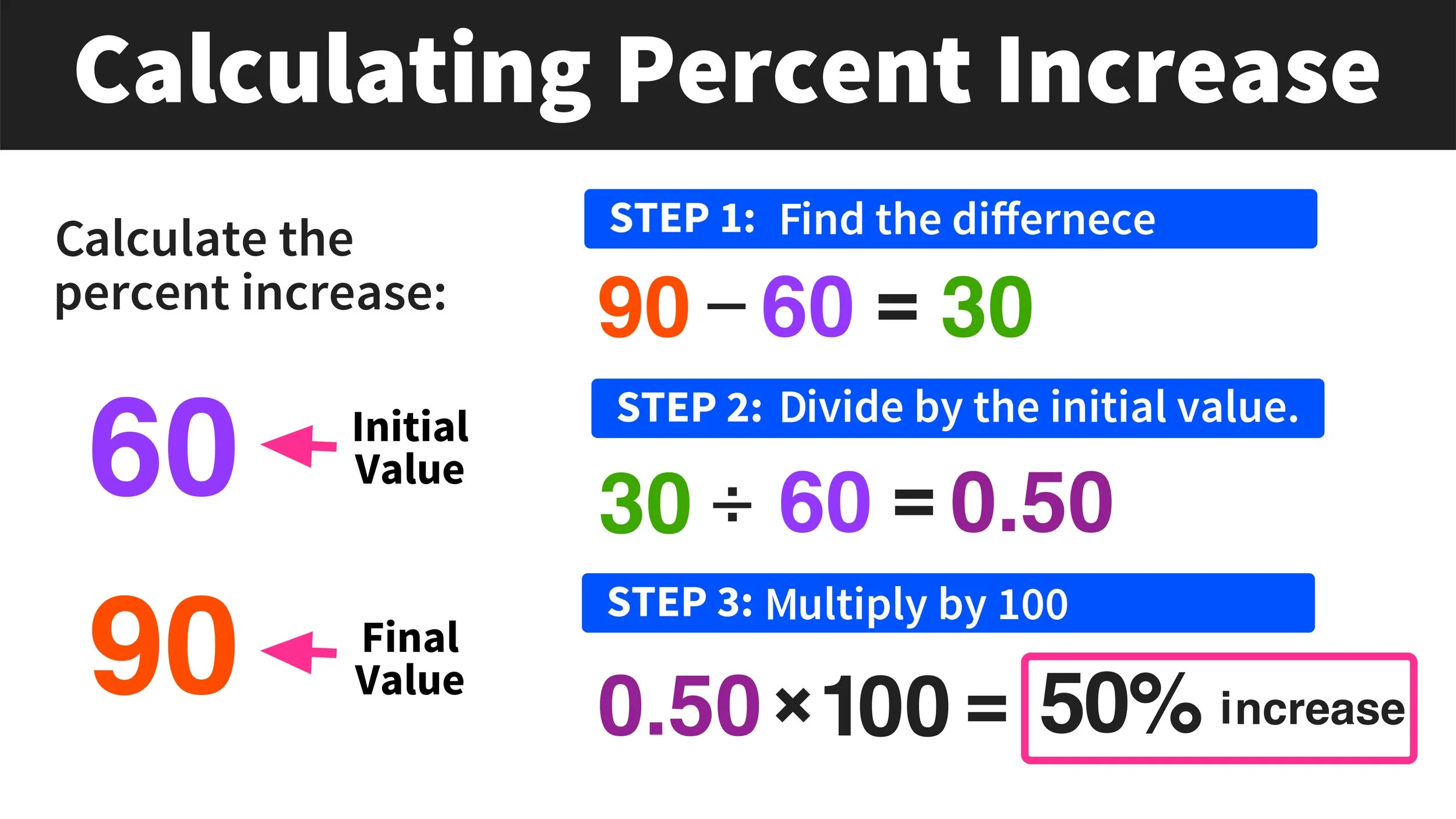
One of the most frequent questions in finance is: “How much has my value changed?” Whether you are looking at a stock price move or a salary raise, the percentage change formula is vital:
[(New Value – Old Value) / Old Value] × 100.
If a stock you bought for $150 rises to $180, the increase is $30. Dividing $30 by the original $150 gives you 0.20, or a 20% gain. Conversely, if the stock drops to $120, the $30 loss divided by $150 results in a 20% decrease. Mastering this formula helps investors strip away the “noise” of dollar amounts to see the actual performance of their assets.
Calculating Interest and Returns on Investment
Interest is the cost of borrowing money or the reward for lending it. For anyone looking to build wealth, understanding how percentages dictate the growth of capital over time is the difference between stagnation and prosperity.
Simple vs. Compound Interest
Simple interest is calculated only on the principal amount. The formula is Principal × Rate × Time. However, most modern financial vehicles—like savings accounts and credit cards—rely on compound interest, where you earn (or owe) interest on the interest already accumulated.
The power of compound interest is often called the “eighth wonder of the world.” If you have $10,000 at a 5% annual interest rate, after one year, you have $10,500. In the second year, the 5% is calculated on $10,500, not the original $10,000. Over decades, these small percentage points create an exponential curve. Understanding how to calculate these shifts allows you to project your retirement needs with accuracy.
The Rule of 72: Estimating Doubling Time
While not a formal “calculation” in the traditional sense, the Rule of 72 is a mental percentage shortcut used by top financial advisors. It allows you to quickly figure out how long it will take for an investment to double at a fixed annual rate of interest.
You simply divide 72 by the annual rate of return. For instance, if your index fund returns an average of 8% per year, 72 divided by 8 equals 9. This means your money will double every nine years. This quick percentage-based tool is invaluable for long-term financial planning and comparing the efficacy of different investment vehicles.
Percentage-Based Budgeting Frameworks
Mathematics is the backbone of discipline. Without a percentage-based framework, budgeting often feels like a series of arbitrary restrictions. By using percentages, you create a scalable system that works whether you earn $30,000 or $300,000 a year.
The 50/30/20 Rule
The most famous percentage-based budget is the 50/30/20 rule. This allocates your after-tax income into three distinct buckets:
- 50% for Needs: Housing, utilities, groceries, and insurance.
- 30% for Wants: Dining out, travel, and hobbies.
- 20% for Financial Goals: Debt repayment, emergency funds, and retirement investments.

By calculating these percentages monthly, you ensure that your lifestyle doesn’t outpace your ability to save. If your “needs” exceed 50%, it is a mathematical signal that your fixed costs (like rent or car payments) are too high relative to your income, regardless of the raw dollar amount.
Debt-to-Income (DTI) Ratios
Lenders use percentages to determine your creditworthiness. Your Debt-to-Income ratio is calculated by dividing your total monthly debt payments by your gross monthly income.
For example, if you pay $1,500 for a mortgage and $500 for a car loan, and you earn $6,000 a month, your DTI is 33% ($2,000 / $6,000). Most lenders look for a DTI below 36%. Knowing how to figure out this percentage before applying for a loan can save you from rejection and help you negotiate better interest rates.
Mastering Tax and Discount Calculations
The “real” value of your money is often hidden behind taxes and promotional pricing. To be financially savvy, you must be able to calculate the “net” impact of any financial transaction.
Sales Tax and Effective Tax Rates
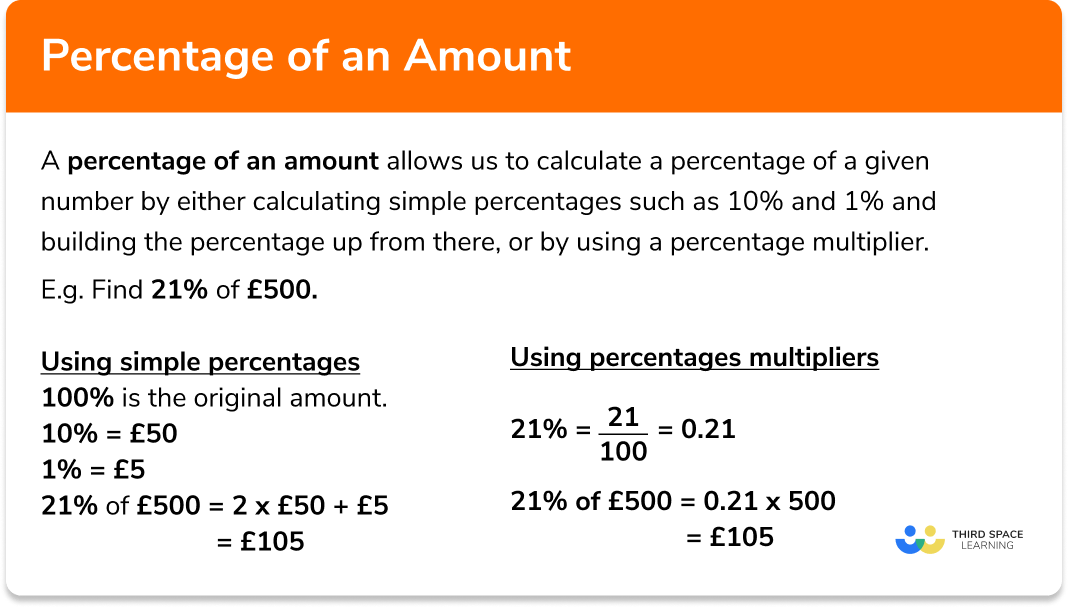
When you see a price tag, the percentage of sales tax must be added to find the true cost. If an item is $80 and the tax is 8%, you multiply $80 by 0.08 to find the $6.40 tax, making the total $86.40.
More importantly, in personal finance, you must understand your effective tax rate. This is the actual percentage of your income you pay in taxes after all deductions and credits. If you earn $100,000 but only pay $15,000 in total taxes, your effective rate is 15%. This is a much more useful metric for budgeting than your “marginal tax bracket,” which only applies to the last dollar you earned.
Calculating Net Savings from Discounts
Retailers often use percentages to entice spending. However, a “20% off” sale is only a saving if you were already planning to buy the item. To calculate the final price of a discounted item, subtract the discount percentage from 100% and multiply by the price.
If a $200 suit is 30% off, you are paying 70% of the price. $200 × 0.70 = $140. For the business-minded individual, calculating these margins is essential for understanding profit and loss. If your business has a 40% profit margin and you offer a 20% discount, you haven’t just lost 20% of your price; you’ve cut your profit margin significantly.
Leveraging Digital Financial Tools
In the modern age, you don’t always need a pencil and paper to figure out percentages, but you do need to know how to use the tools available. Digital literacy is a key component of financial literacy.
Spreadsheet Functions for Finance
Microsoft Excel and Google Sheets are the most powerful tools in a financier’s arsenal. To calculate percentages in a spreadsheet, you simply format a cell as a “Percentage.”
- To find a percentage change between cell A1 (old) and B1 (new), the formula is
=(B1-A1)/A1. - To find 15% of a value in A1, the formula is
=A1*0.15.
Learning these basic syntax rules allows you to build complex financial models, track your net worth over time, and visualize your progress through charts and graphs.
Financial Calculators and Apps
Beyond basic spreadsheets, specialized financial calculators can handle “Time Value of Money” (TVM) calculations. These tools allow you to input a present value, a percentage interest rate, and a time period to find a future value.
Apps like Mint, YNAB (You Need A Budget), or Personal Capital automate these percentage calculations for you, providing “burn rates” (the percentage of your savings spent each month) and “portfolio allocation” (the percentage of your wealth in stocks vs. bonds). However, the software is only as good as the user’s understanding. Knowing the math behind the app allows you to spot errors and interpret the data with a critical eye.
Conclusion: The Strategic Value of the Percentage
Figuring out percentages is more than a mathematical requirement; it is a mindset. When you stop looking at money in terms of absolute dollars and start looking at it in terms of percentages, your financial perspective shifts. You begin to see that a 1% difference in an investment fee can cost you hundreds of thousands of dollars over a lifetime. You realize that a 5% raise is negated by 6% inflation.
By mastering the formulas for percentage change, interest, budgeting, and taxes, you gain a level of control over your financial destiny that few possess. Whether you are navigating the complexities of the stock market or simply trying to optimize your monthly grocery bill, the ability to calculate percentages accurately and insightfully is the ultimate financial superpower. In the world of money, those who understand percentages get to keep more of them.
aViewFromTheCave is a participant in the Amazon Services LLC Associates Program, an affiliate advertising program designed to provide a means for sites to earn advertising fees by advertising and linking to Amazon.com. Amazon, the Amazon logo, AmazonSupply, and the AmazonSupply logo are trademarks of Amazon.com, Inc. or its affiliates. As an Amazon Associate we earn affiliate commissions from qualifying purchases.