
In the world of personal finance and global investing, few terms carry as much weight as the “S&P 500.” Whether you are listening to nightly business news, reading a financial blog, or discussing retirement plans with a professional, the S&P 500 is frequently cited as the ultimate barometer for the health of the United States economy and the performance of the stock market. But for many individual investors, the index remains a nebulous concept—a number that goes up or down without a clear explanation of what it actually represents.
Understanding the S&P 500 is not merely an academic exercise; it is a fundamental requirement for anyone looking to build long-term wealth. It is the yardstick against which nearly all other investments are measured. In this guide, we will explore the mechanics, the history, and the strategic importance of the S&P 500, providing you with the insights needed to navigate this essential pillar of the financial world.
The Mechanics and Methodology: How the Index is Built
The S&P 500, or the Standard & Poor’s 500 Index, is a stock market index that tracks the performance of 500 of the largest companies listed on stock exchanges in the United States. Launched in its current form in 1957, it was the first companion index to be weighted by market capitalization. Unlike the Dow Jones Industrial Average, which only tracks 30 companies and is price-weighted, the S&P 500 provides a much broader and more mathematically sound representation of the equity market.
Eligibility and Selection Criteria
Contrary to popular belief, the S&P 500 is not simply a list of the 500 largest companies in America. Instead, it is a curated list managed by the S&P Dow Jones Indices Index Committee. To be eligible for inclusion, a company must meet strict quantitative and qualitative criteria. First, it must be a U.S. company with an unadjusted market capitalization of at least $15.8 billion (this threshold is adjusted periodically). Second, the company must be highly liquid, meaning its shares are easily traded.
Most importantly, the company must demonstrate financial viability. The committee typically requires that the sum of the previous four quarters’ earnings be positive, as well as the most recent quarter. This ensures that the index represents not just “large” companies, but “successful” large companies.
The Power of Market-Cap Weighting
The S&P 500 is a float-adjusted market-capitalization-weighted index. This means that companies with higher market valuations have a greater impact on the index’s total value. To calculate a company’s weight, you take its share price and multiply it by the number of shares available for public trading (the “float”).
Because of this structure, the “Magnificent Seven”—tech giants like Apple, Microsoft, and Nvidia—exert a massive influence on the index. When these titans thrive, the S&P 500 tends to soar, even if smaller companies in the index are struggling. This weighting reflects the reality of the modern economy, where a handful of dominant firms drive a significant portion of total corporate profits.
The 11 GICS Sectors
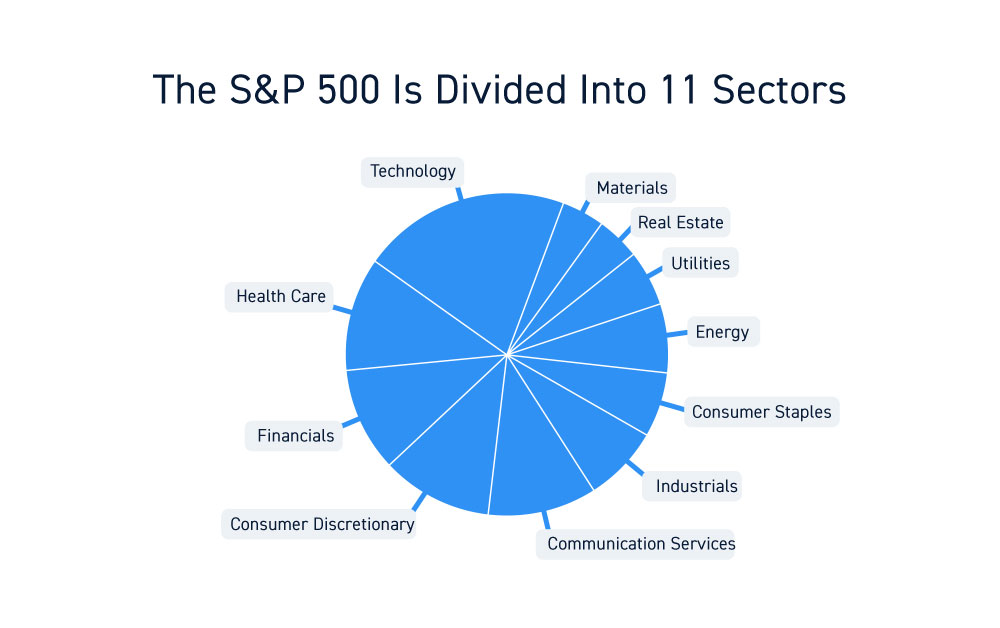
To ensure the index remains a diversified reflection of the economy, the S&P 500 is divided into 11 Global Industry Classification Standard (GICS) sectors. These include Information Technology, Health Care, Financials, Consumer Discretionary, Communication Services, Industrials, Consumer Staples, Energy, Real Estate, Materials, and Utilities. Monitoring these sectors allows investors to see which parts of the economy are leading the market and which are lagging.
Why the S&P 500 is the Gold Standard for Investors
For the individual investor, the S&P 500 serves two primary roles: it is a benchmark for performance and a vehicle for wealth creation. It is often referred to as a “passive” investment strategy, yet its historical track record often outperforms the majority of “active” fund managers who try to pick individual winning stocks.
A Mirror of the American Economy
The S&P 500 covers approximately 80% of the available market capitalization of the U.S. equity market. Because of this massive coverage, the index’s movement is highly correlated with the overall economic health of the United States. When consumer confidence is high and corporate earnings are growing, the index reflects that optimism. Conversely, it is often the first place where market participants “price in” an upcoming recession or geopolitical instability.

Historical Performance and the Rule of 7%
Historically, the S&P 500 has delivered an average annual return of approximately 10% (around 7% when adjusted for inflation) over long periods. While the market experiences “bear markets” (declines of 20% or more) and “bull markets” (extended periods of growth), the long-term trajectory has consistently been upward. For a personal finance enthusiast, this historical reliability makes the S&P 500 the foundation of many retirement portfolios. Through the power of compound interest, a steady investment in the index can turn modest savings into a significant nest egg over 20 or 30 years.
The Efficiency of the Index
One of the most compelling arguments for the S&P 500 was popularized by John Bogle, the founder of Vanguard. He argued that because the market is “efficient”—meaning all known information is already baked into stock prices—it is nearly impossible to consistently “beat the market” after accounting for fees and taxes. By simply “owning the market” through the S&P 500, investors eliminate the risk of picking a failing company and instead capture the aggregate growth of the most successful corporations in the world.
How to Invest: From Index Funds to ETFs
You cannot “buy” the S&P 500 index directly because it is a mathematical calculation, not a tradable asset. However, financial institutions have created products that “track” or “mimic” the index with near-perfect accuracy. These are known as index funds and Exchange-Traded Funds (ETFs).
Mutual Funds vs. ETFs
For decades, the standard way to gain exposure was through an S&P 500 index mutual fund. These funds are priced once at the end of the trading day. However, in recent years, ETFs have become the preferred choice for many. ETFs trade like individual stocks throughout the day and often come with lower “expense ratios”—the annual fee charged by the fund manager.
Popular examples include the SPDR S&P 500 ETF Trust (SPY), the iShares Core S&P 500 ETF (IVV), and the Vanguard S&P 500 ETF (VOO). These funds have expense ratios as low as 0.03%, meaning you pay only $3 a year for every $10,000 invested.
The Role of Dividends
Investors often focus on the “price” of the S&P 500, but a significant portion of the total return comes from dividends. Most of the 500 companies in the index pay out a portion of their profits to shareholders. When you invest in an S&P 500 fund, these dividends are collected by the fund and usually redistributed to you. By opting for “Dividend Reinvestment” (DRIP), you use those payouts to buy more shares, which accelerates the compounding process significantly.
Passive Management and Rebalancing
One of the greatest benefits of investing in the S&P 500 is that it is self-cleansing. If a company fails or its market value shrinks significantly, the Index Committee removes it and replaces it with a rising star. For example, Tesla was added in 2020 after proving its sustained profitability. As an investor, you don’t have to worry about selling “losers” or buying “winners”; the index does the rebalancing for you.
Risks, Realities, and Portfolio Construction
While the S&P 500 is an incredible tool for wealth building, it is not without risks. A sophisticated investor must understand the limitations of the index to ensure their financial plan is truly resilient.
Concentration Risk and Volatility
Because the index is market-cap weighted, it can become “top-heavy.” In recent years, the top 10 companies have accounted for nearly 30% of the index’s total value. If the technology sector experiences a downturn, the entire S&P 500 will drop, even if companies in the healthcare or energy sectors are doing well. Furthermore, the S&P 500 is 100% equities. It can be highly volatile, often seeing swings of 10% to 30% in a single year. It is not a “safe” investment in the short term; it is a growth investment for the long term.
The Importance of Asset Allocation
Rarely should an investor put 100% of their money into the S&P 500. A balanced portfolio typically includes a mix of large-cap U.S. stocks (S&P 500), international stocks, small-cap companies, and fixed-income assets like bonds. While the S&P 500 provides the “growth engine,” other assets provide a “cushion” during market crashes.

Psychology and the Long-Term Mindset
The biggest risk to an S&P 500 investor is not the market—it is their own behavior. During a market “correction,” many investors panic and sell their shares at a loss. Success in S&P 500 investing requires a “buy and hold” mentality. By using a strategy like Dollar-Cost Averaging (DCA)—investing a fixed amount of money every month regardless of the price—you buy more shares when prices are low and fewer when prices are high, effectively lowering your average cost over time.
In conclusion, the S&P 500 is more than just a list of stocks; it is a testament to the enduring growth and innovation of the American corporate landscape. For the modern investor, it offers a low-cost, highly efficient way to participate in the profits of the world’s most influential companies. By understanding how it works, why it matters, and how to use it within a diversified strategy, you can transform the S&P 500 from a mere financial term into a powerful engine for your personal financial freedom.
aViewFromTheCave is a participant in the Amazon Services LLC Associates Program, an affiliate advertising program designed to provide a means for sites to earn advertising fees by advertising and linking to Amazon.com. Amazon, the Amazon logo, AmazonSupply, and the AmazonSupply logo are trademarks of Amazon.com, Inc. or its affiliates. As an Amazon Associate we earn affiliate commissions from qualifying purchases.