
In the modern household, the line item for “entertainment” has undergone a radical transformation. What used to be a single, predictable cable bill has fragmented into a dozen micro-transactions, a phenomenon economists often refer to as the “subscription economy.” At the heart of this shift is Paramount+, a major player in the streaming wars that presents a unique value proposition. However, determining “how much” Paramount+ costs requires more than a simple glance at a price tag. To truly understand its impact on your personal finances, one must look at the tier structures, the hidden value of bundles, and the opportunity costs associated with the broader digital landscape.
As we navigate an era of persistent inflation and tightening discretionary spending, every recurring monthly expense must be audited for its Return on Investment (ROI). This guide provides a deep-seated financial analysis of Paramount+, examining its pricing tiers, its position in the competitive market, and the strategic ways consumers can optimize their spending to ensure they are getting the most utility for every dollar spent.
Understanding the Paramount+ Pricing Structure: Essential vs. Premium
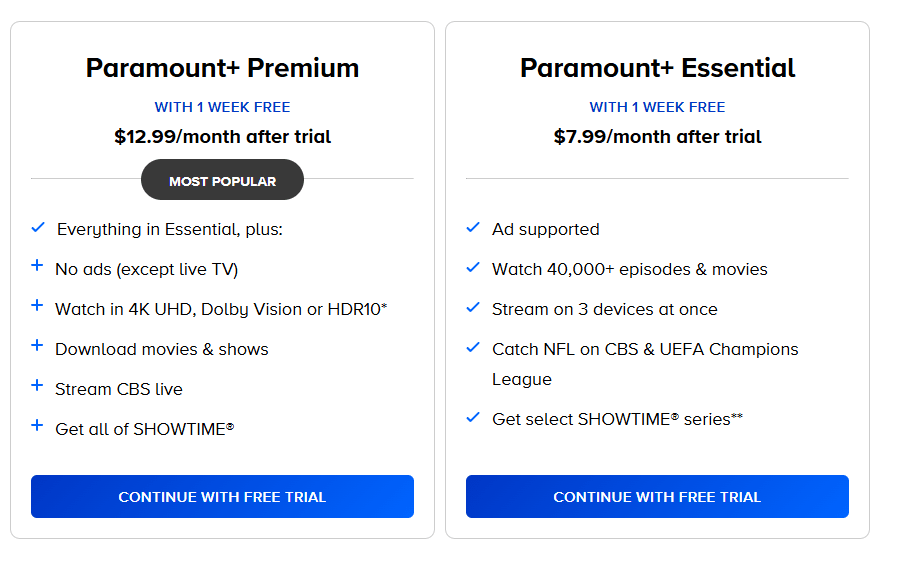
The pricing of Paramount+ is designed using a classic “good-better-best” marketing strategy, aimed at capturing different segments of the consumer market based on their price sensitivity. As of the current fiscal year, the service is divided into two primary tiers, each catering to a specific financial profile.
The Essential Plan: Analyzing the Low-Cost, Ad-Supported Tier
The “Essential” plan represents the entry point for the budget-conscious consumer. Priced at approximately $5.99 per month (or $59.99 per year), this tier is built on an ad-supported model. From a personal finance perspective, this plan is an exercise in trading time for money. By choosing the Essential plan, users agree to view several minutes of advertising per hour in exchange for a lower monthly outlay.
For households managing a strict monthly budget, the Essential plan is often the most logical choice. It provides access to the vast majority of the content library, including NFL on CBS and top-tier original programming, without the double-digit price tag. However, it is important to note what this plan lacks: a local live CBS station feed and the ability to download content for offline viewing. Financially, if you are a commuter who relies on offline viewing to save on mobile data costs, the Essential plan might actually be more expensive in the long run if it leads to data overages.
The Paramount+ with SHOWTIME Plan: Is the Premium Surcharge Worth It?
The upper echelon of the service is the “Paramount+ with SHOWTIME” tier, priced at approximately $11.99 per month (or $119.99 per year). This plan represents a significant jump in cost—nearly double the Essential plan—but it consolidates two major content libraries into one billing cycle.
From a financial management standpoint, this tier is about consolidation. By integrating SHOWTIME, Paramount Global is attempting to increase the “Average Revenue Per User” (ARPU) while providing the consumer with a streamlined billing experience. The premium tier removes most advertising (excluding live TV and select shows), provides a local live CBS feed, and allows for content downloads. For a consumer who previously subscribed to both Paramount+ and SHOWTIME separately, this bundled tier represents a net saving, illustrating the importance of auditing separate subscriptions to find integrated deals.
Annual vs. Monthly Billing: The Mathematics of Long-Term Savings
One of the simplest ways to improve the ROI of a streaming service is to shift from monthly to annual billing. Paramount+ offers an annual discount that typically saves the consumer around 16% to 20% compared to the month-to-month rate.
While the monthly plan offers the “liquidity” of being able to cancel at any time, the annual plan is a “capital investment” in your entertainment. If you are certain that you will use the service for at least ten months out of the year, the annual plan is the mathematically superior choice. In the world of personal finance, these small optimizations—saving $10 to $20 per year per service—aggregate into significant annual savings when applied across an entire digital portfolio.
The Hidden Value of Bundles and Partnerships
In the current economic climate, the most successful consumers are those who avoid paying “sticker price” for their digital services. Paramount+ has been particularly aggressive in forming corporate partnerships that can effectively reduce the cost of the service to zero for certain demographics.
The Walmart+ Synergy: Free Access and Household Budgeting
Perhaps the most significant financial disruption in the streaming space is the partnership between Paramount+ and Walmart. Subscribing to Walmart+ (the retailer’s answer to Amazon Prime) includes a Paramount+ Essential subscription at no additional cost.
For a household already paying for Walmart+ for its grocery delivery and fuel discounts, the “cost” of Paramount+ becomes $0. When evaluating your monthly cash flow, it is essential to look for these overlaps. If you are paying for Paramount+ separately while also holding a Walmart+ membership, you are essentially leaking $72 per year in unnecessary expenditures. This highlights the necessity of a “subscription audit” twice a year to ensure you aren’t paying for benefits you already own through another channel.
Corporate Tie-ins and Credit Card Perks
Beyond retail bundles, the financial services industry has stepped in to subsidize streaming costs. Many high-end credit cards now offer “streaming credits” as part of their annual fee structure. For example, certain American Express cards or Chase offerings provide monthly statement credits for digital entertainment.

When you factor in these credits, the effective cost of Paramount+ can drop significantly. For the savvy investor or budgeter, using a credit card that offers 3% to 6% cashback on streaming services further chips away at the monthly cost. While these percentages seem small, they represent a proactive approach to managing the “death by a thousand cuts” that multiple small subscriptions can cause to a bank account.
Comparative ROI: Paramount+ vs. The Streaming Market
To determine if Paramount+ is “worth it,” we must move beyond the nominal price and look at the relative value compared to competitors like Netflix, Disney+, and Max.
Cost-Per-Hour Analysis: Evaluating Content Volume
In professional financial analysis, we often look at the “unit cost.” In streaming, the unit is an hour of entertainment. Paramount+ holds an advantage here due to its ownership of the deep ViacomCBS library, which includes thousands of episodes of legacy content (Star Trek, CSI, Nickelodeon).
If a household spends 40 hours a month watching Paramount+ on the Essential plan, the cost is approximately $0.15 per hour. Compared to a movie theater ticket, which can cost $7.50 per hour of entertainment, or even Netflix’s premium tier (which can hover around $0.30 to $0.50 per hour depending on usage), Paramount+ often emerges as a high-utility, low-cost leader. For families, the inclusion of the Nickelodeon library provides a massive amount of content for children, which often results in a lower “cost-per-use” than niche or premium-only services.
The “Subscription Creep” Phenomenon and Your Monthly Cash Flow
The danger of Paramount+, and the streaming industry at large, is not the cost of a single service but the cumulative effect of “subscription creep.” When a service costs “only $5.99,” it is easy for consumers to justify the expense without realizing they have ten other similar expenses.
From a business finance perspective, streaming companies rely on “inertia.” They bet on the fact that once you sign up, you will forget to cancel, even if your usage drops. To maintain a healthy financial profile, consumers should treat Paramount+ as a variable expense rather than a fixed one. If there are months where no specific content interests you, the “cost” of the service is effectively an 100% loss on investment.
Strategic Cancellation and the “Churn” Method of Saving
Financial literacy in the digital age requires a shift in mindset: you do not need to own every service all the time. The “Churn” method is a strategic approach to managing streaming costs by rotating subscriptions based on content releases.
Capitalizing on Seasonal Promotions and Trials
Paramount+ frequently utilizes “win-back” offers and seasonal promotions. It is common to see deals during Black Friday or the Super Bowl where the service is offered for $1.99 a month for three months. By remaining a “fluid” subscriber—canceling when a show ends and waiting for a promotional email to return—a consumer can significantly lower their annual expenditure.
Furthermore, Paramount+ is one of the few remaining services that frequently offers one-month free trials via various promo codes. For a disciplined consumer, this allows for the consumption of specific “event” content (like a specific movie premiere or sports event) at a total cost of $0, preserving capital for other financial goals.
Managing Recurring Expenses Through Financial Tools
To keep track of “how much” you are truly spending, it is advisable to use financial aggregation tools. Apps that track recurring subscriptions can alert you when a Paramount+ bill is about to hit, giving you a “decision point” to either keep or cancel the service.
Treating your streaming portfolio like a mini-business budget—where every service must justify its existence monthly—prevents the slow erosion of your savings. If the utility provided by Paramount+ (in terms of hours watched or joy derived) does not exceed its monthly cost, the most sound financial move is a temporary cancellation.
The Bottom Line: Is Paramount+ a Sound Financial Investment?
When answering the question “how much is Paramount+,” the nominal answer is $5.99 to $11.99. However, the real answer is tied to your individual financial ecosystem.
For the sports fan who requires NFL on CBS, the service is a high-value substitute for a much more expensive cable package. For the Walmart+ member, it is a free perk that adds value to an existing investment. For the casual viewer, it is a low-cost entry into a massive library of nostalgia and new media.
Ultimately, Paramount+ occupies a “mid-tier” financial position in the market. It is more affordable than the high-end Netflix or Max plans, yet it offers more comprehensive “live” utility than services like Apple TV+. By understanding the pricing tiers, leveraging bundles, and practicing disciplined subscription management, you can ensure that Paramount+ remains a source of value rather than a financial burden. In the economy of the future, the most successful consumers won’t be those who have the most subscriptions, but those who pay the least for the content they value the most.
aViewFromTheCave is a participant in the Amazon Services LLC Associates Program, an affiliate advertising program designed to provide a means for sites to earn advertising fees by advertising and linking to Amazon.com. Amazon, the Amazon logo, AmazonSupply, and the AmazonSupply logo are trademarks of Amazon.com, Inc. or its affiliates. As an Amazon Associate we earn affiliate commissions from qualifying purchases.