
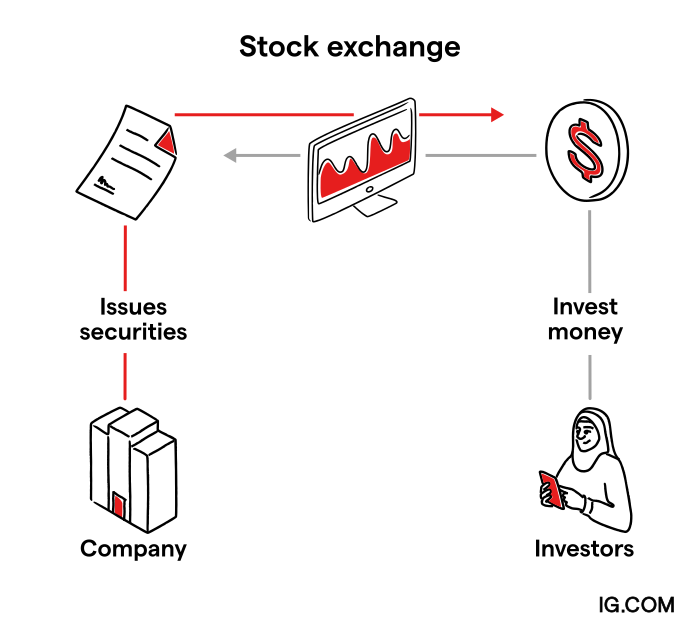
To the uninitiated, the financial market often appears as a chaotic whirlwind of flickering red and green numbers, shouting traders, and complex algorithms. However, beneath this veneer of complexity lies a remarkably structured system designed to facilitate the exchange of value. At its core, the market is a mechanism for capital allocation, where those with excess capital (investors) provide it to those who need capital (businesses and governments) in exchange for a potential return. Understanding how this system functions is the first step toward financial literacy and successful investing.
The Fundamental Engine: Supply, Demand, and Price Discovery
The most basic principle governing any market is the relationship between supply and demand. This interaction determines the price of every asset, from a single share of a multinational corporation to a barrel of crude oil.

The Law of Supply and Demand
In a free market, price acts as a signal. When the demand for a particular security increases—perhaps due to a positive earnings report or a breakthrough innovation—and the supply remains constant, the price rises. Conversely, if investors lose confidence in an asset and rush to sell it, the increased supply coupled with low demand forces the price downward. This constant tug-of-war ensures that prices are always moving toward a point where the number of buyers matches the number of sellers.
The Process of Price Discovery
Price discovery is the method by which the market determines the “fair value” of an asset at any given moment. It is not a static number but a continuous process. On modern electronic exchanges, this happens through the “limit order book.” Buyers post “bid” prices (the maximum they are willing to pay), and sellers post “ask” prices (the minimum they are willing to accept). The difference between these two is the “bid-ask spread.” When a buyer’s bid matches a seller’s ask, a trade occurs, and that transaction price becomes the new “market price.”
Navigating the Ecosystem: Major Asset Classes and Exchanges
While we often speak of “the market” as a single entity, it is actually a collection of various sub-markets, each with its own rules, risks, and participants.
The Equities Market (Stocks)
The stock market is perhaps the most visible component of the financial world. When a company “goes public” through an Initial Public Offering (IPO), it sells pieces of ownership (shares) to the public. These shares are then traded on secondary markets like the New York Stock Exchange (NYSE) or the Nasdaq. For the company, this is a way to raise capital without taking on debt. For the investor, it is an opportunity to participate in the company’s growth through capital appreciation and dividends.
The Fixed Income Market (Bonds)
The bond market is significantly larger than the stock market but often receives less media attention. Bonds are essentially loans made by investors to borrowers, such as corporations or governments. In exchange for the loan, the borrower agrees to pay back the principal at a set date (maturity) and provide regular interest payments (coupons) along the way. This market is the backbone of global infrastructure, allowing governments to fund schools and roads, and corporations to fund expansion.
Derivatives and Commodities
Beyond stocks and bonds lie more complex instruments. Commodities markets handle the trade of raw materials like gold, oil, wheat, and natural gas. Derivatives, such as options and futures, are contracts that derive their value from an underlying asset. While these are often used for speculation, their primary economic purpose is “hedging”—allowing producers and consumers to lock in prices and protect themselves against future price volatility.
The Hierarchy of Participants: Who Moves the Market?
The market is populated by a diverse array of actors, each with different motivations, time horizons, and levels of capital.

Institutional Investors
Institutional investors are the “whales” of the financial sea. This category includes pension funds, mutual funds, insurance companies, and hedge funds. Because they manage billions of dollars, their trades have the power to move market prices significantly. These entities employ teams of analysts and use sophisticated technology to identify mispriced assets. Their primary goal is often to achieve “alpha”—returns that exceed the standard market benchmarks.
Retail Investors
Retail investors are individual people trading for their own accounts. Historically, retail investors had limited access to the markets and high transaction costs. However, the digital revolution and the rise of commission-free trading platforms have democratized access. While individual retail trades rarely move the market, the collective behavior of millions of retail investors—often referred to as “crowd sentiment”—can occasionally create massive shifts, as seen in recent “meme stock” phenomena.
Market Makers and Liquidity Providers
For a market to function efficiently, there must be liquidity—the ability to buy or sell an asset quickly without causing a massive change in its price. Market makers are specialized firms that stand ready to buy or sell securities at any time. They profit from the bid-ask spread. By providing constant “quotes,” they ensure that when you want to sell a share of stock, there is always a buyer waiting on the other side, even if it isn’t another individual investor.
Market Efficiency and the Psychology of Valuation
A central debate in finance is how “efficient” the market truly is. Does the current price of a stock reflect all available information, or are there opportunities to outsmart the system?
The Efficient Market Hypothesis (EMH)
The Efficient Market Hypothesis suggests that because millions of participants are constantly analyzing data, all known information is already “baked into” the price of an asset. According to this theory, it is impossible to consistently “beat the market” because any new information is reflected in the price almost instantaneously. In an efficient market, the only way to get higher returns is by taking on higher risk.
Behavioral Finance: The Human Element
In contrast to the EMH, the field of behavioral finance argues that markets are not always rational because the people trading in them are not always rational. Human emotions—fear, greed, and overconfidence—often lead to market “bubbles” (where prices are irrationally high) and “crashes” (where prices are irrationally low). Investors often suffer from cognitive biases, such as “loss aversion,” where the pain of losing money is felt more intensely than the joy of gaining an equal amount. These psychological factors create inefficiencies that savvy investors attempt to exploit.
Economic Drivers and the Impact of Monetary Policy
Markets do not exist in a vacuum; they are deeply intertwined with the broader economy and the decisions of policymakers.
The Influence of Interest Rates
Perhaps the single most important factor affecting the market is the cost of money, determined by central banks like the Federal Reserve. When interest rates are low, borrowing is cheap, which encourages businesses to expand and consumers to spend. This generally leads to rising stock prices. When inflation rises, central banks increase interest rates to cool the economy. Higher rates make bonds more attractive relative to stocks and increase the cost of debt for companies, which often leads to a contraction in market valuations.
The Business Cycle: Bulls and Bears
The market moves in cycles. A “Bull Market” is characterized by rising prices, investor optimism, and economic expansion. Conversely, a “Bear Market” is defined by a sustained decline in prices (typically 20% or more from recent highs) and widespread pessimism. These cycles are a natural part of the economic rhythm. Understanding that markets move in waves helps investors maintain a long-term perspective, avoiding the temptation to panic during short-term downturns.
Indicators of Market Health
Investors look to various macroeconomic indicators to gauge the market’s future direction. These include Gross Domestic Product (GDP) growth, unemployment rates, and Corporate Earnings reports. If the economy is growing and people are employed, companies generally sell more products and services, leading to higher profits and higher stock prices. The market is often considered a “leading indicator,” meaning it tries to predict what the economy will look like six to nine months in the future, rather than reflecting where it is today.
In summary, the market is a sophisticated and dynamic ecosystem that balances the needs of capital seekers and capital providers. It operates on the simple mechanics of supply and demand but is influenced by a complex web of participant psychology, institutional behavior, and global economic policy. While it can be volatile and unpredictable in the short term, its long-term function remains constant: to serve as the engine of economic growth and a primary vehicle for wealth creation. Understanding these underlying structures allows individuals to move from being mere observers to informed participants in the global financial story.
aViewFromTheCave is a participant in the Amazon Services LLC Associates Program, an affiliate advertising program designed to provide a means for sites to earn advertising fees by advertising and linking to Amazon.com. Amazon, the Amazon logo, AmazonSupply, and the AmazonSupply logo are trademarks of Amazon.com, Inc. or its affiliates. As an Amazon Associate we earn affiliate commissions from qualifying purchases.