
Transitioning from a casual side hustle to a formal business entity is a significant milestone for any entrepreneur. Central to this transition is the establishment of a dedicated business bank account. Beyond the basic utility of storing revenue, a business account serves as the cornerstone of professional financial management, offering liability protection, tax clarity, and a foundation for future creditworthiness. However, the process of opening an account is more rigorous than setting up a personal one. Financial institutions are bound by strict federal regulations and internal risk management policies that require a comprehensive set of documentation.

Understanding the specific requirements for opening a business account is essential to avoid delays and ensure that your enterprise is built on a compliant financial structure. Whether you are a solo freelancer or the founder of a growing corporation, the requirements generally fall into four primary categories: legal entity documentation, tax identification, personal identification of owners, and operational specifics.
Establishing Your Business Structure and Legal Identity
The first thing a financial institution will evaluate is the legal structure of your business. The documents required vary significantly depending on whether you are operating as a sole proprietorship, a limited liability company (LLC), a partnership, or a corporation. These documents prove to the bank that your business is a legally recognized entity authorized to conduct financial transactions.
Sole Proprietorships and DBAs
A sole proprietorship is the simplest form of business, where there is no legal distinction between the owner and the business. Because of this, the requirements are often the least complex. If you are operating under your own name, you may only need your social security number and a basic business license. However, if you are operating under a trade name—such as “Peak Consulting” instead of “John Doe”—most banks will require a “Doing Business As” (DBA) certificate or a Fictitious Name Statement. This document, usually filed at the county or state level, proves that you have the legal right to use that business name.
Limited Liability Companies (LLCs)
For an LLC, the bank requires proof that the entity has been properly registered with the state. The primary document needed is the Articles of Organization. This document outlines the basic details of the company, including its name, address, and the names of its members or managers.
Additionally, most banks will request an Operating Agreement. While not always required by state law, banks use the Operating Agreement to verify who has the authority to open accounts, sign checks, and take out loans on behalf of the company. Without this, the bank cannot be certain that the person standing at the desk has the legal right to bind the company to a financial contract.
Corporations
Corporations face the most stringent documentation requirements. You will need to provide your Articles of Incorporation, which are filed with the Secretary of State. Furthermore, banks typically require Corporate Bylaws, which dictate how the corporation is governed. A crucial requirement unique to corporations is the Corporate Resolution. This is a document, often signed by the board of directors, specifically authorizing certain individuals to open the bank account and manage the corporation’s funds.
Tax Identification and Regulatory Compliance
Once the legal structure is established, the next hurdle is tax identification. In the eyes of the Internal Revenue Service (IRS) and financial institutions, your business needs its own “social security number” to track income, pay employees, and report taxes.
The Employer Identification Number (EIN)
The most critical piece of information for almost any business account is the Employer Identification Number (EIN). Issued by the IRS, this nine-digit number is used to identify the tax accounts of employers and certain others who have no employees. Even if you are a sole proprietor with no plans to hire staff, obtaining an EIN is highly recommended. It allows you to keep your personal Social Security Number private and provides a cleaner audit trail for business expenses. Banks will typically require a copy of the EIN Confirmation Letter (CP 575 or 147C) to verify the number.
Business Licenses and Permits
Beyond tax IDs, banks must ensure that your business is operating legally within its industry and jurisdiction. Depending on your field, you may be asked to provide professional licenses. For example, a medical practice, law firm, or construction company must show that its practitioners are licensed to operate. Similarly, local general business licenses issued by your city or municipality may be requested to prove that the business is in good standing with local government regulations.
Personal Identification and the “Beneficial Ownership” Rule
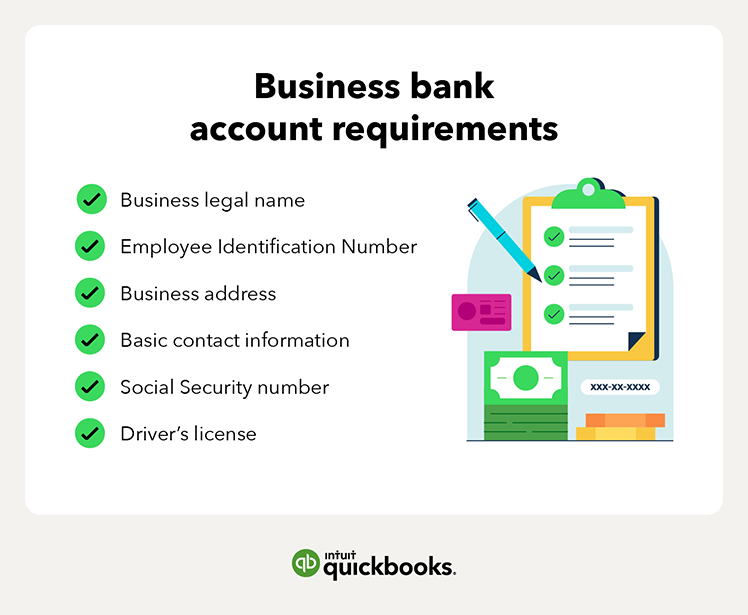
In an effort to combat money laundering, terrorism financing, and other financial crimes, the federal government enforces strict “Know Your Customer” (KYC) regulations. This means that even though you are opening an account for a business, the bank must verify the identities of the human beings behind the entity.
Primary Identification Requirements
Every individual who will be a signer on the account must provide valid, government-issued photo identification. Typically, this includes a driver’s license or a passport. Some banks may require a second form of identification, such as a utility bill in the individual’s name or a social security card, to verify their residential address.
Verifying Beneficial Owners
One of the most significant regulatory shifts in recent years is the requirement to identify “beneficial owners.” Financial institutions are now required to collect and verify information about anyone who owns 25% or more of the company, as well as one individual with significant control over the entity (such as a CEO or Managing Member).
This requirement means that even if a partner is not going to be a signer on the account, you must still provide their name, date of birth, address, and social security number to the bank. This transparency is a cornerstone of the Corporate Transparency Act and is non-negotiable for modern business banking.
Financial and Operational Requirements
The final set of requirements involves the actual logistics of the account and the intended nature of the business relationship. Banks need to understand how you plan to use the account to monitor for suspicious activity and to ensure you are placed in the correct product tier.
Initial Deposits and Minimum Balances
Most business accounts require an initial deposit to activate the account. This can range from as little as $25 for a small business checking account to several thousand dollars for specialized commercial accounts. You should also be aware of minimum balance requirements. Many banks waive monthly maintenance fees only if you maintain a certain average daily balance. Understanding these thresholds is vital for cash flow management, particularly for startups with fluctuating revenue.
Revenue Projections and Transaction Volume
When applying for an account, you will likely be asked about your expected monthly revenue and transaction volume (including wire transfers, ACH payments, and cash deposits). This is not just a sales tactic; it is a regulatory requirement. Banks use this information to create a “baseline” for your account activity. If your business suddenly receives a $1 million wire transfer when you projected $5,000 in monthly revenue, it may trigger an internal review or a hold on funds until the source of the money is verified.
Industry-Specific Restrictions
It is important to note that certain industries are classified as “high-risk” by financial institutions. This includes businesses involved in cannabis (even where legal at the state level), online gambling, adult entertainment, and cryptocurrency. If your business falls into one of these categories, the documentation requirements will be significantly more extensive, and you may need to seek out specialized “high-risk” merchant banks that are equipped to handle the specific compliance burdens of your industry.
Choosing the Right Institution and Account Type
While the core requirements are standard across the industry, the experience of opening and managing a business account varies based on the institution you choose. Modern entrepreneurs now have the choice between traditional brick-and-mortar banks and digital-first fintech platforms.
Traditional Banks vs. Digital Platforms
Traditional banks often offer a wider range of services, including physical branches for cash deposits, dedicated relationship managers, and comprehensive lending products like equipment financing or SBA loans. However, they may have higher fees and more rigid application processes that require an in-person visit.
In contrast, digital-first banks (often referred to as neobanks) cater to the tech-savvy entrepreneur. They often feature lower fees, seamless integration with accounting software like QuickBooks or Xero, and an entirely online application process. The trade-off is often a lack of physical infrastructure, which can be a hurdle for businesses that handle significant amounts of physical cash.

Scalability and Future Credit Access
When selecting an account, look beyond the immediate requirements. Consider the future of your business finance needs. If you anticipate needing a line of credit or a business credit card in the next twelve months, it is often beneficial to open your checking account with an institution where you intend to borrow. Establishing a deposit relationship can improve your internal credit score with that bank, making the loan application process smoother when the time comes to scale.
By meticulously gathering your legal entity documents, securing your EIN, and preparing for identity verification, you position your business as a professional and compliant entity. While the checklist may seem daunting, these requirements are the safeguards that protect the integrity of the financial system and, by extension, the security of your business’s capital. Successfully opening a business account is more than just a bureaucratic hurdle; it is the definitive step in separating your personal life from your professional enterprise, ensuring that your business is prepared for growth, transparency, and long-term financial success.
aViewFromTheCave is a participant in the Amazon Services LLC Associates Program, an affiliate advertising program designed to provide a means for sites to earn advertising fees by advertising and linking to Amazon.com. Amazon, the Amazon logo, AmazonSupply, and the AmazonSupply logo are trademarks of Amazon.com, Inc. or its affiliates. As an Amazon Associate we earn affiliate commissions from qualifying purchases.