
Establishing a dedicated business account is one of the most critical milestones in the lifecycle of any enterprise, whether you are launching a solo side hustle or scaling a high-growth startup. From a financial perspective, the separation of personal and professional funds is not merely a matter of organizational convenience; it is a fundamental requirement for legal protection, tax efficiency, and long-term capital management.
In the realm of business finance, your bank account serves as the primary “source of truth.” It is the hub through which all operational liquidity flows, and its structure determines how effectively you can track margins, manage debt, and leverage financial tools for growth. This guide explores the strategic nuances of setting up a business account, focusing on the fiscal architecture required to build a sustainable and scalable organization.

The Financial Architecture of Professional Separation
The first step in setting up a business account is understanding why the distinction between personal and professional finance is non-negotiable. In the eyes of tax authorities and legal systems, a business is often viewed as a distinct entity. Failing to maintain a clear boundary—a practice known in legal circles as “commingling funds”—can have dire consequences for the business owner.
Protecting Personal Assets
For those operating as a Limited Liability Company (LLC) or a Corporation, the primary benefit of the legal structure is the protection of personal assets from business liabilities. However, if a business owner uses a personal bank account for business transactions, they risk “piercing the corporate veil.” In the event of a lawsuit or a debt collection action, a court may rule that the business and the individual are one and the same, effectively nullifying the liability protection. Establishing a dedicated business account is the most effective way to reinforce this legal barrier.
Streamlining Tax Compliance and Audits
From a “Money” niche perspective, the ease of tax preparation cannot be overstated. When business expenses and income are siloed into a single account, identifying deductible expenses becomes a streamlined process rather than a forensic accounting nightmare. During a tax audit, the Internal Revenue Service (IRS) or relevant tax body will look for a clear paper trail. A dedicated business account provides an objective, chronological record of every dollar earned and spent, ensuring that your financial reporting is robust and defensible.
Building Business Credit
Just as individuals have personal credit scores, businesses have their own credit profiles. A business bank account is the foundational element required to build a relationship with financial institutions. Consistent deposits and responsible management of a business checking account are often prerequisites for securing business credit lines, corporate credit cards, and commercial loans. By setting up the account early, you begin the “seasoning” process of your business’s financial history, which is vital for future capital acquisition.
Choosing the Right Banking Partner and Account Type
The modern financial landscape offers a diverse array of banking options, ranging from century-old traditional institutions to agile, tech-forward neobanks. The “right” choice depends on your specific business model, transaction volume, and need for specialized financial tools.
Traditional vs. Digital-First Banking
Traditional banks (such as Chase, Bank of America, or local credit unions) offer the advantage of physical branches, which is essential for businesses dealing with significant cash deposits or those requiring in-person services like notary signatures or safe deposit boxes. These institutions often provide a broader suite of lending products and personal relationship managers.
Conversely, digital-first fintech platforms (such as Mercury, Brex, or Relay) are designed specifically for the modern entrepreneur. These platforms often feature lower fee structures, higher interest rates on savings, and seamless integrations with accounting software. For online businesses, digital agencies, and startups, these platforms often provide a more intuitive user experience and faster onboarding processes.
Evaluating Fee Structures and Minimums
When selecting an account, you must conduct a rigorous cost-benefit analysis of the fee schedule. Common fees include:
-
Monthly Maintenance Fees: Often waived if a minimum daily balance is maintained.
-
Transaction Fees: Some accounts limit the number of free deposits or withdrawals per month.
-
Wire Transfer Fees: Crucial for businesses engaged in international trade or high-value B2B services.
-
ATM Fees: Relevant if your business requires frequent cash access.
Specialized Account Types: Beyond Checking
While a business checking account is the primary operational tool, a sophisticated financial strategy often involves multiple accounts:
-
Business Savings Accounts: Designed to hold tax reserves or emergency funds while earning a modest yield.
-
Merchant Accounts: Necessary if you plan to accept credit and debit card payments directly.
-
High-Yield Cash Management Accounts: For businesses with significant capital, these accounts offer higher APY (Annual Percentage Yield) than standard savings accounts, ensuring that idle capital is still working for the business.
Documentation and Legal Requirements for Financial Onboarding
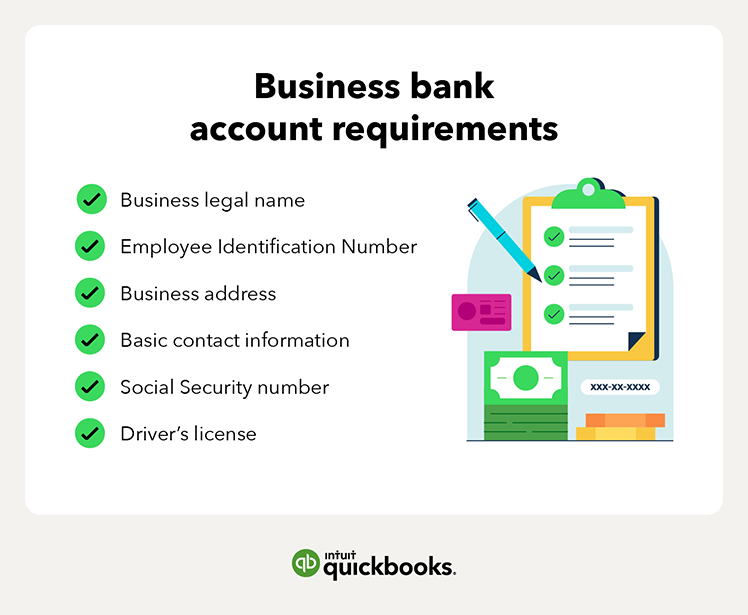
Setting up a business account requires a specific set of documents to comply with “Know Your Customer” (KYC) and Anti-Money Laundering (AML) regulations. While requirements vary by institution and business structure, the following are almost universally required.
Identification and Tax Information
The cornerstone of any business account application is the Employer Identification Number (EIN). Issued by the IRS, the EIN acts as a social security number for your business. While sole proprietors can technically use their personal SSN, obtaining an EIN is highly recommended for privacy and to establish the business as a separate financial entity. Additionally, all beneficial owners (anyone with more than a 25% stake) will typically need to provide personal identification, such as a driver’s license or passport.
Governing Documents
Banks need proof that your business is legally registered and that you have the authority to open an account on its behalf.
-
For LLCs: Articles of Organization and an Operating Agreement.
-
For Corporations: Articles of Incorporation and Corporate Bylaws.
-
For Partnerships: A Partnership Agreement.
-
For Sole Proprietorships: A Business License or a “Doing Business As” (DBA) certificate if you are operating under a name other than your legal name.
The Corporate Resolution
In cases where there are multiple partners or stakeholders, the bank may require a “Corporate Resolution.” This is a document signed by the board of directors or the members of an LLC that explicitly grants an individual the authority to open the account and manage the business’s finances. This ensures that no single member can unilaterally commit the business to a banking relationship without the consent of the other stakeholders.
Integrating Financial Tools for Scalable Management
Once the account is open, it should not exist in a vacuum. To maximize the financial health of the business, the account must be integrated into a broader ecosystem of financial tools and workflows.
Seamless Accounting Integration
Modern business finance relies on real-time data. By connecting your business bank account to accounting software like QuickBooks, Xero, or FreshBooks, you can automate the categorization of expenses. This “bank feed” reduces manual entry errors and allows for the generation of real-time financial statements, such as Profit and Loss (P&L) reports and Balance Sheets. For an entrepreneur, this visibility is the difference between guessing at profitability and knowing exactly where every cent is allocated.
Payroll and Tax Automation
A business account is the engine for payroll. By linking your account to a payroll provider (such as Gusto or ADP), you ensure that employees are paid accurately and that payroll taxes are automatically calculated, withheld, and paid to the government. Furthermore, many businesses use their account to set up “automated tax buckets.” By transferring a fixed percentage of every deposit into a separate tax reserve account, you avoid the common financial pitfall of a massive, unexpected tax bill at the end of the quarter.
Cash Flow Forecasting
Sophisticated financial management involves looking forward, not just backward. With a dedicated business account, you can utilize cash flow forecasting tools that analyze your historical spending and income patterns. These tools help predict “cash crunches” before they happen, allowing you to adjust spending or draw on a line of credit proactively. In the world of business finance, liquidity is the lifeblood of survival, and the bank account is the primary gauge of that liquidity.
Optimizing Long-Term Capital Management
Setting up the account is only the beginning. As the business grows, your banking strategy should evolve to focus on capital optimization and risk mitigation.
Maximizing Yield on Excess Capital
Once your business reaches a level of consistent profitability, you may find yourself with excess cash that is not immediately needed for operations. Leaving this money in a non-interest-bearing checking account is an opportunity cost. Smart financial management involves moving excess liquidity into high-yield savings accounts, money market funds, or short-term Treasury bills. In a high-interest-rate environment, the yield on these reserves can significantly offset operational overhead.
Managing Fraud and Security
Business accounts do not always have the same consumer protection laws that personal accounts do. Therefore, security is a paramount financial concern. When setting up your account, implement multi-factor authentication (MFA), set up real-time transaction alerts, and consider using “Positive Pay” services—a fraud detection system provided by many banks that matches the checks you issue with those presented for payment.

Scaling with Credit Lines
Eventually, the purpose of a business account shifts from simply “holding money” to “leveraging money.” A well-managed account history is your strongest asset when applying for an Unsecured Business Line of Credit. This provides a safety net for seasonal fluctuations or the capital necessary to seize a sudden growth opportunity. By maintaining high average daily balances and avoiding overdrafts from day one, you position your business as a low-risk borrower, unlocking more favorable interest rates and higher credit limits.
In conclusion, setting up a business account is a foundational act of financial stewardship. It moves a venture from the realm of a hobby into the professional sphere. By carefully selecting a banking partner, ensuring legal compliance, and integrating the account into a robust financial tech stack, you create a framework that supports growth, ensures compliance, and protects your personal financial future. In the complex world of business finance, your bank account is far more than a repository for cash—it is the cornerstone of your entire economic enterprise.
aViewFromTheCave is a participant in the Amazon Services LLC Associates Program, an affiliate advertising program designed to provide a means for sites to earn advertising fees by advertising and linking to Amazon.com. Amazon, the Amazon logo, AmazonSupply, and the AmazonSupply logo are trademarks of Amazon.com, Inc. or its affiliates. As an Amazon Associate we earn affiliate commissions from qualifying purchases.