
In the modern digital economy, the ability to process payments efficiently is the lifeblood of any scalable business. Whether you are launching a side hustle, managing a growing e-commerce brand, or scaling a global SaaS platform, your choice of financial infrastructure dictates your operational agility and long-term profitability. Stripe has emerged as the premier financial tool for business owners, offering far more than a simple “buy button.” It serves as a sophisticated ledger, a fraud prevention engine, and a global gateway to international markets.
Setting up a Stripe account is a foundational step in establishing your professional financial stack. However, the process involves more than just entering an email address. To ensure compliance with global banking regulations and to optimize your cash flow from day one, you must approach the setup with a strategic understanding of business finance.
The Role of Stripe in Modern Business Finance
Before diving into the technical setup, it is essential to understand why Stripe is categorized as a critical financial tool rather than just another software app. In the world of online income and business finance, Stripe acts as the intermediary between your customer’s bank account and your business’s treasury.
Why Stripe is the Gold Standard for Online Income
For entrepreneurs focused on maximizing their net margins, Stripe provides a consolidated view of financial health. It handles the complexities of “Know Your Customer” (KYC) and Anti-Money Laundering (AML) regulations, which are legal requirements that every legitimate financial entity must satisfy. By using Stripe, you are effectively outsourcing a significant portion of your financial compliance burden, allowing you to focus on revenue-generating activities.
Furthermore, Stripe’s infrastructure is built for high-velocity finance. It supports diverse payment methods—from traditional credit cards to digital wallets like Apple Pay and regional payment rails like SEPA or iDEAL. For a business looking to diversify its income streams, this flexibility is a competitive advantage that prevents cart abandonment and increases the lifetime value of a customer.
Understanding Transaction Fees and Financial Modeling
Every business owner must account for the cost of capital and transaction overhead. Stripe typically operates on a pay-as-you-go model, often starting at 2.9% plus 30 cents per successful card charge. From a financial planning perspective, these “basis points” must be factored into your pricing strategy. When setting up your account, you should analyze these costs against your projected margins to ensure that your business model remains sustainable as you scale.
Step-by-Step Account Configuration and Verification
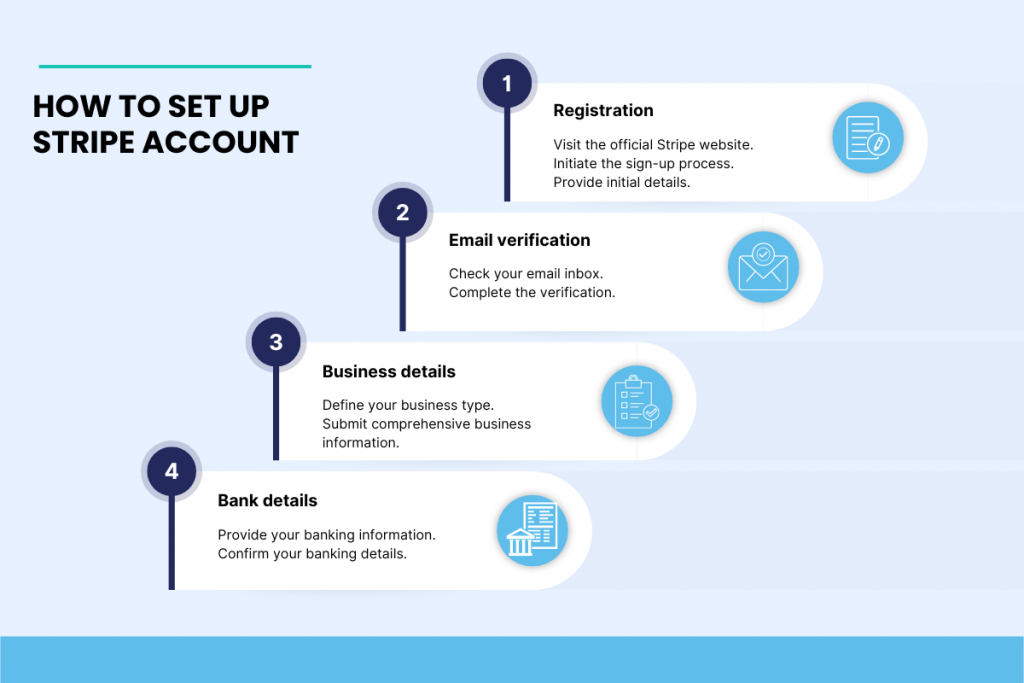
The integrity of your financial data depends on the accuracy of your initial setup. Stripe requires specific documentation to verify your identity and the legal standing of your business. This verification process is mandatory to prevent fraud and ensure that your payouts are never delayed by compliance flags.
Pre-requisites: Business Entities and Tax Documentation
Before you begin the online application, gather the following financial and legal documents:
-
Tax Identification Number: Depending on your jurisdiction, this could be an EIN (Employer Identification Number) in the United States, a VAT number in Europe, or a Social Security Number for sole proprietors.
-
Business Address: A physical location where your business is legally registered.
-
Bank Account Details: A professional business checking account is highly recommended over a personal account to maintain “corporate auras” and simplify tax auditing.
Selecting the right business structure during setup—whether it’s a Sole Proprietorship, LLC, or Corporation—has significant implications for your tax liability and personal risk. Ensure that the information you provide to Stripe matches your official government filings exactly.
Navigating the Onboarding Workflow
Once you initiate the setup on the Stripe website, you will be prompted to describe your business activities. This is a critical step for risk assessment. Financial institutions are wary of certain high-risk industries (such as gambling or certain types of supplements). Be clear and transparent about the products or services you provide to avoid having your account restricted during the first high-volume sales event.
The “Business Description” should clearly state what you sell and when you charge customers. For example, a subscription-based business model carries different financial risks than a one-time physical product shipment. Stripe uses this data to calibrate its internal risk models specifically for your account.
Linking Bank Accounts for Seamless Payouts
The final stage of the basic setup is connecting your bank account. This is where your processed funds will be “paid out” after the standard holding period. In the initial phases of a new account, Stripe may implement a 7-day or 14-day payout delay to mitigate the risk of chargebacks. As your business establishes a positive financial history, these windows often shorten.
For those managing multiple side hustles or separate business lines, Stripe allows you to create multiple “accounts” under one login. This enables you to keep the financial records of different ventures distinct, which is a best practice for clean bookkeeping and financial reporting.
Maximizing Your Financial Infrastructure with Advanced Features
Once your account is verified, the real value of Stripe lies in its advanced financial tools. These features are designed to protect your capital and automate complex fiscal tasks that would otherwise require a full-time accounting department.
Stripe Radar: Mitigating Financial Risk and Fraud
Fraud is a direct threat to business finance. Every fraudulent transaction that results in a chargeback costs you the original sale amount, the cost of the goods, and a significant chargeback fee. Stripe Radar uses machine learning to assign a risk score to every transaction. During your setup, you should configure your “Risk Thresholds.” By setting strict rules for CVC and ZIP code verification, you can protect your bottom line from high-risk transactions before they are even processed.
Stripe Billing for Recurring Revenue
For businesses built on subscriptions, Stripe Billing is an indispensable financial tool. It automates the generation of invoices, handles proration for customers who upgrade mid-cycle, and manages “dunning”—the process of retrying failed credit card payments. Effectively managing dunning is one of the most direct ways to reduce “passive churn” and increase your monthly recurring revenue (MRR).
Global Expansion: Handling Multi-Currency Transactions
If you intend to generate online income from international markets, you must understand currency conversion fees. Stripe allows you to accept over 135 currencies. You can choose to have Stripe convert these funds into your native currency automatically, or, if you have a foreign currency bank account, you can hold the funds in their original denomination to avoid conversion fees during a market downturn. This level of financial control is vital for businesses operating at a global scale.
Compliance and Reporting for Fiscal Accuracy
As your business grows, the complexity of your financial reporting will increase. Stripe provides built-in tools that simplify the “Money” side of the business, ensuring you stay on the right side of tax authorities.
Tax Automation with Stripe Tax
One of the greatest challenges in business finance is calculating and remitting sales tax, VAT, and GST across different jurisdictions. Stripe Tax can be enabled during or after your setup to automatically calculate the correct tax amounts based on the customer’s location. This tool tracks your “economic nexus”—the threshold at which you are legally required to pay taxes in a specific state or country—and provides the reports your accountant will need at year-end.
Financial Reporting and Reconciliation
Stripe provides a suite of financial reports, including “Balance,” “Payouts,” and “Fees” reports. For those who use professional accounting software like QuickBooks or Xero, Stripe offers direct integrations. Ensuring that your Stripe data flows seamlessly into your general ledger is essential for maintaining an accurate balance sheet. You should establish a monthly cadence for reconciling your Stripe payouts against your bank statements to ensure no discrepancies exist in your cash flow.
Optimizing Cash Flow and Payout Schedules
The ultimate goal of setting up a Stripe account is to facilitate the movement of money into your business. How you manage that movement can significantly impact your liquidity.
Instant Payouts vs. Standard Cycles
For businesses that require immediate access to capital—perhaps to reinvest in ad spend or to purchase inventory for a side hustle—Stripe offers “Instant Payouts.” This feature allows you to transfer your available balance to your bank account within minutes for a small fee (usually 1%). While standard payouts are free, the ability to access capital instantly can be a life-saver during periods of rapid growth or unexpected expenses.

Scaling Your Side Hustle into a Corporate Entity
Many entrepreneurs begin their journey as sole proprietors using Stripe to collect their first few dollars of online income. As the volume increases, the financial structure of the business should evolve. Stripe makes it relatively simple to update your business information from a personal tax ID to a corporate EIN. This transition is a hallmark of professional financial management, separating personal assets from business liabilities and preparing the company for potential investment or acquisition.
In conclusion, setting up a Stripe account is not merely a task of filling out forms; it is the process of building a robust financial foundation. By meticulously configuring your identity verification, leveraging fraud protection, and automating your tax compliance, you transform a payment processor into a powerful engine for business growth. In the realm of business finance, the tools you use are as important as the products you sell, and a properly configured Stripe account is the cornerstone of a modern, profitable enterprise.
aViewFromTheCave is a participant in the Amazon Services LLC Associates Program, an affiliate advertising program designed to provide a means for sites to earn advertising fees by advertising and linking to Amazon.com. Amazon, the Amazon logo, AmazonSupply, and the AmazonSupply logo are trademarks of Amazon.com, Inc. or its affiliates. As an Amazon Associate we earn affiliate commissions from qualifying purchases.