
For many investors, watching a portfolio turn red is a visceral experience. The sight of downward-pointing arrows and declining balances often triggers an immediate search for answers. However, the stock market is a complex ecosystem influenced by a myriad of interconnected factors, ranging from global macroeconomics to the subtle nuances of human psychology. When the market experiences a downturn, it is rarely due to a single isolated event. Instead, it is usually the result of several forces converging at once, creating a “perfect storm” that pushes prices lower.
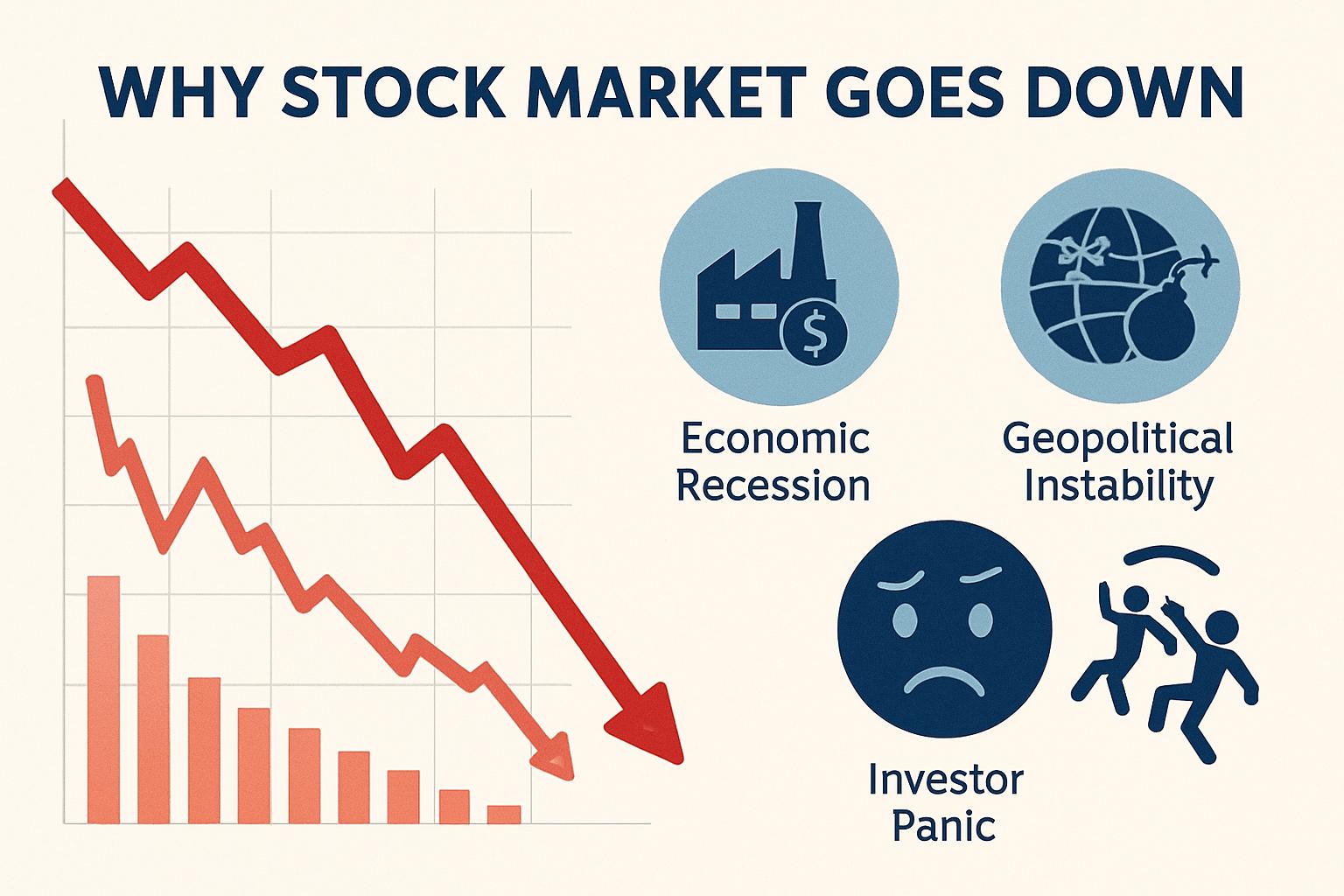
Understanding why stocks are going down is the first step in moving from reactive panic to informed strategy. By deconstructing the primary drivers of market decline—interest rates, corporate performance, geopolitical shifts, and investor sentiment—market participants can gain a clearer perspective on the current landscape and make more rational decisions regarding their financial future.
The Gravity of Interest Rates and Monetary Policy
In the world of finance, interest rates act like gravity on stock prices. When interest rates are low, money is cheap to borrow, and stocks tend to soar. Conversely, when the central bank—such as the Federal Reserve in the United States—begins to raise rates, the “gravity” increases, pulling asset prices back toward earth.
The Federal Reserve’s Mandate and Inflation
The primary reason central banks raise interest rates is to combat inflation. When the cost of living rises too quickly, the economy risks overheating. By raising the federal funds rate, the Fed makes it more expensive for businesses to take out loans for expansion and for consumers to borrow for homes or cars. This cooling effect on the economy is intentional, but it has a direct negative impact on the stock market. As borrowing costs rise, the cost of doing business increases, which can squeeze profit margins and lead to lower stock valuations.
The Discounted Cash Flow Impact
From a technical valuation standpoint, higher interest rates change the way investors value future earnings. Most professional analysts use a Discounted Cash Flow (DCF) model to determine what a company is worth. This model calculates the value of a company’s future profits in “today’s dollars.” When the “discount rate” (which is heavily influenced by interest rates) goes up, the present value of those future profits goes down. This is why high-growth tech stocks, which often promise big profits years into the future, are usually the first and hardest hit when interest rates rise.
The Shift to Fixed Income
As interest rates climb, the “yield” on safer investments like Treasury bonds and Certificates of Deposit (CDs) becomes more attractive. If an investor can get a guaranteed 5% return on a government bond, they are less likely to risk their capital in the volatile stock market for a potential 7% or 8% return. This leads to a “rotation” of capital, where institutional and retail investors sell stocks to buy bonds, creating significant downward pressure on equity prices.
Corporate Earnings and the Reality of Valuation
While macroeconomic factors set the stage, the individual performance of companies remains the bedrock of the stock market. Stocks are, fundamentally, a claim on the future earnings of a business. If those earnings appear to be in jeopardy, the stock price will inevitably follow.
Missing Expectations and Forward Guidance
Every quarter, publicly traded companies report their financial results. The market does not just react to how much money a company made; it reacts to how that performance compared to “analyst expectations.” If a company reports record profits but those profits are slightly lower than what Wall Street predicted, the stock may still fall.
Even more important than past performance is “forward guidance.” If a CEO suggests that the next six months will be challenging due to decreased consumer demand or rising costs, investors will often sell the stock immediately to avoid future losses. A wave of negative guidance across an entire sector can cause a localized market crash.
The Correction of Overvalued Assets
Markets occasionally enter periods of irrational exuberance where stock prices decouple from their underlying financial reality. This is often seen in the Price-to-Earnings (P/E) ratio. If the historical average P/E for a sector is 15, but stocks are trading at a P/E of 50, the market is “priced for perfection.” Any slight hiccup in the economy or corporate growth can cause a “valuation correction.” In these scenarios, stocks go down not necessarily because the companies are failing, but because they were simply too expensive to begin with.
Profit Margin Compression
Inflation is a double-edged sword for corporations. While they may be able to raise prices for consumers, they also face higher costs for raw materials, labor, and energy. If a company cannot pass these costs onto the consumer quickly enough, its profit margins shrink. Investors keep a close eye on “margin compression,” as it signals that a company is becoming less efficient at generating profit, leading to a de-rating of the stock price.
Geopolitical Instability and Global Supply Chains
Modern corporations operate in a hyper-globalized environment. A factory in Southeast Asia, a shipping lane in the Middle East, and a legislative vote in Europe can all impact the bottom line of a company listed on the New York Stock Exchange.
The Uncertainty Premium
Markets crave stability and predictability. Geopolitical conflicts, trade wars, and political upheaval introduce uncertainty. When the future becomes unpredictable, institutional investors often move into a “risk-off” posture. They sell equities—which are considered “risk assets”—and move into “safe havens” like gold or the U.S. Dollar. This “uncertainty premium” can suppress stock prices for as long as the conflict or political tension remains unresolved.
Supply Chain Disruptions and Energy Costs
Geopolitical tensions often manifest as physical disruptions to the economy. For example, a conflict in an oil-producing region can send energy prices skyrocketing. Since almost every business requires energy to manufacture or transport goods, high oil prices act as a hidden tax on the entire global economy. Similarly, disruptions in the supply of semiconductors or essential minerals can stall production for months, leading to lower sales and declining stock prices for manufacturers and retailers alike.
Investor Psychology and the Feedback Loop
While financial metrics are objective, the people trading stocks are subjective. Human emotion plays a massive role in why stocks go down, often exacerbating a minor decline into a major sell-off.
Fear and the Herd Mentality
Loss aversion is a powerful psychological phenomenon; studies suggest that the pain of losing money is twice as powerful as the joy of gaining it. When the market begins to dip, fear can spread quickly. Investors see their neighbors or colleagues selling, and they follow suit to “protect what they have left.” This herd mentality creates a self-fulfilling prophecy where selling begets more selling.
Technical Selling and Algorithmic Trading
In the modern market, a significant portion of trading is handled by algorithms. These “bots” are often programmed to sell when a stock hits a certain “support level” or when a specific technical indicator is triggered. If a major index like the S&P 500 falls below a key psychological level (such as a 200-day moving average), it can trigger a cascade of automated sell orders. This can cause the market to drop rapidly in a very short period, often referred to as a “flash crash” or a “liquidity event.”
Margin Calls and Forced Liquidation
Many large investors and hedge funds trade on “margin,” meaning they use borrowed money to increase their positions. When stock prices fall significantly, the value of their collateral drops. Lenders then issue “margin calls,” demanding that the investor deposit more cash or sell their stocks to cover the loan. This forced liquidation adds even more supply to a market where there is already a lack of buyers, accelerating the downward spiral.
Navigating the Downturn: A Strategic Perspective
While seeing the market go down is difficult, it is an inherent part of the investing cycle. Historical data shows that market corrections (a 10% drop) and bear markets (a 20% drop) are frequent occurrences. Understanding the “why” allows an investor to transition from a victim of the market to a participant in its recovery.
Successful investors often use these periods to rebalance their portfolios. When stocks are down, they may look for high-quality companies that have been “thrown out with the bathwater”—strong businesses whose stock prices have fallen due to general market panic rather than fundamental flaws. Furthermore, for those with a long-term horizon, market downturns represent an opportunity to “dollar-cost average,” buying more shares at lower prices to lower their average cost basis over time.
Ultimately, stocks go down because the market is a giant voting machine, processing millions of data points regarding interest rates, earnings, and global risks. While the short-term noise can be deafening, the long-term trend of the market has historically been driven by innovation, productivity, and corporate growth. Recognizing that a downturn is a temporary recalibration rather than a permanent end is the hallmark of a sophisticated financial mind.
aViewFromTheCave is a participant in the Amazon Services LLC Associates Program, an affiliate advertising program designed to provide a means for sites to earn advertising fees by advertising and linking to Amazon.com. Amazon, the Amazon logo, AmazonSupply, and the AmazonSupply logo are trademarks of Amazon.com, Inc. or its affiliates. As an Amazon Associate we earn affiliate commissions from qualifying purchases.