
The S&P 500 is often cited as the definitive barometer of the United States stock market and, by extension, the health of the global economy. For the individual investor, understanding what stocks make up this index is not merely an academic exercise; it is a fundamental requirement for building a diversified and resilient portfolio. While the name suggests a simple list of 500 companies, the reality is a complex, living entity that undergoes constant evolution to reflect the shifting landscape of American business.

To understand the stocks within the S&P 500, one must look beyond a simple directory of tickers. The index represents approximately 80% of the available market capitalization of the U.S. equity market. It is a market-capitalization-weighted index of 500 leading publicly traded companies in the U.S., but because some companies issue multiple classes of stock, the index actually contains 503 distinct stock listings. These companies are the titans of industry, ranging from Silicon Valley software giants to century-old industrial conglomerates and essential healthcare providers.
The Mechanics of the Index: How Stocks are Selected
The S&P 500 is not a list of the 500 largest companies by revenue, nor is it an automated list based purely on size. Instead, the stocks within the index are selected by a committee at S&P Dow Jones Indices. This committee follows a strict set of eligibility criteria to ensure that the index remains a reliable proxy for the “large-cap” segment of the U.S. economy.
Eligibility Requirements for Inclusion
For a company to be considered for a spot in the S&P 500, it must meet several rigorous standards. First is the market capitalization threshold. As of early 2024, a company must have an unadjusted market cap of at least $15.8 billion, though this number is frequently adjusted to reflect market conditions. This ensures that only the most significant players in the market are represented.
Second, the stock must be highly liquid. The committee looks for a “public float,” meaning a significant portion of the shares must be available for public trading rather than held by insiders or founders. The shares must also demonstrate high trading volume, ensuring that institutional investors can buy and sell large positions without causing extreme price volatility.
Financial Viability and Domicile
Unlike other indices that might include any company regardless of its profitability, the S&P 500 requires a certain level of financial health. Specifically, the sum of a company’s earnings over the most recent four consecutive quarters must be positive, as must the earnings in the most recent quarter. This rule acts as a quality filter, preventing distressed or speculative companies from entering the benchmark.
Furthermore, the S&P 500 is strictly a U.S. index. While many of its components, such as Coca-Cola or Apple, derive a majority of their revenue from international markets, they must be “U.S. domiciled.” This means they must file 10-K annual reports with the SEC, have a majority of fixed assets and revenues in the U.S., and maintain a primary listing on an eligible U.S. exchange like the NYSE or Nasdaq.
Sector Breakdown: The Pillars of the US Economy
To truly understand what the stocks in the S&P 500 are, one must look at them through the lens of sectors. The index is divided into 11 Global Industry Classification Standard (GICS) sectors. This diversification ensures that the index reflects the broad economy rather than being overly concentrated in a single industry.
Technology and Communication Services
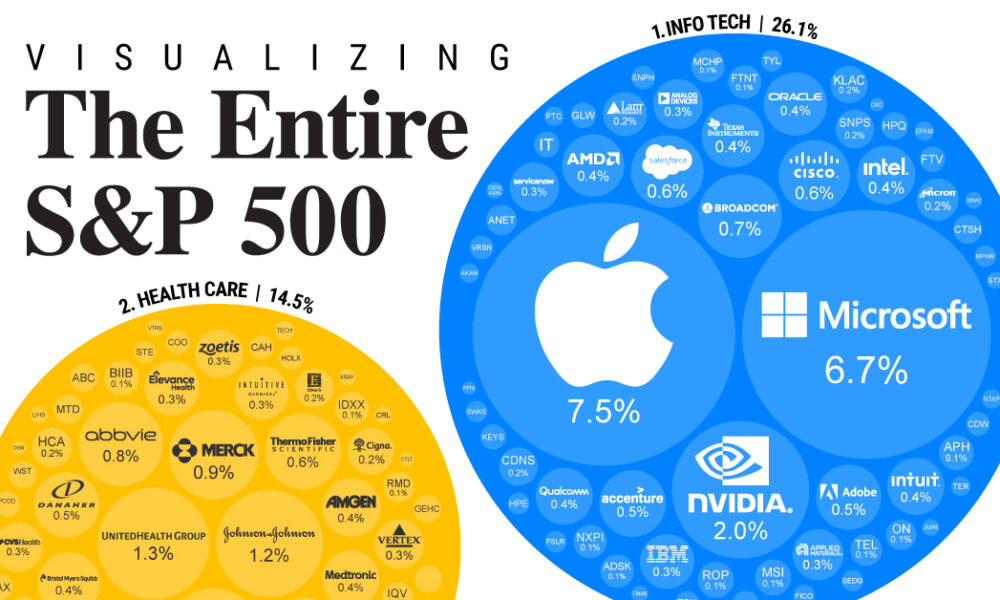
In the modern era, Information Technology is the undisputed heavyweight of the S&P 500, often accounting for nearly 30% of the index’s total weight. This sector includes software behemoths like Microsoft, hardware innovators like Apple, and semiconductor leaders like Nvidia. Closely related is the Communication Services sector, which houses digital advertising and media giants like Alphabet (Google’s parent company) and Meta (Facebook). These companies are the primary drivers of growth in the 21st-century economy, and their performance heavily dictates the direction of the overall index.
Healthcare, Financials, and Consumer Discretionary
Following technology, the Healthcare sector represents a massive portion of the index. This includes pharmaceutical giants like Eli Lilly and Johnson & Johnson, as well as healthcare providers and medical device manufacturers. The Financials sector, consisting of “too big to fail” institutions like JPMorgan Chase and Goldman Sachs, serves as the backbone of the capital markets.
The Consumer Discretionary sector is another vital component, featuring companies that rely on consumer spending power. This includes e-commerce leaders like Amazon, automotive innovators like Tesla, and retail mainstays like Home Depot. These stocks are often seen as “cyclical,” meaning their performance is closely tied to the strength of the consumer and the overall economic cycle.
Defensive and Industrial Sectors
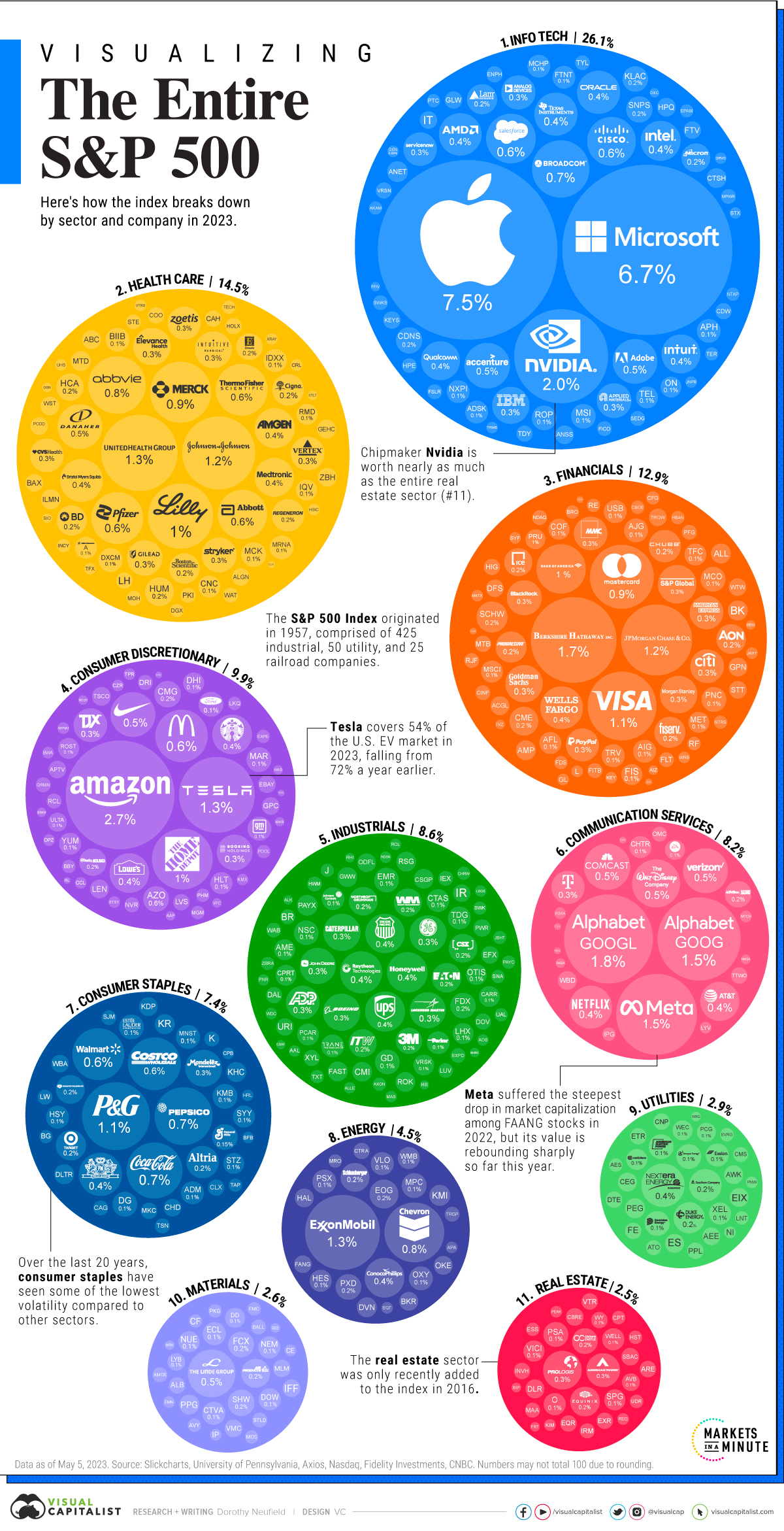
The remaining sectors—Consumer Staples (Procter & Gamble, Walmart), Energy (ExxonMobil, Chevron), Industrials (Caterpillar, Union Pacific), Utilities, Real Estate, and Materials—provide the “defensive” and “foundational” elements of the index. While they may not offer the explosive growth of tech, they provide stability and dividends, ensuring that the S&P 500 captures the essential services and infrastructure that keep the nation running.
The Dominance of the Top Holdings
While there are 500 companies in the index, they are not all created equal. The S&P 500 uses a “float-adjusted market capitalization” weighting method. This means that companies with the highest market value have the largest impact on the index’s price movements.
The “Magnificent Seven” and Market Concentration
In recent years, the index has become increasingly “top-heavy.” A small group of mega-cap stocks, often referred to as the “Magnificent Seven”—Apple, Microsoft, Alphabet, Amazon, Nvidia, Meta, and Tesla—represent a staggering percentage of the index’s total value. When these seven stocks perform well, the S&P 500 can rise even if the “average” stock in the index is flat or down.
For the investor, this means that owning an S&P 500 index fund is largely an investment in big tech. This concentration has led to debate among financial analysts regarding the risks of lack of diversification. However, proponents argue that these companies earn their outsized weight through unprecedented profitability and global dominance.
Understanding Market-Cap Weighting
The logic behind market-cap weighting is that it reflects the “collective wisdom” of the market. If investors believe a company is more valuable, its stock price rises, its market cap increases, and its weight in the S&P 500 grows accordingly. This automatically “rebalances” the index toward the winners of the economy and away from the losers. Consequently, the stocks in the S&P 500 today are vastly different from those in the 1980s, as the economy shifted from manufacturing and oil to services and technology.
Strategic Investment: How to Access the S&P 500
For most personal finance enthusiasts and long-term investors, the goal is not to buy all 500 stocks individually, which would be prohibitively expensive and difficult to manage. Instead, the focus is on “indexing”—the practice of buying a single financial product that tracks the performance of the index.
Exchange-Traded Funds (ETFs) and Mutual Funds
The most popular way to invest in the S&P 500 is through Exchange-Traded Funds (ETFs). The SPDR S&P 500 ETF Trust (ticker: SPY) was the first of its kind and remains one of the most traded securities in the world. Other low-cost options include the Vanguard S&P 500 ETF (VOO) and the iShares Core S&P 500 ETF (IVV). These funds offer “passive” management, meaning they simply mirror the index committee’s selections.
The primary advantage of these funds is their extremely low expense ratios. Because there is no active manager picking stocks, these funds often cost as little as 0.03% per year. In the world of personal finance, minimizing costs is one of the most effective ways to maximize long-term wealth.
The Role of Dividends
While the price of the S&P 500 is what makes the headlines, the stocks within the index also provide significant income through dividends. Many of the “Old Economy” stocks in the index, such as those in the Utilities or Staples sectors, pay regular dividends to shareholders. When these dividends are reinvested, they contribute significantly to the “total return” of the index. Historically, dividends have accounted for a substantial portion of the S&P 500’s long-term growth, highlighting the importance of the index as an income-generating tool.
The Evolution of the Benchmark
The list of stocks in the S&P 500 is never static. Every quarter, the S&P Index Committee meets to discuss “rebalancing.” During these meetings, some companies are removed—perhaps due to a declining market cap, a merger, or a failure to maintain profitability—and new, rising stars are added.
Recent years have seen the inclusion of companies that reflect the modern digital economy, such as Uber or Airbnb. These additions are historic moments for a company, as inclusion in the index triggers a massive wave of buying from institutional funds and ETFs that are required to hold the stock. This “index effect” often causes a temporary spike in the stock price, further cementing the S&P 500’s role as the ultimate “club” for American corporations.
By understanding the stocks in the S&P 500, investors gain insight into the structural drivers of the global economy. From the massive influence of tech giants to the steady stability of healthcare and staples, the S&P 500 remains the most efficient vehicle for capturing the growth and innovation of the American private sector. Whether you are a novice saver or a seasoned financial professional, the 500 stocks of this index likely form the cornerstone of your financial future.
aViewFromTheCave is a participant in the Amazon Services LLC Associates Program, an affiliate advertising program designed to provide a means for sites to earn advertising fees by advertising and linking to Amazon.com. Amazon, the Amazon logo, AmazonSupply, and the AmazonSupply logo are trademarks of Amazon.com, Inc. or its affiliates. As an Amazon Associate we earn affiliate commissions from qualifying purchases.