
The stock market has long been the primary engine for wealth creation in the modern economy. For the uninitiated, the prospect of trading can seem like a daunting labyrinth of ticker symbols, fluctuating charts, and complex jargon. However, at its core, trading in the stock market is about participating in the growth of businesses and capital markets. To transition from a curious observer to a confident trader, one must follow a structured path that combines education, strategic planning, and disciplined execution.
Building the Foundation: Prerequisites for Market Entry
Before placing your first trade, it is imperative to establish a stable financial baseline. Trading should never be viewed as a “get-rich-quick” scheme or a solution for urgent financial distress. Instead, it is a sophisticated method of capital allocation that requires patience and a clear head.

Defining Your Financial Goals and Risk Tolerance
Every successful trader begins with a clear objective. Are you looking to generate a secondary stream of income through frequent trades, or are you focused on building a retirement nest egg over several decades? Your goals will dictate your strategy. Alongside your goals, you must honestly assess your risk tolerance. Market volatility is a mathematical certainty; prices will go down as often as they go up. Understanding how much capital you are willing to risk—and how you will react emotionally when a position moves against you—is the most critical step in your preliminary preparation.
Establishing an Emergency Fund and Investing Capital
Financial advisors universally recommend having three to six months of living expenses in a liquid savings account before committing capital to the stock market. This “safety net” ensures that you are never forced to sell your stocks at a loss during a market downturn simply because you need cash for an emergency. Once your safety net is in place, you can identify your “risk capital.” This is money that, if lost, would not fundamentally alter your quality of life. Starting with a modest amount allows you to learn the mechanics of the market without the paralyzing fear of catastrophic loss.
Navigating the Mechanics: Selecting a Broker and Opening an Account
The bridge between an individual and the stock market is the brokerage firm. In the current digital era, the barrier to entry has never been lower, but the variety of choices requires careful discernment.
Choosing the Right Brokerage Firm
Modern brokerages generally fall into two categories: full-service brokers and discount (or online) brokers. Full-service brokers offer personalized advice, estate planning, and tax assistance, typically in exchange for higher fees or a percentage of assets under management. Discount brokers, which include popular apps and established web platforms, provide the tools for self-directed trading with little to no commission on stock trades.
When selecting a broker, consider the following factors:
-
Fees and Commissions: While many platforms offer $0 commissions on stocks, look for hidden fees like withdrawal charges, inactivity fees, or high margin rates.
-
Platform Features: Does the broker provide real-time data, advanced charting tools, and news feeds?
-
Educational Resources: For beginners, brokers that offer webinars, articles, and “paper trading” (simulated trading with fake money) are invaluable.
-
Account Types: Ensure the broker supports the account you need, whether it is a standard taxable brokerage account, an Individual Retirement Account (IRA), or a Roth IRA.
Opening and Funding Your Account
The process of opening an account is now largely digitized and can often be completed in minutes. You will need to provide personal identification, your social security number, and employment information to comply with financial regulations. Once the account is approved, you can fund it via electronic bank transfer (ACH), wire transfer, or check. It is important to note that while your money may appear in your account balance immediately, it often takes three to five business days for funds to “settle” before you can use them to purchase securities.
Mastery of Methodology: Fundamental and Technical Analysis
To trade effectively, you need a system for deciding what to buy and when to buy it. Traders generally rely on two primary schools of thought: fundamental analysis and technical analysis.
Fundamental Analysis: Evaluating Corporate Health
Fundamental analysis involves looking at the intrinsic value of a company. You are essentially acting as a business analyst, asking: “Is this company worth more than its current stock price?”
-
Earnings Reports: Public companies must release quarterly reports detailing their profits and losses. Consistent earnings growth is often a primary driver of stock price appreciation.
-
Price-to-Earnings (P/E) Ratio: This metric compares a company’s stock price to its per-share earnings. It helps traders determine if a stock is overvalued or undervalued relative to its peers.
-
Balance Sheets: Examining a company’s debt-to-equity ratio tells you if the business is over-leveraged or if it has enough cash to weather an economic downturn.
-
Market Position: Consider the company’s “moat”—its competitive advantage. Does it have a unique product, high brand loyalty, or a dominant market share?
Technical Analysis: Decoding Market Sentiment
Technical analysis ignores the underlying business and focuses strictly on price action and volume. It operates on the premise that all known information is already “priced in” to the stock and that historical price patterns tend to repeat themselves.
-
Trend Lines: Traders look for “Higher Highs” and “Higher Lows” to identify an uptrend, or “Lower Highs” and “Lower Lows” for a downtrend.
-
Support and Resistance: Support is a price level where a stock historically struggles to fall below, while resistance is a level where it struggles to rise above.
-
Moving Averages: These indicators smooth out price data to help traders identify the overall direction of the trend over a specific period, such as 50 or 200 days.
-
Relative Strength Index (RSI): This momentum oscillator measures the speed and change of price movements, helping identify “overbought” or “oversold” conditions.
Crafting Your Strategy: From Day Trading to Value Investing
There is no “one size fits all” strategy in the stock market. Your approach should align with your personality and the amount of time you can dedicate to the screens.
Day Trading vs. Swing Trading
Day trading involves buying and selling stocks within the same trading day. It requires intense focus, high-speed internet, and a mastery of technical analysis. It is high-risk and high-reward. Swing trading, conversely, involves holding stocks for several days or weeks to capture a specific “swing” in price. This is often more manageable for those with full-time jobs, as it requires less constant monitoring.
Long-Term Value and Growth Investing
Value investors, inspired by the likes of Warren Buffett, look for “bargains”—companies trading for less than their intrinsic value. Growth investors look for companies with high potential for future expansion, even if their current valuations seem high. Both strategies typically involve holding stocks for years, allowing the power of compounding and business growth to drive returns.
The Role of Exchange-Traded Funds (ETFs)
For many, the best way to trade is not to pick individual stocks at all. ETFs allow you to buy a basket of stocks in a single transaction. For example, an S&P 500 ETF gives you exposure to the 500 largest companies in the United States. This provides instant diversification and significantly reduces the risk of a single company’s failure ruining your portfolio.
The Psychology of the Trade: Risk Management and Emotional Discipline
The greatest enemy of a trader is not the market, but their own emotions. Greed and fear drive most poor financial decisions.
Implementing Risk Management
You must protect your capital at all costs. A common rule of thumb is the “1% Rule,” which suggests you should never risk more than 1% of your total account value on a single trade.
-
Stop-Loss Orders: This is an automated instruction to your broker to sell a stock if it hits a certain price. It acts as a “circuit breaker” to prevent a small loss from turning into a catastrophic one.
-
Position Sizing: Avoid the temptation to “go all in” on a single “hot tip.” Diversifying your holdings across different sectors (Tech, Healthcare, Energy) ensures that a slump in one industry doesn’t take down your entire portfolio.
Maintaining Emotional Discipline
The stock market is a sea of noise. News headlines, social media “gurus,” and “fear of missing out” (FOMO) can lead to impulsive decisions. Developing a written trading plan is essential. Your plan should specify exactly why you are entering a trade, what your profit target is, and at what point you will admit you were wrong and exit. By following a pre-defined script, you remove the emotional volatility that leads to “revenge trading”—the dangerous habit of trying to “win back” losses by taking increasingly larger risks.

Execution: Your First Trade and Beyond
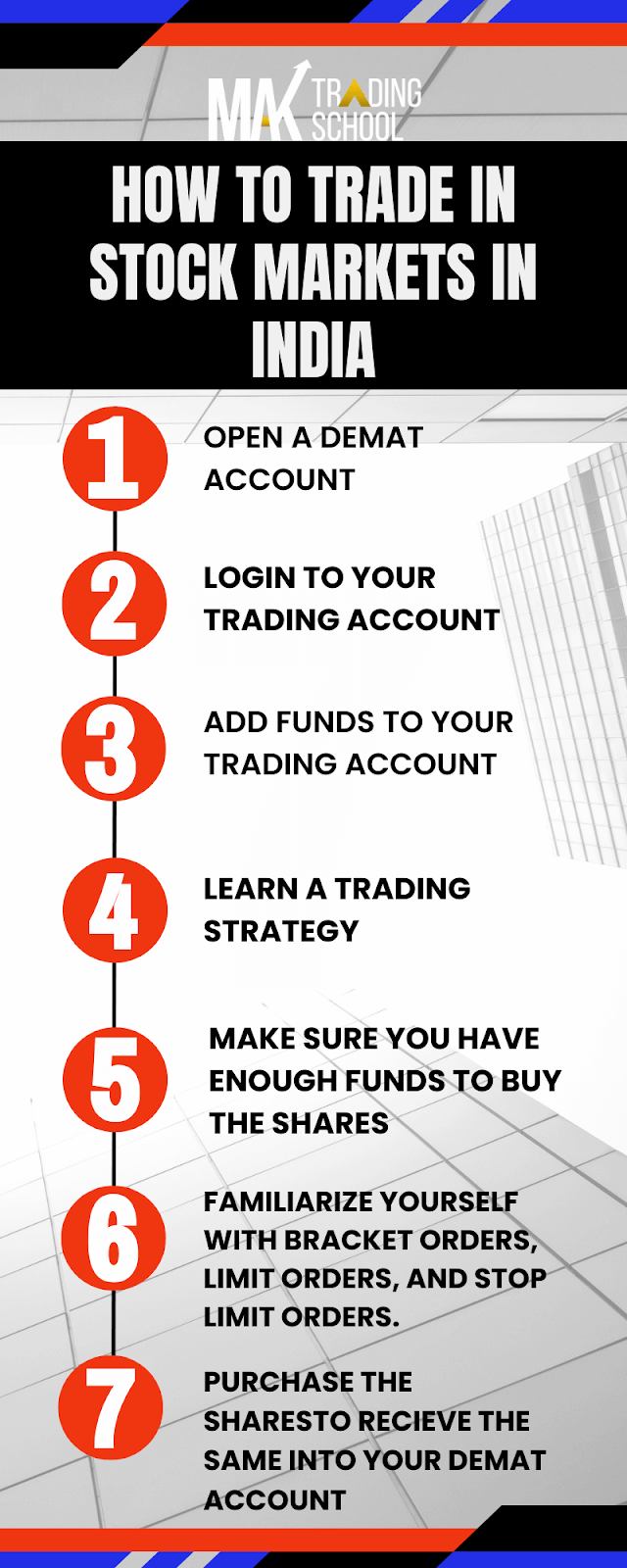
Once you have done your research and funded your account, it is time to execute. When you go to place an order, you will encounter different order types. A Market Order executes immediately at the current price, while a Limit Order only executes if the stock reaches a price you specify. Limit orders are generally preferred because they give you control over the entry price, preventing you from overpaying during moments of high volatility.
After the trade is executed, the work is not over. Professional traders keep a “trading journal,” documenting every trade, the reasoning behind it, and the eventual outcome. This self-reflection is the only way to identify patterns in your successes and failures.
The stock market is a lifelong classroom. Success does not come from a single lucky trade, but from the consistent application of sound financial principles, rigorous analysis, and unwavering discipline. By treating your trading as a business—focusing on risk management as much as profit potential—you can navigate the complexities of the market and work toward achieving your long-term financial independence.
aViewFromTheCave is a participant in the Amazon Services LLC Associates Program, an affiliate advertising program designed to provide a means for sites to earn advertising fees by advertising and linking to Amazon.com. Amazon, the Amazon logo, AmazonSupply, and the AmazonSupply logo are trademarks of Amazon.com, Inc. or its affiliates. As an Amazon Associate we earn affiliate commissions from qualifying purchases.