
The Invesco QQQ Trust, commonly known by its ticker symbol “QQQ,” is one of the most widely recognized and heavily traded exchange-traded funds (ETFs) in the world. Since its inception in 1999, it has become a staple for both institutional and retail investors seeking exposure to innovation and large-cap growth. Often referred to as “the triple Qs,” this fund tracks the Nasdaq-100 Index, which consists of 100 of the largest non-financial companies listed on the Nasdaq Stock Market.
To understand what stocks are in the QQQ, one must first understand that the fund is a reflection of the modern economy’s shift toward digitization, automation, and biotechnology. While many investors equate QQQ strictly with “tech stocks,” the reality is more nuanced. The fund offers a diversified, albeit concentrated, look at the leaders in retail, health care, and industrial innovation, provided they meet the specific listing and market capitalization requirements of the Nasdaq-100.

Understanding the QQQ: The Benchmark of Innovation
The QQQ is designed to provide investors with investment results that generally correspond to the price and yield performance of the Nasdaq-100 Index. This index is market-capitalization weighted, meaning that the largest companies exert the most significant influence on the fund’s daily price movements.
Tracking the Nasdaq-100 Index
The Nasdaq-100 is not a general market index like the S&P 500 or the Dow Jones Industrial Average. Instead, it is a modified capitalization-weighted index that focuses on the “new economy.” To be included in the QQQ, a stock must be listed on the Nasdaq, must have been listed for at least two years (with some exceptions for massive IPOs), and must have significant trading volume to ensure liquidity.
Because the index excludes financial companies—such as banks, insurance providers, and brokerage firms—the QQQ naturally leans toward sectors that prioritize research, development, and intellectual property. This exclusion is a defining characteristic that differentiates the QQQ from other broad-market ETFs.
Why the QQQ is Often Misidentified as a “Pure Tech” Fund
While it is true that Information Technology (IT) makes up the lion’s share of the QQQ—often hovering around 50% to 60% of the total weight—calling it a “tech fund” is technically inaccurate. The fund contains massive entities in the Consumer Discretionary sector, such as Amazon and Tesla, and Health Care leaders like Amgen and Gilead Sciences.
The confusion stems from the fact that many modern companies are “tech-enabled.” Is a company that sells clothes primarily through a sophisticated AI-driven app a retail company or a tech company? The QQQ captures these hybrid leaders, making it a proxy for “growth” rather than just “silicon and software.”
The Dominant Players: Analyzing the Top Holdings
The performance of the QQQ is largely driven by a handful of mega-cap companies often referred to as the “Magnificent Seven.” These stocks command the highest weightings in the fund, and their quarterly earnings reports frequently dictate the direction of the entire ETF.
The Influence of Big Tech (The Magnificent Seven)
As of the current market cycle, the top holdings in the QQQ are dominated by Apple (AAPL), Microsoft (MSFT), Amazon (AMZN), NVIDIA (NVDA), Alphabet (GOOGL/GOOG), Meta Platforms (META), and Tesla (TSLA).
-
Apple and Microsoft: These two are typically the largest positions in the QQQ. Their combined weight often exceeds 15-20% of the entire fund. They represent the bedrock of personal computing, enterprise software, and consumer hardware.
-
Alphabet and Meta: These companies represent the pinnacle of digital advertising and data. Their inclusion ensures that the QQQ is heavily influenced by trends in social media, search engine dominance, and the burgeoning field of artificial intelligence.
-
Amazon: Classified under Consumer Discretionary, Amazon is a vital component of the QQQ, representing the shift from brick-and-mortar retail to e-commerce and cloud computing (AWS).
Semiconductor Giants and the AI Wave
Beyond the household names, the QQQ is a primary vehicle for investing in the semiconductor industry. Companies like NVIDIA, Broadcom (AVGO), and Advanced Micro Devices (AMD) are essential components. As the global economy pivots toward Artificial Intelligence and high-performance computing, these hardware providers have seen their weightings within the QQQ increase significantly. NVIDIA, in particular, has recently vied for a top-three spot in the fund, reflecting its dominance in the AI chip market.
Beyond Technology: Diversification Across Other Sectors
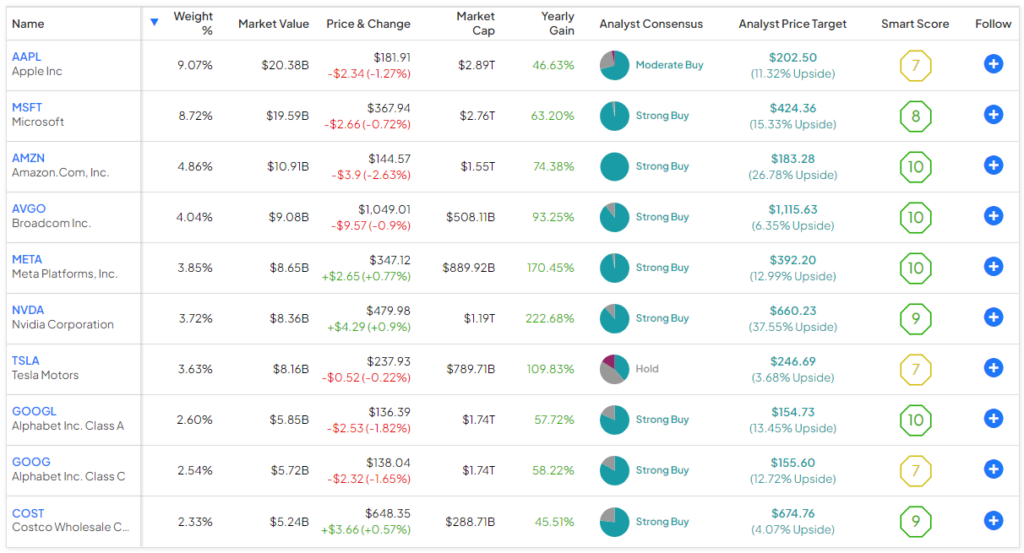
To truly understand what stocks are in the QQQ, one must look past the software and hardware giants. The fund’s methodology allows for any large-cap company to enter, provided it isn’t a bank and it stays on the Nasdaq exchange.
Consumer Discretionary and Retail Powerhouses
The Consumer Discretionary sector is usually the second-largest sector in the QQQ. This includes companies like:
-
Costco Wholesale (COST): A retail giant that thrives on a membership-based model.
-
Starbucks (SBUX): A global leader in food and beverage services.
-
PepsiCo (PEP): Interestingly, PepsiCo is a staple of the QQQ, providing a defensive buffer with its diverse portfolio of snacks and beverages.
-
Airbnb (ABNB) and Booking Holdings (BKNG): Representing the travel and hospitality tech sector.
Health Care and Biotechnology Innovation
The Nasdaq has long been the preferred home for biotechnology companies. Consequently, the QQQ includes several of the world’s most innovative medical firms. These are not your traditional “Big Pharma” companies that might be found in the Dow; they are firms focused on genomics, specialized immunology, and advanced drug delivery.
-
Amgen (AMGN) and Vertex Pharmaceuticals (VRTX): These companies focus on high-margin, specialized treatments.
-
Intuitive Surgical (ISRG): A leader in robotic-assisted surgery, sitting at the intersection of health care and high-tech engineering.
Industrials and Modern Utilities
The QQQ even touches the industrial sector, though these companies are often selected for their logistical or technological advantages. Examples include Honeywell International (HON) and CSX Corporation, a major railroad operator. By including these, the QQQ captures the “plumbing” of the modern economy—transportation and automation systems that allow the tech giants to function.
The Rules of Admission: How Stocks Enter the QQQ
The list of stocks in the QQQ is not static. It changes through a process of rebalancing and reconstitution. This ensures that the fund always represents the current leaders of the market rather than being weighed down by yesterday’s giants.
Liquidity and Market Capitalization Requirements
To be eligible for the Nasdaq-100, and subsequently the QQQ, a company must have a minimum average daily trading volume of 200,000 shares. This ensures that the ETF can buy and sell shares of its underlying holdings without causing massive price distortions. Furthermore, companies must be among the top 100 non-financial firms by market cap. If a company’s valuation drops significantly, it risks being “delisted” from the index during the annual review.
The Exclusion of Financial Companies
The most notable absence in the QQQ is the banking sector. You will not find JPMorgan Chase, Goldman Sachs, or Bank of America in this fund. This exclusion was originally intended to keep the index focused on industrial and growth-oriented sectors. For investors, this means the QQQ has a very different risk profile than the S&P 500; it is less sensitive to interest rate spreads that govern bank profits but more sensitive to interest rates in terms of how they affect the valuation of future growth earnings.
Quarterly Rebalancing and Annual Reconstitution
The Nasdaq-100 undergoes a “reconstitution” every December. This is when companies are added or removed based on their year-end market caps. Additionally, the index is rebalanced quarterly (March, June, September, and December). During rebalancing, the weights of the stocks are adjusted to ensure that no single company becomes too dominant, though the “modified” nature of the weighting still allows for significant concentration in the top names.
Investment Strategy: Is the QQQ Right for Your Portfolio?
Knowing what stocks are in the QQQ is only half the battle; understanding how those stocks behave in a portfolio is the key to successful investing.
Performance Comparison: QQQ vs. S&P 500
Historically, the QQQ has outperformed the broader S&P 500 over long horizons, largely due to its heavy exposure to the booming technology sector. However, this outperformance comes with higher volatility. Because the QQQ is more concentrated (100 stocks versus 500), it experiences sharper swings. In “bull markets” led by growth and innovation, QQQ tends to lead. In “bear markets” or periods of rising interest rates, the QQQ may see deeper drawdowns than a more diversified value-tilted fund.
Managing Concentration Risk and Volatility
Investors should be aware of “concentration risk.” Since the top 10 holdings in the QQQ often account for nearly 50% of the fund’s total value, the fortunes of the fund are tied heavily to a small group of CEOs and corporate strategies. If Apple or Microsoft has a bad year, it is very difficult for the other 90+ companies to pull the ETF into positive territory.

Tax Efficiency and Low Expense Ratios
One of the reasons the QQQ is so popular is its structure as a Unit Investment Trust (UIT). It is generally very tax-efficient, meaning it triggers fewer capital gains distributions for shareholders compared to actively managed funds. Furthermore, its expense ratio is relatively low (typically around 0.20%), making it a cost-effective way to own a basket of the world’s most successful companies without having to buy each individual stock.
In summary, the stocks in the QQQ represent the vanguard of the global economy. From the chips that power AI to the logistics networks that deliver goods to our doors, the QQQ is a curated collection of non-financial leaders. While the “Big Tech” names provide the horsepower, the inclusion of health care, retail, and industrial innovators provides a multidimensional growth engine that continues to attract trillions of dollars in global capital.
aViewFromTheCave is a participant in the Amazon Services LLC Associates Program, an affiliate advertising program designed to provide a means for sites to earn advertising fees by advertising and linking to Amazon.com. Amazon, the Amazon logo, AmazonSupply, and the AmazonSupply logo are trademarks of Amazon.com, Inc. or its affiliates. As an Amazon Associate we earn affiliate commissions from qualifying purchases.