
Tesla, Inc. (TSLA) is far more than just an electric vehicle manufacturer; it is a financial phenomenon that has redefined the dynamics of the modern stock market. As one of the most valuable companies in the world, the question of who owns Tesla is central to understanding its market volatility, its strategic direction, and its unique position at the intersection of technology and heavy industry. Unlike many legacy automakers that are controlled by founding families through dual-class share structures, Tesla’s ownership is a complex tapestry of high-profile individuals, massive institutional index funds, and a fiercely loyal legion of retail investors.
To understand the financial architecture of Tesla, one must look beyond the headlines of Elon Musk’s latest social media posts and delve into the SEC filings that dictate the power dynamics of the boardroom. The ownership structure of Tesla is divided into three primary tiers: institutional investors, individual insiders, and the public (retail) shareholders. Each group plays a distinct role in the company’s valuation and governance.
The Dominance of Institutional Capital
Institutional investors—large organizations such as mutual funds, pension funds, and insurance companies—represent the backbone of Tesla’s ownership. As of 2024, institutional ownership typically hovers between 40% and 45% of the total outstanding shares. These entities provide a level of stability to the stock, though their influence is often passive rather than activist.
The Power of Index Tracking: Vanguard and BlackRock
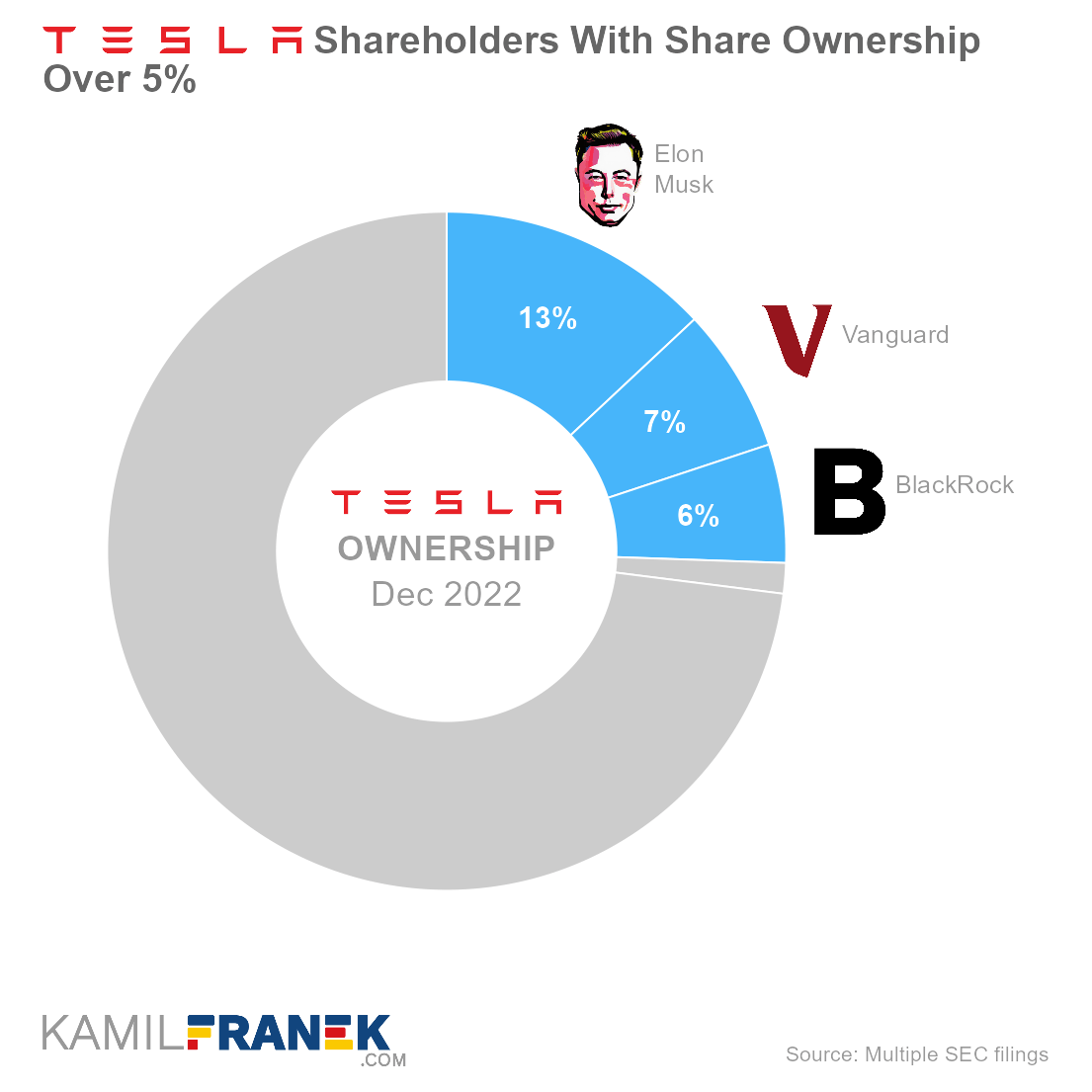
The two largest institutional holders of Tesla are consistently The Vanguard Group and BlackRock, Inc. These financial behemoths do not necessarily own Tesla because of a specific conviction in Elon Musk’s vision; rather, they own it because they must. As Tesla is a prominent member of the S&P 500 and the Nasdaq-100, any fund tracking these indices is required to hold a proportional amount of TSLA stock.
Vanguard currently holds approximately 7% to 8% of the company, while BlackRock follows closely with roughly 5% to 6%. For investors, this means that a significant portion of Tesla’s market cap is tied to the broader health of the equity markets and the continuous flow of capital into passive investment vehicles. When millions of 401(k) contributors buy an S&P 500 index fund, they are indirectly increasing their stake in Tesla.
State Street and Large Asset Managers
State Street Corporation, another “Big Three” asset manager, maintains a significant position, often around 3%. Other notable institutional players include Geode Capital Management and Capital World Investors. These institutions provide the liquidity necessary for a stock that frequently tops the charts for the highest daily trading volume on Wall Street. Their presence acts as a counterweight to the volatility often introduced by retail trading and insider movements.
Elon Musk and the Concentrated Insider Stake
While institutions hold the largest collective block, the single most influential owner of Tesla is undoubtedly its CEO, Elon Musk. His ownership stake is not merely a financial asset; it is the primary engine of his net worth and the source of his corporate authority.
Navigating the Percentage: Musk’s Fluctuating Holdings
Elon Musk’s ownership percentage has been in a state of flux over the last several years. Historically, Musk owned upwards of 20% of the company. However, several major events have altered this figure. Most notably, his acquisition of Twitter (now X) required the sale of tens of billions of dollars worth of Tesla shares, which diluted his personal stake.
Currently, Musk owns approximately 12% to 13% of Tesla’s outstanding common stock. However, this figure is deceptive when considering his total potential control. Musk holds a vast array of exercisable stock options granted through his 2018 CEO Performance Award. If these options are fully factored in—despite the legal challenges surrounding his compensation package in Delaware courts—his theoretical stake could climb back toward the 20% mark. This level of concentration is rare for a company with a trillion-dollar market cap potential, creating a “Key Man Risk” that investors must constantly weigh.
Other Key Insiders and the Board of Directors
Beyond Musk, other insiders hold relatively small but significant stakes. These include Kimbal Musk, Elon’s brother and a long-standing board member, and Jeffrey B. Straubel, the co-founder and former CTO who returned to the board.
While the combined holdings of the Board of Directors (excluding Elon) account for less than 1% of the total shares, their ownership aligns their interests with shareholders. In the world of business finance, insider buying is often seen as a signal of confidence, while heavy insider selling can trigger market anxiety. For Tesla, the focus remains almost exclusively on Elon Musk’s filings, as his divestments often dictate short-term price action.
The Retail Revolution: Why Individual Investors Matter
Perhaps the most unique aspect of Tesla’s ownership structure is the sheer volume of retail (individual) investors. In most mega-cap companies, retail ownership is a negligible fraction of the total. In Tesla’s case, individual investors own an estimated 30% to 40% of the company.
The “Tesla Bulls” and Market Volatility
The high concentration of retail ownership is a double-edged sword for the company’s financial health. On one hand, Tesla enjoys a level of brand loyalty that traditional companies envy. Many retail investors are “HODLers”—long-term believers who refuse to sell despite massive price swings. This provides a floor during market downturns.
On the other hand, retail sentiment is often driven by social media trends and news cycles rather than fundamental financial analysis. This contributes to Tesla’s high Beta (a measure of volatility relative to the market). The democratization of ownership through platforms like Robinhood has made Tesla the “people’s stock,” but it also means that the stock price can fluctuate wildly based on retail enthusiasm or panic.
Direct Ownership vs. Indirect Exposure
For the average individual, owning Tesla happens in two ways: direct and indirect. Direct ownership involves purchasing shares through a brokerage. Indirect exposure occurs through ETFs like the ARK Innovation ETF (ARKK), managed by Cathie Wood. Wood has been one of Tesla’s most vocal proponents, and her funds’ heavy weighting in TSLA has made her a proxy for retail sentiment among institutional circles.
Governance, Voting Rights, and Corporate Control
Ownership is not just about equity; it is about the power to steer the ship. In the world of business finance, voting rights are the currency of control. Tesla utilizes a “one share, one vote” system, which is standard for most public companies but differs from the multi-class structures used by Meta or Alphabet (Google).
The Influence of the Board of Directors
Tesla’s board has faced intense scrutiny regarding its independence from Elon Musk. From a financial governance perspective, the board’s role is to ensure that management acts in the best interest of all shareholders. However, given Musk’s dominant personality and ownership stake, the board has often been accused of being a “rubber stamp” for his initiatives.
Investors pay close attention to board elections and proxy votes. Issues such as executive compensation, the relocation of the corporate headquarters from Delaware to Texas, and the integration of AI and robotics into the core business model are all decided by shareholder votes. Because institutional investors often follow the recommendations of proxy advisory firms like ISS or Glass Lewis, the tension between Musk’s vision and institutional standards of governance is a recurring theme in Tesla’s financial narrative.
The Compensation Saga and its Financial Impact
The legal battle over Elon Musk’s $56 billion compensation package is a landmark case in corporate finance. The voiding of this package by a Delaware judge highlighted the risks of concentrated ownership and perceived board bias. For shareholders, the resolution of this dispute is critical. If Musk does not feel sufficiently incentivized through equity ownership, there are concerns he might focus his efforts on his other ventures, such as SpaceX or xAI. Conversely, issuing massive amounts of new stock to satisfy his compensation dilutes existing shareholders, reducing their fractional ownership of the company.
Strategic Outlook: How Ownership Affects Tesla’s Valuation
The ownership structure of Tesla has direct implications for its valuation and its ability to raise capital. Understanding who owns the company allows investors to predict how the stock might react to macroeconomic shifts.
Dilution Risks and Capital Raises
Because Tesla is a capital-intensive business, it has historically relied on secondary stock offerings to fund its Gigafactory expansions and R&D. Every time Tesla issues new shares, the ownership percentage of existing shareholders is diluted. However, because the demand for TSLA shares—particularly from retail and index funds—has remained high, the company has been able to raise billions of dollars with minimal impact on its long-term share price growth. This ability to “print” capital is a luxury few companies possess.

Institutional Stability vs. Retail Sentiment
Looking forward, the “institutionalization” of Tesla is likely to continue. As the company matures from a high-growth disruptor into a dominant global automaker and energy provider, more value-oriented funds may enter the fray. This shift would likely decrease volatility but might also signal the end of the hyper-growth phase that attracted retail “moonshot” investors.
The future of Tesla’s ownership will be defined by the balance of power between Elon Musk’s visionary control and the fiduciary requirements of the world’s largest asset managers. For the individual investor, staying informed about these ownership shifts is not just an academic exercise; it is a fundamental requirement for navigating the risks and rewards of the TSLA ticker. Whether you are a retail enthusiast or a passive participant via an index fund, you are a part of a global ownership experiment that continues to challenge the traditional rules of corporate finance.
aViewFromTheCave is a participant in the Amazon Services LLC Associates Program, an affiliate advertising program designed to provide a means for sites to earn advertising fees by advertising and linking to Amazon.com. Amazon, the Amazon logo, AmazonSupply, and the AmazonSupply logo are trademarks of Amazon.com, Inc. or its affiliates. As an Amazon Associate we earn affiliate commissions from qualifying purchases.