
The United States tax system operates on a “pay-as-you-go” basis. While W-2 employees fulfill this requirement through automatic withholdings from their paychecks, entrepreneurs, freelancers, investors, and small business owners must take a more proactive approach. For these individuals, understanding when federal tax estimates are due is not just a matter of compliance—it is a fundamental component of professional cash flow management and personal financial health.
Failure to adhere to the quarterly schedule can result in unexpected penalties and interest charges that erode profit margins and disrupt long-term financial planning. This guide provides a comprehensive breakdown of the deadlines, calculation methods, and strategic considerations necessary to navigate the federal estimated tax system with confidence.
Understanding the Pay-As-You-Go Tax System
The Internal Revenue Service (IRS) requires that tax liabilities be settled throughout the year as income is earned. When you are self-employed or receive significant income from sources other than a traditional salary, no employer is withholding taxes on your behalf. Consequently, the responsibility shifts entirely to you to estimate your annual liability and pay it in four distinct installments.
Who Must Pay Estimated Taxes?
Generally, individuals, sole proprietors, partners, and S corporation shareholders must make estimated tax payments if they expect to owe at least $1,000 in tax for the year after subtracting their withholding and credits. Corporations generally must make estimated tax payments if they expect to owe tax of $500 or more.
This requirement often captures a wide range of taxpayers, including:
-
Freelancers and independent contractors (1099 workers).
-
Business owners with pass-through income.
-
Investors with significant capital gains, dividends, or interest.
-
Landlords receiving rental income.
-
Individuals receiving prizes, awards, or gambling winnings.
The Safe Harbor Rule
To avoid underpayment penalties, the IRS provides “Safe Harbor” guidelines. Generally, you will not face a penalty if the total of your timely paid estimated taxes (plus any withholding) equals at least 90% of the tax shown on your current year’s return, or 100% of the tax shown on your return for the prior year—whichever is smaller. For high-income earners (those with an adjusted gross income over $150,000), the prior-year safe harbor threshold increases to 110%.
The Critical Deadlines: Your Quarterly Schedule
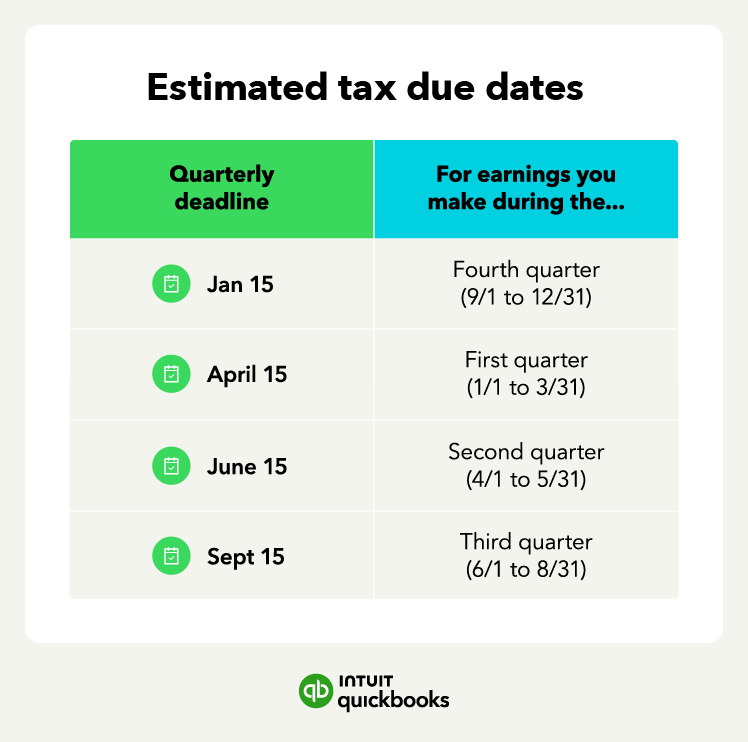
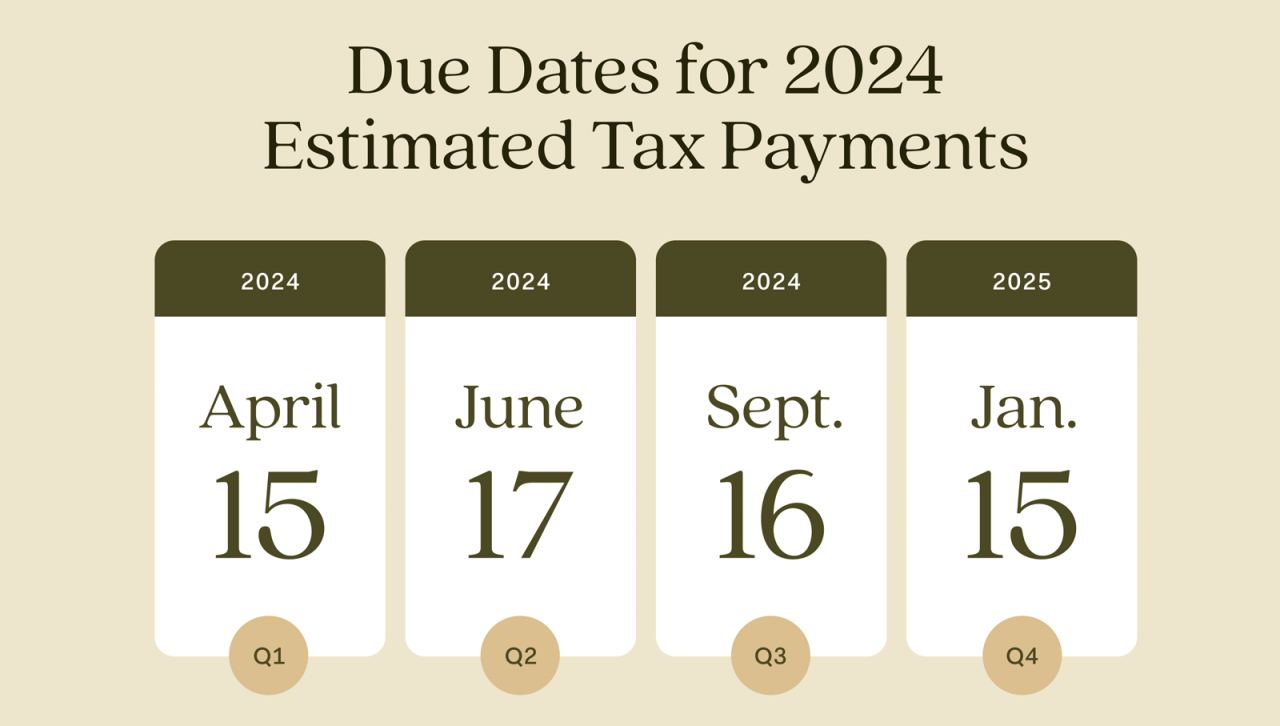
Despite being referred to as “quarterly” payments, the IRS deadlines do not align perfectly with standard three-month calendar quarters. It is essential to mark these specific dates on your financial calendar, as missing a deadline by even a few days can trigger interest charges.
First Period: January 1 – March 31
The deadline for the first installment is April 15. This date coincides with the traditional tax filing deadline for the previous year. It represents the first opportunity to set the tone for your financial year. If April 15 falls on a weekend or a legal holiday, the deadline is pushed to the next business day.
Second Period: April 1 – May 31
The second installment is due on June 15. Notably, this period covers only two months (April and May), which often catches new business owners off guard. Because the window between the first and second payments is shorter than others, it is vital to have a cash reserve ready to cover this installment shortly after the April 15 filing.
Third Period: June 1 – August 31
The third installment is due on September 15. This deadline covers the summer months and is a critical midpoint for reassessing your annual income projections. If your business has seen a significant surge in growth during the second or third quarter, this is the time to adjust your payment upward to avoid a large balance due in April.
Fourth Period: September 1 – December 31
The final installment for the tax year is due on January 15 of the following year. This payment accounts for the final four months of income. If you file your annual tax return (Form 1040) by January 31 and pay the entire balance due with your return, you may be able to skip the January 15 estimated payment without penalty.
Strategies for Accurate Calculation
Calculating estimated taxes can be intimidating, particularly for those with fluctuating income. However, utilizing the right tools and strategies can simplify the process and ensure you are neither overpaying nor underpaying.
Using Form 1040-ES
The IRS provides Form 1040-ES, “Estimated Tax for Individuals,” which includes a worksheet to help you figure your estimated tax. This worksheet prompts you to estimate your expected adjusted gross income, taxable income, taxes, deductions, and credits for the year. It is advisable to use your prior year’s tax return as a starting point, adjusting for any known changes in income or tax law.
The Annualized Income Installment Method
For seasonal businesses or freelancers whose income is “lumpy”—meaning they earn significantly more in some months than others—the standard equal installment method can cause cash flow strain. In such cases, the IRS allows the “Annualized Income Installment Method.” This allows you to pay an amount based on what you actually earned during each specific period. While this requires more complex record-keeping and the filing of Form 2210 with your annual return, it ensures that your tax payments remain proportional to your actual cash flow.
Adjusting for New Tax Credits and Deductions
When calculating your estimates, do not forget to account for deductions that reduce your taxable income. For the self-employed, this includes the self-employment tax deduction (50% of the self-employment tax), health insurance premiums, and contributions to SEP-IRAs or Solo 401(k)s. Accounting for these early in the year prevents you from over-sending funds to the IRS that could otherwise be working for you in a high-yield savings account or business investment.
How to Submit Your Federal Tax Estimates
The IRS has modernized its payment systems, making it easier than ever to submit funds electronically. Choosing a digital method provides an immediate digital receipt, which is essential for your records.
IRS Direct Pay
Direct Pay is a free service provided by the IRS that allows you to pay directly from your checking or savings account. There is no registration required, and you receive an instant confirmation number. This is often the preferred method for individual taxpayers and sole proprietors.
EFTPS: The Electronic Federal Tax Payment System
EFTPS is a more robust system designed for both individuals and businesses. While it requires an initial enrollment process (which involves receiving a PIN via physical mail), it allows you to schedule payments up to 365 days in advance. For the disciplined business owner, scheduling all four quarterly payments at the start of the year ensures that no deadline is ever missed due to forgetfulness.
Credit and Debit Cards
You can pay your estimated taxes via credit or debit card through various third-party processors authorized by the IRS. While this can be a way to earn reward points or manage a temporary cash gap, these processors charge a convenience fee (usually a percentage of the payment). It is important to calculate whether the rewards earned outweigh the fees incurred.
Traditional Vouchers
If you prefer the traditional route, you can mail a physical check or money order along with the payment vouchers found in Form 1040-ES. If you choose this method, it is highly recommended to use certified mail with a return receipt requested to prove the payment was postmarked by the deadline.
Managing Cash Flow and Strategic Tax Planning
The key to mastering quarterly tax estimates is integrating them into your broader business and personal finance strategy. Viewing taxes as a recurring operational expense rather than a once-a-year surprise is the first step toward financial stability.
The Tax Sinking Fund
One of the most effective ways to manage estimated payments is to create a dedicated “tax sinking fund.” Every time you receive a payment from a client or a distribution from your business, immediately transfer a percentage (often 25-30% depending on your tax bracket) into a separate, high-yield savings account. This ensures that when the quarterly deadline arrives, the money is already set aside and earning interest for you in the meantime.
Mid-Year Reviews with Professionals
Tax laws are subject to change, and your business’s profitability may shift unexpectedly. Engaging with a tax professional for a mid-year review in July or August can be a wise investment. They can help you determine if you are on track to meet the Safe Harbor requirements and suggest adjustments if your income has significantly increased or decreased compared to the previous year.

Integrating Tax Estimates into Business Growth
For the sophisticated business owner, tax planning is a tool for growth. By accurately estimating your quarterly payments, you gain a clearer picture of your “true” net income. This clarity allows for better-informed decisions regarding hiring, equipment purchases, and marketing spend. When you know exactly what is owed to the government, you can move forward with the remaining capital with total confidence.
In conclusion, while the federal tax estimate schedule may seem complex at first glance, it is a manageable and essential part of the modern financial landscape. By respecting the deadlines of April 15, June 15, September 15, and January 15, and utilizing tools like the Safe Harbor rule and electronic payment systems, you protect yourself from penalties and position your finances for sustainable, long-term success.
aViewFromTheCave is a participant in the Amazon Services LLC Associates Program, an affiliate advertising program designed to provide a means for sites to earn advertising fees by advertising and linking to Amazon.com. Amazon, the Amazon logo, AmazonSupply, and the AmazonSupply logo are trademarks of Amazon.com, Inc. or its affiliates. As an Amazon Associate we earn affiliate commissions from qualifying purchases.