
Navigating the landscape of federal taxation can often feel like a complex administrative hurdle, particularly for those who operate outside the traditional W-2 employment structure. For freelancers, small business owners, investors, and contractors, the “pay-as-you-go” nature of the United States tax system requires a proactive approach to financial management. Instead of waiting until April to settle a massive debt, the IRS requires individuals with significant non-wage income to submit payments throughout the year. These are known as estimated tax payments.
Understanding where to mail these payments—and how to ensure they are processed correctly—is a fundamental pillar of personal and business finance. While digital options have grown in popularity, many taxpayers still prefer the tangible record of a paper check and a physical voucher. This guide provides a comprehensive breakdown of the mailing procedures, regional requirements, and strategic considerations for managing your quarterly tax obligations.
Understanding the IRS Pay-As-You-Go System
The United States tax system is designed to collect revenue incrementally as income is earned. For most employees, this happens automatically through payroll withholding. However, when you receive income that is not subject to withholding—such as dividends, interest, capital gains, alimony, or self-employment income—you become responsible for calculating and sending that money to the IRS yourself.
Who Must Make Estimated Payments?
Generally, you are expected to make estimated tax payments if you expect to owe at least $1,000 in tax for the current year after subtracting your withholding and refundable credits. This applies to individuals, sole proprietors, partners, and S corporation shareholders. If your prior year’s tax liability was zero, you might be exempt for the current year, but for those with consistent income, missing these payments can lead to underpayment penalties.
The Role of Form 1040-ES
The primary vehicle for mailing estimated payments is Form 1040-ES, “Estimated Tax for Individuals.” This form includes a worksheet to help you estimate your tax liability and four individual payment vouchers. Each voucher corresponds to a specific quarter of the fiscal year. When mailing a payment, you must include the correct voucher to ensure the IRS applies the funds to the correct account and tax year.
Locating the Correct Mailing Address for Form 1040-ES
The IRS operates several processing centers across the country to manage the high volume of incoming mail. The specific address you must use depends entirely on your state of residence and whether or not you are enclosing a payment (which, in the case of estimated taxes, you almost certainly are).
Because the IRS occasionally shifts its processing workloads between centers, it is vital to verify the address based on the most recent version of the Form 1040-ES instructions. However, the general regional breakdown usually follows a predictable pattern.
Eastern and Mid-Atlantic States
If you live in Florida, Louisiana, Mississippi, Texas, or certain parts of the Southeast, your payments are traditionally directed to a specific processing center in Charlotte, North Carolina. Conversely, taxpayers in states like New York, New Jersey, and Pennsylvania often mail their vouchers to a center in Philadelphia or Louisville.
Midwestern and Western States
Taxpayers in the Midwest, including Illinois, Indiana, Iowa, and Michigan, typically send their payments to a processing center in Cincinnati or Kansas City. For those located in the West—California, Washington, Oregon, and Nevada—the IRS often designates a mailing address in San Francisco or Charlotte, depending on the specific year’s logistical routing.
A Breakdown by Residency
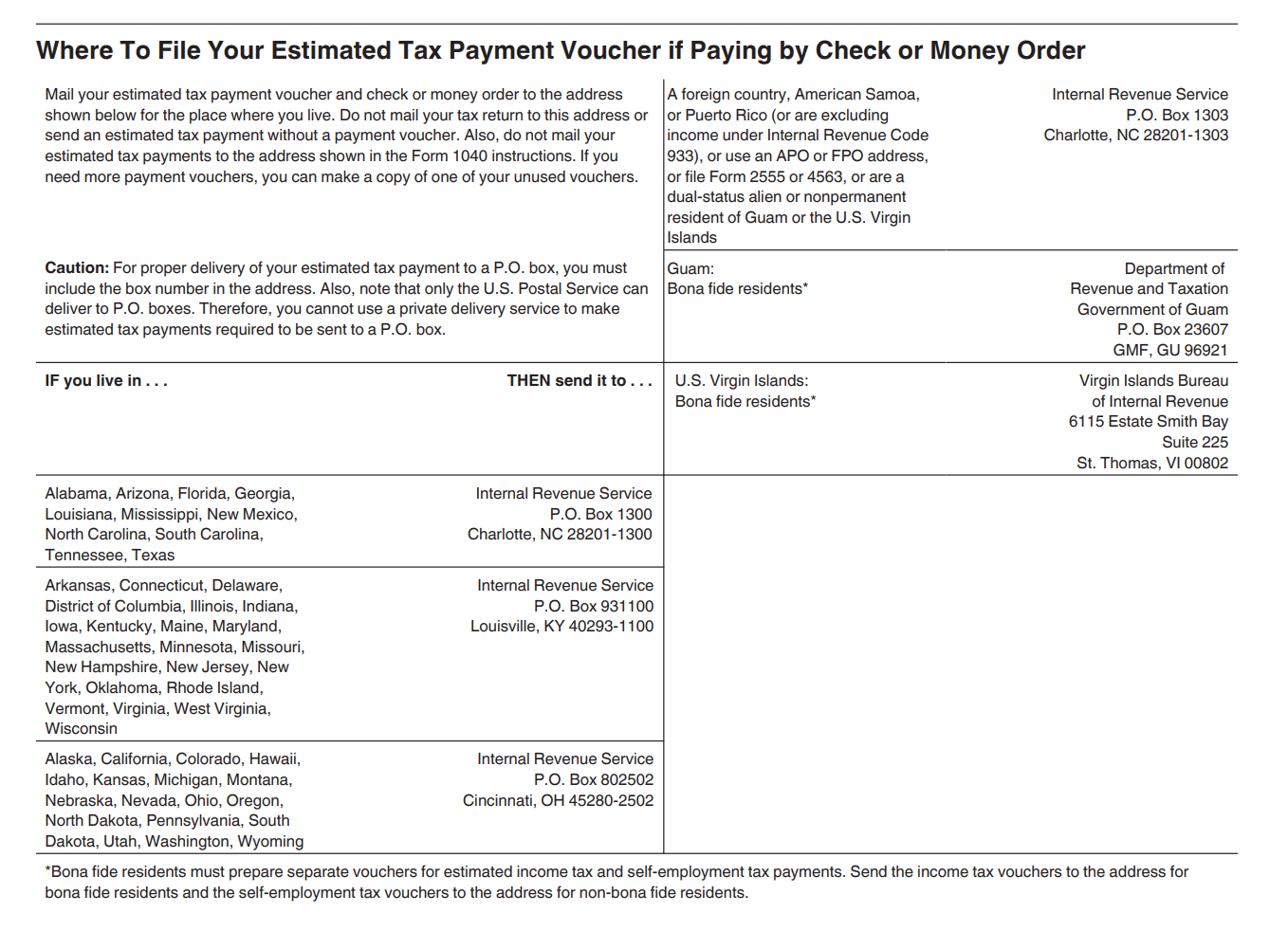
To ensure your payment reaches the correct destination, use the following general guidelines (always double-check the current year’s Form 1040-ES for the exact P.O. Box):
-
Internal Revenue Service, P.O. Box 1300, Charlotte, NC 28201-1300: Commonly used for residents of Alabama, Arkansas, Florida, Georgia, Louisiana, Mississippi, North Carolina, Oklahoma, South Carolina, Tennessee, and Texas.
-
Internal Revenue Service, P.O. Box 510000, San Francisco, CA 94151-5100: Frequently the destination for residents of Alaska, Arizona, California, Colorado, Hawaii, Idaho, Nevada, New Mexico, Oregon, Utah, Washington, and Wyoming.
-
Internal Revenue Service, P.O. Box 931100, Louisville, KY 40293-1100: Often serves Connecticut, Delaware, District of Columbia, Maine, Maryland, Massachusetts, New Hampshire, New Jersey, New York, Pennsylvania, Rhode Island, Vermont, Virginia, and West Virginia.
-
Internal Revenue Service, P.O. Box 802502, Cincinnati, OH 45280-2502: Usually designated for Illinois, Indiana, Iowa, Kansas, Kentucky, Michigan, Minnesota, Missouri, Montana, Nebraska, North Dakota, Ohio, South Dakota, and Wisconsin.
Crucial Deadlines and Timing for Paper Filings

Mailing your payment isn’t just about finding the right address; it’s about hitting the deadline. The IRS divides the year into four payment periods, and the deadlines often fall on the 15th of the month following the end of the period.
The Quarterly Schedule
The standard deadlines for estimated tax payments are:
-
First Period (Jan 1 – March 31): Payment due April 15.
-
Second Period (April 1 – May 31): Payment due June 15.
-
Third Period (June 1 – Aug 31): Payment due September 15.
-
Fourth Period (Sept 1 – Dec 31): Payment due January 15 of the following year.
If the 15th falls on a Saturday, Sunday, or legal holiday, the deadline is pushed to the next business day.
The Postmark Rule
One of the most important concepts for those mailing their taxes is the “postmark rule.” The IRS considers a payment to be made on time if the envelope is properly addressed, has enough postage, and is postmarked by the U.S. Postal Service by the due date. This provides a safety net for taxpayers who might be worried about mail delays. However, it is highly recommended to use certified mail with a return receipt requested. This provides you with physical proof of when the payment was sent and when it was received, which is invaluable if a dispute ever arises regarding late payment penalties.
Best Practices for Success: Calculation and Penalty Prevention
Mailing the check is the final step in a much larger financial strategy. To ensure you are mailing the correct amount and avoiding IRS scrutiny, you must employ sound accounting practices throughout the year.
The Safe Harbor Rule
One of the most effective ways to avoid underpayment penalties is to utilize the “Safe Harbor” rule. The IRS generally will not penalize you if you pay at least 90% of the tax you owe for the current year, or 100% of the tax shown on your return for the prior year, whichever is smaller. For high-income earners (those with an adjusted gross income over $150,000), the prior-year requirement jumps to 110%. By mailing 25% of this “safe harbor” amount each quarter, you protect yourself even if your income fluctuates significantly.
Managing Cash Flow
For the self-employed, the biggest challenge of estimated taxes is liquidity. It is a best practice to maintain a separate high-yield savings account dedicated solely to taxes. By setting aside 25% to 30% of every payment received from clients, you ensure that when the quarterly deadline arrives, the funds are available to be mailed without disrupting your business operations or personal budget.
Accuracy in Documentation
When mailing your payment, ensure your check or money order is made out to “United States Treasury.” Do not use “IRS.” On the memo line of the check, clearly write:
-
Your Social Security Number or Employer Identification Number (EIN).
-
The tax year (e.g., “2024”).
-
The form number and quarter (e.g., “Form 1040-ES, Q3”).
This level of detail ensures that even if the voucher becomes separated from the check during processing, the IRS can still accurately credit your account.
Beyond Snail Mail: Modern Alternatives for Tax Compliance
While mailing a payment is a valid and often preferred method for those who value physical documentation, it is worth noting the alternatives that the IRS has introduced to streamline the process. Understanding these can help you decide if mailing is truly the best option for your specific workflow.
IRS Direct Pay
Direct Pay allows individuals to pay their estimated taxes directly from a checking or savings account at no cost. You receive an immediate confirmation number, which serves as a digital equivalent to a certified mail receipt. This is often the fastest way to handle a last-minute payment if you realize you’ve missed the post office hours on a deadline day.
EFTPS (Electronic Federal Tax Payment System)
For small business owners who want more control, the EFTPS is a free service provided by the Department of the Treasury. It allows you to schedule payments in advance, which is an excellent tool for financial planning. You can set up all four quarterly payments at the beginning of the year, ensuring you never forget a deadline.
The Hybrid Approach
Many taxpayers choose to use digital tools for calculation and tracking while still mailing physical checks for their own record-keeping purposes. Regardless of the method chosen, the goal remains the same: consistent, accurate, and timely contributions to your federal tax liability.
By mastering the “where” and “how” of mailing estimated tax payments, you transform a potentially stressful administrative task into a routine part of your professional financial life. Proper planning, adherence to regional mailing guidelines, and an understanding of safe harbor rules will ensure that you remain in good standing with the IRS while maintaining the financial health of your household or business.
aViewFromTheCave is a participant in the Amazon Services LLC Associates Program, an affiliate advertising program designed to provide a means for sites to earn advertising fees by advertising and linking to Amazon.com. Amazon, the Amazon logo, AmazonSupply, and the AmazonSupply logo are trademarks of Amazon.com, Inc. or its affiliates. As an Amazon Associate we earn affiliate commissions from qualifying purchases.