
For the modern entrepreneur, freelancer, or gig economy participant, the transition from being a traditional W-2 employee to a self-employed professional brings a newfound sense of freedom. However, that freedom comes with a significant administrative shift: the responsibility of managing your own tax withholdings. In the United States, the tax system operates on a “pay-as-you-go” basis. While traditional employers handle this by deducting taxes from every paycheck, the self-employed must act as their own payroll department. This necessitates making quarterly estimated tax payments to the Internal Revenue Service (IRS).
The digital age has significantly streamlined this process. Gone are the days of mailing paper checks and hoping they arrive at the correct processing center. Today, paying your quarterly federal taxes online is not only the most efficient method but also the most secure. Mastering these digital tools is a critical component of professional financial management.

The Financial Framework of Quarterly Estimated Taxes
Before diving into the technical “how-to,” it is essential to understand the “why” and the “who.” Quarterly taxes are not a separate tax; they are simply a method of paying your income tax and self-employment tax (Social Security and Medicare) throughout the year as you earn income.
Who is Required to Pay?
Generally, you must make estimated tax payments if you expect to owe at least $1,000 in taxes for the current year after subtracting your withholding and credits. This typically applies to:
-
Sole proprietors and independent contractors.
-
Partners in a partnership.
-
S corporation shareholders.
-
Individuals with significant “unearned” income, such as interest, dividends, capital gains, or alimony.
If you are both a W-2 employee and a side-hustler, you might avoid quarterly payments by asking your employer to withhold more from your regular paycheck. However, for those whose primary income is derived from business activities, the online quarterly payment system is an unavoidable reality.
The Consequences of Non-Compliance
The IRS enforces these deadlines strictly. Failing to pay enough tax throughout the year—or failing to pay on time—can result in an underpayment penalty. This penalty is calculated based on the amount of the underpayment and the duration of the delay. Even if you are due a refund when you file your annual return, you can still be penalized for not paying enough during the specific quarter the income was earned. Transitioning to an online payment schedule is the most effective way to mitigate this risk, as digital payments offer immediate confirmation and a clear audit trail.
Navigating the Online Payment Landscape
The IRS has invested heavily in its digital infrastructure to encourage electronic filing and payment. There are three primary gateways for paying federal taxes online, each suited to different types of taxpayers and business structures.
IRS Direct Pay: The Gold Standard for Individuals
For sole proprietors and individual freelancers, IRS Direct Pay is the most straightforward tool. It allows you to pay directly from your checking or savings account without any processing fees.
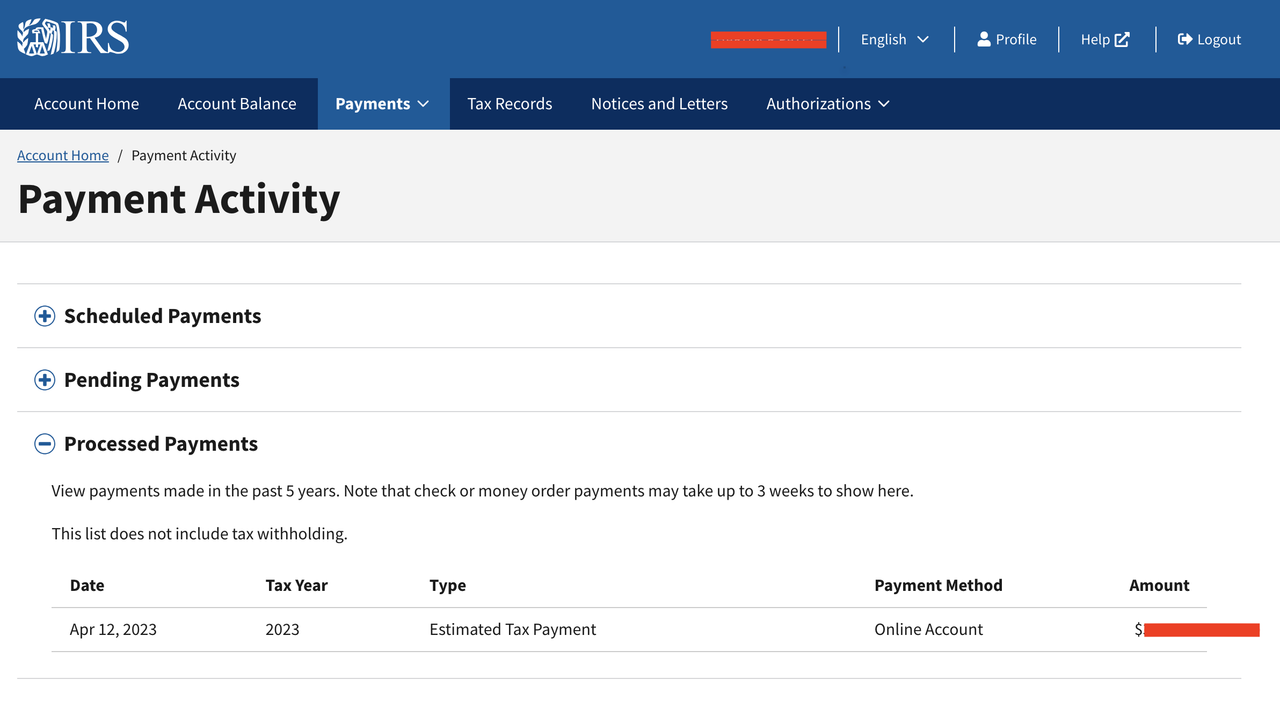
One of the greatest advantages of Direct Pay is that it does not require a formal registration process. You verify your identity using information from a prior year’s tax return. Once verified, you can select “Estimated Tax” as your reason for payment and apply it to the 1040-ES form. The system provides an immediate confirmation number, which should be saved digitally or printed for your financial records.
EFTPS: The Professional Choice for Scalable Businesses
The Electronic Federal Tax Payment System (EFTPS) is a free service provided by the U.S. Department of the Treasury. While Direct Pay is convenient for one-off transactions, EFTPS is designed for those who want a more robust management system.
EFTPS requires a formal enrollment process, which includes receiving a PIN via physical mail for security purposes. Once set up, it allows you to:
-
Schedule payments up to 365 days in advance.
-
View a comprehensive history of all payments made over the last 16 months.
-
Manage payments for both personal and corporate tax IDs (EINs).
For business owners who want to automate their tax strategy, EFTPS is superior because it allows for “set it and forget it” scheduling, ensuring you never miss a deadline due to a busy work schedule.
Credit/Debit Card and Digital Wallet Options
The IRS utilizes third-party payment processors to handle credit and debit card transactions, as well as payments via PayPal and Venmo. While this offers convenience and the potential to earn credit card rewards, it comes with a caveat: processing fees.
These fees are typically a flat rate for debit cards and a percentage (usually between 1.85% and 2%) for credit cards. From a financial management perspective, paying via credit card only makes sense if the value of your rewards or the necessity of short-term cash flow outweighs the processing fee. For most high-earning professionals, Direct Pay or EFTPS remains the more cost-effective choice.
Strategic Calculation of Your Quarterly Liability
Paying online is the mechanical part of the process; the strategic part is determining how much to pay. Overpaying ties up capital that could be invested elsewhere, while underpaying leads to penalties.
The Safe Harbor Rule
To avoid penalties, the IRS provides “Safe Harbor” guidelines. Generally, you will not face an underpayment penalty if you pay at least:
-
90% of the tax you owe for the current year, or
-
100% of the tax shown on your return for the prior year (110% if your adjusted gross income was more than $150,000).
The second option—paying 100% or 110% of the prior year’s tax—is often the safest and simplest strategy for business owners with fluctuating incomes. By dividing last year’s total tax liability by four and paying that amount each quarter online, you protect yourself from penalties even if your income spikes significantly in the current year.
Utilizing Modern Financial Tools
To move beyond basic estimates, many professionals use accounting software such as QuickBooks, FreshBooks, or Xero. These platforms integrate with your bank accounts to track income and expenses in real-time, providing a running estimate of what you owe.
When you combine these AI-driven accounting tools with the IRS’s online payment portals, you create a seamless financial workflow. You can calculate your liability in your accounting software, then immediately log into Direct Pay or EFTPS to execute the transfer, ensuring your books and your tax balance are always in sync.
Deadlines and Cash Flow Management
Quarterly taxes are not paid at the end of every three months; the IRS schedule is slightly irregular. The standard deadlines are:
-
Q1 (Jan 1 – March 31): Due April 15.
-
Q2 (April 1 – May 31): Due June 15.
-
Q3 (June 1 – Aug 31): Due September 15.
-
Q4 (Sept 1 – Dec 31): Due January 15 of the following year.
Integrating Tax Reserves into Your Business Strategy
A common mistake for those new to online tax payments is failing to set aside the cash throughout the quarter. To manage this, many successful entrepreneurs use “tax “buckets” or separate High-Yield Savings Accounts (HYSA).
By diverting 25% to 30% of every incoming payment into a dedicated tax savings account, you ensure that the funds are available when the quarterly deadline approaches. Furthermore, by keeping this money in an HYSA until the day of the online payment, you earn interest on the government’s money—a small but effective way to optimize your business cash flow.
Common Pitfalls in Online Tax Payments
Even with the best tools, errors can occur. Being aware of these common mistakes can save you hours of administrative headaches later.
Applying Payment to the Wrong Tax Year
When using IRS Direct Pay, you must select the correct tax year. If you are making a payment in January for the fourth quarter of the previous year, ensure you select the previous year in the dropdown menu. Applying a payment to the wrong year can trigger an automated underpayment notice for the correct year, requiring a lengthy phone call to the IRS to resolve.
Mixing Business and Personal Payments
If your business is an LLC taxed as a S-corp or a C-corp, payments are often handled differently than those for a sole proprietorship. Always ensure you are using the correct identification number (SSN vs. EIN) and the correct portal. For individuals and most single-member LLCs, the SSN is the primary identifier for quarterly estimated payments.
Forgetting State Requirements
While this guide focuses on federal taxes, most states also require quarterly estimated payments. Many state tax departments have modeled their online portals after the IRS. When you schedule your federal payment online, it is a best practice to immediately log into your state’s tax portal and handle that liability simultaneously.

Conclusion: The Professional Path Forward
Transitioning to an online payment system for quarterly taxes is more than just a convenience; it is a hallmark of a professional business operation. By utilizing tools like IRS Direct Pay or EFTPS, adhering to Safe Harbor rules, and leveraging accounting software to predict liabilities, you remove the stress and ambiguity of tax season. This proactive approach ensures that you remain in good standing with the IRS while maintaining the clear financial records necessary to scale your business and build long-term wealth.
aViewFromTheCave is a participant in the Amazon Services LLC Associates Program, an affiliate advertising program designed to provide a means for sites to earn advertising fees by advertising and linking to Amazon.com. Amazon, the Amazon logo, AmazonSupply, and the AmazonSupply logo are trademarks of Amazon.com, Inc. or its affiliates. As an Amazon Associate we earn affiliate commissions from qualifying purchases.