
Navigating the American tax system is a fundamental component of financial literacy, especially for those who fall outside the traditional W-2 employment model. For freelancers, small business owners, investors, and contractors, the responsibility of tax withholding shifts from an employer to the individual. This is where estimated tax payments come into play. Failure to manage these quarterly obligations can result in significant penalties and an overwhelming lump-sum bill come April. Fortunately, the Internal Revenue Service (IRS) has modernized its infrastructure, allowing taxpayers to fulfill these obligations entirely online. This guide explores the strategic importance of estimated taxes and provides a comprehensive walkthrough of the digital tools available to manage them effectively.

Understanding the Requirement: Who Must Pay Estimated Taxes?
The United States operates on a “pay-as-you-go” tax system. This means that income tax must be paid as you earn or receive income during the year, rather than in one single payment at the end of the fiscal cycle. While traditional employees have taxes withheld from every paycheck, others must manually calculate and submit their share to the federal government.
The Self-Employed and Gig Economy Workers
The rise of the “1099 economy” has brought millions of individuals into the world of estimated taxes. If you are a sole proprietor, a partner in a business, or an independent contractor, you generally have to make estimated tax payments if you expect to owe $1,000 or more when your return is filed. This applies to side hustles just as much as full-time entrepreneurial ventures. Digital platforms like Uber, Etsy, and Upwork do not typically withhold taxes, making the online payment portal your most essential financial tool.
Investors and Dividend Earners
It is a common misconception that estimated taxes only apply to earned labor income. If you receive substantial income from interest, dividends, capital gains, or rental properties, you may be required to pay quarterly. For high-net-worth individuals, these non-wage income streams can quickly push their tax liability beyond the threshold that triggers mandatory estimated payments.
The Underpayment Penalty and Safe Harbor Rules
The IRS incentivizes timely payments through the underpayment penalty. However, the “Safe Harbor” rules provide a roadmap for avoiding these fees. Generally, you will not face a penalty if you pay at least 90% of the tax for the current year or 100% of the tax shown on your return for the prior year, whichever is smaller. For those whose adjusted gross income exceeds $150,000, the prior-year requirement increases to 110%. Understanding these benchmarks is the first step in a professional financial strategy, ensuring that you keep more of your money while remaining compliant.
Choosing the Right Digital Payment Method
The IRS offers several distinct online platforms for submitting estimated payments. Choosing the right one depends on your specific needs for speed, record-keeping, and the nature of your business entity.
IRS Direct Pay: The Simplest Solution for Individuals
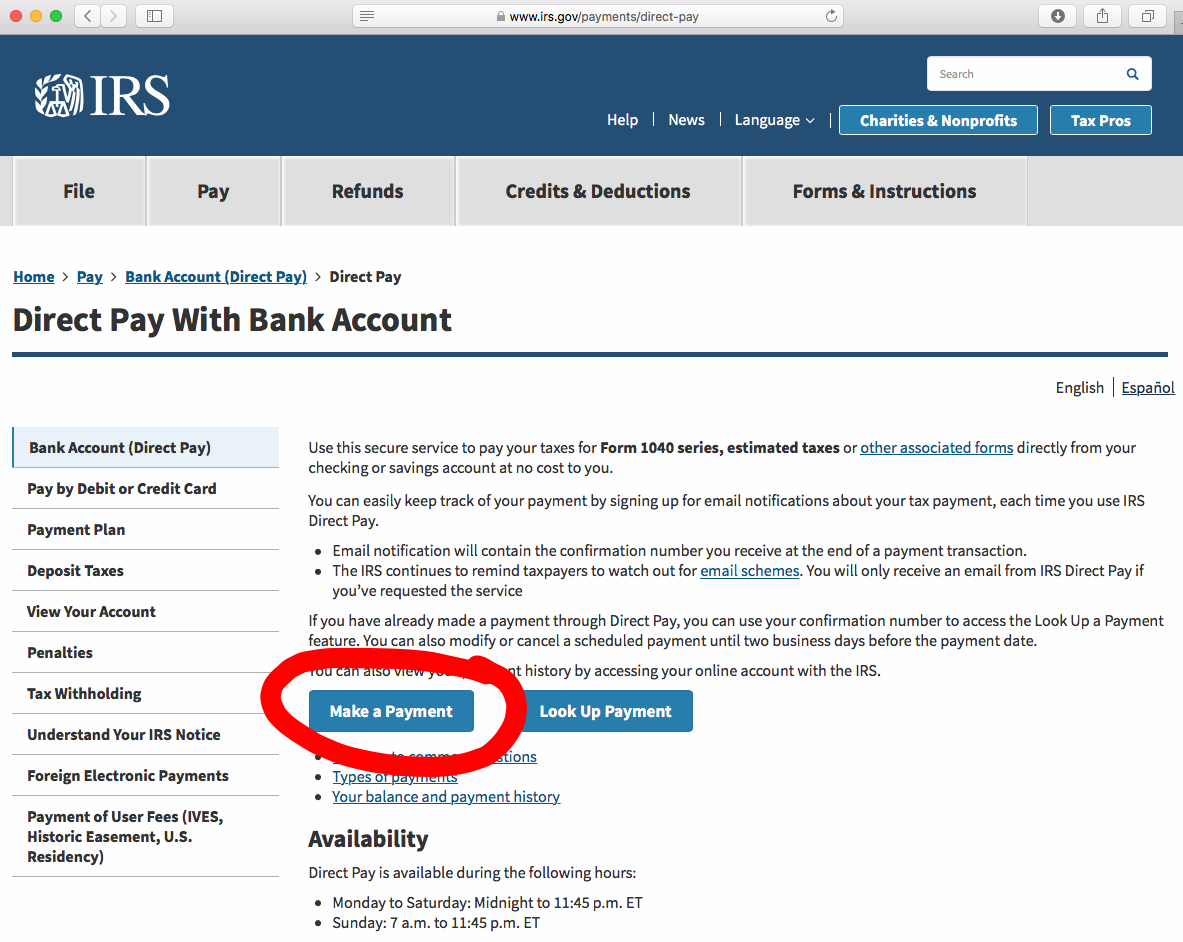
For most individual taxpayers and sole proprietors, IRS Direct Pay is the gold standard for convenience. This service allows you to pay your taxes directly from your checking or savings account without any registration or login requirements. It is a one-time transaction model that is free to use.
The primary advantage of Direct Pay is immediacy. You receive an instant confirmation number once the transaction is authorized, which is vital for audit trails. However, because it does not require an account, you must verify your identity each time using information from a previously filed tax return (typically the last five years).
IRS Online Account: A Holistic View
For those who prefer a more integrated approach to their personal finances, the IRS Online Account is the superior choice. By creating a secure account through ID.me, you can view your total balance owed, see your payment history, and access tax records.
When you make a payment through your Online Account, the system already knows who you are, eliminating the need for repetitive identity verification. This is highly recommended for individuals who want to track their progress toward their annual tax goals and ensure that every quarterly payment has been properly applied to the correct tax year.
EFTPS: The Gold Standard for Businesses
The Electronic Federal Tax Payment System (EFTPS) is a robust service provided by the U.S. Department of the Treasury. While it is available to individuals, it is primarily designed for businesses and those who have complex tax requirements.
EFTPS requires a formal enrollment process, which includes receiving a PIN via physical mail. Once set up, however, it offers unparalleled features, such as the ability to schedule payments up to 365 days in advance and a 16-month history of all payments made. For entrepreneurs who want to “set it and forget it” at the beginning of the year, EFTPS is the most reliable financial tool.
A Step-by-Step Guide to Using IRS Direct Pay
Since IRS Direct Pay is the most common method for estimated payments, understanding its workflow is essential for digital financial management.
Selecting the Reason for Payment
Upon reaching the Direct Pay portal, you will be prompted to select the “Reason for Payment.” For quarterly estimated taxes, you must select “Estimated Tax.” It is critical to ensure that the “Apply Payment To” section correctly reflects Form 1040-ES and that the “Tax Period for Payment” is set to the current calendar year. Errors in this section can lead to the IRS applying your funds to the wrong year, which may trigger an automated underpayment notice for the current period.
Verifying Your Identity
The IRS uses “Tax Year for Verification” to pull your records and confirm your identity. You will need to provide your name, Social Security Number, and filing status as it appeared on a specific prior year’s return. This step serves as a digital signature, ensuring that the payment is credited to the correct taxpayer.
Entering Payment Information and Confirmation
You will enter your bank’s routing number and your account number. Unlike credit card payments, Direct Pay does not involve processing fees, making it the most cost-effective way to transfer funds. After reviewing your details, you will receive a confirmation number. This is a critical financial document; you should save it as a PDF or print it for your permanent records. In the event of a dispute, this confirmation is your proof of timely submission.
Optimizing Your Cash Flow for Quarterly Payments
Making payments online is a technical task, but managing the money for those payments is a strategic one. High-performing business owners and investors treat their tax liability as a non-negotiable operational expense.
Syncing Payments with Business Cycles
The deadlines for estimated taxes—April 15, June 15, September 15, and January 15—do not always align with the natural flow of every business. For example, a seasonal business that generates 80% of its revenue in the summer may find the September payment particularly heavy. By using the “Annualized Income Installment Method” (Form 2210), you can align your payments with your actual income flow rather than paying in four equal installments. This protects your liquidity during slower months.
Utilizing High-Yield Savings Accounts for Tax Reserves
A professional financial habit is to divert a percentage of every check—typically 25% to 30%—into a dedicated high-yield savings account (HYSA). By holding your estimated tax funds in a high-yield account until the quarterly deadline, you can earn interest on the government’s money. For high earners, the interest accrued over a year can represent a significant “discount” on the total tax bill.
Digital Tools for Tracking Deductions
The amount you pay online is determined by your net income, not your gross. Utilizing digital accounting software like QuickBooks, FreshBooks, or specialized apps for the 1099 economy allows you to track deductible expenses in real-time. The more accurately you track your home office, travel, and equipment expenses, the lower your quarterly online payments will be, thereby increasing your monthly cash flow.
Record Keeping and Compliance in the Digital Age
The transition to online payments has simplified the paper trail, but it requires a different approach to organization.
Archiving Digital Receipts
In the event of an audit, the IRS expects clear documentation. Digital payment confirmations should be stored in a secure, encrypted cloud storage system. These receipts should be categorized by tax year and quarter. This not only aids in compliance but also provides your CPA or tax preparer with a clear “source of truth” when filing your annual return.
Deadlines and Timing
Online payments must be submitted by 8:00 PM Eastern Time on the due date to be considered timely for that day. However, it is a best practice to initiate payments at least 24 to 48 hours in advance to account for any technical glitches or banking delays. If a deadline falls on a weekend or a legal holiday, the payment is due on the next business day.
Leveraging Third-Party Processors
While Direct Pay and EFTPS are free, the IRS also authorizes several third-party processors to accept payments via debit or credit cards. These services—such as PayUSAtax or ACI Payments—charge a processing fee, usually ranging from 1.8% to 2.0%. While this is generally less efficient than a direct bank transfer, it can be a strategic move for individuals who want to earn credit card rewards or who need a short-term “float” to manage a temporary cash flow gap.
Mastering the process of making estimated tax payments online is more than a clerical duty; it is an essential part of modern wealth management. By utilizing the digital tools provided by the IRS and integrating them into a broader financial strategy, taxpayers can avoid penalties, maximize their interest-earning potential, and maintain the peace of mind that comes with total fiscal compliance.
aViewFromTheCave is a participant in the Amazon Services LLC Associates Program, an affiliate advertising program designed to provide a means for sites to earn advertising fees by advertising and linking to Amazon.com. Amazon, the Amazon logo, AmazonSupply, and the AmazonSupply logo are trademarks of Amazon.com, Inc. or its affiliates. As an Amazon Associate we earn affiliate commissions from qualifying purchases.