
In the high-stakes world of semiconductor manufacturing and artificial intelligence, headcount is more than just a HR metric; it is a vital indicator of operational efficiency, scalability, and investment potential. As NVIDIA has ascended from a specialized graphics card manufacturer to a foundational pillar of the global AI economy, its workforce has undergone a strategic transformation. Investors and market analysts frequently look at the question of how many employees NVIDIA has not just to understand the company’s size, but to measure its “revenue per employee”—a key metric that separates industry leaders from those bogged down by corporate bloat.
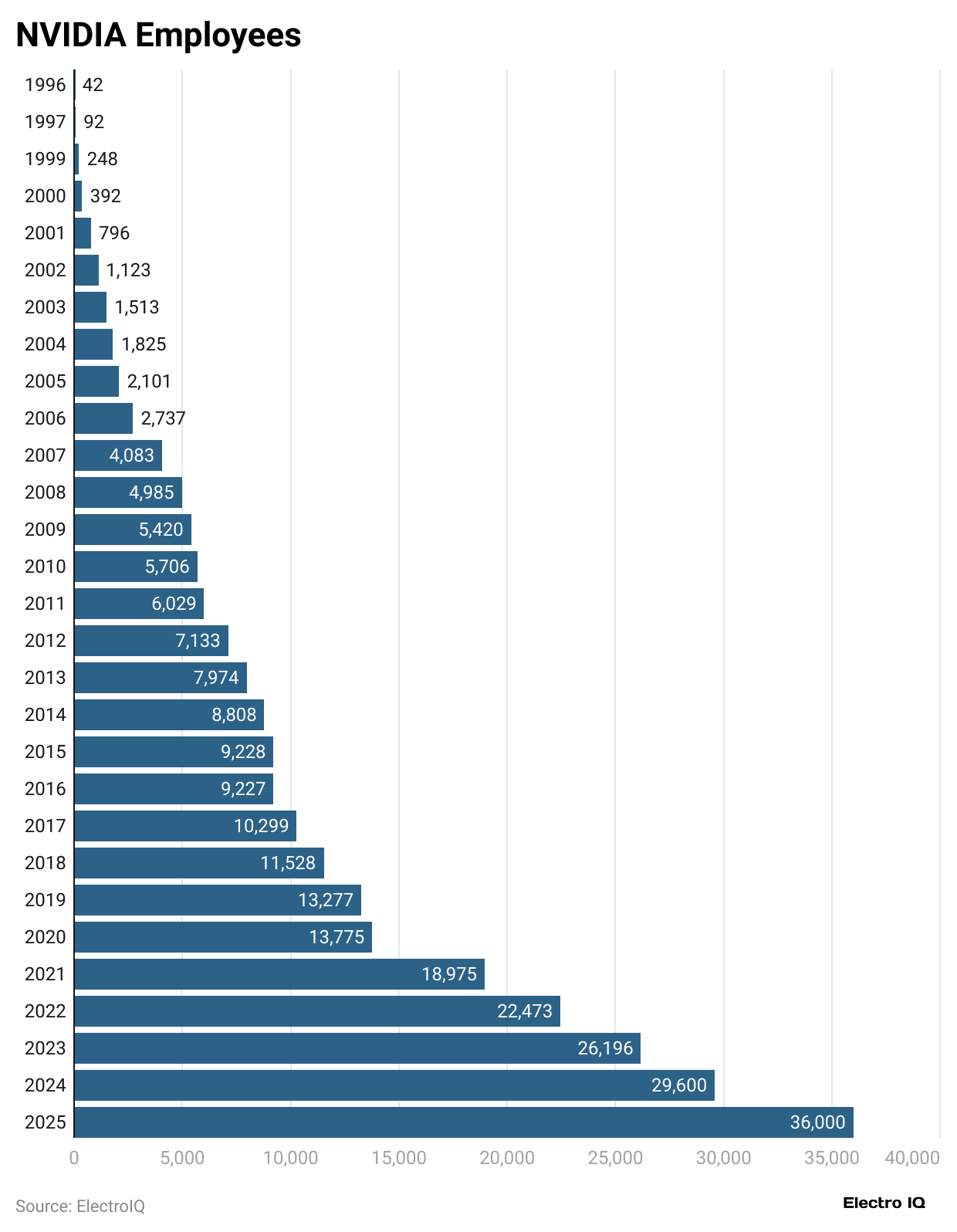
As of the most recent fiscal reports for 2024, NVIDIA employs approximately 29,600 people globally. While this number is significantly smaller than the workforce of legacy tech giants like Microsoft, Amazon, or even Intel, the financial output associated with these individuals is nothing short of historic. Understanding the structure and growth of this workforce provides a clear window into how NVIDIA maintains its dominance in a competitive, capital-intensive market.
The Exponential Growth of NVIDIA’s Workforce: A Financial Trajectory
For much of its thirty-year history, NVIDIA operated as a relatively lean organization focused on the niche markets of PC gaming and professional visualization. However, the pivot toward data centers and generative AI necessitated a rapid expansion of its talent pool. A decade ago, NVIDIA’s headcount hovered under 10,000. The acceleration seen in the last five years mirrors the company’s stock price trajectory, reflecting a deliberate effort to capture the burgeoning AI market.
Historical Headcount Trends and Scaling
In the fiscal year 2021, NVIDIA reported roughly 18,100 employees. By 2022, that number grew to 22,400, and by the close of fiscal 2024, it reached nearly 30,000. This represents a compound annual growth rate (CAGR) that signals aggressive reinvestment of profits back into human capital. Unlike many of its “Big Tech” peers that underwent massive layoffs in 2023 and 2024 following pandemic-era over-hiring, NVIDIA has remained remarkably stable. This stability is a testament to its disciplined hiring practices and its focus on specialized engineering roles that are difficult to replace.
Strategic Acquisitions and Talent Integration
The growth in employee count is not solely organic. NVIDIA has utilized its massive cash reserves to acquire companies that bring both intellectual property and specialized engineering teams. The $6.9 billion acquisition of Mellanox Technologies in 2020 was a watershed moment, adding thousands of networking experts to the roster. This move was critical because it allowed NVIDIA to evolve from a chipmaker into a “full-stack” data center company. For investors, these headcount jumps are viewed as value-adds rather than overhead increases, as they directly contribute to the company’s ability to sell integrated systems rather than just individual components.
Workforce Efficiency and Revenue Per Employee
When evaluating a company’s financial health, the sheer number of employees is less important than the productivity of those employees. In this regard, NVIDIA is an outlier in the corporate world. Revenue per employee is a primary metric used to assess how well a company leverages its human capital.
Benchmarking Against Big Tech Rivals
To put NVIDIA’s 29,600 employees into perspective, one must look at its competitors. Intel, for instance, employs over 120,000 people, yet its market capitalization is a fraction of NVIDIA’s. Apple and Microsoft employ roughly 160,000 and 220,000 people, respectively. While these companies have much larger workforces, NVIDIA’s revenue generation per individual contributor is staggering.
In fiscal year 2024, NVIDIA reported annual revenue of approximately $60.9 billion. With a headcount of roughly 29,600, NVIDIA generates more than $2 million in revenue per employee. This level of efficiency is nearly unparalleled in the hardware sector and rivals the leanest software-as-a-service (SaaS) companies. For investors, this suggests a highly optimized business model where a relatively small, elite group of engineers produces high-margin products that the global market is desperate to acquire.

Profitability Metrics: The Value of the Individual Contributor
Beyond gross revenue, the net income per employee at NVIDIA reveals a highly profitable operation. Because NVIDIA operates on a fabless model—meaning it designs its chips but outsources the actual manufacturing to companies like TSMC—it does not need the massive labor force required to run semiconductor fabrication plants. This “capital-light” human resource strategy allows NVIDIA to focus its payroll on high-value research and development (R&D) rather than low-margin manufacturing labor. This lean structure is a primary reason why NVIDIA’s profit margins have remained in the stratosphere even as it scales.
Global Footprint and Labor Costs
NVIDIA’s workforce is distributed across more than 30 countries, with significant hubs in the United States, India, Israel, and Taiwan. This global distribution is a calculated business strategy designed to tap into localized talent pools and manage labor costs effectively while maintaining 24/7 development cycles.
Strategic Locations: Where NVIDIA Invests Its Human Capital
The United States remains the primary hub for NVIDIA’s executive leadership and core R&D, particularly at its headquarters in Santa Clara, California. However, India has become a crucial pillar for the company’s engineering efforts. With thousands of employees across sites in Bangalore, Pune, and Hyderabad, NVIDIA leverages India’s vast pool of VLSI (Very Large Scale Integration) and software engineers. Similarly, the acquisition of Mellanox gave NVIDIA a massive footprint in Israel, which has become its second-largest engineering hub outside the US. This geographic diversity allows NVIDIA to hedge against regional labor shortages and maintain a pipeline of world-class talent in the competitive fields of AI and networking.
Compensation and R&D Investment
Maintaining a workforce of 30,000 elite engineers is an expensive endeavor. NVIDIA consistently ranks among the top-paying companies in the tech industry. For the business-minded observer, this high compensation is a necessary reinvestment. Total compensation at NVIDIA often includes a significant portion of Restricted Stock Units (RSUs). As the company’s stock price has surged, these equity packages have served as a powerful retention tool.
From a financial statement perspective, NVIDIA’s R&D expenditure is one of its largest line items. In 2024, the company spent billions on R&D, a significant portion of which is dedicated to the salaries and benefits of its employees. This is not viewed by the market as a “cost” but as “capital expenditure” on the company’s future. The ability to attract and retain the world’s best AI researchers is NVIDIA’s ultimate “moat,” protecting it from competitors who may have similar capital but lack the same concentration of human expertise.
The Future of NVIDIA’s Talent Acquisition and Market Value
As NVIDIA looks toward a future dominated by autonomous machines, healthcare AI, and the “Omniverse,” the question of how many employees it needs will continue to evolve. However, the company’s trajectory suggests it will not follow the path of legacy conglomerates that grow their headcount linearly with revenue.
Sustaining Innovation in a Tight Labor Market
The war for AI talent is currently the most intense labor market in history. Companies like Google, Meta, and OpenAI are constantly vying for the same pool of specialized engineers that NVIDIA employs. NVIDIA’s advantage lies in its culture and its role as the “enabler” of the entire industry. Engineers want to work at NVIDIA because they are building the hardware that everyone else uses. For the company’s finance department, this “brand equity” in the labor market reduces recruitment costs and turnover rates, further enhancing operational efficiency.

Conclusion for Investors
When analyzing “how many employees at NVIDIA,” the answer is less about the number 29,600 and more about the multiplier effect those individuals have on the global economy. NVIDIA has mastered the art of scaling its financial impact without bloating its payroll. This lean, high-efficiency model is a primary driver of its trillion-dollar valuation.
As long as NVIDIA can maintain its high revenue-per-employee ratio and continue to integrate talent from strategic acquisitions, its workforce size will remain a source of strength rather than a liability. For the savvy investor or business analyst, NVIDIA’s headcount is a story of quality over quantity—a specialized elite force that has successfully positioned itself at the center of the greatest technological shift of the 21st century. The company’s ability to manage this growth while maintaining its culture of innovation will be the deciding factor in its continued financial dominance.
aViewFromTheCave is a participant in the Amazon Services LLC Associates Program, an affiliate advertising program designed to provide a means for sites to earn advertising fees by advertising and linking to Amazon.com. Amazon, the Amazon logo, AmazonSupply, and the AmazonSupply logo are trademarks of Amazon.com, Inc. or its affiliates. As an Amazon Associate we earn affiliate commissions from qualifying purchases.