
For many individuals and families, a vacation represents a significant annual capital expenditure. Among the various travel options available, the cruise industry offers a unique value proposition that combines transportation, lodging, and dining into a single, upfront cost. However, the sticker price of a 7-day cruise is rarely the final amount debited from your bank account. From a personal finance perspective, understanding the total cost of ownership for a cruise vacation requires a deep dive into base fares, ancillary fees, and the strategic timing of the purchase.

To accurately answer “how much is a 7-day cruise,” one must move beyond the marketing materials and analyze the financial variables that dictate the final invoice. This guide provides a comprehensive breakdown of the costs associated with a week-long voyage, offering a framework for budgeting and maximizing the return on your leisure investment.
Decoding the Base Fare: Where Your Money Goes First
The base fare is the most visible component of a cruise budget, but it is highly variable based on market demand, cabin inventory, and the specific brand’s market positioning. Typically, for a standard 7-day cruise on a mainstream line (such as Royal Caribbean, Carnival, or Norwegian Cruise Line), the base fare can range anywhere from $500 to $1,500 per person, based on double occupancy.
Cabin Category and Financial Trade-offs
The selection of your “stateroom” is the primary lever for controlling your initial outlay.
-
Interior Cabins: Often the entry point for budget-conscious travelers. These rooms lack windows and are the most cost-effective way to access the ship’s amenities. Financially, choosing an interior cabin can save $300 to $700 compared to a balcony, capital that can be reallocated toward excursions or high-yield savings.
-
Oceanview and Balcony Cabins: These represent the mid-tier. A balcony cabin is generally the “standard” for modern cruisers, usually commanding a 30% to 50% premium over interior rates.
-
Suites and Luxury Tiers: For those utilizing their travel budget for high-end experiences, suites can range from $3,000 to over $10,000 for a 7-day period. These often include “perks” that may offset other costs, such as included WiFi, laundry, and concierge services.
Market Positioning of Cruise Brands
Financial planning requires matching your budget to the correct brand tier.
-
Budget/Value Lines: Often priced between $70 and $100 per person, per day.
-
Premium Lines (Celebrity, Princess, Holland America): These cater to a demographic willing to pay $150 to $250 per day for refined service and fewer crowds.
-
Luxury Lines (Silversea, Regent Seven Seas): These can exceed $600 per day. While the initial cost is higher, they are often “all-inclusive,” which simplifies the budgeting process by eliminating the “nickel-and-diming” associated with mainstream lines.
The Secondary Ledger: Navigating Onboard Expenses and Hidden Fees
One of the most common financial pitfalls for cruisers is the “onboard account.” It is not uncommon for a traveler to spend an additional 50% to 100% of their base fare on miscellaneous services during the voyage.
Gratuities and Service Charges
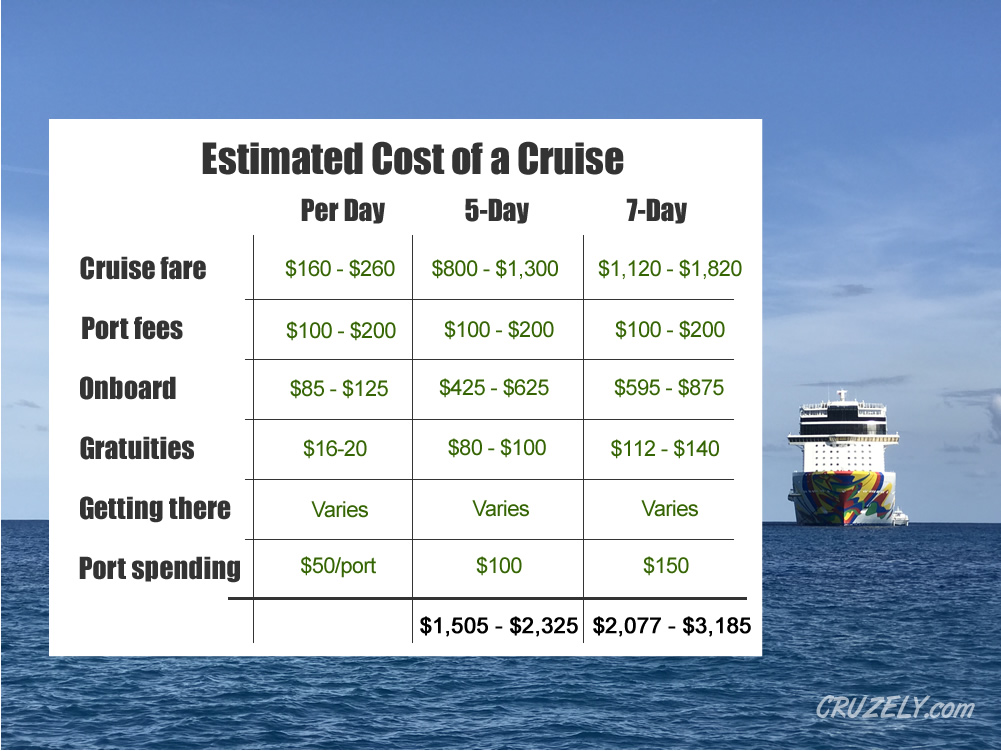
Most cruise lines automatically apply a daily gratuity fee to your account, usually ranging from $16 to $20 per person, per day. For a 7-day cruise for a couple, this adds roughly $224 to $280 to the final bill. From a financial management standpoint, these should be viewed as a fixed cost rather than a discretionary tip, and they are often best paid in advance to avoid a large charge on the final morning of the cruise.
Beverage Packages: A Cost-Benefit Analysis
The beverage package is one of the most debated financial decisions on a cruise. Most lines charge between $60 and $100 per day for an “unlimited” alcohol package.
-
The Math: If a single cocktail costs $14, a traveler must consume at least 5 to 7 drinks daily to break even.
-
The Risk: For light drinkers, paying for drinks a la carte is almost always more financially sound. However, the package offers “price certainty,” which some travelers value as a hedge against a fluctuating final bill.
Communication and Connectivity
In an era of remote work and digital connectivity, WiFi is often a necessary expense. Cruise ship internet is notoriously expensive, frequently costing $20 to $30 per day for a single device. When budgeting, consider this a utility cost. Some savvy travelers mitigate this by utilizing “port days” to find local cafes with free WiFi, thereby reducing their total digital spend.
External Financial Factors: Transportation, Insurance, and Contingencies
A 7-day cruise does not start and end at the gangway. To calculate the true cost, one must look at the peripheral expenses that facilitate the trip.
Pre-Cruise Logistics
Unless you live within driving distance of a cruise terminal, airfare is a mandatory line item. For a 7-day cruise, it is standard financial wisdom to arrive in the port city at least one day in advance to mitigate the risk of flight delays causing a missed departure. This necessitates a hotel stay (averaging $150–$300) and meal expenses. Failure to account for these “pre-trip” costs can result in a 20% budget overrun before the ship even leaves the dock.
Taxes and Port Fees
The price you see on a travel aggregator website often excludes government taxes and port fees. Depending on the itinerary (e.g., Alaska or the Mediterranean), these fees can add $150 to $400 per person. These are non-negotiable costs that the cruise line collects on behalf of local governments and port authorities.
Travel Insurance: Risk Management
From a personal finance perspective, travel insurance is a risk-mitigation tool. For a 7-day cruise costing several thousand dollars, a policy typically costs 5% to 10% of the total trip value. This protects your investment against unforeseen medical emergencies, trip cancellations, or lost luggage. Given the high cost of “medical debarkation” at sea, insurance is often a fiscally responsible “loss leader” in your budget.
Value Maximization: Strategic Booking and Reward Leveraging
To optimize the Return on Investment (ROI) of your travel dollars, the timing and method of your purchase are critical.
The “Wave Season” and Promotional Windows
The cruise industry has a peak booking period known as “Wave Season” (January through March). During this time, cruise lines offer their most aggressive incentives. While the base price might not always be lower, the “value-adds”—such as free WiFi, included gratuities, or onboard credit—can significantly lower the net cost of the 7-day experience.
Leveraging Loyalty and Credit Card Rewards
Many cruise enthusiasts utilize specific financial instruments to subsidize their travel. Co-branded cruise credit cards or high-value travel cards (like those from Chase, Amex, or Capital One) allow users to redeem points for cruise fares or statement credits. Additionally, owning shares in a cruise line’s parent company (e.g., Carnival Corp or Royal Caribbean Group) often entitles shareholders to onboard credits, effectively providing a “dividend” on their vacation spend.
Last-Minute vs. Early Booking
Cruising follows a different pricing logic than hotels. Often, the lowest prices are found 12 to 18 months in advance. As the ship fills, prices generally rise. However, for those with flexible schedules, “last-minute” bookings (within 90 days of sailing) can yield massive discounts as the cruise lines attempt to sell off remaining inventory to ensure the ship sails at 100% capacity.

The Comprehensive Budget Template: Calculating Your Total Cost
To bring clarity to the question of “how much is a 7-day cruise,” let us look at a realistic financial breakdown for a mid-range, 7-day Caribbean cruise for two people.
-
Base Fare (Balcony Cabin): $2,200
-
Taxes and Port Fees: $400
-
Pre-Cruise Hotel & Parking/Uber: $350
-
Daily Gratuities ($18/day x 2 people x 7 days): $252
-
Basic WiFi Package: $140
-
Shore Excursions (2 excursions for two): $500
-
Specialty Dining/Casual Drinks: $300
-
Travel Insurance: $200
-
TOTAL ESTIMATED INVESTMENT: $4,342
In this scenario, the “advertised price” might have been $1,100 per person ($2,200 total), but the actual financial commitment is nearly double that amount.
By categorizing these expenses into “Fixed Costs” (Fare, Taxes, Gratuities) and “Variable Costs” (Drinks, Excursions, WiFi), a traveler can exercise better control over their cash flow. For those on a strict budget, the variable costs are the easiest to prune. For those seeking a seamless experience, prepaying for these items allows for a “zero-balance” checkout at the end of the voyage, ensuring that the vacation does not lead to a “financial hangover” in the following billing cycle.
In conclusion, a 7-day cruise is a complex financial product. While the base entry price is accessible, the true cost is determined by your choices in cabin category, onboard spending, and risk management. By approaching the cruise as a line-item budget rather than a single purchase, you can ensure that your 7-day voyage provides maximum enjoyment without compromising your long-term financial health.
aViewFromTheCave is a participant in the Amazon Services LLC Associates Program, an affiliate advertising program designed to provide a means for sites to earn advertising fees by advertising and linking to Amazon.com. Amazon, the Amazon logo, AmazonSupply, and the AmazonSupply logo are trademarks of Amazon.com, Inc. or its affiliates. As an Amazon Associate we earn affiliate commissions from qualifying purchases.