
The Nasdaq is often used as a shorthand for the health of the modern economy, particularly the sectors driven by innovation and high growth. However, for many investors, the term “Nasdaq” is used interchangeably to describe two very different things: a global electronic marketplace for buying and selling securities, and the prestigious indices that track those securities. Understanding what truly makes up the Nasdaq requires a deep dive into its unique weighting methodology, the specific sectors that dominate its performance, and the rigorous criteria a company must meet to earn a spot on its roster.
Unlike the Dow Jones Industrial Average, which is price-weighted and limited to 30 companies, or the S&P 500, which offers a broad cross-section of the U.S. economy, the Nasdaq is the spiritual home of the growth investor. It represents a concentrated bet on the future of technology, biotechnology, and consumer services. To understand its composition is to understand where capital is flowing in the 21st century.
The Distinction Between the Exchange and the Indices
Before dissecting the components, it is essential to distinguish between the Nasdaq Stock Market (the exchange) and the indices that people track on news tickers. The Nasdaq Stock Market is the physical and digital infrastructure where over 3,000 companies are listed. When people ask “what makes up the Nasdaq,” they are usually referring to one of two primary benchmarks: the Nasdaq Composite or the Nasdaq-100.
The Nasdaq Composite Index
The Nasdaq Composite is the broadest measure of the exchange. it includes nearly every stock listed on the Nasdaq Stock Market. Because it encompasses over 3,000 securities, it is a highly diversified reflection of the exchange’s overall health. It includes American companies as well as international firms that choose to list their American Depositary Receipts (ADRs) on the exchange. The Composite is heavily weighted toward the technology sector, but because it includes everything from small-cap biotech firms to massive conglomerates, it provides a “fever chart” for the speculative and growth-oriented parts of the financial markets.
The Nasdaq-100 Index
The Nasdaq-100 is a much more exclusive club. It consists of the 100 largest non-financial companies listed on the Nasdaq Stock Market. This index is the basis for some of the world’s most popular exchange-traded funds (ETFs), such as the Invesco QQQ. By excluding financial firms—such as commercial and investment banks—the Nasdaq-100 maintains a distinct focus on industrial, technology, retail, telecommunication, and healthcare companies. This exclusion is a defining characteristic; it removes the cyclical influence of interest rate spreads and banking regulations that often weigh down other major indices.
Sector Breakdown: A Concentration of Innovation
While many investors view the Nasdaq as a “tech index,” its actual composition is more nuanced. While technology is undeniably the largest slice of the pie, the index’s performance is also driven by significant holdings in consumer services and healthcare.
The Dominance of Technology
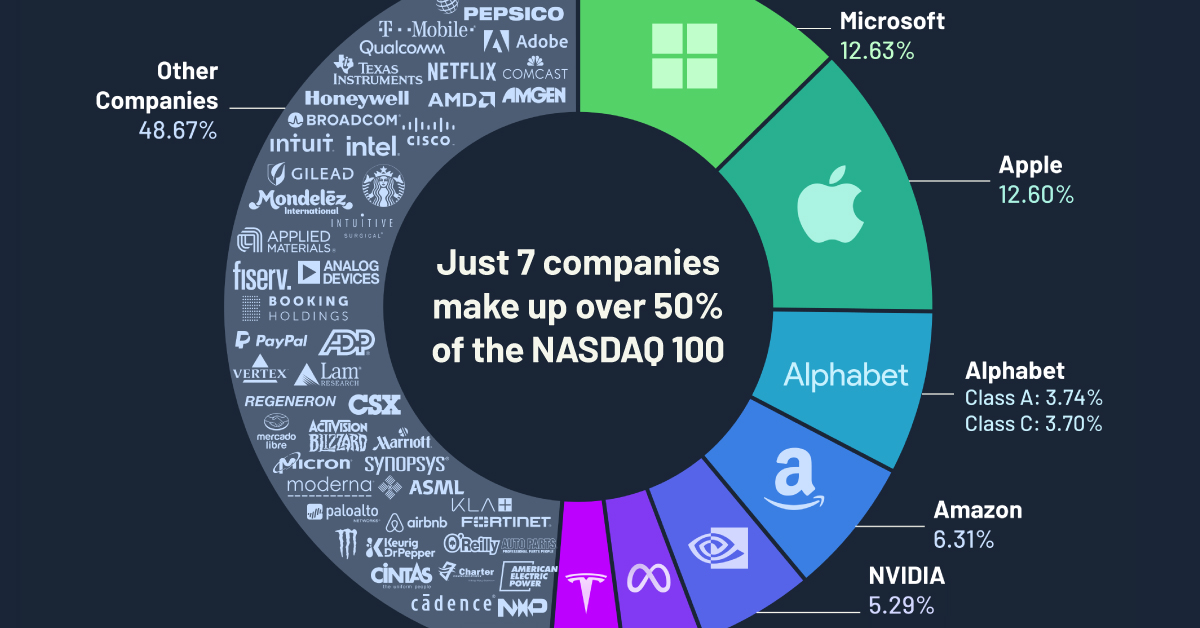
Technology typically accounts for more than 50% of the Nasdaq-100’s weight. This includes software developers, semiconductor manufacturers, hardware providers, and cloud computing giants. The presence of firms like Microsoft, Apple, and Nvidia defines the index’s trajectory. These companies are not just tech firms; they are the fundamental utility providers of the modern era, supplying the operating systems, chips, and devices that power global commerce.
Consumer Services and Discretionary Spending
The second-largest sector in the Nasdaq is usually Consumer Services, often hovering around 15% to 20%. This category is anchored by behemoths like Amazon and Tesla. These companies blur the lines between retail, automotive, and technology. Their inclusion highlights the Nasdaq’s role as a tracker of “disruptors”—companies that use technological advantages to upend traditional industries like brick-and-mortar retail or internal combustion engine manufacturing.
Healthcare and Biotechnology
The Nasdaq is the primary home for the biotechnology industry. From established giants like Amgen and Gilead Sciences to smaller firms researching gene therapies, the healthcare sector makes up a vital portion of the index (often around 6% to 10%). This gives the Nasdaq a unique profile compared to the S&P 500; it captures the high-risk, high-reward nature of pharmaceutical innovation and medical device development.
The Mechanics of Weighting: Why the Giants Lead the Way
What makes the Nasdaq particularly unique—and sometimes controversial—is its weighting methodology. Both the Composite and the Nasdaq-100 use a modified market-capitalization weighting system.

Market Capitalization Explained
In a basic market-cap-weighted index, a company’s influence is determined by its total market value (share price multiplied by the number of outstanding shares). If a company represents 10% of the total value of all companies in the index, a 1% move in that company’s stock price will have ten times the impact of a 1% move in a company that only represents 1% of the index. This means that the “Magnificent Seven”—the handful of mega-cap tech stocks—largely dictate whether the Nasdaq ends the day in the red or the green.
The “Modified” Approach and Special Rebalancing
To prevent a few individual stocks from becoming so large that they render the rest of the index irrelevant, the Nasdaq-100 utilizes a “modified” weighting system. There are specific rules regarding concentration. For instance, if the collective weight of the largest companies (those making up 4.5% or more of the index) exceeds 48%, the Nasdaq will perform a “Special Rebalance.”
This occurred famously in July 2023. At that time, companies like Microsoft, Apple, Nvidia, and Amazon had grown so significantly that their combined weight threatened the index’s diversification standards. The Nasdaq adjusted the weights downward for these giants and redistributed that weight among the smaller members of the 100. This mechanism ensures that while the giants still lead, the index remains a somewhat broader representation of its constituent base.
Eligibility and Inclusion: The High Bar for Entry
Not just any company can list on the Nasdaq, and even fewer make it into the flagship indices. The criteria for inclusion are designed to ensure liquidity, transparency, and institutional quality.
Listing Requirements
To be listed on the Nasdaq exchange, a company must meet stringent financial, liquidity, and corporate governance requirements. This includes maintaining a minimum share price (typically $4.00), having a minimum number of publicly traded shares (float), and meeting specific thresholds for annual income or total assets. Additionally, companies must have an independent audit committee and adhere to strict financial reporting standards.
Nasdaq-100 Specific Criteria
For a company to move from the general exchange into the Nasdaq-100, it must meet additional hurdles:
-
Listing Tier: It must be listed on the Nasdaq Global Select or Nasdaq Global Market tiers.
-
Liquidity: It must have an average daily trading volume of at least 200,000 shares, ensuring that investors can enter and exit positions without causing massive price swings.
-
Longevity: A company generally must have been listed for at least three months.
-
Non-Financial: As noted previously, it cannot be a “financial” company (banks, brokerage firms, etc.) as classified by the Industry Classification Benchmark (ICB).
The Role of the Nasdaq in a Modern Investment Portfolio
For the individual investor, understanding what makes up the Nasdaq is crucial for asset allocation. Because of its heavy concentration in growth stocks and its lack of financial exposure, the Nasdaq behaves differently than the broader market.
Growth vs. Value
The Nasdaq is the quintessential “Growth” index. The companies within it often reinvest their earnings into research and development rather than paying out high dividends. Consequently, the Nasdaq typically outperforms during periods of low interest rates and economic expansion, when investors are willing to pay a premium for future earnings. Conversely, it can experience higher volatility and sharper drawdowns during periods of rising interest rates, as the “present value” of those future earnings is discounted more heavily.
Volatility and Risk Profile
Because the Nasdaq is more concentrated in a few sectors than the S&P 500, it carries a higher standard deviation of returns. Investors who hold Nasdaq-tracking ETFs should be prepared for larger swings. However, over the last two decades, the “innovation premium” of the Nasdaq has historically provided higher total returns than more traditional, value-heavy indices, largely due to the explosive growth of the digital economy and the software revolution.
Strategic Allocation
Financial advisors often view the Nasdaq as a “satellite” holding or a way to gain targeted exposure to the “New Economy.” By understanding that the Nasdaq is essentially a basket of the world’s most successful non-financial, growth-oriented companies, an investor can better balance their portfolio against more defensive sectors like utilities or staples, which are better represented in other indices.
Conclusion
The Nasdaq is far more than just a list of stocks; it is a meticulously curated collection of the companies defining the future of global commerce. From its specialized “modified” market-cap weighting to its strict exclusion of financial firms, every aspect of its composition is designed to highlight innovation and growth. Whether you are looking at the 3,000-plus names in the Composite or the elite 100 in the Nasdaq-100, you are looking at the engine of the modern digital and biological frontiers. Understanding these inner workings is the first step for any investor looking to harness the power of the world’s most dynamic market index.
aViewFromTheCave is a participant in the Amazon Services LLC Associates Program, an affiliate advertising program designed to provide a means for sites to earn advertising fees by advertising and linking to Amazon.com. Amazon, the Amazon logo, AmazonSupply, and the AmazonSupply logo are trademarks of Amazon.com, Inc. or its affiliates. As an Amazon Associate we earn affiliate commissions from qualifying purchases.