
Determining how much house you will be approved for is one of the most critical steps in the home-buying journey. It sits at the intersection of your financial history, your current income, and the lending environment’s appetite for risk. While many prospective buyers focus on the visual appeal of a property, the math behind the scenes—conducted by mortgage underwriters—ultimately dictates the reality of the purchase.
Understanding the specific metrics lenders use allows you to move from guesswork to a strategic financial position. Mortgage approval isn’t just about a single number; it is a complex calculation involving your debt-to-income ratio, your credit health, your down payment, and the current interest rate landscape.
The Pillars of Mortgage Approval: Understanding the Underwriter’s Lens
When a lender evaluates your application, they are essentially trying to predict the future likelihood of repayment. To do this, they rely on several core pillars that define your “capacity” to take on debt.
Gross Monthly Income and Stability
The foundation of any mortgage approval is your gross monthly income—your earnings before taxes and other deductions. Lenders prefer consistency. If you are a W-2 employee, this is straightforward: they look at your base salary, bonuses, and commissions over a two-year period. For those who are self-employed or work as independent contractors, the process is more rigorous, usually requiring two years of tax returns to find a stable average of net profit.
Lenders look for “stable and predictable” income. If you recently changed careers or have gaps in your employment, you may need to provide additional documentation to prove that your current income is sustainable for the duration of the 15- or 30-year loan term.
The Debt-to-Income (DTI) Ratio
The most significant mathematical factor in determining your maximum loan amount is the Debt-to-Income (DTI) ratio. This is the percentage of your gross monthly income that goes toward paying your monthly debt obligations. Lenders divide this into two categories:
-
Front-End Ratio: This represents the percentage of your income that would go strictly toward housing costs, including the mortgage principal, interest, property taxes, and homeowners insurance (often referred to as PITI).
-
Back-End Ratio: This is the most critical number. it includes your projected housing payment plus all other recurring monthly debts, such as car loans, student loans, minimum credit card payments, and child support.
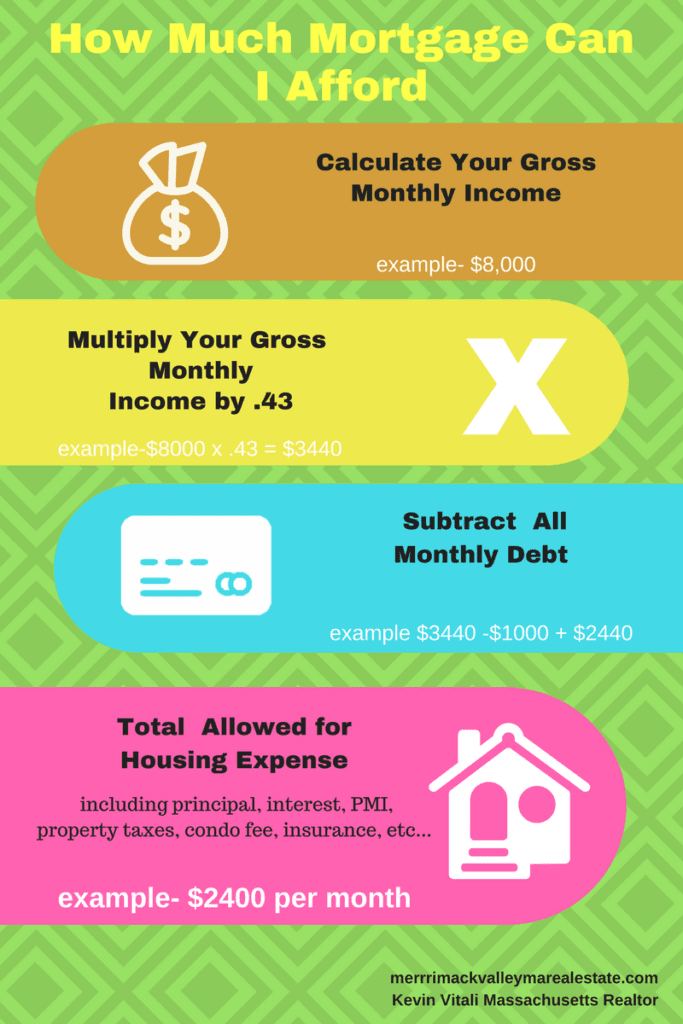
Most conventional lenders prefer a back-end DTI of 36% or lower, though many programs allow up to 43%, and some government-backed loans (like FHA) may go as high as 50% in specific circumstances. The lower your existing debt, the higher the “house” portion of that ratio can be.
Credit Score and Interest Rate Impact
Your credit score does more than just determine if you get approved; it determines how much you get approved for by influencing your interest rate. A higher credit score translates to a lower interest rate. Because a lower interest rate reduces your monthly payment for the same loan amount, it effectively increases your purchasing power. For example, a buyer with a 760 credit score might qualify for a $400,000 mortgage because their interest rate is low enough to keep the DTI within limits, while a buyer with a 620 score might only qualify for $350,000 due to a higher interest rate increasing the monthly payment.
The Mathematical Framework: Front-End vs. Back-End Ratios
To estimate your approval amount, you must look at the “28/36 Rule,” a standard benchmark used by many financial institutions to assess risk.
The 28% Rule (Front-End)
According to this guideline, your total monthly housing costs should not exceed 28% of your gross monthly income. If you earn $10,000 per month, the lender would ideally like to see a total mortgage payment (including taxes and insurance) of no more than $2,800. This ensures that you have enough liquidity left over for taxes, food, and other lifestyle expenses that do not appear on a credit report.
The 36% Rule (Back-End)
The 36% rule dictates that your total debt obligations should not exceed 36% of your gross income. Using the same $10,000 monthly income example, your total debt—housing plus car payments, student loans, etc.—should not exceed $3,600.
If you have no other debt, you might be able to push your housing payment closer to that 36% mark, depending on the loan product. However, if you have $1,000 in monthly student loan and car payments, your available room for a mortgage payment drops to $2,600 ($3,600 minus $1,000), even if your income suggests you could handle more. This is why paying off small high-interest debts can significantly boost your mortgage approval ceiling.
Loan-to-Value (LTV) and the Down Payment
The amount of money you put down directly affects the loan amount. Lenders use the Loan-to-Value (LTV) ratio to assess risk. A 20% down payment results in an 80% LTV, which is the “gold standard” for conventional loans. If you put down less than 20%, you will likely have to pay Private Mortgage Insurance (PMI), which is an additional monthly cost that must be factored into your DTI calculation. By increasing your down payment, you lower the loan amount and eliminate PMI, which can allow you to be approved for a more expensive property.
Loan Programs and Their Specific Approval Limits

The type of loan you choose will have a profound impact on the final approval number. Different loan “products” have different rules regarding credit scores, DTI, and down payments.
Conventional Loans
Standard conventional loans are typically sold to Fannie Mae or Freddie Mac. These loans usually require a minimum credit score of 620. They are stricter regarding DTI ratios but offer more flexibility if you have a large down payment or significant cash reserves. The approval limit for conventional loans is also subject to “conforming loan limits,” which are set annually by the government. If you need a loan larger than these limits, you must enter the realm of “Jumbo Loans.”
FHA Loans
Backed by the Federal Housing Administration, FHA loans are designed for buyers with lower credit scores or smaller down payments (as low as 3.5%). Because the government insures these loans against default, lenders are often willing to approve buyers with DTI ratios as high as 45% or 50%. This can allow a buyer to qualify for a more expensive home than they might with a conventional loan, though the trade-off is the requirement of a Mortgage Insurance Premium (MIP) for the life of the loan.
VA and USDA Loans
VA loans (for veterans and service members) and USDA loans (for specific rural properties) are unique because they often require zero down payment. VA loans are particularly generous with DTI ratios, focusing more on “residual income”—the amount of money a family has left over for living expenses after all debts are paid. This often results in veterans being approved for higher loan amounts than they would qualify for under traditional DTI-based underwriting.
Jumbo Loans
In high-cost real estate markets, buyers often need loans that exceed conforming limits. Jumbo loans require much higher credit scores (often 700-720+) and lower DTI ratios (usually capped at 43%). Lenders also require significant cash reserves, sometimes equal to 6-12 months of mortgage payments, to prove that you can handle the large debt even in the event of income loss.
Hidden Costs and the “House Poor” Trap
While a lender might tell you that you are approved for a certain amount, that doesn’t always mean you should spend that amount. Approval is based on gross income, but you live on net income (take-home pay).
Property Taxes and Insurance
A common mistake is focusing only on the principal and interest. In many states, property taxes can add hundreds or even thousands of dollars to your monthly payment. Similarly, homeowners insurance varies by region; a home in a flood zone or hurricane-prone area will have significantly higher premiums. These costs are included in the lender’s DTI calculation and can eat into the amount of money available for the loan itself.
Maintenance and HOA Fees
Lenders generally do not factor in maintenance costs when approving a loan, but as a homeowner, you must. The general rule of thumb is to set aside 1% of the home’s value annually for repairs. Furthermore, if the property is part of a Homeowners Association (HOA), those monthly or annual fees are included in the lender’s DTI calculation. A high HOA fee will directly reduce the maximum loan amount you can get approved for.
The Psychology of Affordability
Being “approved” for $500,000 means the lender believes you can pay it back without defaulting. It does not account for your personal financial goals, such as saving for retirement, traveling, or funding a child’s education. Financial experts often suggest looking at your take-home pay and ensuring your total housing cost doesn’t exceed 30% of your net income, which is a much more conservative and sustainable approach than the lender’s DTI-based approval.
Strategies to Increase Your Maximum Approval
If your current approval estimate is lower than the price of homes in your desired area, there are several levers you can pull to increase that number.
1. Reduce Existing Debt
Since the back-end DTI is the primary constraint for most buyers, paying off a car loan or high-balance credit cards can have a dramatic effect. Even a $300 monthly car payment can represent $40,000 to $60,000 in mortgage purchasing power, depending on interest rates.
2. Improve Your Credit Score
Moving your credit score from the “fair” range (640-670) to the “very good” range (740+) can lower your interest rate significantly. On a 30-year mortgage, a 1% difference in interest rates can save you hundreds of dollars a month, which the lender will then allow you to apply toward a higher loan principal.
3. Consider a Co-Signer or Co-Borrower
Adding a spouse, partner, or even a family member to the loan allows the lender to count two incomes instead of one. This significantly lowers the DTI ratio, though it also means the lender will consider the co-borrower’s debts and credit score as well.
4. Adjust the Loan Term or Type
While 30-year fixed-rate mortgages are the most common, some buyers look at Adjustable-Rate Mortgages (ARMs). ARMs often have a lower initial interest rate for the first 5, 7, or 10 years. Because the initial payment is lower, the lender may approve you for a higher loan amount. However, this carries the risk of the rate increasing in the future.
5. Supplement the Down Payment
If you have access to a gift from a family member or a 401(k) loan, increasing your down payment reduces the amount you need to borrow and may eliminate PMI. This lowers the monthly obligation and satisfies LTV requirements, often clearing the path for a higher-tier property.
In conclusion, knowing how much house you will be approved for is a matter of understanding the specific formulas lenders use to mitigate risk. By auditing your DTI, optimizing your credit score, and choosing the right loan product, you can maximize your purchasing power while ensuring your new home remains a financial asset rather than a burden.
aViewFromTheCave is a participant in the Amazon Services LLC Associates Program, an affiliate advertising program designed to provide a means for sites to earn advertising fees by advertising and linking to Amazon.com. Amazon, the Amazon logo, AmazonSupply, and the AmazonSupply logo are trademarks of Amazon.com, Inc. or its affiliates. As an Amazon Associate we earn affiliate commissions from qualifying purchases.