
The year 2020 stands as a singular epoch in the history of global finance, specifically within the American mortgage market. It was a year characterized by extreme volatility, unprecedented central bank intervention, and a fundamental shift in how consumers approached personal debt and homeownership. For anyone analyzing the trajectory of personal finance and real estate investing, understanding the mortgage rate environment of 2020 is essential. It was the year the “sub-3%” mortgage transitioned from a theoretical possibility to a widespread reality, forever altering the financial landscape for millions of households.

The Macroeconomic Climate: From Stability to Crisis Intervention
At the dawn of 2020, the economic outlook was relatively stable. Mortgage rates had ended 2019 in a downward trend, but few analysts predicted the precipitous drop that was to come. In January 2020, the average 30-year fixed-rate mortgage hovered around 3.72%. While low by historical standards, it was within a range that economists considered “normal” for the post-Great Recession era.
The arrival of the COVID-19 pandemic in March 2020 served as a massive “black swan” event. As the global economy ground to a halt, financial markets experienced a liquidity crisis that necessitated immediate and aggressive action from the Federal Reserve. To prevent a total collapse of the credit markets, the Federal Open Market Committee (FOMC) slashed the federal funds rate to a target range of 0% to 0.25%.
The Federal Reserve and Quantitative Easing
While the federal funds rate does not directly set mortgage rates, it influences the broader interest rate environment. More significantly, the Federal Reserve launched a massive program of quantitative easing (QE), which included the purchase of billions of dollars in mortgage-backed securities (MBS). By becoming a primary buyer of these securities, the Fed increased demand, drove up prices, and pushed yields down. This intervention was the primary engine behind the record-breaking low mortgage rates that defined the latter half of 2020.
The Flight to Safety
In times of economic uncertainty, investors often flee “risky” assets like stocks in favor of “safe-haven” assets like U.S. Treasury bonds. In 2020, this flight to safety saw the yield on the 10-year Treasury note—the primary benchmark for 30-year mortgage rates—plummet to historic lows, at one point dipping below 0.6%. This narrowing of spreads and the collapse of Treasury yields provided the floor upon which the lowest mortgage rates in history were built.
Tracking the Numbers: A Month-by-Month Descent to Record Lows
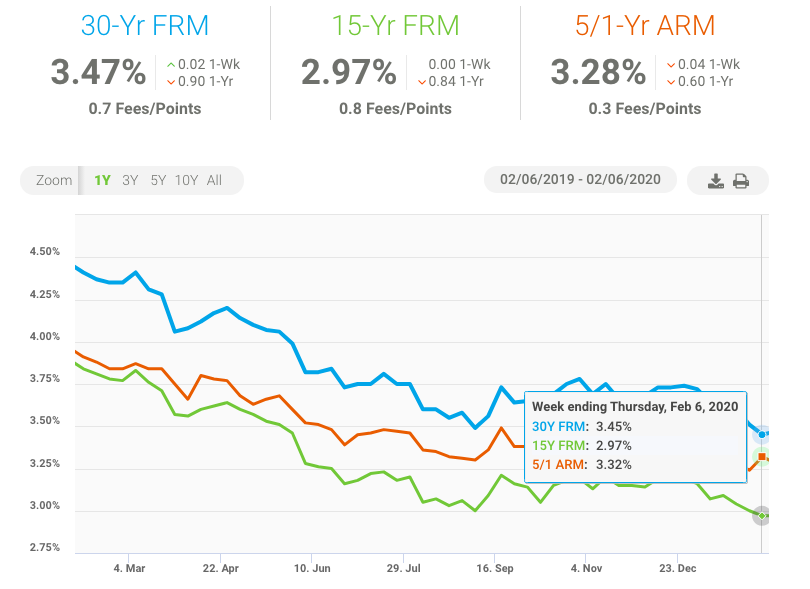
To understand the magnitude of the 2020 rate environment, one must look at the specific data points provided by Freddie Mac’s Primary Mortgage Market Survey. The year was marked by a series of “all-time lows,” with the record being broken more than a dozen times within a single twelve-month period.
The First Half of 2020: Volatility and the Initial Drop
In February 2020, rates sat at roughly 3.45%. By March, as the pandemic took hold, rates initially spiked due to market panic and liquidity issues, briefly touching 3.65% before the Fed’s intervention stabilized the market. By April, the downward trend was established, with the 30-year fixed-rate mortgage falling to 3.23%.
In June 2020, the market crossed a psychological threshold: the 30-year fixed-rate mortgage averaged 2.98%. This was the first time in the history of the Freddie Mac survey (which dates back to 1971) that the average rate dropped below 3%.
The Second Half of 2020: The “Floor” of the Market
The decline continued throughout the summer and into the fall.
-
August 2020: Rates averaged 2.88%.
-
October 2020: Rates hit 2.80%.
-
December 2020: The year closed with the 30-year fixed-rate mortgage at an astounding 2.67%.
For the 15-year fixed-rate mortgage, which is a popular tool for those looking to build equity quickly or refinance, the numbers were even lower. By the end of 2020, the 15-year average had fallen to approximately 2.21%. These figures represented the cheapest borrowing costs in the history of modern finance, creating a massive incentive for both new buyers and existing homeowners.
The Financial Impact: Refinancing and Purchasing Power

The plummeting rates of 2020 triggered two major financial phenomena: a historic refinancing boom and a significant increase in consumer purchasing power. These shifts had profound implications for personal net worth and household cash flow.
The Great Refinance Boom
For millions of American homeowners, 2020 presented an opportunity to drastically reduce their largest monthly expense. Homeowners who had purchased properties just two or three years prior at rates of 4.5% or 5% found that they could shave 1.5 to 2 percentage points off their interest rate.
This led to a surge in “rate-and-term” refinances, where the primary goal was to lower the monthly payment. On average, households that refinanced in 2020 saved between $200 and $300 per month. In the context of personal finance, this was equivalent to a significant annual raise, providing households with extra disposable income to save, invest, or pay down other debts during a period of economic instability.
Enhanced Purchasing Power and the Housing Boom
Lower interest rates effectively gave home buyers more “bang for their buck.” When rates drop, the monthly principal and interest payment for a specific loan amount decreases. Conversely, for the same monthly payment, a buyer can afford a significantly higher loan amount.
In 2020, a buyer with a $2,000 monthly budget for principal and interest could afford a much more expensive home at a 2.7% rate than they could at the 4% rates seen in 2018. This increased purchasing power, combined with a newfound desire for more space due to remote work, fueled a massive surge in demand for residential real estate. This demand eventually led to the rapid home price appreciation that characterized the 2021-2022 market.
Challenges and Paradoxes of the 2020 Market
While the headline news of 2020 was the record-low interest rates, the reality on the ground for many consumers and investors was more complex. The year presented several paradoxes that made it difficult for some to capitalize on the financial environment.
Tightening Underwriting Standards
Despite the low rates, obtaining a mortgage in 2020 was not necessarily easy. Lenders, wary of the economic fallout from the pandemic and the high number of workers in forbearance or facing unemployment, significantly tightened their credit requirements. Many lenders raised their minimum FICO score requirements and demanded higher down payments for certain loan products. This created a “K-shaped” financial opportunity where those with stable jobs and high credit scores could access the best rates in history, while those most impacted by the pandemic were locked out of the market.
The Inventory Crisis
Low rates are a double-edged sword for the real estate market. While they stimulate demand, they also discourage supply. In 2020, many potential sellers were hesitant to list their homes due to health concerns or economic uncertainty. Furthermore, homeowners who had just refinanced into a sub-3% rate were suddenly “locked in” to their current homes, as moving would mean giving up a historically low cost of capital. This mismatch between soaring demand and shrinking supply led to the beginning of a chronic inventory shortage that would plague the housing market for years to follow.
The Rise of Cash-Out Refinancing
As home prices began to rise toward the end of 2020, some homeowners utilized the low-rate environment for “cash-out” refinances. This strategy allowed them to tap into their growing home equity to fund renovations, consolidate high-interest credit card debt, or invest in other assets. While this increased household liquidity, it also meant that many Americans were once again leveraging their primary residence to fuel consumption, a trend that financial advisors monitored with a mix of optimism and caution.
The Long-Term Lessons of 2020 for Investors and Homeowners
Looking back at 2020 from a higher-interest-rate environment provides valuable perspective on market cycles and personal financial planning. The mortgage rates of 2020 were an anomaly—a product of a specific set of crisis-driven circumstances that are unlikely to be repeated in the near future.
The Value of Fixed-Rate Debt in an Inflationary Cycle
Those who secured 30-year fixed-rate mortgages in 2020 are now holding what many financial analysts call “the most valuable asset in the world.” With inflation rising in subsequent years and market interest rates climbing well above 6% or 7%, a 2.7% mortgage represents a massive hedge against inflation. The “real” interest rate (the nominal rate minus inflation) for these homeowners became negative, meaning they were effectively being paid to borrow money.
Market Timing vs. Financial Readiness
The 2020 market taught investors that while timing the market for the lowest possible rate can be beneficial, financial readiness is more important. Those who had their credit scores optimized and their down payments ready were able to strike when the window of opportunity opened. In the world of money and investing, 2020 serves as a reminder that the cost of capital is a dynamic force that can change rapidly based on geopolitical and macroeconomic shifts.
In conclusion, mortgage rates in 2020 were more than just a statistical curiosity; they were a catalyst for a massive redistribution of household wealth and a reshaping of the American real estate market. By bottoming out at 2.67% in December 2020, these rates provided a once-in-a-generation opportunity for debt optimization, while simultaneously setting the stage for the inventory and affordability challenges that would define the next era of the housing economy. For the savvy investor, 2020 remains the benchmark for the “lower bound” of what is possible in the realm of mortgage finance.
aViewFromTheCave is a participant in the Amazon Services LLC Associates Program, an affiliate advertising program designed to provide a means for sites to earn advertising fees by advertising and linking to Amazon.com. Amazon, the Amazon logo, AmazonSupply, and the AmazonSupply logo are trademarks of Amazon.com, Inc. or its affiliates. As an Amazon Associate we earn affiliate commissions from qualifying purchases.