
In the high-stakes world of commercial aviation, the title of “biggest” is not merely a badge of honor; it is a complex financial metric that shifts depending on whether one is looking at the balance sheet, the stock ticker, or the operational volume. For investors, business analysts, and financial enthusiasts, identifying the largest carrier in the United States requires a deep dive into revenue streams, market capitalization, and asset management.
While a casual traveler might define size by the number of seats or the ubiquity of a logo, the financial sector evaluates airlines through the lens of profitability, debt-to-equity ratios, and the valuation of intangible assets like loyalty programs. Currently, the competition for the top spot is a perennial battle between three legacy giants—American Airlines, Delta Air Lines, and United Airlines—along with the low-cost titan, Southwest Airlines.

Defining Size in the Skies: Revenue vs. Market Capitalization
To determine which airline truly wears the crown, we must first establish the metric of measurement. In business finance, “size” is often a dual-track conversation involving top-line revenue and total market valuation.
The Revenue Powerhouse: American Airlines
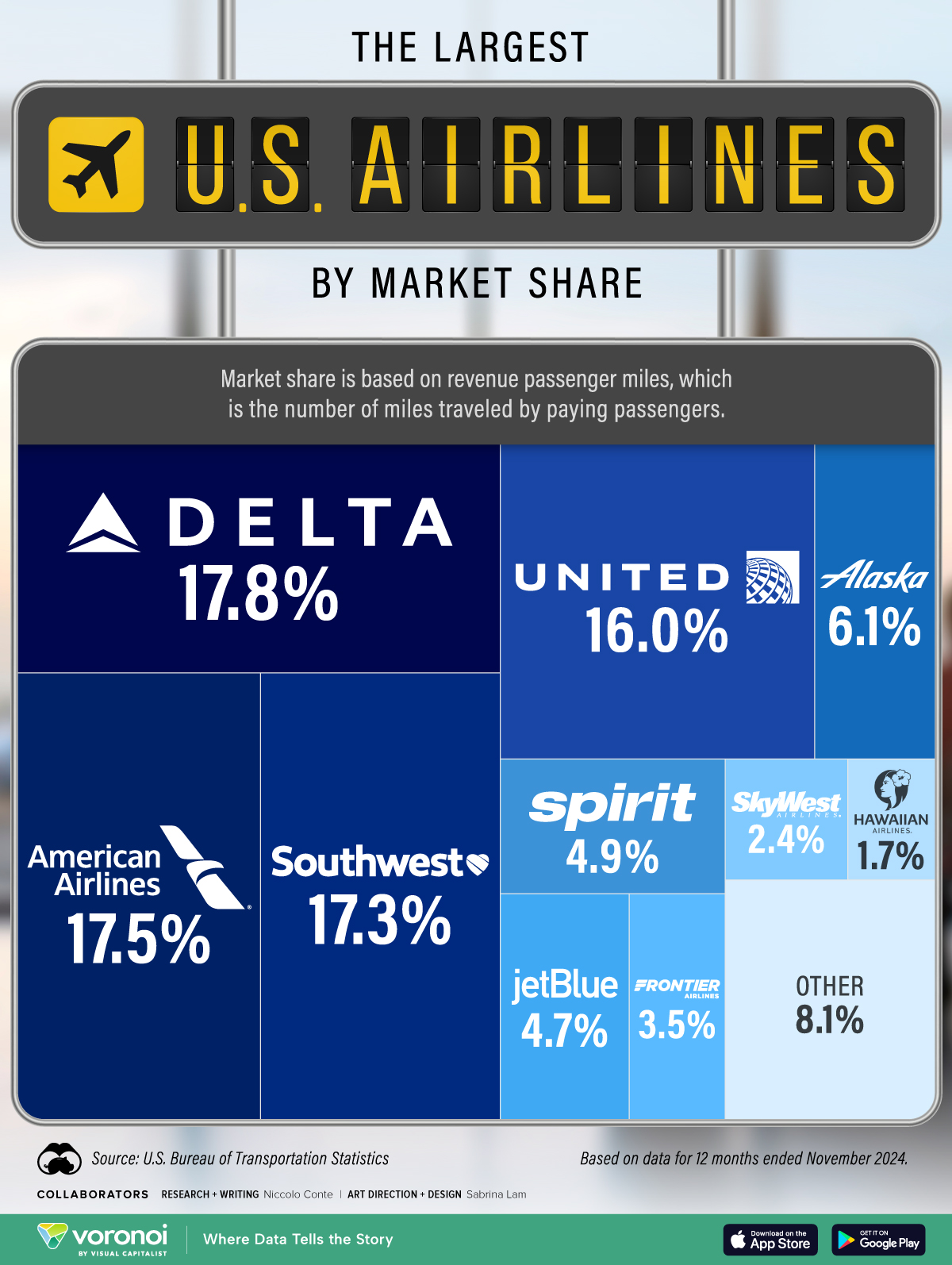
When measuring size by sheer operational scale and top-line revenue, American Airlines Group Inc. frequently leads the pack. With a massive global network and a fleet that often exceeds 900 mainline aircraft, American generates staggering annual revenue. From a business perspective, American’s strategy has long been focused on capturing the largest possible share of the “Revenue Passenger Miles” (RPM) market. By maintaining the largest fleet, they command a significant portion of the domestic market share, which is a critical indicator of industry influence and cash flow potential.
The Market Capitalization Leader: Delta Air Lines
While American may move the most people, Delta Air Lines often holds the title of the world’s most valuable airline by market capitalization. For investors, market cap is the ultimate measure of “size” because it reflects the total value the market assigns to the company’s equity. Delta has historically commanded a premium valuation due to its superior operational reliability, higher profit margins, and its ability to attract high-yield business travelers. In the world of business finance, Delta is frequently cited as the industry benchmark for financial health, often achieving a higher valuation than its larger-revenue competitors because of its efficient capital allocation and robust “Return on Invested Capital” (ROIC).
Why Investors Value Efficiency Over Volume
The disparity between American’s revenue and Delta’s market cap highlights a fundamental principle of financial analysis: volume does not always equate to value. An airline can have the most planes and the most employees, but if its “Cost per Available Seat Mile” (CASM) is too high, its valuation will suffer. Investors look for airlines that can maximize “Revenue per Available Seat Mile” (RASM). Delta’s success in segmenting its cabin—selling premium experiences rather than just transportation—has allowed it to maintain a dominant financial position even when it isn’t the largest by passenger count.
The Financial Dominance of the Big Four
The U.S. aviation market is essentially an oligopoly. Four carriers—American, Delta, United, and Southwest—control approximately 80% of the domestic market. Understanding the “biggest” airline requires looking at how these four entities manage their massive financial infrastructures.
The United Airlines Strategy: Global Connectivity
United Airlines occupies a unique financial niche by focusing heavily on international long-haul routes. From a business finance perspective, United’s “size” is bolstered by its high-margin international segments. During periods of strong global economic growth, United’s financial performance often outpaces its peers because international business class tickets offer significantly higher margins than domestic economy seats. Their investment in “United Polaris” is a branding move backed by a clear financial objective: capturing the highest possible share of the lucrative trans-Atlantic and trans-Pacific corporate spend.
Southwest Airlines: The Cash Flow King
Southwest Airlines represents a different kind of “big.” For decades, Southwest was the only major U.S. airline to maintain a consistent streak of profitability. Their financial model—operating a single aircraft type (the Boeing 737) to minimize maintenance and training costs—is a masterclass in operational efficiency. While Southwest might not have the global reach of United or the premium revenue of Delta, its balance sheet has traditionally been the cleanest in the industry, with lower debt levels and higher liquidity. For many years, Southwest’s market cap rivaled the legacy carriers, proving that a simplified business model can produce outsized financial results.
The Role of Consolidation and Mergers
The current size of these entities is the result of decades of massive mergers. The “biggest” airlines today are the product of the American-US Airways, Delta-Northwest, and United-Continental unions. These mergers were driven by the need for “economies of scale.” By consolidating, these brands were able to cut redundant administrative costs, negotiate better fuel rates, and dominate specific “hub” airports, creating a financial fortress that makes it incredibly difficult for smaller “Ultra Low-Cost Carriers” (ULCCs) like Spirit or Frontier to break into the top tier.
Ancillary Revenue and the Multi-Billion Dollar Loyalty Asset
When we ask what the biggest airline is, we are increasingly asking which airline has the biggest credit card business. In modern aviation finance, the actual flying of planes is sometimes secondary to the financial services provided by loyalty programs.
Loyalty Programs as Financial Collateral
During the 2020 financial crisis, the “Big Three” (American, Delta, United) revealed the true scale of their loyalty programs. These programs—AAdvantage, SkyMiles, and MileagePlus—were appraised as independent business units worth tens of billions of dollars. In many cases, the loyalty program was valued higher than the airline’s entire fleet of aircraft. These programs are high-margin, asset-light businesses that generate cash by selling miles to banks (like American Express, Chase, and Citi).
The Shift to a Service-Based Business Model
The biggest airlines have effectively become fintech companies with wings. Delta’s partnership with American Express, for example, contributes billions of dollars in high-margin revenue annually. This diversification is a key financial strategy to hedge against the volatility of fuel prices and labor strikes. When analyzing which airline is the largest, one must look at these “ancillary” revenue streams, which now account for a massive portion of total profitability.
Designing for Brand Equity and Financial Retention
Branding in the airline industry isn’t just about a logo; it’s about creating a “walled garden” for the consumer. Through tiered status and credit card integration, the biggest airlines ensure that high-value customers are financially incentivized to remain loyal, regardless of ticket price. This creates “sticky” revenue, which is highly prized by Wall Street and contributes significantly to an airline’s overall market valuation.
Investment Analysis: Navigating the Volatility of Aviation Stocks
For those looking at the aviation sector through a personal finance or investing lens, the “biggest” airline isn’t always the best investment. The industry is notoriously capital-intensive and cyclical.
Cyclicality and Macroeconomic Trends
Airlines are highly sensitive to the economic cycle. When the economy is booming, corporate travel budgets expand, and the big airlines see a surge in high-margin revenue. Conversely, in a recession, travel is often the first expense to be cut. Investors must monitor “Load Factors” (the percentage of seats filled) and “Yield” (the average fare paid per mile). The biggest airlines often have the most to lose during a downturn because of their high fixed costs, including massive debt loads taken on to purchase new, fuel-efficient aircraft.
Debt Management and Capital Expenditure
The biggest airlines are also some of the biggest debtors. Modernizing a fleet costs billions of dollars. Investors analyze the “CAPEX” (Capital Expenditure) schedules of these companies to see how much of their cash flow is being eaten up by new plane orders. An airline might be “big” in terms of revenue, but if it is drowning in high-interest debt, its “Enterprise Value” may be compromised.
Fuel Hedging: The Hidden Financial Lever
Fuel is typically the first or second-largest expense for any airline. The biggest carriers use complex financial derivatives to “hedge” their fuel costs—essentially betting on the future price of oil to lock in lower rates. Delta took this a step further by actually purchasing an oil refinery (Trainer Refinery in Pennsylvania). This unique financial strategy allows them to manage the “crack spread” (the difference between the price of crude oil and the refined products), adding a layer of industrial finance to their aviation business.
The Economic Outlook: Scaling for the Next Decade
As we look toward the future, the definition of the “biggest” airline will continue to evolve, driven by technological integration and the push for sustainability.
The Digital Transformation of Revenue Management
The biggest airlines are now leveraging AI and machine learning to optimize “Dynamic Pricing.” By analyzing vast amounts of consumer data, they can adjust ticket prices in real-time to ensure every flight maximizes its revenue potential. This digital infrastructure is a massive barrier to entry for smaller competitors and ensures that the “Big Four” maintain their financial dominance through technological superiority.
ESG and the Cost of Decarbonization
The financial landscape of aviation is also being reshaped by “Environmental, Social, and Governance” (ESG) criteria. The biggest airlines are under immense pressure from institutional investors to invest in “Sustainable Aviation Fuel” (SAF) and carbon offset programs. The cost of transitioning to a net-zero future is estimated in the trillions. The airlines with the strongest balance sheets—the true “biggest” players—will be the only ones capable of financing this transition, likely leading to even further market consolidation in the coming decades.
In conclusion, identifying the “biggest” airline in the United States is a multifaceted exercise in business finance. If you measure by revenue and fleet size, American Airlines often leads. If you measure by market value, operational efficiency, and investor confidence, Delta Air Lines frequently takes the top spot. However, for the astute observer of business and finance, the real “size” lies in the ability to leverage loyalty assets, manage complex debt, and dominate the domestic market share through the sheer force of an established brand. Regardless of which metric one chooses, the “Big Four” remain the undisputed titans of the American economy’s travel sector.
aViewFromTheCave is a participant in the Amazon Services LLC Associates Program, an affiliate advertising program designed to provide a means for sites to earn advertising fees by advertising and linking to Amazon.com. Amazon, the Amazon logo, AmazonSupply, and the AmazonSupply logo are trademarks of Amazon.com, Inc. or its affiliates. As an Amazon Associate we earn affiliate commissions from qualifying purchases.