
In the vast landscape of science and technology, certain concepts, though seemingly abstract, form the bedrock of our modern world. The “free electron” is one such concept. While its name might evoke images of untethered particles zipping through space, its true significance lies in its fundamental role in electricity, conductivity, and the very technologies that shape our lives. This article delves into the essence of the free electron, exploring its nature, its impact on various technological domains, and how understanding it is crucial for anyone navigating the realms of tech, brand, and money.

The journey into understanding free electrons begins with a basic grasp of atomic structure. At the heart of every atom lies a nucleus, containing positively charged protons and neutral neutrons. Orbiting this nucleus are negatively charged electrons. These electrons are typically bound to their respective atoms, occupying specific energy levels or “shells.” However, not all electrons are created equal in their commitment to their atomic homes.
The Nature of the Free Electron: Beyond the Atomic Bond
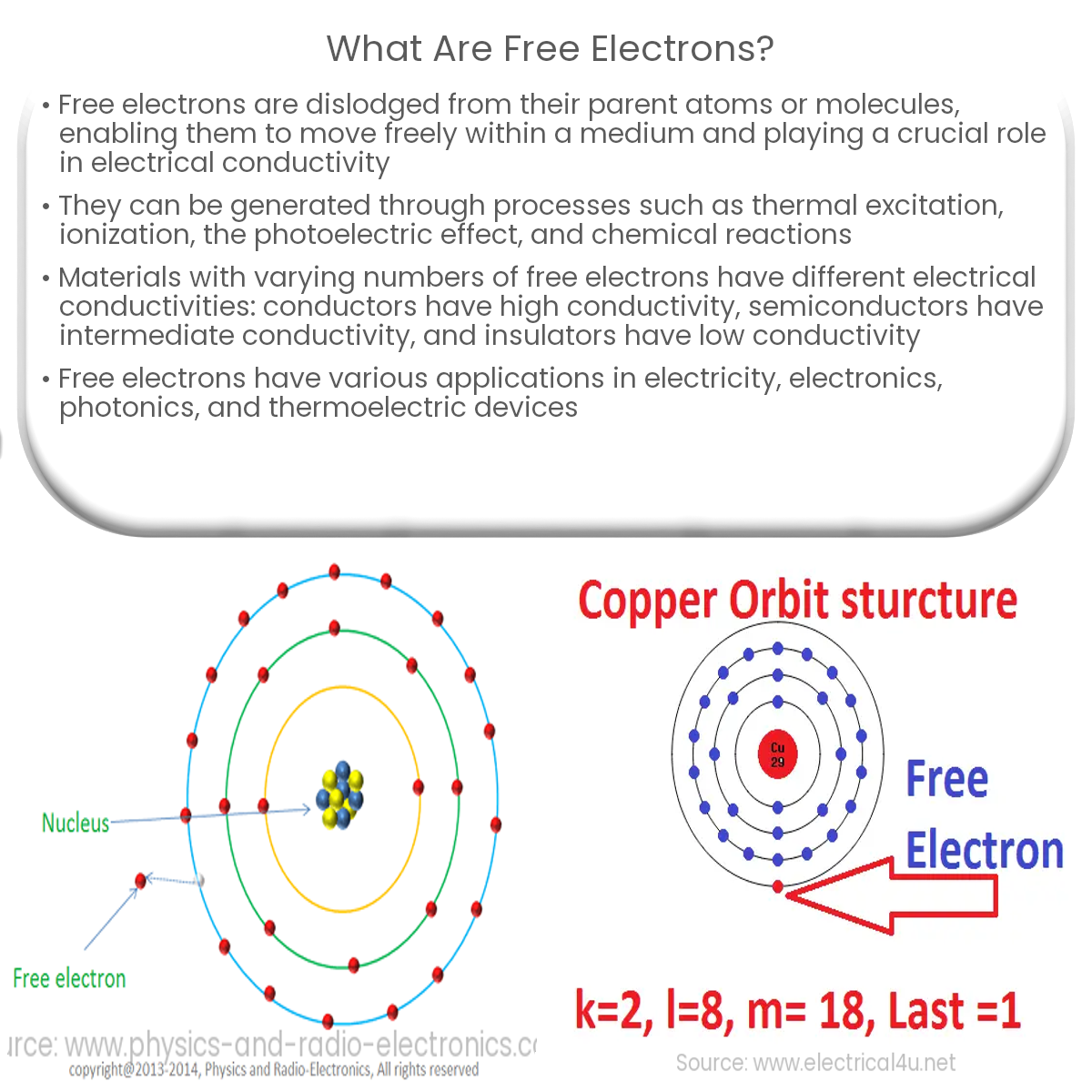
The term “free electron” refers to an electron that is not strongly bound to a particular atom. Instead, it has enough energy to detach from its parent atom and move relatively freely within a material. This freedom of movement is the key to their profound impact on the world around us.
1. Electrons in the Atomic Dance: Bound vs. Free
To truly appreciate the concept of a free electron, we must first understand its counterpart: the bound electron. In most materials, electrons are held tightly within the electron shells of atoms by the electrostatic attraction between their negative charge and the positive charge of the nucleus. These bound electrons are essential for chemical bonding, forming the intricate structures that make up everything from water molecules to complex organic compounds.
However, in certain types of materials, particularly conductors like metals, some electrons in the outermost electron shell, known as valence electrons, are only loosely bound to their atoms. These valence electrons exist in what is often described as a “sea” of electrons, delocalized and free to roam throughout the material’s atomic lattice. This “sea of electrons” is not a physical ocean, but rather a conceptual model representing the shared mobility of these charge carriers.
2. Energy and Mobility: The Keys to Freedom
What grants an electron this freedom? It’s largely a matter of energy. Electrons occupy specific energy levels. When an electron gains sufficient energy – perhaps from an external electric field, heat, or light – it can overcome the attractive force of its nucleus and jump to a higher, unbound energy state. This transition marks its liberation from its atomic anchor.
The mobility of these free electrons is what enables electrical conductivity. Unlike insulators, where electrons are firmly bound and cannot move freely, conductors allow these liberated electrons to drift in a particular direction when an electric field is applied. This directed movement of charge is, by definition, electric current.
Free Electrons in Technology: The Engine of the Digital Age
The existence and behavior of free electrons are not merely academic curiosities; they are the foundational principles upon which much of modern technology is built. From the simplest circuits to the most sophisticated artificial intelligence, the controlled movement of free electrons is indispensable.
1. Semiconductors: The Controlled Flow
Perhaps the most critical application of understanding free electrons lies in the realm of semiconductors. Materials like silicon and germanium are neither perfect conductors nor perfect insulators. Their conductivity can be precisely controlled by introducing impurities, a process called doping.
- N-type semiconductors: When silicon is doped with elements like phosphorus (which have one extra valence electron), the excess electrons become free carriers, increasing the material’s conductivity. These are often referred to as “majority carriers.”
- P-type semiconductors: Doping with elements like boron (which have one fewer valence electron) creates “holes,” which are essentially vacant spots where an electron could be. These holes can act as positive charge carriers, allowing for a different type of conductivity.
The interplay between free electrons and holes in semiconductor junctions forms the basis of diodes, transistors, and integrated circuits (ICs). These tiny components are the building blocks of all modern electronic devices, from your smartphone and laptop to advanced AI hardware. The ability to precisely control the flow of free electrons and holes allows us to create logic gates, amplifiers, and memory – the essential functions of computation.
2. Conductors: The Unfettered Path
In materials like copper, silver, and gold, a large number of valence electrons are inherently free. This high density of free electrons makes them excellent conductors of electricity. The ease with which electrons can move through these metals allows for efficient transmission of electrical power over long distances and the reliable operation of electronic circuits. The development of advanced materials with even greater conductivity, or with tailored conductive properties, continues to be a significant area of research in materials science, impacting everything from energy grids to high-speed computing.
3. Digital Security and Data Transmission: The Invisible Current
The secure and efficient transmission of data relies heavily on the principles of electromagnetism, which are governed by the behavior of charged particles, including free electrons.
- Signal Propagation: Electrical signals, essentially the synchronized movement of free electrons, travel through wires and waveguides. Understanding how these signals propagate, how they can be attenuated or distorted, and how to protect them from interference is crucial for robust digital communication. This is where concepts like signal integrity and noise reduction become paramount.
- Cybersecurity: While not directly about free electrons in a physical sense, the digital information they carry is the target of cybersecurity efforts. Protecting this flow of data from unauthorized access, manipulation, or disruption requires sophisticated algorithms and protocols. The underlying digital infrastructure that transmits and processes this information is entirely dependent on the controlled movement of free electrons.
The Economic Ripple Effect: Free Electrons and Financial Innovation
The influence of free electrons extends far beyond the laboratory and into the economic landscape, shaping industries, creating opportunities, and driving financial innovation.
1. The Tech Economy: Fueling Growth and Investment
The direct consequence of understanding and harnessing free electrons is the burgeoning tech industry.
- Hardware Manufacturing: The production of semiconductors, microprocessors, and other electronic components is a multi-billion dollar global industry. Companies that innovate in semiconductor design and manufacturing, optimizing for efficiency and performance through subtle control of electron behavior, often see significant financial rewards.
- Software Development and AI: While software deals with abstract logic, it relies on the physical hardware powered by free electrons. The development of advanced AI tools, machine learning algorithms, and sophisticated software applications is only possible because of the immense processing power delivered by microchips. This creates a symbiotic relationship where hardware advancements enable software innovation, and demand for new software drives further hardware development.
- Gadgets and Consumer Electronics: From the latest smartphones to smart home devices, the consumer electronics market is a direct manifestation of our ability to manipulate free electrons. These products represent significant economic value and drive consumer spending.
2. Personal Finance and Investment: Understanding the Underlying Assets
For individuals navigating the world of personal finance and investing, understanding the technological trends driven by free electrons can provide a competitive edge.
- Investing in Tech Companies: Identifying companies at the forefront of semiconductor technology, AI development, or digital security can be a lucrative investment strategy. A basic understanding of the underlying principles, like how a new transistor design might improve processing power, can inform investment decisions.
- The Rise of Digital Currencies: While not directly about physical free electrons, the infrastructure that supports cryptocurrencies and blockchain technology is built upon complex computational processes executed by hardware powered by these fundamental particles. The decentralization and security of these systems are enabled by advanced computing, which in turn relies on the principles of electron behavior.
- Productivity Tools and Online Income: The proliferation of productivity apps, cloud computing services, and online platforms for side hustles are all direct or indirect beneficiaries of advancements in electronics. These technologies enable individuals to earn money online, manage their finances more effectively, and improve their overall productivity.

3. Brand and Marketing in the Digital Age: Communicating Value
The impact of free electrons on brand strategy and marketing is undeniable, as the digital landscape has become the primary battleground for consumer attention.
- Digital Marketing Strategies: Effective marketing today requires a deep understanding of online platforms, social media, and search engine optimization – all of which are powered by digital technology. Brands must adapt their strategies to reach consumers through these digital channels, leveraging data analytics and targeted advertising, which are themselves products of sophisticated electronic systems.
- Personal Branding: For individuals seeking to build a personal brand, digital presence is paramount. Websites, social media profiles, online portfolios, and content creation all rely on the digital infrastructure enabled by free electrons. The ability to communicate one’s expertise and value proposition effectively online is a crucial skill in today’s job market.
- Reputation Management: In an era of instant information and social media, a brand’s reputation can be built or destroyed in moments. Online reputation management tools and strategies are essential for businesses and individuals alike. The effectiveness of these tools is intrinsically linked to the digital technologies that allow for information to spread rapidly.
In conclusion, the humble free electron, a particle unbound and mobile, is far more than a scientific abstraction. It is the fundamental force that powers our technological world, drives economic growth, and shapes our digital interactions. From the intricate dance of atoms within a semiconductor to the global flow of financial information, understanding the concept of the free electron provides a crucial lens through which to view and navigate the interconnected domains of technology, brand, and money. As we continue to push the boundaries of innovation, the mastery and manipulation of these unseen forces will undoubtedly remain at the forefront of progress.
aViewFromTheCave is a participant in the Amazon Services LLC Associates Program, an affiliate advertising program designed to provide a means for sites to earn advertising fees by advertising and linking to Amazon.com. Amazon, the Amazon logo, AmazonSupply, and the AmazonSupply logo are trademarks of Amazon.com, Inc. or its affiliates. As an Amazon Associate we earn affiliate commissions from qualifying purchases.