
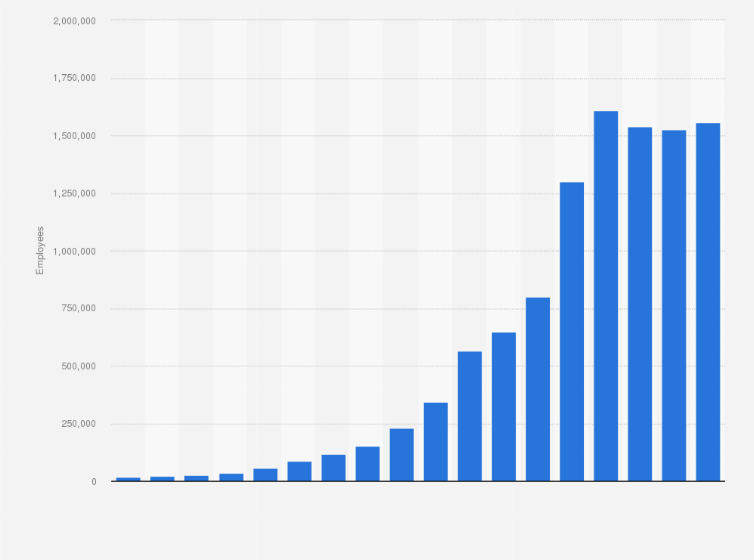
As of 2024, Amazon remains one of the largest private employers on the planet, trailing only Walmart in total headcount. To understand the scale of this organization is to understand a financial entity that functions more like a sovereign state than a traditional corporation. Entering 2024, Amazon’s global workforce sits at approximately 1.5 million full-time and part-time employees. This figure, while staggering, represents a strategic stabilization following a period of unprecedented volatility in the labor market and corporate restructuring.
For investors, analysts, and business enthusiasts, the headcount at Amazon is not just a human resources metric; it is a primary indicator of operational efficiency, capital allocation, and the company’s long-term margin potential. In a high-interest-rate environment where every basis point of margin is scrutinized, how Amazon manages its human capital determines its standing on Wall Street.

Analyzing the Scale: Amazon’s Workforce Evolution and Current 2024 Figures
The journey to 1.5 million employees has been anything but linear. To grasp the 2024 landscape, one must look back at the “hiring binge” of the pandemic era. Between 2020 and early 2022, Amazon nearly doubled its workforce to meet the explosive demand for e-commerce. However, as the world reopened and consumer habits normalized, the company faced a surplus of capacity and labor that weighed heavily on its bottom line.
The Post-Pandemic Correction and Stabilization
In 2023, Amazon executed the largest layoffs in its history, trimming roughly 27,000 corporate roles across high-growth but low-margin divisions like Alexa, physical stores, and advertising. By the start of 2024, the “right-sizing” initiative appeared largely complete. The current headcount reflects a leaner, more disciplined organization. While the total number remains around 1.5 million, the internal composition has shifted. There is a higher concentration of frontline fulfillment workers relative to middle-management, a move designed to protect core operational delivery while cutting administrative overhead.
Regional Distribution and Operational Density
The vast majority of Amazon’s workforce is concentrated in the United States, where it employs over one million people. However, its international footprint is expanding rapidly in emerging markets like India and across the European Union. Financially, this distribution is critical. In the U.S., Amazon is battling rising wage floors and unionization efforts, while in international markets, it deals with varied labor laws and currency fluctuations. The 2024 strategy focuses on “operational density”—hiring in specific geographic clusters to reduce the “last-mile” delivery cost, which is the most expensive part of the logistics chain.
The Financial Weight of Human Capital: Labor Costs and Profitability
For most tech companies, the primary expense is research and development or server costs. For Amazon, the primary expense is people. Managing a 1.5-million-person payroll is a monumental financial task that dictates the company’s operating margins.
Operating Margin Sensitivity to Wage Hikes
In late 2023 and early 2024, Amazon increased its average hourly wage for fulfillment and transportation employees to over $20.50 per hour. While this move was necessary to remain competitive in a tight labor market, the financial implications are massive. A $1 increase in the average hourly wage across its entire frontline workforce can translate into billions of dollars in additional annual operating expenses.
Investors track these wage trends closely because they directly impact the North America segment’s profitability. In 2024, Amazon’s ability to offset these rising labor costs through improved logistics software and “regionalization” (shortening the distance a package travels) has been the key to its stock’s resilience. The goal is to reach a state where revenue growth outpaces headcount growth—a hallmark of a maturing, efficient business.
The Impact of Minimum Wage Leadership on Brand Equity
From a brand and business finance perspective, Amazon’s decision to lead on wages is a defensive financial play. By staying ahead of federal and state minimum wage requirements, Amazon mitigates the risk of sudden regulatory shocks that could force a massive, unplanned expense. Furthermore, high wages and comprehensive benefits (like the Career Choice program) are designed to reduce “churn.” Employee turnover is an “invisible” drain on capital; the cost of recruiting, onboarding, and training a new warehouse worker is estimated to be several thousand dollars. By retaining staff longer in 2024, Amazon is effectively boosting its internal rate of return (IRR) on its human capital investments.
Automation vs. Human Capital: The ROI of the Robotic Revolution
The most significant narrative surrounding Amazon’s 2024 headcount is the tension between human labor and robotic automation. As labor costs rise, the Return on Investment (ROI) for automation becomes increasingly attractive. Amazon is no longer just a retailer; it is one of the world’s most advanced robotics companies.
Capital Expenditure (CapEx) in Warehouse Robotics
In 2024, Amazon has deployed over 750,000 robots across its fulfillment centers. These are not just conveyor belts but sophisticated autonomous mobile robots (AMRs) like “Proteus” and “Sparrow.” From a financial standpoint, this is a shift from Operating Expenditure (OpEx)—paying wages every month—to Capital Expenditure (CapEx)—buying a robot once and depreciating it over several years.
The financial “break-even” point for these robots is shrinking. As sensors and AI become cheaper and labor becomes more expensive, the incentive to replace repetitive human tasks with mechanical ones grows. For the 2024 fiscal year, analysts are looking for signs that Amazon can handle higher holiday volumes without the massive seasonal hiring spikes seen in previous years. If Amazon can process 10% more packages with the same number of employees, the resulting margin expansion would be transformative for its valuation.
Long-term Financial Forecasts: Efficiency over Headcount
The 2024 headcount of 1.5 million may represent a “plateau.” In the coming decade, we may see Amazon’s revenue continue to climb while its headcount remains flat or even decreases. This “decoupling” of labor from growth is the holy grail for industrial-scale businesses. It allows for the scalability of a software company with the physical dominance of a traditional retailer.
Workforce Metrics and Stock Valuation
Wall Street uses several key performance indicators (KPIs) involving headcount to value Amazon. The most prominent of these is “Revenue per Employee.”
Revenue per Employee: A Key Metric for Investors
When comparing Amazon to other “Big Tech” peers like Meta or Alphabet, Amazon’s revenue per employee appears much lower. This is because Meta and Alphabet are primarily software/advertising businesses with high margins and low headcounts. Amazon, however, is a hybrid.
In 2024, the financial community is paying closer attention to the revenue per employee within specific divisions. AWS (Amazon Web Services), for example, has an incredibly high revenue-to-headcount ratio, contributing a disproportionate amount of the company’s operating income. Meanwhile, the retail division is the “heavy lifter” of the headcount. The 2024 strategy is to use the high-margin profits from AWS and Advertising to fund the automation of the retail division, eventually bringing the total corporate revenue per employee to new heights.
Comparing Amazon to Retail Rivals
Compared to Walmart (with ~2.1 million employees) and Target, Amazon is significantly more efficient in terms of logistics-per-human-hour. In 2024, Amazon’s push toward “same-day delivery” is a financial gamble that relies on having exactly the right number of people in the right locations. Over-hiring leads to “idle time” costs, while under-hiring leads to missed delivery windows and lost “Prime” subscriptions. The precision of Amazon’s 2024 workforce management is a testament to its data-driven approach to business finance.

Future Outlook: Scaling Sustainable Growth in the 2020s
As we look toward the remainder of 2024 and into 2025, the question is not just “how many” employees Amazon has, but “how profitable” those employees are. The company is currently in a phase of “intensive” growth rather than “extensive” growth. This means extracting more value from its existing infrastructure and workforce rather than simply building more warehouses and hiring more people.
The financial health of Amazon is now tied to its ability to navigate the complexities of a global, 1.5-million-person workforce. This involves balancing competitive compensation with the need for margin expansion, and leveraging cutting-edge technology to assist—and in some cases replace—human labor. For the investor, the 2024 headcount is a sign of a company that has matured, moving past the frantic hiring of the pandemic and into a disciplined era of operational excellence.
In conclusion, Amazon’s 1.5 million employees are the engine of a global economic powerhouse. The management of this workforce in 2024 represents one of the most complex financial balancing acts in corporate history. By focusing on efficiency, strategic automation, and high-margin segments like AWS, Amazon is positioning itself to remain a dominant force in the global economy, proving that in the world of business finance, the way you manage your people is just as important as the way you manage your capital.
aViewFromTheCave is a participant in the Amazon Services LLC Associates Program, an affiliate advertising program designed to provide a means for sites to earn advertising fees by advertising and linking to Amazon.com. Amazon, the Amazon logo, AmazonSupply, and the AmazonSupply logo are trademarks of Amazon.com, Inc. or its affiliates. As an Amazon Associate we earn affiliate commissions from qualifying purchases.