
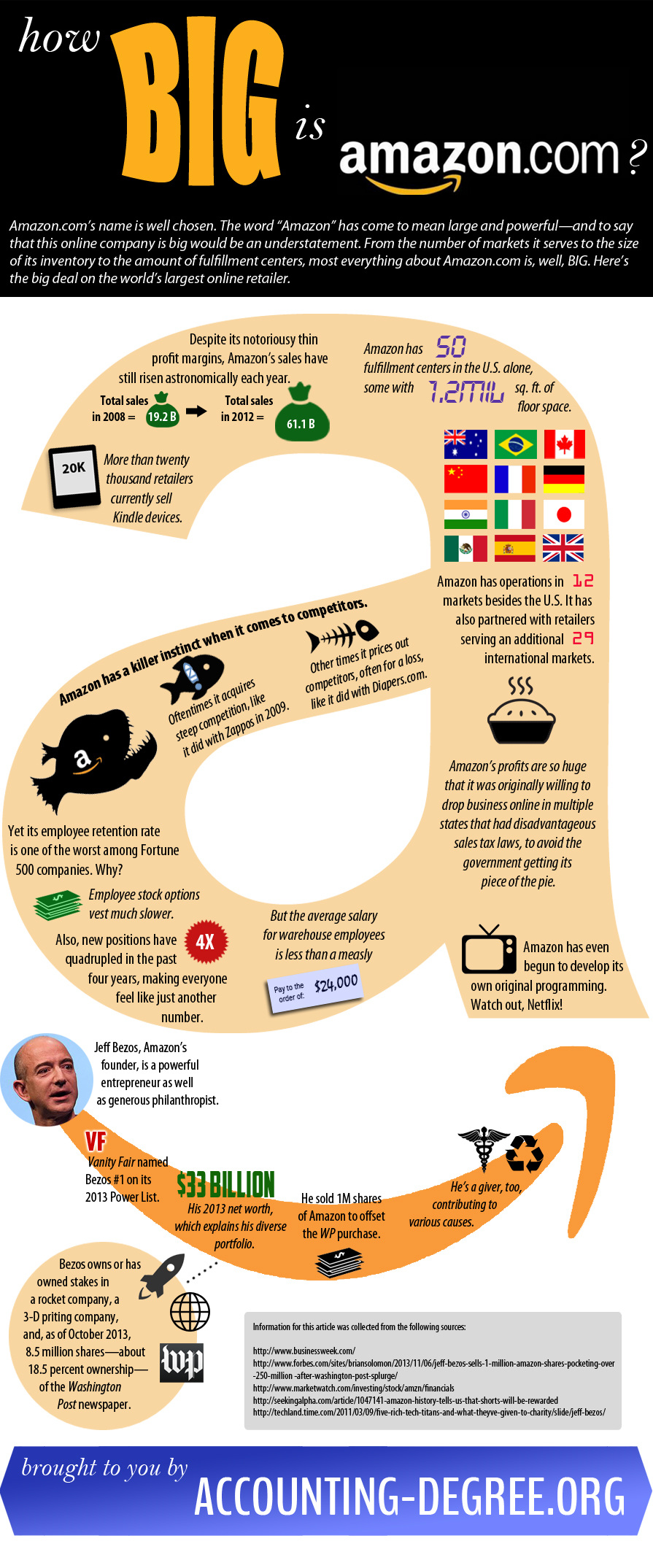
When the average consumer considers the scale of Amazon, they often visualize a sprawling warehouse or a fleet of delivery vans. However, to understand “how big” Amazon truly is from a technological perspective, one must look past the cardboard boxes and into the silicon, the code, and the massive data centers that form the backbone of the modern digital economy. Amazon is no longer merely an e-commerce company; it is a global technology infrastructure provider, an AI powerhouse, and a pioneer in robotics. Its scale is best measured not in square footage, but in petabytes, server instances, and the millions of lines of code that govern global logistics and internet traffic.

The Cloud Infrastructure: AWS and the Backbone of the Modern Internet
The most significant metric of Amazon’s technological size is Amazon Web Services (AWS). To quantify its scale, one must recognize that a significant portion of the internet lives on Amazon’s hardware. AWS is the undisputed leader in the cloud infrastructure market, consistently holding a market share that rivals its top three competitors combined.
Global Regional Footprint and Server Density
The physical footprint of AWS is staggering. As of the current architectural roadmap, AWS spans dozens of geographic regions and hundreds of “Availability Zones.” Each Availability Zone consists of one or more discrete data centers, each with redundant power, networking, and connectivity. This global network allows for the processing of unfathomable amounts of data with millisecond latency. When we ask how big Amazon is, we are asking about millions of custom-designed servers running proprietary Nitro System architectures that offload networking and storage functions to dedicated hardware, maximizing the efficiency of the main CPU.
This infrastructure is the foundation for everything from streaming giants like Netflix to critical government operations and financial institutions. The technological scale here is measured by the sheer variety of services offered—over 200 fully-featured services ranging from basic compute (EC2) and storage (S3) to advanced quantum computing environments (Braket).
Powering the Competitive Landscape
The “bigness” of AWS is also reflected in its influence on the software development lifecycle. Amazon has effectively standardized the way modern software is built, deployed, and scaled. Through the introduction of “Serverless” computing with AWS Lambda, Amazon fundamentally changed how developers think about infrastructure, allowing code to run in response to events without the need for manual server management. This shift has enabled thousands of startups to scale to millions of users overnight, further cementing Amazon’s role as the central nervous system of the tech industry.
Automation and Robotics: The Physical Tech Web
Beyond the digital cloud, Amazon’s technological scale is visible in its massive investment in robotics and autonomous systems. This is where the virtual world of algorithms meets the physical world of logistics.
The Evolution of Warehouse Intelligence
Amazon’s acquisition of Kiva Systems over a decade ago was the catalyst for a robotics revolution that has grown into one of the largest deployments of autonomous mobile robots (AMRs) in the world. Today, Amazon utilizes over 750,000 robots across its fulfillment centers. These are not simple machines; they are sophisticated edge-computing devices that navigate complex environments using computer vision and advanced pathfinding algorithms.
The scale of this operation is unprecedented. Each robot must communicate in real-time with a centralized “warehouse management system” that orchestrates the movement of millions of items. Newer models, such as Proteus—Amazon’s first fully autonomous mobile robot—can navigate around human employees safely without being confined to caged areas. This represents a massive leap in sensor fusion and real-time spatial processing, demonstrating a level of technological maturity that few other firms can match.
Last-Mile Innovations and Autonomous Systems
The technological reach extends to the “last mile” of delivery. Amazon’s Prime Air drone program and its investments in autonomous delivery vehicles represent a massive R&D commitment to solving the most difficult problems in robotics: navigation in unstructured environments. The “bigness” here is found in the complexity of the AI models required to detect power lines, domestic pets, and changing weather conditions in real-time. By developing its own custom silicon to handle these AI workloads at the edge, Amazon is positioning itself as a leader in hardware-software integration, rivaling traditional semiconductor and automotive companies.

Data, AI, and the Algorithmic Core
At the heart of Amazon’s operations is a data processing engine of unparalleled proportions. The company’s ability to predict consumer demand, optimize supply chains, and personalize user experiences is driven by a massive investment in Artificial Intelligence and Machine Learning (ML).
Personalization and Predictive Analytics at Scale
The “Amazon Flywheel” is powered by algorithms. Every interaction on the Amazon storefront—every click, hover, and purchase—feeds into a recommendation engine that handles billions of requests per day. This is not merely a marketing tool; it is a sophisticated data science operation that utilizes deep learning to forecast inventory needs weeks in advance. The scale of these models allows Amazon to place products in warehouses closer to the consumer before the consumer even knows they want to buy them—a concept known as “anticipatory shipping.”
Generative AI and the Bedrock Framework
As the industry shifts toward generative AI, Amazon’s scale has allowed it to build a comprehensive stack for LLM (Large Language Model) development. Amazon Bedrock provides developers with access to foundation models from leading AI startups alongside Amazon’s own “Titan” models. By building the infrastructure for the next generation of AI applications, Amazon ensures its continued dominance. The sheer compute power required to train these models is a testament to the company’s technological size. With custom-built AI chips like Trainium and Inferentia, Amazon is reducing its reliance on third-party silicon, creating a vertically integrated AI powerhouse that controls everything from the chip design to the end-user application.
The Software Ecosystem: Beyond the Browser
Amazon’s technological reach extends deep into the consumer’s home and the developer’s toolkit, creating a ubiquitous presence through hardware and ambient intelligence.
Alexa and Ambient Intelligence
The Alexa ecosystem represents one of the largest deployments of voice-activated AI in history. Powering hundreds of millions of devices, Alexa handles billions of interactions every week. The technical challenge of processing natural language at this scale, with minimal latency, requires a massive distributed computing architecture. Amazon’s vision of “ambient intelligence”—where technology is integrated seamlessly into the environment—requires constant innovations in far-field voice recognition, acoustic modeling, and privacy-preserving edge processing.
Hardware Strategy and Fire OS
From Kindle e-readers to Fire TV and Ring security systems, Amazon’s hardware lineup serves as an entry point into its vast software ecosystem. Each of these devices runs on custom or highly modified software stacks (such as Fire OS) designed to prioritize services and data collection. The Kindle, for instance, is a marvel of specialized display technology and power management, while Ring devices contribute to a massive, decentralized network of computer vision sensors. This interconnected web of devices creates a data loop that informs product development and improves the AI models that power the entire company.
Cybersecurity and Enterprise Solutions
A final metric of Amazon’s size is its role in the global security landscape. Because so much of the world’s data flows through AWS, Amazon has developed some of the most sophisticated cybersecurity tools in existence.
Protecting the Global Cloud
Amazon’s security protocols govern the safety of data for millions of organizations. The company employs automated reasoning—a branch of mathematical logic—to prove the security of its code and network configurations. This level of technical rigor is necessary when you are responsible for the infrastructure of the world’s largest banks and healthcare providers. The scale of Amazon’s security operations involves monitoring trillions of events per day to identify and mitigate threats before they can impact the broader internet.
The Integrated Enterprise Stack
For the modern enterprise, Amazon is more than a service provider; it is an integrated environment. Through tools like Amazon Connect (a cloud-based contact center) and Amazon Chime (communication), the company has moved up the software stack to compete directly with traditional enterprise software giants. The “bigness” of Amazon is ultimately its versatility. It possesses the rare ability to operate at the lowest levels of hardware (custom silicon and data centers) while simultaneously dominating the highest levels of consumer software and AI applications.
In summary, the question of “how big” Amazon is cannot be answered by looking at its retail market share alone. Its true size is found in the invisible layers of the digital world. It is the architect of the cloud, the leader in industrial robotics, and a primary driver of the AI revolution. For the modern technologist, Amazon is not just a company—it is the foundational platform upon which the 21st-century economy is built.
aViewFromTheCave is a participant in the Amazon Services LLC Associates Program, an affiliate advertising program designed to provide a means for sites to earn advertising fees by advertising and linking to Amazon.com. Amazon, the Amazon logo, AmazonSupply, and the AmazonSupply logo are trademarks of Amazon.com, Inc. or its affiliates. As an Amazon Associate we earn affiliate commissions from qualifying purchases.