
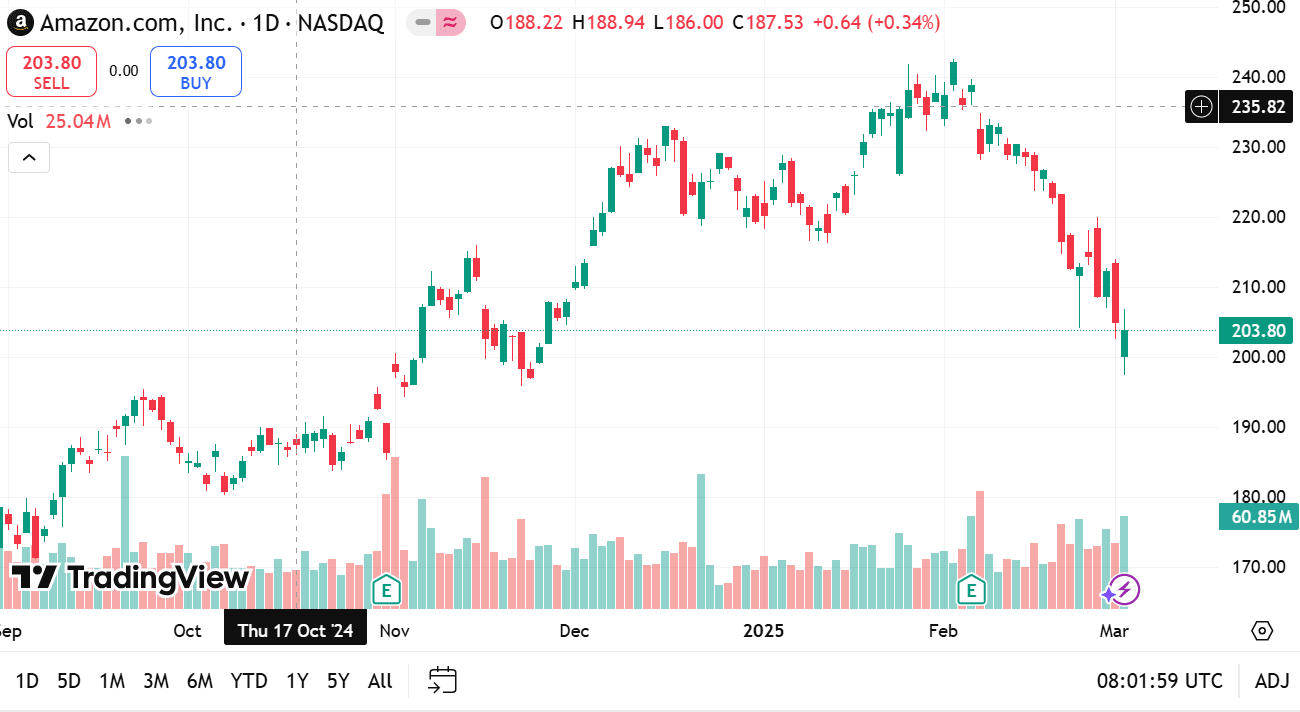
For any serious investor, the question of “what is the current stock price for Amazon” is rarely about the single numerical value displayed on a ticker at a specific moment. Instead, it is an inquiry into the underlying value, the growth trajectory, and the strategic positioning of one of the world’s most influential corporations. Amazon.com, Inc. (AMZN) has evolved from a niche online bookseller into a diversified global conglomerate with its hands in e-commerce, cloud computing, digital advertising, and artificial intelligence. Understanding its current stock price requires a comprehensive look at the financial metrics and market forces that drive its valuation.

When we look at the price of AMZN today, we are seeing the market’s real-time consensus on the company’s ability to generate future cash flows. Following its historic 20-for-1 stock split in 2022, the share price became significantly more accessible to retail investors, moving from the thousands into a more manageable triple-digit range. However, the nominal price is secondary to the company’s market capitalization and its performance relative to the broader indices like the S&P 500 and the Nasdaq-100.
The Financial Engines Powering Amazon’s Market Valuation
To understand why Amazon’s stock price sits where it does, one must dissect the various business segments that contribute to its bottom line. Amazon is no longer just a retail giant; it is a high-margin technology and services provider.
Amazon Web Services (AWS): The Profit Powerhouse
While the e-commerce platform generates the most buzz among consumers, Amazon Web Services (AWS) is the primary driver of the company’s operating income. As the global leader in cloud infrastructure, AWS provides the backbone for much of the modern internet. For investors, the “current price” of Amazon is heavily weighted by the growth and margins of AWS. When cloud spending increases across the enterprise sector, AMZN stock typically sees a positive correlation. The high margins associated with cloud computing allow Amazon to reinvest capital into more speculative or capital-intensive ventures, such as satellite internet (Project Kuiper) and healthcare.
The Evolution of Digital Advertising
A relatively recent but explosive growth area for Amazon is its advertising business. By leveraging its vast repository of consumer purchase data, Amazon has built an advertising ecosystem that rivals Google and Meta. Unlike search ads or social media ads, Amazon’s ads appear at the very point of purchase, making them incredibly valuable to brands. This high-margin revenue stream has significantly bolstered Amazon’s financial health, providing a cushion during periods when the retail segment faces headwinds like rising logistics costs or inflation.
Logistics and the Retail Flywheel
The core retail business operates on the “flywheel” principle: lower prices lead to a better customer experience, which drives more traffic, which attracts more third-party sellers, which expands the selection and allows for further price reductions. From an investment perspective, the retail side is capital-heavy. The stock price often reflects the efficiency of Amazon’s fulfillment network. When the company successfully optimizes its “last-mile” delivery and reduces shipping times through regionalization, investors respond favorably to the improved margins.
Assessing Valuation: Is the Current Price a Value Play?
Determining whether the current stock price represents a “buy” requires a shift from looking at the price per share to looking at valuation multiples. Amazon has historically traded at a high Price-to-Earnings (P/E) ratio compared to the broader market, a reflection of the market’s willingness to pay a premium for its aggressive growth and reinvestment strategy.
Interpreting the P/E Ratio and Cash Flow
For decades, traditional P/E ratios were considered a poor metric for Amazon because the company intentionally kept its net income low by reinvesting every dollar of profit back into the business. However, as the company matures, investors are increasingly looking at Free Cash Flow (FCF) and Operating Cash Flow. A rising stock price is often backed by a significant turnaround in FCF, especially after the heavy capital expenditure years required to double their fulfillment network during the pandemic era. When Amazon demonstrates that it can grow revenue while simultaneously expanding its cash flow margins, the stock price usually finds a new, higher floor.
Comparison with Peer Tech Giants
In the context of the “Magnificent Seven”—the group of high-performing tech stocks that dominate the market—Amazon’s price performance is often measured against Microsoft, Alphabet, and Apple. Investors analyze Amazon’s “PEG ratio” (Price/Earnings to Growth) to determine if the stock price is keeping pace with its projected earnings growth. If Amazon’s cloud growth outpaces Microsoft’s Azure or Alphabet’s Google Cloud, it creates a valuation premium that pushes the stock price upward.
The Impact of Share Buybacks and Capital Allocation
Management’s philosophy on capital allocation is a major determinant of the stock price. In recent years, Amazon has signaled a more disciplined approach to spending. By focusing on cost-cutting in its retail division and being more selective with its “moonshot” projects, the company has improved its earnings per share (EPS). Any announcement regarding share buybacks or, eventually, a dividend, would likely cause a structural shift in the stock’s valuation, attracting a different class of value-oriented investors.
Navigating the Risks: What Could Impact the Share Price?
No investment is without risk, and several factors can put downward pressure on Amazon’s stock price regardless of its internal performance.
Regulatory Scrutiny and Antitrust Concerns
One of the most persistent “dark clouds” over Amazon’s valuation is the threat of regulatory action. Governments in the United States and Europe have frequently scrutinized Amazon’s dual role as both a marketplace operator and a seller of its own private-label goods. Investors must account for the “regulatory discount” in the stock price—the possibility that the company could be forced to spin off AWS or change its third-party seller practices, which could disrupt its integrated business model.
Macroeconomic Factors and Consumer Sentiment
As a massive player in the consumer discretionary space, Amazon is sensitive to the health of the global economy. Inflationary pressures can increase the cost of labor and fuel, squeezing the margins of the retail business. Furthermore, if high interest rates lead to a slowdown in enterprise spending, AWS revenue could decelerate. Investors tracking the stock price must keep a close eye on Federal Reserve policy and Consumer Price Index (CPI) data, as these macro factors often dictate the short-term swings in the ticker.
Labor Relations and Operational Costs
Amazon is one of the largest employers in the world. Its stock price is sensitive to labor market trends, including wage inflation and unionization efforts. An increase in the cost of human capital directly impacts the profitability of the logistics network. To counter this, Amazon is heavily investing in robotics and automation within its warehouses. The success of these technological integrations is a key variable that institutional investors monitor when projecting the stock’s future price.
Investment Strategies for the Modern Portfolio
For those looking at the current stock price of Amazon as an entry point, the strategy should align with one’s financial goals and risk tolerance.
The Long-Term “Buy and Hold”
Historically, Amazon has rewarded patient investors. Despite periods of extreme volatility—such as the “dot-com” bust or the 2022 tech sell-off—the company’s focus on long-term market dominance has led to substantial capital appreciation over decades. For those with a 10-year horizon, the day-to-day fluctuations in the stock price are often “noise” compared to the long-term signal of Amazon’s growing ecosystem.
Dollar-Cost Averaging (DCA)
Given the inherent volatility of the tech sector, many financial advisors recommend dollar-cost averaging into a position in AMZN. By investing a fixed dollar amount at regular intervals, an investor buys more shares when the price is low and fewer shares when the price is high. This mitigates the risk of “timing the market” poorly and is particularly effective for a stock like Amazon that can experience sharp swings based on quarterly earnings reports or macroeconomic shifts.

The Role of Fractional Shares
The 2022 stock split made Amazon more accessible, but for many starting their investment journey, the use of fractional shares through modern brokerage platforms is a game-changer. It allows individuals to own a piece of the company based on a dollar amount (e.g., $50) rather than having to meet the full price of a single share. This democratizes access to high-performing assets and allows for more precise portfolio rebalancing.
In conclusion, the current stock price for Amazon is a reflection of a complex interplay between massive infrastructure, high-margin digital services, and global economic conditions. While the ticker symbol AMZN provides a snapshot of the company’s value at any given moment, the true insight for an investor lies in understanding how Amazon converts its vast data and logistical reach into sustainable, long-term cash flow. As the company continues to integrate AI into AWS and optimize its global supply chain, it remains a cornerstone of the modern financial landscape, offering a unique blend of growth potential and established market dominance.
aViewFromTheCave is a participant in the Amazon Services LLC Associates Program, an affiliate advertising program designed to provide a means for sites to earn advertising fees by advertising and linking to Amazon.com. Amazon, the Amazon logo, AmazonSupply, and the AmazonSupply logo are trademarks of Amazon.com, Inc. or its affiliates. As an Amazon Associate we earn affiliate commissions from qualifying purchases.