
In the intricate world of language, understanding the building blocks of a sentence is crucial for effective communication. While we often focus on subjects and verbs, another vital component that can significantly enhance clarity and completeness is the complement. But what exactly is a complement, and how does it function within the structure of a sentence? This article will delve into the nuances of complements, exploring their different types and their indispensable role in conveying meaning, drawing parallels to how technology, branding, and finance leverage specific elements to achieve their goals.
The Essential Role of Complements in Sentence Structure
Think of a sentence as a digital system, where each component plays a specific role to ensure the smooth flow of information. Just as a software application needs specific inputs to perform its function, or a brand needs a clear value proposition to resonate with its audience, a sentence often requires a complement to achieve its full communicative potential. Without a complement, many sentences would feel incomplete, leaving the reader with an unfulfilled sense of expectation.

A complement is essentially a word or group of words that completes the meaning of a verb, a noun, or an adjective. It provides necessary information that the subject and verb alone cannot fully convey. In many ways, complements act like the crucial details that elevate a basic design concept into a compelling brand identity, or the targeted financial strategy that turns modest savings into substantial wealth. They are the elements that add depth, specificity, and completeness.
Subject Complements: Completing the Subject’s Identity
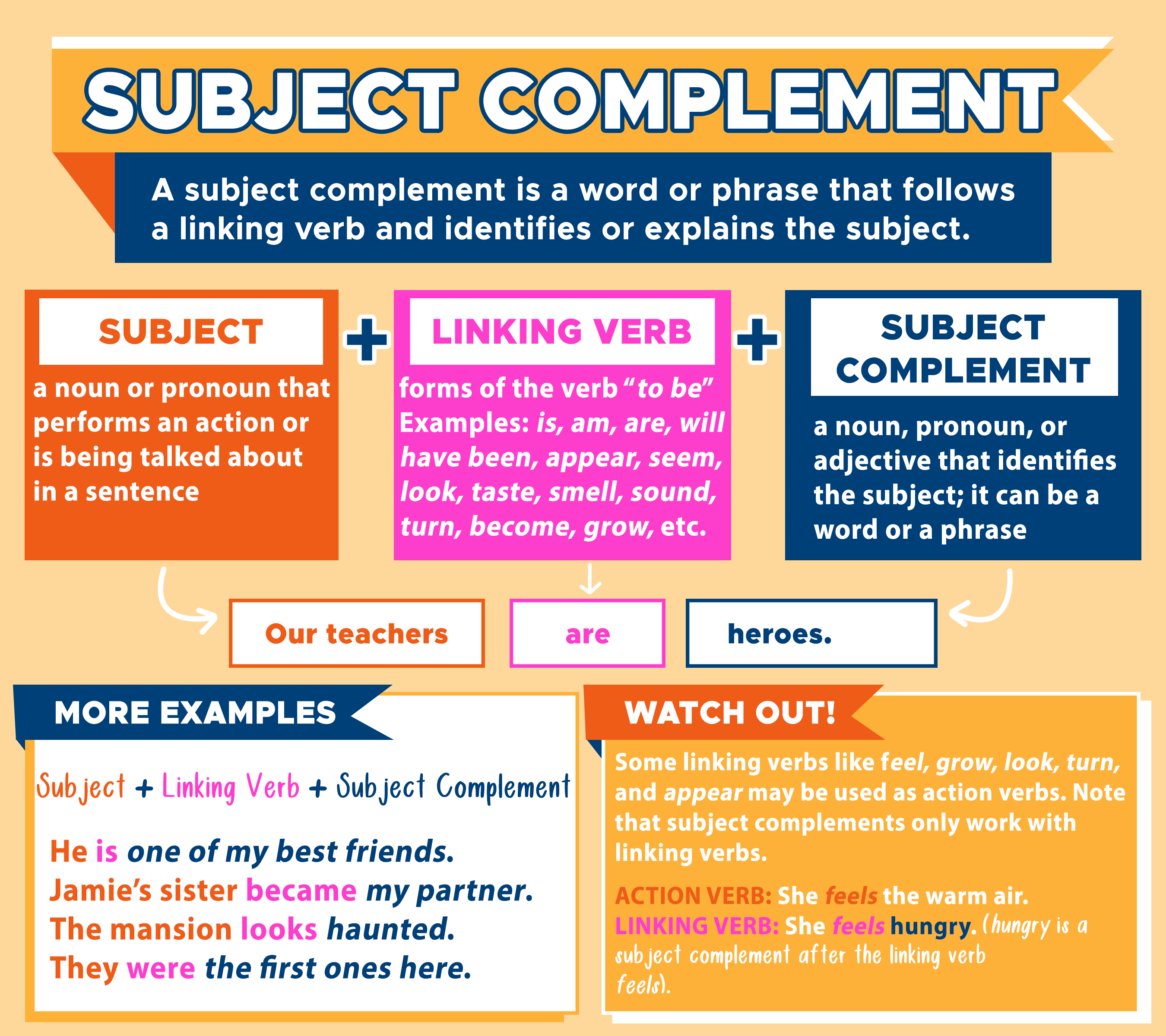
One of the most common types of complements is the subject complement. These complements follow a linking verb (such as is, am, are, was, were, be, being, seem, become, appear, feel, look, smell, sound, taste) and describe or rename the subject of the sentence. They tell us what the subject is or what it is like.
Consider the analogy of personal branding. A personal brand statement aims to define who you are and what you offer. Similarly, a subject complement defines or redefines the subject.
There are two main types of subject complements:
Predicate Nominatives: Renaming the Subject
A predicate nominative is a noun or pronoun that follows a linking verb and renames the subject. It answers the question “Who?” or “What?” after the linking verb.
Examples:
- “The CEO is a visionary leader.” Here, “a visionary leader” is the predicate nominative, renaming the subject “CEO.” Without this phrase, the sentence “The CEO is” would be incomplete and leave us wondering what the CEO is.
- “She became a renowned architect.” “A renowned architect” renames “She,” completing the meaning.
- “He is the author.” “The author” renames “He.”
In the realm of technology, think of software classifications. If we say “The new AI tool is a language model,” “a language model” functions as a predicate nominative, categorizing and defining the AI tool. It’s like assigning a specific product type to a new gadget.
Predicate Adjectives: Describing the Subject
A predicate adjective is an adjective that follows a linking verb and describes the subject. It answers the question “How?” or “What kind?” after the linking verb.
Examples:
- “The new smartphone is innovative.” “Innovative” is a predicate adjective describing the subject “smartphone.” The sentence “The new smartphone is” lacks crucial descriptive information.
- “Their marketing campaign seemed successful.” “Successful” describes the “marketing campaign.”
- “The investment opportunity looks promising.” “Promising” describes the “investment opportunity.”
In finance, adjectives describing the performance of an investment are crucial. Saying “The stock is volatile” uses “volatile” as a predicate adjective to inform investors about its nature. This is akin to providing a risk assessment for a financial product.
Object Complements: Completing the Object’s Identity
While subject complements focus on the subject, object complements follow a direct object and rename or describe that direct object. They are typically found in sentences with verbs that take direct objects and imply a change in state or an opinion about the object. Common verbs that take object complements include make, call, name, consider, elect, appoint.
Think of brand building. When a company names a new product or considers it a certain way, it’s shaping the perception of that product, much like an object complement shapes the understanding of the direct object.
There are two types of object complements:
Object Nouns: Renaming the Direct Object
When an object complement is a noun, it renames the direct object.
Examples:
- “The board named her CEO.” Here, “CEO” is an object noun that renames the direct object “her.” Without “CEO,” the sentence “The board named her” would be vague about what she was named.
- “They elected him president.” “President” renames “him.”
- “We consider the project a success.” “A success” renames “the project.”
In the context of technology, imagine a company deciding on a project’s designation. If they say, “We consider this a breakthrough,” “a breakthrough” is an object noun describing the “this” (likely referring to a specific technological advancement). This is similar to how a project manager might label a project’s phase or outcome.
Object Adjectives: Describing the Direct Object
When an object complement is an adjective, it describes the direct object.
Examples:
- “The difficult test made the students exhausted.” “Exhausted” is an object adjective describing the direct object “students.” The sentence “The difficult test made the students” would not explain the students’ state.
- “The constant updates kept the software reliable.” “Reliable” describes “the software.”
- “Her presentation found the audience attentive.” “Attentive” describes “the audience.”
This is analogous to how a company might describe the user experience of its app. “The intuitive interface made the app user-friendly.” “User-friendly” is an object adjective describing “the app.” This directly impacts how users perceive and interact with the technology.
Verb Complements: Completing the Verb’s Action (Beyond Simple Objects)
While direct objects receive the action of the verb, some verbs require additional elements to complete their meaning, often implying a recipient or a destination of the action. These can be considered verb complements in a broader sense, particularly when they are essential for the verb to make sense.
Indirect Objects: To Whom or For Whom
An indirect object typically precedes the direct object and indicates to whom or for whom the action of the verb is performed. It answers the questions “To whom?” or “For whom?”
Examples:
- “She gave her mother a gift.” “Her mother” is the indirect object, indicating to whom the gift was given. The direct object is “a gift.” Without “her mother,” the sentence “She gave a gift” is less specific about the recipient.
- “He told the audience a story.” “The audience” is the indirect object.
- “The company offered the employees a bonus.” “The employees” is the indirect object.
In branding, understanding the target audience is paramount. If a brand is “offering customers value,” “customers” are the indirect recipients of that value. This aligns with the principle of identifying and serving the intended market.
In personal finance, understanding who benefits from a financial decision is key. “He sent his son some money.” “His son” is the indirect object, the recipient of the money. This relates to family financial planning and gifting.
Prepositional Phrases as Complements
Sometimes, a prepositional phrase can function as a complement, providing essential information about the verb, noun, or adjective it modifies. This often occurs when the verb or adjective inherently requires a preposition to express its full meaning.
Examples:
- “He believes in honesty.” The prepositional phrase “in honesty” completes the meaning of the verb “believes.” Simply saying “He believes” is incomplete.
- “The new software is compatible with older systems.” The prepositional phrase “with older systems” complements the adjective “compatible.”
- “She is an expert in artificial intelligence.” The prepositional phrase “in artificial intelligence” complements the noun “expert.”
This parallels how technology often integrates with existing infrastructure. A new app might need to be “compatible with various devices,” making the prepositional phrase essential for understanding its functionality.
In branding, a brand’s message might be “relevant to its target market.” The prepositional phrase clarifies the scope of that relevance.
In finance, an investment might be “interested in sustainable growth.” The prepositional phrase specifies the nature of that interest.
The Strategic Importance of Complements in Communication
Just as a well-crafted brand strategy needs specific elements to define its unique selling proposition, and a robust financial plan requires clear objectives and action steps, a sentence needs its complements to convey precise meaning.
Clarity and Specificity: Avoiding Ambiguity
The primary function of complements is to add clarity and specificity to a sentence. Without them, sentences can be vague, open to misinterpretation, or simply feel unfinished. In the fast-paced world of technology, clear communication is vital for development and deployment. Ambiguous instructions can lead to costly errors. For instance, a tutorial that says “Install the program” is less helpful than “Install the program on your C drive.” The latter, with its prepositional phrase acting as a complement, provides the necessary specificity.
Similarly, in branding, a vague tagline like “We are the best” is less effective than one that specifies how they are the best, such as “We are the best for reliable data security.” This adds a crucial layer of understanding.
In finance, saying “Invest your money” is less actionable than “Invest your money in low-risk bonds.” The complement clarifies the investment strategy.
Completeness and Satisfaction: Fulfilling Reader Expectations
Complements contribute to the feeling of completeness in a sentence, satisfying the reader’s expectation for a full thought. When a sentence is grammatically complete with a subject, verb, and any necessary complements, it leaves the reader with a sense of closure and understanding. This is akin to a user experiencing a complete and satisfying interaction with a piece of technology, or a customer feeling that a brand has fully addressed their needs.
Consider a website review. If the review states, “The app is,” the reader is left wanting more. But if it says, “The app is incredibly user-friendly,” the sentence is complete, and the reader understands a key attribute.
A brand promise needs to feel complete. “Our products are” is unsatisfying. But “Our products are designed for durability” provides a complete and reassuring statement.
A financial goal needs to feel achievable. “Save money” is a start, but “Save money for a down payment” offers a concrete purpose and sense of completion.

Conclusion: The Indispensable Complement
In essence, a complement is a crucial element that elevates a sentence from a basic statement to a fully realized expression of meaning. Whether it’s a predicate nominative defining a subject, a predicate adjective describing it, an object complement renaming or characterizing a direct object, or a prepositional phrase providing essential context, complements play an indispensable role in ensuring clarity, specificity, and completeness.
Just as advancements in AI tools can enhance productivity, a clear brand strategy can build a strong reputation, and sound financial planning can secure future wealth, a solid understanding and application of sentence complements can significantly improve the effectiveness of our written and spoken communication. By recognizing and utilizing these vital components, we can build more robust, articulate, and impactful sentences, ensuring our messages are received precisely as intended. So, the next time you construct a sentence, remember the power of the complement to complete the picture and enrich your communication.
aViewFromTheCave is a participant in the Amazon Services LLC Associates Program, an affiliate advertising program designed to provide a means for sites to earn advertising fees by advertising and linking to Amazon.com. Amazon, the Amazon logo, AmazonSupply, and the AmazonSupply logo are trademarks of Amazon.com, Inc. or its affiliates. As an Amazon Associate we earn affiliate commissions from qualifying purchases.