
Apple Inc. (AAPL) stands as a cornerstone of the modern financial markets. For many individual investors, the question of “how much is a share of Apple stock” is often the first step in a broader journey toward building a diversified investment portfolio. As of the current market cycle, Apple consistently fluctuates as one of the most valuable companies in the world by market capitalization, often vying for the top spot with other tech giants. However, the price of a single share is more than just a number on a ticker; it is a reflection of global consumer demand, corporate efficiency, and the broader health of the equity markets.

To understand the cost of a share of Apple today, one must look beyond the real-time quote found on a brokerage app. One must analyze the valuation metrics, the historical context of stock splits, and the fundamental drivers that cause that price to move. Whether you are a seasoned value investor or a newcomer looking to put your first hundred dollars to work, understanding the financial anatomy of Apple is essential.
Decoding the Price: What Determines the Cost of AAPL?
The nominal price of a share of Apple stock—whether it is trading at $150, $190, or $230—is determined by the basic laws of supply and demand in the public marketplace. However, for the serious investor, the “price” is only a starting point. To understand if that price represents a bargain or an overvaluation, we must look at the underlying financial structure of the company.
Market Capitalization vs. Share Price
Market capitalization is the total dollar market value of a company’s outstanding shares of stock. It is calculated by multiplying the current share price by the total number of outstanding shares. Apple famously became the first U.S. company to hit a $1 trillion market cap, followed by $2 trillion and $3 trillion milestones.
When you ask how much a share costs, you are looking at a fractional slice of that multi-trillion-dollar valuation. If Apple has billions of shares outstanding, a $200 share price implies a much larger company than a different firm with a $500 share price but only a few million shares. Therefore, investors should always view the share price in the context of the total market cap to understand the company’s true scale in the financial ecosystem.
The Role of Stock Splits
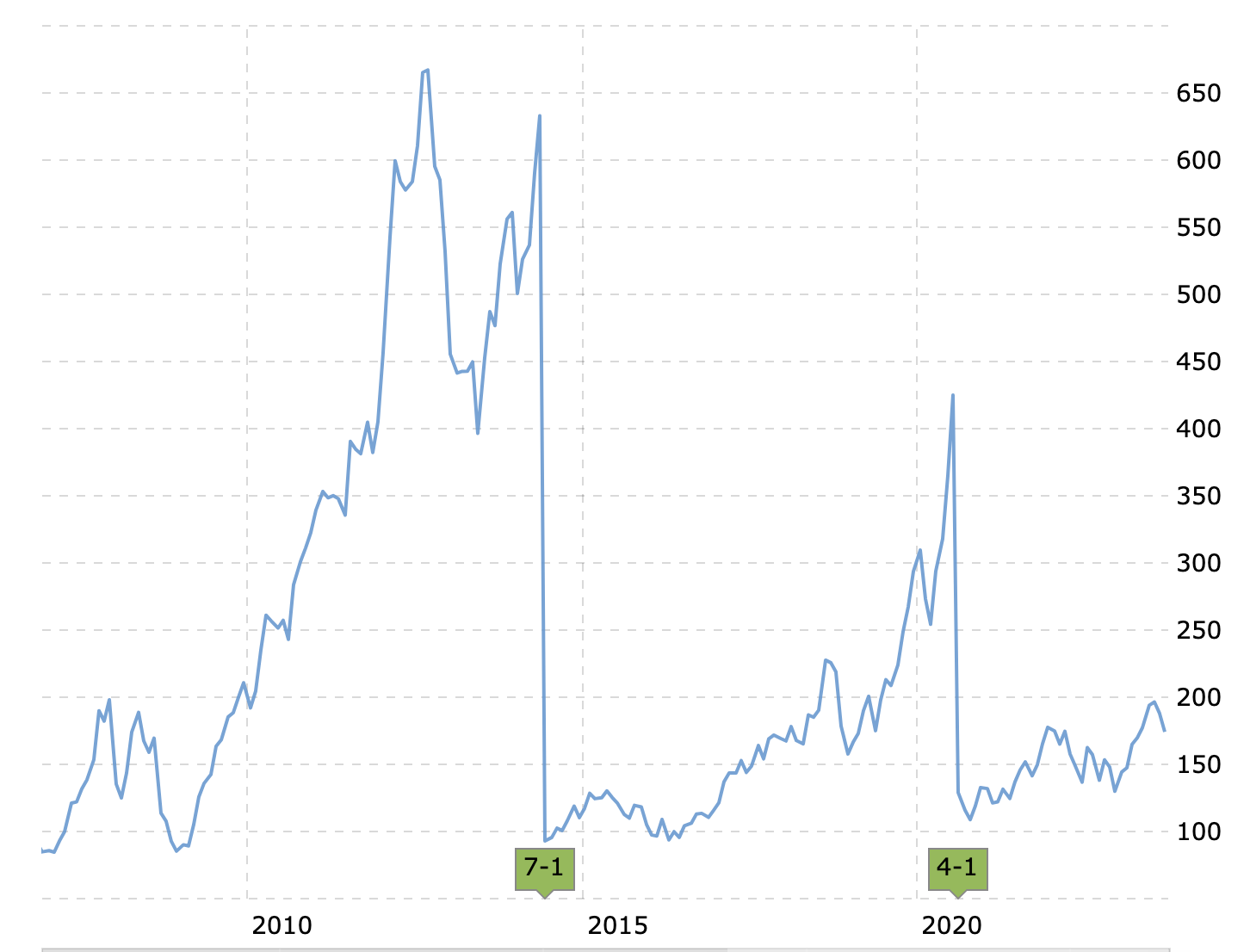
If you look at Apple’s historical charts, you might see prices from the 1980s or 90s that look like pennies. This is due to stock splits. Apple has split its stock several times in its history—most recently a 4-for-1 split in 2020.
The purpose of a stock split is typically to make the shares more accessible to retail investors. When a stock price climbs too high—say, toward $500 or $1,000—it can become difficult for small-scale investors to buy a single share. By splitting the stock, Apple increases the number of shares while decreasing the price per share proportionally. For the investor, the total value of their holding remains the same, but the “entry price” for a new share becomes more manageable. This historical context is vital; without these splits, a single share of Apple would cost thousands of dollars today, making it a “heavy” stock similar to Berkshire Hathaway Class A.
Real-Time Volatility
The price of Apple stock is not static. It changes every second during market hours (9:30 AM to 4:00 PM EST) and continues to move in after-hours trading. These fluctuations are driven by high-frequency trading algorithms, institutional rebalancing, and retail sentiment. Daily price movements are often “noise,” but they provide the entry and exit points that dictate an investor’s realized returns.
Key Financial Indicators Driving Share Value
To determine if the current price of Apple stock is “expensive” or “cheap” from a fundamental perspective, investors look at specific financial ratios and performance indicators. These metrics tell the story of the company’s profitability and its ability to generate cash.
The Price-to-Earnings (P/E) Ratio
The P/E ratio is perhaps the most widely used metric for valuing Apple. It compares the current share price to the company’s earnings per share (EPS). Historically, Apple traded at a lower P/E ratio when it was viewed strictly as a hardware company subject to “boom and bust” product cycles.
As Apple successfully transitioned toward a services-oriented business model (including the App Store, iCloud, and Apple Pay), the market began to award it a higher P/E multiple. A higher P/E suggests that investors are willing to pay more today for each dollar of profit because they expect consistent, recurring growth in the future. Comparing Apple’s current P/E to its five-year average or to the S&P 500 average helps investors decide if the current share price is justified by its earnings power.
Revenue Streams: Hardware vs. Services
The share price reacts sharply to Apple’s quarterly earnings reports, specifically the breakdown of revenue. While the iPhone remains the primary driver of the stock’s price, the growth of the “Services” segment is what often dictates the long-term trajectory of the share value.
Services have higher profit margins than hardware. When Apple reports a surge in service subscriptions, the stock price often responds positively because it represents “high-quality” revenue that isn’t dependent on a customer buying a new physical phone every year. Investors tracking the price of Apple must monitor these segments to see if the company is maintaining its ecosystem’s “stickiness.”

Dividend Yield and Share Buybacks
For many investors, the cost of an Apple share is offset by the income it generates. Apple is a prolific returner of capital to shareholders. It pays a quarterly dividend, and although the yield is often modest (typically under 1%), it is exceptionally reliable.
More significant than the dividend is Apple’s share buyback program. Apple uses its massive cash reserves to buy its own shares off the open market and retire them. This reduces the total number of shares outstanding, which increases the “Earnings Per Share” and, theoretically, puts upward pressure on the stock price. This financial engineering is a major reason why Apple’s share price has shown such resilience over the last decade.
The Macroeconomic Environment and the Tech Sector
The price of a share of Apple does not exist in a vacuum. External economic forces play a massive role in how much you will pay for the stock at any given time.
Interest Rates and Inflation
Technology stocks, even established ones like Apple, are sensitive to interest rate changes by the Federal Reserve. When interest rates rise, the “discount rate” applied to future cash flows increases, which can lower the current valuation of growth stocks. Furthermore, high interest rates increase the cost of borrowing for consumers, potentially dampening demand for luxury tech products like the MacBook Pro or the latest iPhone.
Global Supply Chain and Currency Risks
Apple is a global entity with a complex supply chain centered largely in Asia. Disruptions in manufacturing or geopolitical tensions can lead to supply shortages, which negatively impact quarterly revenue and, consequently, the share price.
Additionally, because Apple earns a significant portion of its revenue in foreign currencies but reports its earnings in U.S. dollars, a “strong dollar” can actually hurt the company’s bottom line. When the dollar is strong, the euros and yen Apple earns convert into fewer dollars, which can lead to “earnings misses” that cause the share price to drop, even if the business is performing well operationally.
Strategic Investing: How to Buy Apple Stock
If you have determined that the current price of Apple fits your investment criteria, the next step is the mechanical process of acquisition. The modern financial landscape has made it easier than ever to own a piece of this tech giant.
The Rise of Fractional Shares
In the past, if a share of Apple cost $200 and you only had $50, you were out of luck. Today, most major brokerages offer fractional shares. This means you can invest based on a dollar amount rather than a share count. If you want to invest $20 into Apple, the brokerage will simply credit your account with 1/10th of a share (assuming a $200 price). This has democratized access to the stock, allowing investors to utilize “dollar-cost averaging”—the practice of investing a fixed amount of money at regular intervals, regardless of the share price.
Choosing the Right Account Type
When purchasing Apple stock, the “where” is as important as the “how much.”
-
Individual Brokerage Account: Offers the most flexibility but is subject to capital gains taxes when you sell for a profit.
-
Roth IRA or Traditional IRA: These are tax-advantaged retirement accounts. Buying Apple within an IRA can allow your investment to grow tax-free or tax-deferred, which is highly beneficial for long-term compounding.
-
ETFs and Index Funds: If the price of a single share feels too risky, many investors own Apple through exchange-traded funds like the QQQ (which tracks the Nasdaq-100) or SPY (which tracks the S&P 500). Because Apple is a top holding in these funds, a significant portion of every dollar you invest in them goes directly toward Apple shares.
Risks and the Long-Term Outlook
No investment is without risk, and the share price of Apple is subject to various “bear case” scenarios that investors must weigh against the “bull case.”
Regulatory and Antitrust Challenges
One of the primary threats to Apple’s valuation is government intervention. Regulators in the U.S. and the European Union have consistently scrutinized Apple’s App Store practices and its “walled garden” ecosystem. Fines or forced changes to their business model (such as allowing third-party app stores) could impact the high-margin Services revenue, potentially leading to a de-rating of the stock’s P/E multiple and a lower share price.
Innovation and Competition
Apple’s current share price accounts for its future innovation. Investors are currently watching the company’s integration of Artificial Intelligence (AI) and its foray into spatial computing with the Vision Pro. If Apple fails to lead in the AI revolution or if a new competitor disrupts the smartphone market, the “premium” that investors pay for Apple stock could evaporate.
Conclusion for the Modern Investor
The answer to “how much is a share of Apple stock” is a moving target, shaped by quarterly earnings, macroeconomic shifts, and investor psychology. For the long-term investor, the specific price on any given Tuesday is often less important than the company’s underlying fundamentals. Apple remains a cash-flow machine with a loyal customer base and a massive balance sheet. Whether the price is high or low today, the decision to buy should be based on a thorough analysis of your own financial goals, risk tolerance, and belief in the company’s ability to innovate over the next decade. By focusing on valuation metrics rather than just the ticker price, you can make an informed decision on how to integrate this financial powerhouse into your personal portfolio.
aViewFromTheCave is a participant in the Amazon Services LLC Associates Program, an affiliate advertising program designed to provide a means for sites to earn advertising fees by advertising and linking to Amazon.com. Amazon, the Amazon logo, AmazonSupply, and the AmazonSupply logo are trademarks of Amazon.com, Inc. or its affiliates. As an Amazon Associate we earn affiliate commissions from qualifying purchases.