
Understanding how loan payments are calculated is more than just a mathematical exercise; it is a fundamental pillar of financial literacy. Whether you are signing for a mortgage, financing a vehicle, or managing student debt, the mechanics behind your monthly obligation determine how much you pay over the life of the loan and how quickly you build equity in your assets. To the untrained eye, a monthly payment may seem like a static number chosen by a lender, but it is actually the result of a precise formula that balances the principal amount, the interest rate, and the duration of the debt.

The Fundamental Anatomy of a Loan Payment
At its core, a standard installment loan payment is composed of two primary elements: principal and interest. However, depending on the type of loan, other costs such as insurance, taxes, and fees may also be bundled into that single monthly check.
Principal vs. Interest
The principal is the original sum of money you borrowed. If you take out a $30,000 car loan, your initial principal is $30,000. Interest, on the other hand, is the cost of borrowing that money. It is essentially the “rent” you pay to the lender for the privilege of using their capital. In the early stages of most loans, a larger portion of your payment goes toward interest. As the principal balance decreases, the amount of interest charged also drops, allowing more of your payment to be applied to the principal.
The Role of the Interest Rate
The interest rate is expressed as a percentage of the principal. Lenders determine this rate based on a variety of factors, including the federal funds rate, inflation, and your individual creditworthiness. A higher interest rate significantly increases the total cost of the loan because it accelerates the rate at which interest accrues on the outstanding balance. Even a 1% difference in an interest rate on a 30-year mortgage can result in tens of thousands of dollars in additional costs over the life of the loan.
Loan Term and Frequency
The “term” is the length of time you have to repay the loan. Common terms include 36 to 72 months for auto loans and 15 to 30 years for mortgages. While a longer term results in a lower monthly payment, it also means you will pay interest for a longer duration, increasing the total cost of the debt. Most loans are calculated on a monthly basis, but some business or personal loans may utilize bi-weekly or even daily interest accrual models.
The Mathematics of Amortization
Most consumer loans—specifically mortgages and auto loans—use a process called amortization. An amortized loan is structured so that the borrower makes a fixed payment every month, but the internal composition of that payment changes over time.
The Standard Amortization Formula
The formula used to calculate a fixed monthly payment (P) is as follows:
P = [r * PV] / [1 – (1 + r)^-n]
In this equation:
-
PV (Present Value) represents the total amount borrowed.
-
r represents the periodic interest rate. To find this, you divide the annual interest rate by the number of payments per year (usually 12).
-
n represents the total number of payments (months).
For example, if you borrow $200,000 at a 6% annual interest rate for 30 years, your “r” would be 0.005 (0.06 / 12), and your “n” would be 360 (30 * 12). Plugging these numbers into the formula yields the monthly principal and interest payment.
Understanding the Amortization Schedule
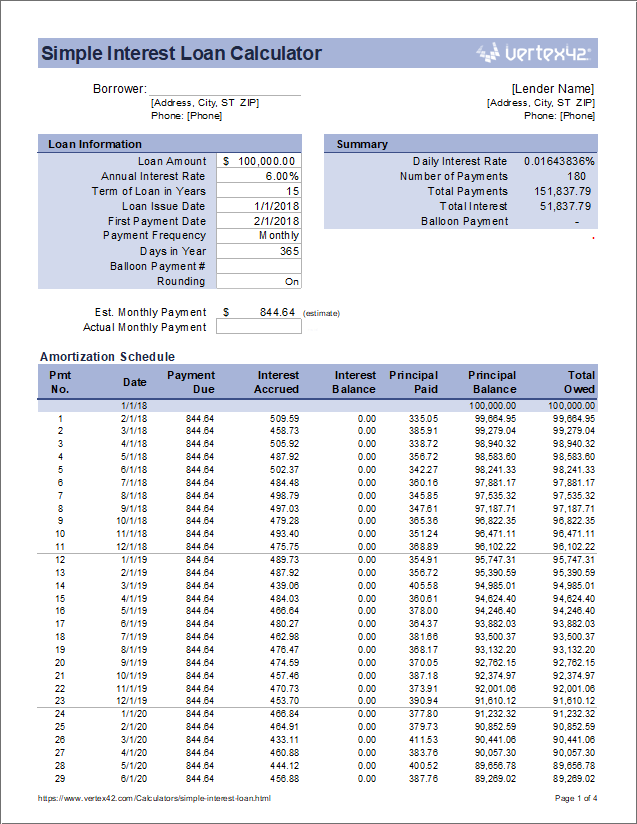
An amortization schedule is a table that details every payment over the life of the loan. It shows exactly how much of each payment is allocated to interest and how much goes toward reducing the principal. In the first month of a long-term loan, the interest is calculated based on the full original balance. As you pay down the principal, the interest for the subsequent month is calculated based on the new, slightly lower balance. This creates a “snowball effect” where the principal reduction accelerates toward the end of the loan term.
The Impact of Compound Interest
Most modern loans utilize compound interest, meaning interest is calculated on the principal plus any accumulated interest. However, with standard installment loans, as long as you make your payments on time, the interest does not “compound” in the traditional sense because you are paying off the accrued interest each month before it can be added to the principal. The mathematical structure of the amortization formula accounts for this to ensure the loan is at a zero balance by the end of the term.

Different Types of Loans and Their Calculation Nuances
While the standard amortization formula covers many scenarios, different financial products utilize unique calculation methods that can drastically change your repayment experience.
Simple Interest Loans
Simple interest is most commonly found in short-term personal loans and some auto loans. Unlike complex amortization, simple interest is calculated daily based on the principal balance. The formula is: Interest = Principal x Rate x Time. If you pay a simple interest loan off early, you save significantly on interest because the interest is not “front-loaded” in the same way as a traditional mortgage.
Credit Cards and the Daily Balance Method
Credit cards do not have a fixed “term,” making them revolving debt. Lenders usually calculate interest based on your “Average Daily Balance.” They take the balance at the end of each day in the billing cycle, add them together, and divide by the number of days in the cycle. This result is then multiplied by the daily periodic rate (APR divided by 365). This is why carrying a balance on a credit card is so expensive; the interest compounds daily, leading to rapid debt growth if only minimum payments are made.
Interest-Only Loans
In an interest-only loan, the borrower is only required to pay the interest charges for a set period, often five to ten years. During this time, the principal balance does not decrease. While this results in a much lower monthly payment initially, it can lead to “payment shock” once the interest-only period ends and the loan begins to amortize over the remaining term, or requires a large “balloon payment” of the full principal.
Variable-Rate vs. Fixed-Rate Calculations
Fixed-rate loans use the same interest rate for the duration of the term, making the calculation straightforward. Variable-rate loans (or Adjustable-Rate Mortgages – ARMs) are tied to an index, such as the SOFR or the Prime Rate. When the index moves, the lender recalculates the payment based on the current principal balance and the remaining term. This can cause payments to fluctuate significantly, complicating long-term budgeting.
Factors That Influence Your Total Loan Cost
Beyond the basic calculation of a monthly payment, several external factors can alter the “effective” cost of your loan.
Fees and the APR
The interest rate is not the same as the Annual Percentage Rate (APR). While the interest rate calculates the monthly payment, the APR reflects the total cost of borrowing, including origination fees, mortgage insurance, and closing costs. When comparing loans, the APR is the more accurate metric for understanding the “true” math of the debt. If two loans have the same interest rate but one has a higher APR, the latter is more expensive because of the upfront fees baked into the calculation.
Prepayment and Extra Principal Payments
One of the most effective ways to disrupt the standard loan calculation is through prepayment. By paying more than the required monthly amount and specifying that the extra funds go toward the principal, you reduce the balance on which future interest is calculated. This effectively “shortens” the amortization schedule. For instance, making one extra mortgage payment per year can often shave five to seven years off a 30-year mortgage and save the borrower tens of thousands in interest.
Escrow and PITI
For homeowners, the monthly check sent to the bank is often higher than the calculated principal and interest. This is known as PITI: Principal, Interest, Taxes, and Insurance. Lenders often require an escrow account to ensure property taxes and homeowner’s insurance are paid. While the principal and interest are calculated via the amortization formula, the tax and insurance portions are estimates that can change annually based on local tax assessments and insurance premiums.
Strategic Approaches to Managing Loan Repayment
Understanding the math allows borrowers to take a more proactive approach to debt management.
Refinancing and Consolidation
Refinancing involves taking out a new loan to pay off an old one, typically at a lower interest rate or for a different term. By recalculating the debt at a lower rate, you reduce the interest portion of your monthly payment. Debt consolidation works similarly but combines multiple high-interest debts (like credit cards) into a single loan with a structured amortization schedule, often resulting in lower overall interest costs.
The Psychology of the Calculation
Financial experts often debate between the “Debt Snowball” and “Debt Avalanche” methods. The Snowball method ignores interest rates and focuses on paying off the smallest balances first for psychological wins. The Avalanche method, however, focuses on the mathematical reality of loan calculations, prioritizing the debt with the highest interest rate to minimize the total amount paid to the lender.
Ultimately, every loan payment is a balance between the time you take to pay and the cost you are willing to incur. By mastering the variables of principal, rate, and term, you transition from being a passive payer to an informed strategist capable of optimizing your financial future. Knowledge of these calculations provides the clarity needed to navigate the complex landscape of personal and business finance with confidence.
aViewFromTheCave is a participant in the Amazon Services LLC Associates Program, an affiliate advertising program designed to provide a means for sites to earn advertising fees by advertising and linking to Amazon.com. Amazon, the Amazon logo, AmazonSupply, and the AmazonSupply logo are trademarks of Amazon.com, Inc. or its affiliates. As an Amazon Associate we earn affiliate commissions from qualifying purchases.