
For most consumers, purchasing a vehicle represents the second-largest financial commitment of their lives, trailing only the purchase of a home. While the “sticker price” or the negotiated sale price of the car often takes center stage during the buying process, the true cost of ownership is significantly influenced by the interest accrued over the life of the loan. Understanding how auto loan interest is calculated is not merely an academic exercise; it is a vital financial skill that can save a borrower thousands of dollars.
Unlike credit cards, which often utilize complex compounding methods, or mortgages, which involve long-term amortization schedules, most auto loans operate on a specific mathematical framework known as simple interest. By deconstructing this formula and understanding the variables that influence it, borrowers can make more informed decisions about their financing options.
The Mechanics of the Simple Interest Model
The vast majority of modern auto loans are structured as simple interest loans. This means that the interest is calculated based on the principal balance remaining on the day the payment is due. Because the principal balance decreases with every monthly payment, the amount of interest you owe also decreases over time.
The Daily Interest Factor
To understand the calculation, one must first look at the daily interest factor. Lenders typically take your annual percentage rate (APR) and divide it by 365 (the number of days in a year). This gives the lender a daily interest rate. For example, if you have an APR of 6%, your daily interest rate would be approximately 0.0164% (0.06 / 365).
Every day, this daily rate is multiplied by your current principal balance. This “daily interest” accumulates until your next payment is made. When you send your monthly check to the lender, the payment is first applied to the interest that has accrued since your last payment. The remainder of the payment is then applied to the principal balance. This cycle repeats monthly, with a smaller portion going toward interest and a larger portion going toward the principal as the loan matures.
Simple Interest vs. Precomputed Interest
While simple interest is the industry standard, it is important to be aware of “precomputed interest” loans, which are less common but still exist in some subprime markets. In a precomputed loan, the total amount of interest for the entire term of the loan is calculated at the beginning and added to the principal.
The primary difference is that with simple interest, you can save money by paying off the loan early or making extra payments, as you are reducing the principal balance that the daily interest is based on. In a precomputed loan, the interest is already “baked in,” and paying early may not provide the same financial benefit. Always confirm with your lender that your contract uses the simple interest method.
The Determinants of Your Interest Rate
The specific percentage used to calculate your interest is not arbitrary. It is a reflection of risk, market conditions, and the value of the collateral. Several key factors determine the rate a lender offers.
Credit Score and Risk Tiers
Your credit score is the most significant factor in the calculation of your auto loan interest. Lenders categorize borrowers into “tiers” based on their FICO scores. Borrowers in the “super-prime” category (typically 780 and above) receive the lowest rates because they have a proven track record of timely repayment. Conversely, “subprime” borrowers (scores below 600) may face interest rates that are significantly higher—sometimes triple or quadruple the prime rate—to compensate the lender for the increased risk of default.
The Loan Term and Its Impact
The duration of the loan—the “term”—also plays a critical role in interest calculation. While a longer term (such as 72 or 84 months) results in a lower monthly payment, it usually carries a higher interest rate. Lenders view longer terms as higher risk because the future is unpredictable, and the vehicle’s value will depreciate significantly over that time. Furthermore, because the interest is calculated over a longer period, the total interest paid over the life of an 84-month loan will be vastly higher than that of a 48-month loan, even if the APR were identical.
Vehicle Age and Condition
Interest rates for used cars are almost always higher than for new cars. This is because the resale value of a used car is more difficult to predict, and the vehicle is more likely to experience mechanical failures that could lead a borrower to stop making payments. Lenders use the car itself as collateral; therefore, the more reliable the collateral, the lower the interest rate tends to be.
Decoding the Amortization Process
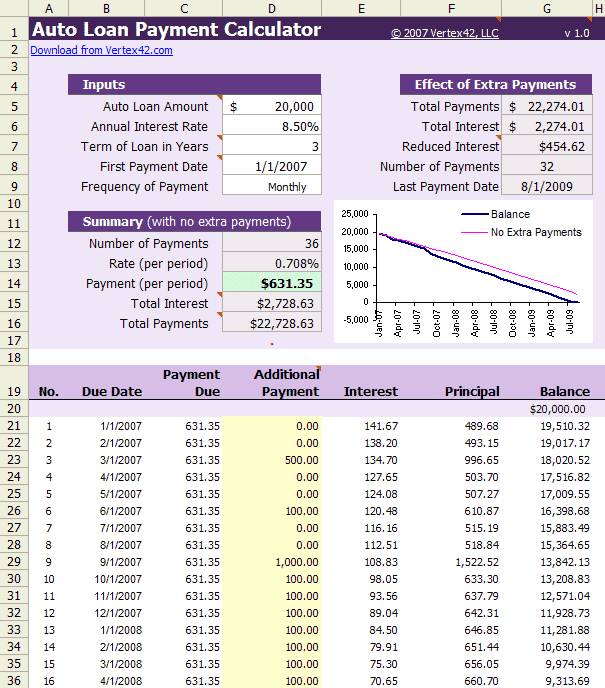
Amortization is the process of spreading out a loan into a series of fixed payments. While your monthly payment remains the same throughout the life of an auto loan, the internal composition of that payment shifts every month.
The Shift from Interest to Principal
In the early stages of an auto loan, your principal balance is at its highest. Consequently, the interest calculation (Daily Rate x Principal) results in a larger amount. This means that during the first year of your loan, a significant portion of your monthly payment is “wasted” on interest, and only a small fraction goes toward actually owning the car.
As you progress through the loan, the principal balance drops. With a lower balance, the interest charge for the month decreases. Because your total monthly payment is fixed, the “extra” money is redirected to the principal. By the final year of the loan, the vast majority of your payment is being applied to the principal balance, with only a few dollars going toward interest.
The “Underwater” Risk
Understanding amortization is crucial for avoiding “negative equity,” often referred to as being “underwater” on a loan. Because cars depreciate rapidly—often losing 20% of their value in the first year—and because amortization schedules back-load the principal repayment, it is common for a borrower to owe more on the loan than the car is worth during the first two to three years. This risk is exacerbated by low down payments and long loan terms, where the principal balance is not reduced fast enough to keep pace with the vehicle’s declining market value.
The Math Behind the Monthly Payment
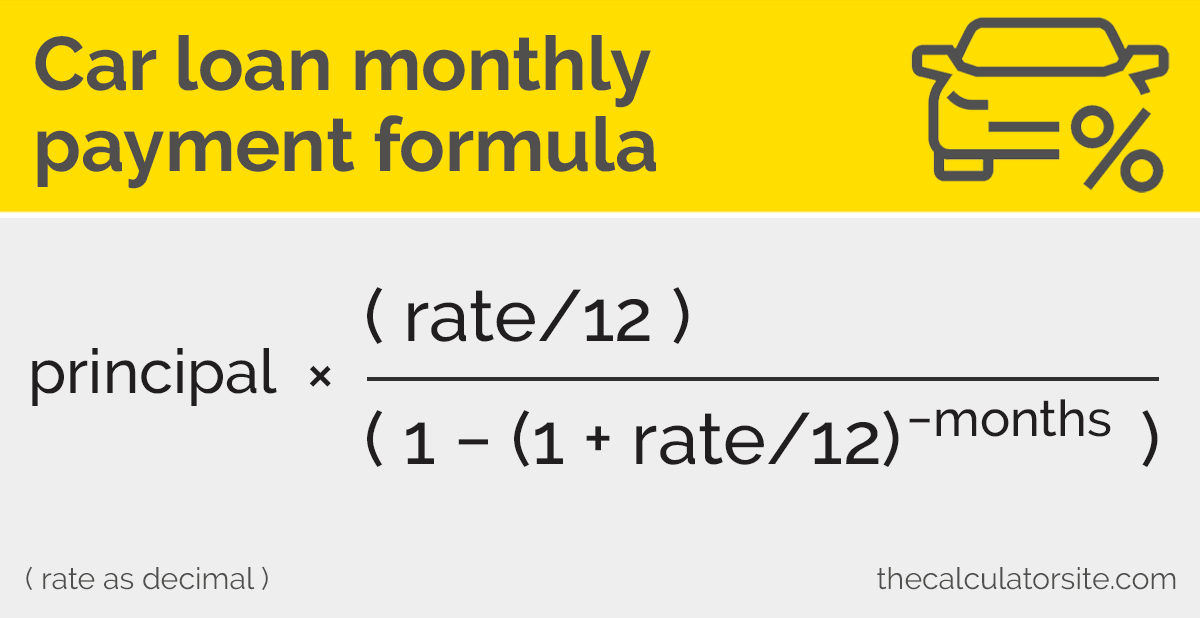
To calculate the exact monthly payment and the interest components, lenders use a specific formula. While most people use online calculators, understanding the underlying math provides clarity on how the variables interact.
The formula for a monthly payment (M) on a simple interest loan is:
M = P [ i(1 + i)^n ] / [ (1 + i)^n – 1 ]
-
P = Principal loan amount
-
i = Monthly interest rate (Annual Rate / 12)
-
n = Number of months (loan term)
A Practical Example
Imagine you take out a $30,000 loan for a new SUV at a 5% APR for 60 months.
-
Your monthly interest rate (i) is 0.05 / 12 = 0.004167.
-
Your number of months (n) is 60.
Plugging these numbers into the formula reveals a monthly payment of approximately $566.14.
In the first month:
-
Interest = $30,000 * 0.004167 = $125.01
-
Principal = $566.14 – $125.01 = $441.13
In the second month, the interest is calculated on the new principal of $29,558.87 ($30,000 – $441.13):
-
Interest = $29,558.87 * 0.004167 = $123.17
-
Principal = $566.14 – $123.17 = $442.97
As shown, the interest decreased by nearly two dollars in just one month. Over 60 months, this compounding effect of principal reduction leads to the total repayment of the debt.
APR vs. Interest Rate
It is important to distinguish between the “base interest rate” and the “Annual Percentage Rate” (APR). The interest rate is the percentage used for the daily calculation. The APR, however, includes the interest rate plus any additional lender fees or prepaid finance charges (such as origination fees). For the most accurate understanding of your costs, always use the APR when comparing loan offers, as it represents the true annual cost of borrowing.
Advanced Strategies to Reduce Interest Expenses
Once you understand how interest is calculated, you can employ strategies to manipulate the math in your favor. Since interest is calculated based on the remaining principal, anything that reduces that principal faster will save you money.
The Power of the Down Payment
The most effective way to reduce interest is to borrow less. A substantial down payment reduces the initial principal (P), which immediately lowers the amount of interest calculated every day from day one. Additionally, a higher down payment improves your loan-to-value (LTV) ratio, which may qualify you for a lower APR tier, providing a double benefit.
Bi-Weekly Payments and Rounding Up
Since auto loans use simple interest, the timing of your payments matters. By making a payment every two weeks instead of once a month, you are effectively making 13 full payments a year instead of 12. More importantly, you are reducing the principal balance more frequently, which slows the accrual of daily interest. Even simply “rounding up” your payment—for example, paying $600 instead of $566—can shave months off the loan term and save hundreds in interest charges.
Refinancing in a Lower Rate Environment
Interest calculation is not static. If your credit score improves significantly after a year of timely payments, or if market interest rates drop, you may be able to refinance your loan. Refinancing involves taking out a new loan at a lower APR to pay off the old one. By lowering the “i” in the calculation formula, you ensure that a greater percentage of your monthly payment goes toward the principal, accelerating your path to full ownership.

Financial Empowerment Through Mathematical Clarity
Understanding how auto loan interest is calculated transforms a monthly bill from a mysterious obligation into a manageable financial variable. By recognizing the impact of the daily interest factor, the structure of amortization, and the influence of credit tiers, consumers can move beyond simply looking at a monthly payment.
True financial health in the context of an auto loan involves minimizing the total cost of the debt. Whether through negotiating a lower APR, choosing a shorter term, or making strategic extra payments, the goal remains the same: to reduce the principal as quickly as possible. In the world of personal finance, knowledge of the math is the most effective tool for keeping more of your money in your pocket and less in the hands of the lender.
aViewFromTheCave is a participant in the Amazon Services LLC Associates Program, an affiliate advertising program designed to provide a means for sites to earn advertising fees by advertising and linking to Amazon.com. Amazon, the Amazon logo, AmazonSupply, and the AmazonSupply logo are trademarks of Amazon.com, Inc. or its affiliates. As an Amazon Associate we earn affiliate commissions from qualifying purchases.