
Purchasing a car is often one of the most significant financial decisions individuals make, second only to buying a home. For most, this substantial investment is facilitated through an auto loan, transforming a large upfront cost into manageable monthly payments. However, the seemingly straightforward concept of a monthly car payment can obscure a complex interplay of financial variables. Understanding how these payments are calculated is not merely an academic exercise; it is a critical step towards financial literacy, empowering you to make informed decisions, negotiate effectively, and manage your personal budget with precision.
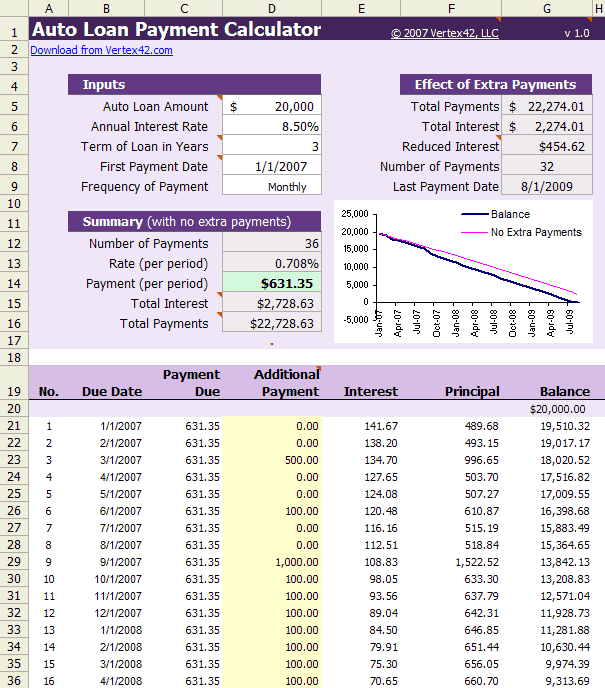
This comprehensive guide aims to demystify the car loan calculation process. We will break down the core components that dictate your monthly outlay, explore the foundational mathematical formulas, introduce practical tools for accurate assessment, and delve into the often-overlooked factors that can significantly alter your financial commitment. By the end of this article, you will possess a robust understanding of how to calculate, scrutinize, and strategically approach your car payment loan, ensuring your automotive aspirations align seamlessly with your financial realities.
Understanding the Core Components of a Car Loan
Before you can accurately calculate a car payment, it’s imperative to understand the fundamental building blocks that comprise any auto loan. Each component plays a distinct role in determining your monthly obligation and the overall cost of borrowing.
Principal Amount: The Foundation of Your Loan
The principal amount is simply the total sum of money you are borrowing from the lender to purchase the car. This figure is not just the vehicle’s sticker price; it’s the agreed-upon sales price minus any down payment, trade-in value, or rebates. For instance, if you purchase a car for $30,000, make a $5,000 down payment, and trade in an old vehicle for $3,000, your principal loan amount would be $22,000 ($30,000 – $5,000 – $3,000). A smaller principal amount directly translates to lower monthly payments and reduced total interest paid over the life of the loan. This is why financial advisors frequently advocate for a substantial down payment when feasible.
Interest Rate: The Cost of Borrowing
The interest rate, expressed as an Annual Percentage Rate (APR), is perhaps the most critical factor influencing your car payment. It represents the cost you pay the lender for the privilege of borrowing money. This percentage is applied to the outstanding principal balance and is a primary driver of the total amount you will repay over the loan term. Interest rates are determined by a myriad of factors, including the prevailing market rates, the lender’s risk assessment of you as a borrower (heavily influenced by your credit score), and the loan term itself. A lower interest rate can save you thousands of dollars over the life of the loan, making it a key negotiation point.
Loan Term: The Duration of Your Commitment
The loan term, also known as the amortization period, is the length of time, typically measured in months, over which you agree to repay the loan. Common loan terms for new cars range from 36 to 72 months, though 84-month terms are becoming increasingly prevalent. A longer loan term results in lower monthly payments because the principal and interest are spread out over more installments. However, this convenience comes at a cost: longer terms almost always mean you’ll pay more in total interest over the life of the loan and your car will likely depreciate faster than you pay it off, leading to “negative equity” or being “upside down” on your loan. Conversely, a shorter loan term means higher monthly payments but significantly less total interest paid.
The Essential Formula for Car Loan Calculation
While online calculators simplify the process, understanding the underlying mathematical formula provides invaluable insight into how your payments are structured and allows you to manually verify figures.
Breaking Down the Auto Loan Payment Formula
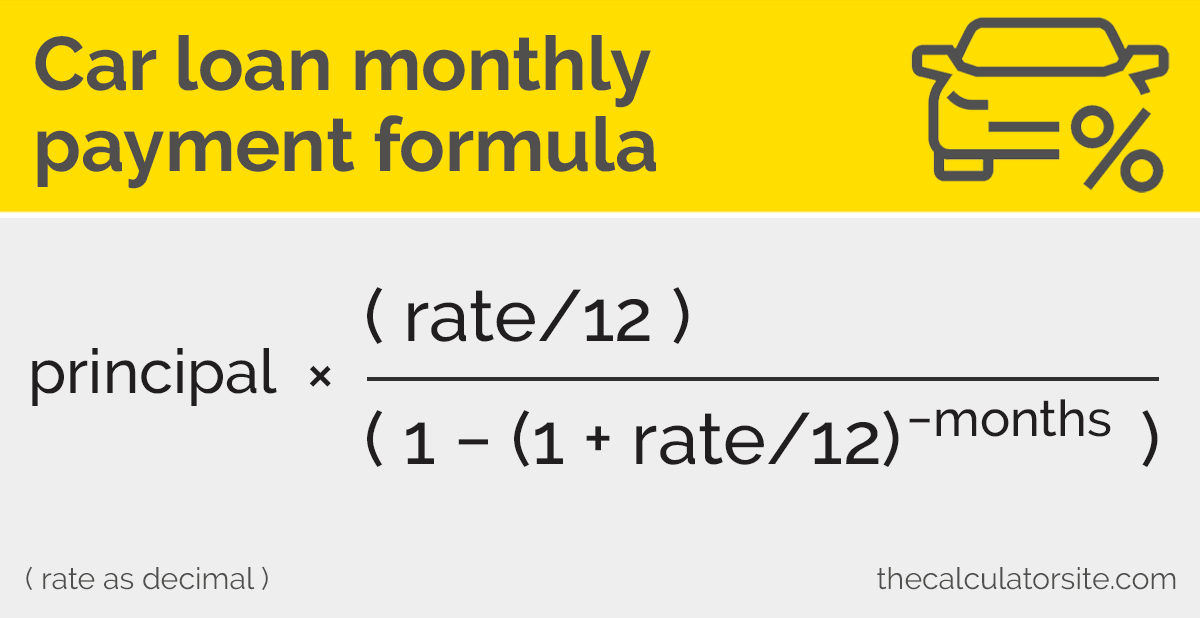
The standard formula used to calculate monthly loan payments for an amortizing loan (where each payment includes both principal and interest) is as follows:
$$ M = P [ i(1 + i)^n ] / [ (1 + i)^n – 1] $$
Where:
-
M = Your Monthly Payment
-
P = Principal Loan Amount (the amount you borrow)
-
i = Monthly Interest Rate (your annual interest rate divided by 12)
-
n = Total Number of Payments (your loan term in years multiplied by 12)
Let’s illustrate this with an example. Suppose you borrow $25,000 for a car at an annual interest rate of 6% over a 60-month (5-year) term.
First, convert the annual interest rate to a monthly decimal:
Annual Interest Rate = 6% = 0.06
Monthly Interest Rate (i) = 0.06 / 12 = 0.005
Next, determine the total number of payments:
Loan Term = 60 months
Total Payments (n) = 60
Now, plug these values into the formula:
M = 25000 [ 0.005(1 + 0.005)^{60} ] / [ (1 + 0.005)^{60} – 1]
M = 25000 [ 0.005(1.005)^{60} ] / [ (1.005)^{60} – 1]
M = 25000 [ 0.005 * 1.34885 ] / [ 1.34885 – 1]
M = 25000 [ 0.00674425 ] / [ 0.34885 ]
M = 25000 * 0.0193318
M ≈ $483.30
So, your estimated monthly payment would be approximately $483.30.
Step-by-Step Manual Calculation Example
While the formula can look daunting, breaking it down into smaller steps makes it manageable:
-
Determine P (Principal Loan Amount): The amount you want to borrow after any down payment or trade-in.
-
Calculate i (Monthly Interest Rate): Divide your annual interest rate by 12, then convert it to a decimal (e.g., 5% = 0.05, so 0.05/12 = 0.00416667).
-
Determine n (Total Number of Payments): Multiply your loan term in years by 12 (e.g., 5 years * 12 = 60 months).
-
Calculate (1 + i)^n: This is the core exponential part of the formula.
-
Calculate the numerator: P multiplied by (i multiplied by (1 + i)^n).
-
Calculate the denominator: ((1 + i)^n) minus 1.
-
Divide the numerator by the denominator: This gives you your monthly payment.
Common Pitfalls in Manual Calculation
Even with a clear formula, errors can creep into manual calculations. Common pitfalls include:
-
Incorrectly converting the annual interest rate to a monthly decimal: Forgetting to divide by 12 or failing to convert the percentage to a decimal.
-
Rounding errors: Rounding intermediate results too early can lead to inaccuracies in the final payment amount. It’s best to carry as many decimal places as possible until the final step.
-
Miscalculating the exponent: Using a standard calculator that doesn’t handle exponents correctly can skew results. Scientific calculators or spreadsheet functions are recommended.
-
Forgetting to account for all costs: Sales tax, registration fees, and other upfront charges are often rolled into the total loan amount, increasing the principal.
Leveraging Financial Tools for Accurate Payments
While manual calculations provide a deep understanding, leveraging modern financial tools offers speed, accuracy, and convenience, especially when exploring multiple scenarios.
Online Car Loan Calculators: Your Digital Ally
The internet is replete with free, user-friendly car loan calculators provided by financial institutions, automotive websites, and personal finance portals. These tools typically require you to input the principal amount, interest rate, and loan term, and they instantly provide your estimated monthly payment. Many advanced calculators also allow you to factor in down payments, trade-ins, sales tax, and even additional fees, offering a more holistic view of your financial commitment. Using these calculators is highly recommended for quickly comparing different loan scenarios (e.g., how a higher down payment or a shorter term impacts your payment).
Spreadsheet Software: Customizing Your Financial Model
For those who prefer a more hands-on approach or need to manage complex financial models, spreadsheet software like Microsoft Excel or Google Sheets is an invaluable tool. Excel’s PMT function (Payment Function) is specifically designed to calculate the payment for a loan based on constant payments and a constant interest rate.
The syntax for the PMT function is:
PMT(rate, nper, pv, [fv], [type])
Where:
-
rate: The interest rate per period (monthly interest rate).
-
nper: The total number of payments for the loan (total months).
-
pv: The present value, or the total value of all loan payments now (the principal loan amount).
-
[fv]: (Optional) The future value, or a cash balance you want to attain after the last payment is made. Defaults to 0.
-
[type]: (Optional) When payments are due. 0 for end of the period (default), 1 for beginning of the period.
Using our previous example (P=$25,000, 6% annual interest, 60 months):
=PMT(0.06/12, 60, -25000)
The result will be approximately -$483.30. The negative sign indicates an outflow of cash. Spreadsheets offer unparalleled flexibility, allowing you to build amortization schedules that show how much principal and interest you pay with each installment, visualize the impact of extra payments, and model various loan structures.
Dealership Calculators vs. Independent Tools
When shopping for a car, dealerships often provide their own calculators or present payment estimates. While convenient, it’s crucial to exercise caution. Dealership calculators may sometimes be configured to highlight favorable aspects or might not always include all fees and charges upfront. Always cross-reference their figures with independent online calculators or your own spreadsheet model. Trusting only the dealership’s numbers can lead to surprises later on. Independent tools offer an unbiased assessment, allowing you to walk into a negotiation with confidence, armed with your own precise calculations.
Factors Beyond the Formula that Impact Your Payment
While the principal, interest rate, and term are the direct inputs for the payment formula, several other financial factors significantly influence these inputs and, consequently, your final monthly car payment.
Down Payment: Reducing Your Principal
A down payment is the initial amount of cash you pay towards the car purchase, directly reducing the principal amount you need to borrow. A larger down payment translates to a smaller loan, which in turn means lower monthly payments and less interest paid over the life of the loan. Financial experts often recommend a down payment of at least 10-20% for a new car and 10% for a used car to minimize the amount financed and avoid being “upside down” on your loan (owing more than the car is worth) early on.
Trade-In Value: Further Reducing Your Borrowed Amount
If you have an existing vehicle, its trade-in value can act much like a down payment. The agreed-upon value of your trade-in is subtracted from the car’s purchase price before the loan amount is determined. This directly reduces your principal, lowering your monthly payments and total interest. Researching your vehicle’s trade-in value beforehand through resources like Kelley Blue Book or Edmunds can strengthen your negotiating position.
Sales Tax and Fees: The Hidden Costs
Beyond the car’s sticker price, buyers face additional costs such as sales tax, registration fees, licensing fees, and documentation fees (doc fees). These charges vary significantly by state and locality and can add hundreds or even thousands of dollars to the total cost. Often, these additional costs are rolled into the loan amount, increasing your principal. It’s essential to factor these into your total “out-the-door” price when calculating how much you need to finance, as they directly impact your monthly payment.
Credit Score: Unlocking Better Rates
Your credit score is a numerical representation of your creditworthiness and is a primary determinant of the interest rate you’ll be offered. Lenders use it to assess the risk of lending money to you. Borrowers with excellent credit scores (typically 750+) qualify for the lowest interest rates, while those with fair or poor credit scores will face significantly higher rates. A higher interest rate, as discussed, dramatically increases your monthly payment and the total cost of the loan. Improving your credit score before applying for a car loan can lead to substantial long-term savings.
Strategic Considerations for Managing Your Car Loan
Calculating your car payment is just the first step. Strategic thinking about your loan structure and future financial flexibility is crucial for responsible car ownership.
The Impact of Longer vs. Shorter Loan Terms
Choosing the right loan term involves balancing affordability with total cost. A longer term means lower monthly payments, which can make a more expensive car seem attainable. However, this often leads to paying substantially more in total interest and can leave you with negative equity for a longer period. Shorter terms, while resulting in higher monthly payments, reduce the total interest paid and build equity faster. Carefully consider your budget and long-term financial goals when deciding on a loan term. Financial prudence often leans towards the shortest term you can comfortably afford.
Refinancing Options: When and Why to Consider It
If your credit score has improved since you first took out your car loan, or if interest rates have dropped significantly, refinancing your auto loan could be a smart financial move. Refinancing involves taking out a new loan, usually with a lower interest rate, to pay off your existing car loan. This can lead to lower monthly payments, less total interest paid, or a shorter loan term – sometimes a combination of these benefits. It’s particularly beneficial if you initially financed with a high interest rate due to a less-than-ideal credit score or unfavorable market conditions.
Budgeting for Your Car Payment and Related Expenses
Your car payment is just one piece of the automotive financial puzzle. Responsible car ownership requires budgeting for an array of related expenses, including car insurance, fuel, maintenance, repairs, and potentially parking fees or tolls. Financial experts often recommend that total car expenses, including your loan payment, should not exceed 10-20% of your net income. Overlooking these additional costs can strain your budget, even if your car payment itself seems manageable. Integrating all these expenses into your overall personal budget provides a realistic picture of the true cost of owning a vehicle.

Conclusion
The ability to calculate your car payment loan effectively is a cornerstone of sound personal finance, transforming a potentially opaque process into a transparent financial decision. By understanding the principal, interest rate, and loan term, and by mastering the underlying formulas, you gain critical insight into how your money is being spent. Furthermore, leveraging financial tools and considering factors like down payments, trade-ins, taxes, and your credit score allows for a holistic and accurate assessment of your financial commitment.
Ultimately, informed car buying extends beyond the showroom floor; it encompasses a thorough financial evaluation that empowers you to negotiate confidently, choose wisely, and manage your budget strategically. Armed with this knowledge, you are not just buying a car; you are investing in financial control and peace of mind, ensuring your next vehicle purchase is a financially responsible and rewarding experience.
aViewFromTheCave is a participant in the Amazon Services LLC Associates Program, an affiliate advertising program designed to provide a means for sites to earn advertising fees by advertising and linking to Amazon.com. Amazon, the Amazon logo, AmazonSupply, and the AmazonSupply logo are trademarks of Amazon.com, Inc. or its affiliates. As an Amazon Associate we earn affiliate commissions from qualifying purchases.