
The emergence of Bitcoin as a premiere asset class has challenged traditional financial paradigms. Unlike equities, which are valued based on discounted cash flows and earnings reports, or bonds, which derive value from interest payments and creditworthiness, Bitcoin produces no yield. It has no physical form, no central bank backing, and no intrinsic industrial utility like copper or oil. Yet, it maintains a market capitalization that rivals the world’s largest corporations. Understanding how Bitcoin is valued requires a departure from classic valuation models and an exploration of its unique role as a digital commodity, a store of value, and a global, decentralized payment network.

To value Bitcoin, one must examine the intersection of scarcity, utility, and market psychology. The valuation of this digital asset is driven by fundamental protocols embedded in its code, the expanding network of its users, and its evolving role within the global macroeconomic landscape.
The Economics of Absolute Scarcity
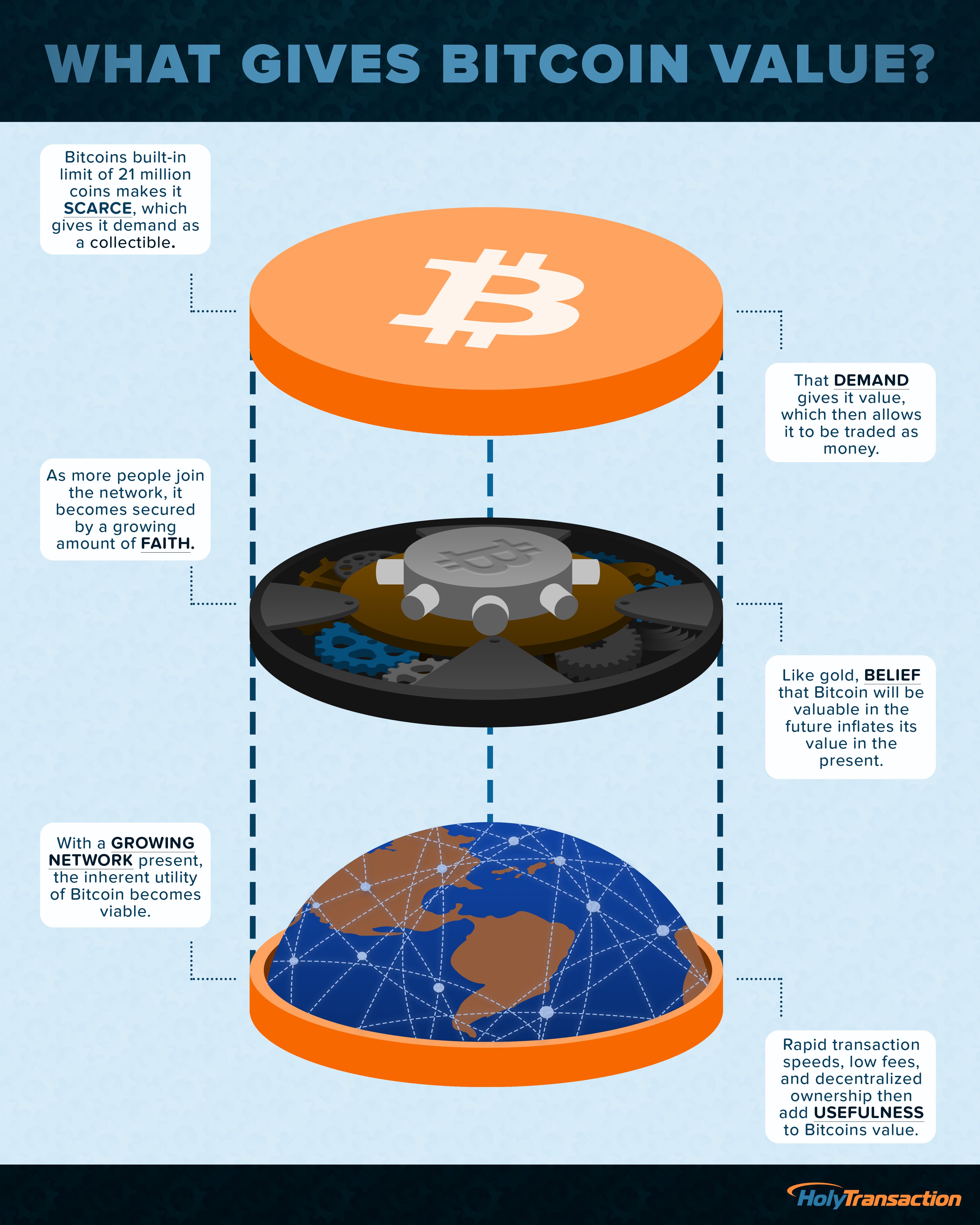
The most fundamental driver of Bitcoin’s value is its supply side. While fiat currencies are subject to the discretionary policies of central banks, Bitcoin operates under a strict, programmatic monetary policy.
The 21 Million Hard Cap
At the core of Bitcoin’s value proposition is its finite supply. There will never be more than 21 million BTC. This absolute scarcity is enforced by a decentralized network of nodes, making it the first asset in human history whose supply is truly fixed. In a traditional financial system where “quantitative easing” can expand the money supply at will, Bitcoin’s fixed supply creates a deflationary pressure. Investors value Bitcoin as a hedge against the debasement of fiat currencies. If the demand for a digital store of value increases while the supply remains capped, the price must theoretically rise to reach a new equilibrium.
The Stock-to-Flow Model
Many institutional investors utilize the Stock-to-Flow (S2F) model to quantify Bitcoin’s scarcity. Originally applied to precious metals like gold and silver, this model measures the ratio of the existing supply (stock) to the annual production (flow). A high S2F ratio indicates that an asset is scarce and difficult to produce. Bitcoin’s “halving” events—which occur roughly every four years and cut the rate of new supply in half—systematically increase its S2F ratio. Each halving serves as a fundamental supply shock, often preceding significant bull markets as the market adjusts to the reduced issuance of new coins.
Network Effects and Metcalfe’s Law
While scarcity explains the supply side, the demand side of Bitcoin’s valuation is largely driven by its utility as a network. Bitcoin is not merely a “coin”; it is a global, permissionless protocol for the transfer of value.
Metcalfe’s Law in Digital Assets
Metcalfe’s Law states that the value of a network is proportional to the square of the number of its connected users. This principle has been used to value telecommunications networks and social media platforms, and it applies remarkably well to Bitcoin. As more individuals, merchants, and institutions join the Bitcoin network, the utility of the network increases exponentially. Each new participant adds liquidity, security, and utility to the system. Analysts often track “active addresses” and “transaction volume” as proxies for network growth; when these metrics trend upward, the fundamental value of the network is seen to be increasing, regardless of short-term price volatility.
Bitcoin as a Settlement Layer
Beyond its use as a “digital gold” for individual savers, Bitcoin’s value is derived from its role as a final settlement layer. Unlike traditional banking transfers that can take days to clear through multiple intermediaries, Bitcoin allows for the final settlement of billions of dollars in value in a matter of minutes, 24/7, without requiring a central authority. This utility as a neutral, global financial rail provides a “base layer” value that is increasingly attractive to international businesses and entities seeking to avoid the frictions and fees of the legacy banking system.
The Cost of Production: Mining Economics
In traditional commodity markets, the price of a good often gravitates toward its cost of production. Bitcoin possesses a similar floor through the mechanism of Proof of Work (PoW).
Hash Rate and Energy Expenditure
Bitcoin is “mined” using specialized hardware that solves complex mathematical puzzles. This process requires significant electrical energy. The total computational power dedicated to the network is known as the “hash rate.” As the hash rate increases, the network becomes more secure, which in turn increases investor confidence. While the cost of production does not strictly dictate the market price (which is determined by buyers and sellers), it does create a psychological and fundamental support level. Miners are generally reluctant to sell their rewards below the cost of the electricity used to mint them, creating a floor during bear markets.
Difficulty Adjustments and Stability
A unique feature of Bitcoin is its “difficulty adjustment.” Every 2,016 blocks (roughly every two weeks), the network automatically adjusts how hard it is to mine a block based on the total hash rate. This ensures that the supply of Bitcoin remains constant regardless of how much computing power is thrown at it. This mechanism prevents a “gold rush” from devaluing the asset through overproduction, a stability feature that traditional commodities do not possess. This predictable issuance schedule allows for more accurate long-term valuation modeling than is possible with physical commodities.
Macroeconomic Drivers and Institutional Adoption
Bitcoin does not exist in a vacuum. Its valuation is heavily influenced by the broader financial environment and the changing profile of its holders.
The “Risk-On” vs. “Store of Value” Debate
In the eyes of the market, Bitcoin’s identity is shifting. During periods of high liquidity and low interest rates, Bitcoin often behaves like a “risk-on” asset, correlating with technology stocks as investors seek high-growth opportunities. However, during periods of geopolitical instability or high inflation, it is increasingly viewed as a “neutral” asset—an alternative to gold that cannot be seized or frozen by a government. This dual identity means that Bitcoin’s value is influenced by Federal Reserve policy, inflation data (CPI), and global currency fluctuations.
Institutional Integration and ETFs
The valuation of Bitcoin took a significant leap forward with the approval of Spot Bitcoin Exchange-Traded Funds (ETFs) in major markets like the United States. This institutionalization removes the technical barriers to entry for pension funds, insurance companies, and retail 401(k) investors. When massive amounts of managed capital move into a supply-constrained asset, the price reflects the newfound “legitimacy” and the massive influx of buy-side pressure. Furthermore, as corporations like MicroStrategy and Tesla began holding Bitcoin on their balance sheets, it transitioned from a speculative retail interest to a legitimate corporate reserve asset, fundamentally altering its valuation floor.
Psychology, Sentiment, and the Lindy Effect
Finally, Bitcoin is valued because the market collectively believes it has value. In the world of finance, perception often dictates reality through the “Lindy Effect.”
The Lindy Effect and Survivability
The Lindy Effect is a concept suggesting that the future life expectancy of a non-perishable thing, like a technology or an idea, is proportional to its current age. Every day that Bitcoin exists without being hacked, banned, or failing, it proves its resilience. This longevity builds trust. For many investors, Bitcoin’s value is derived from its “anti-fragility”—the fact that it has survived numerous “deaths” in the media and various regulatory crackdowns. As it survives, the perceived risk of it going to zero diminishes, which naturally leads to a higher valuation.
Market Sentiment and Speculative Premiums
Because Bitcoin is a relatively young asset, its price contains a significant “speculative premium.” This is the value attributed to what Bitcoin could become in the future (e.g., a global reserve currency or the primary unit of account for the internet). This speculative component makes the asset highly sensitive to news, social media trends, and investor sentiment. Tools like the “Fear and Greed Index” help investors understand when the market has overvalued the asset due to euphoria or undervalued it due to irrational panic.
Conclusion
Valuing Bitcoin is a multidimensional exercise that combines elements of software engineering, monetary history, and behavioral finance. It is valued for its scarcity as digital gold, its utility as a global payment network, its cost of production via mining, and its growing integration into the global financial system. While volatility remains a hallmark of its price discovery phase, the underlying valuation frameworks—from Metcalfe’s Law to the Stock-to-Flow model—suggest that Bitcoin’s value is not arbitrary. Instead, it is the result of a revolutionary shift in how humanity defines, stores, and transfers value in the digital age. As adoption continues to mature, the speculative swings may dampen, but the fundamental drivers of its value—code-based scarcity and decentralized trust—remain the bedrock of its price.
aViewFromTheCave is a participant in the Amazon Services LLC Associates Program, an affiliate advertising program designed to provide a means for sites to earn advertising fees by advertising and linking to Amazon.com. Amazon, the Amazon logo, AmazonSupply, and the AmazonSupply logo are trademarks of Amazon.com, Inc. or its affiliates. As an Amazon Associate we earn affiliate commissions from qualifying purchases.