
Retirement planning is a cornerstone of financial security, and for many, Individual Retirement Accounts (IRAs) serve as a vital component of that strategy. Far more than just a savings account, an IRA is a powerful, tax-advantaged investment vehicle designed to help you build a substantial nest egg for your golden years. While employer-sponsored plans like 401(k)s are excellent, IRAs offer flexibility and control that can significantly boost your long-term wealth accumulation.
Understanding how IRAs work – their various types, contribution rules, investment options, and withdrawal regulations – is crucial for anyone looking to optimize their retirement savings. This guide will demystify IRAs, empowering you to make informed decisions that align with your financial goals and tax situation.

The Core Mechanics of an IRA: Building Your Retirement Nest Egg
At its heart, an IRA is a personal retirement savings plan that offers tax benefits to encourage long-term investing. It’s not an investment itself, but rather a container or wrapper that holds various investments, allowing them to grow with specific tax advantages.
What is an IRA?
An IRA, or Individual Retirement Arrangement/Account, is a personal savings plan that provides tax benefits for retirement savings. Unlike employer-sponsored plans where your investment choices might be limited by your company’s offerings, an IRA gives you the freedom to choose almost any investment vehicle available in the market. The primary purpose is to help individuals save for retirement while potentially reducing their current tax burden or enjoying tax-free growth in the future.
Contribution Limits and Eligibility
The IRS sets annual limits on how much you can contribute to an IRA. These limits are subject to change year by year, so it’s essential to check the most current figures. For example, in recent years, the standard contribution limit has often been around $6,500 to $7,000. For individuals aged 50 and older, an additional “catch-up” contribution is permitted, allowing them to save even more towards retirement.
Eligibility for contributing to an IRA is primarily based on having earned income. However, for certain types of IRAs (like Roth IRAs or the deductibility of Traditional IRA contributions), your Modified Adjusted Gross Income (MAGI) can also play a significant role, potentially limiting or eliminating your ability to contribute directly or deduct contributions.
Investing Within Your IRA
A common misconception is that an IRA is a savings account. In reality, an IRA is an account that holds investments. Once you contribute money to your IRA, you must then actively invest those funds within the account. The range of permissible investments is vast and typically includes:
-
Stocks: Individual company shares.
-
Bonds: Debt instruments issued by governments or corporations.
-
Mutual Funds: Professionally managed portfolios of stocks, bonds, or other securities.
-
Exchange-Traded Funds (ETFs): Similar to mutual funds but trade like stocks on an exchange.
-
Certificates of Deposit (CDs): Savings accounts that hold a fixed amount of money for a fixed period.
-
Real Estate (Self-Directed IRAs): For more advanced investors, certain IRAs allow investment in physical real estate.
The beauty of an IRA lies in its ability to let these investments grow either tax-deferred or tax-free, depending on the type of IRA you choose. The power of compounding, combined with these tax advantages, can significantly accelerate your wealth accumulation over decades.
Unpacking the Main IRA Types: Traditional vs. Roth
The two primary types of IRAs you’ll encounter are the Traditional IRA and the Roth IRA. While both are designed for retirement savings, they offer distinct tax advantages that cater to different financial situations and future expectations.
Traditional IRA: Pre-Tax Contributions, Tax-Deferred Growth
The Traditional IRA is often characterized by its “tax now or tax later” approach, leaning towards “tax later.” Here’s how it generally works:
-
Tax-Deductible Contributions: Depending on your income, filing status, and whether you’re covered by a workplace retirement plan, your contributions to a Traditional IRA may be tax-deductible in the year they are made. This means you can reduce your taxable income now, potentially lowering your current tax bill.
-
Tax-Deferred Growth: Investments within a Traditional IRA grow tax-deferred. You don’t pay taxes on capital gains, dividends, or interest income year after year. Taxes are postponed until you withdraw the money in retirement.
-
Taxable Withdrawals in Retirement: When you take qualified withdrawals from a Traditional IRA during retirement (typically after age 59½), the distributions are taxed as ordinary income.
-
Required Minimum Distributions (RMDs): At a certain age (currently 73, subject to future changes), you are generally required to start taking RMDs from your Traditional IRA, whether you need the money or not. Failure to do so can result in substantial penalties.
-
Early Withdrawal Penalties: If you withdraw funds before age 59½, the distribution is typically subject to your ordinary income tax rate plus a 10% early withdrawal penalty, though certain exceptions apply (e.g., for qualified higher education expenses, first-time home purchase, unreimbursed medical expenses).
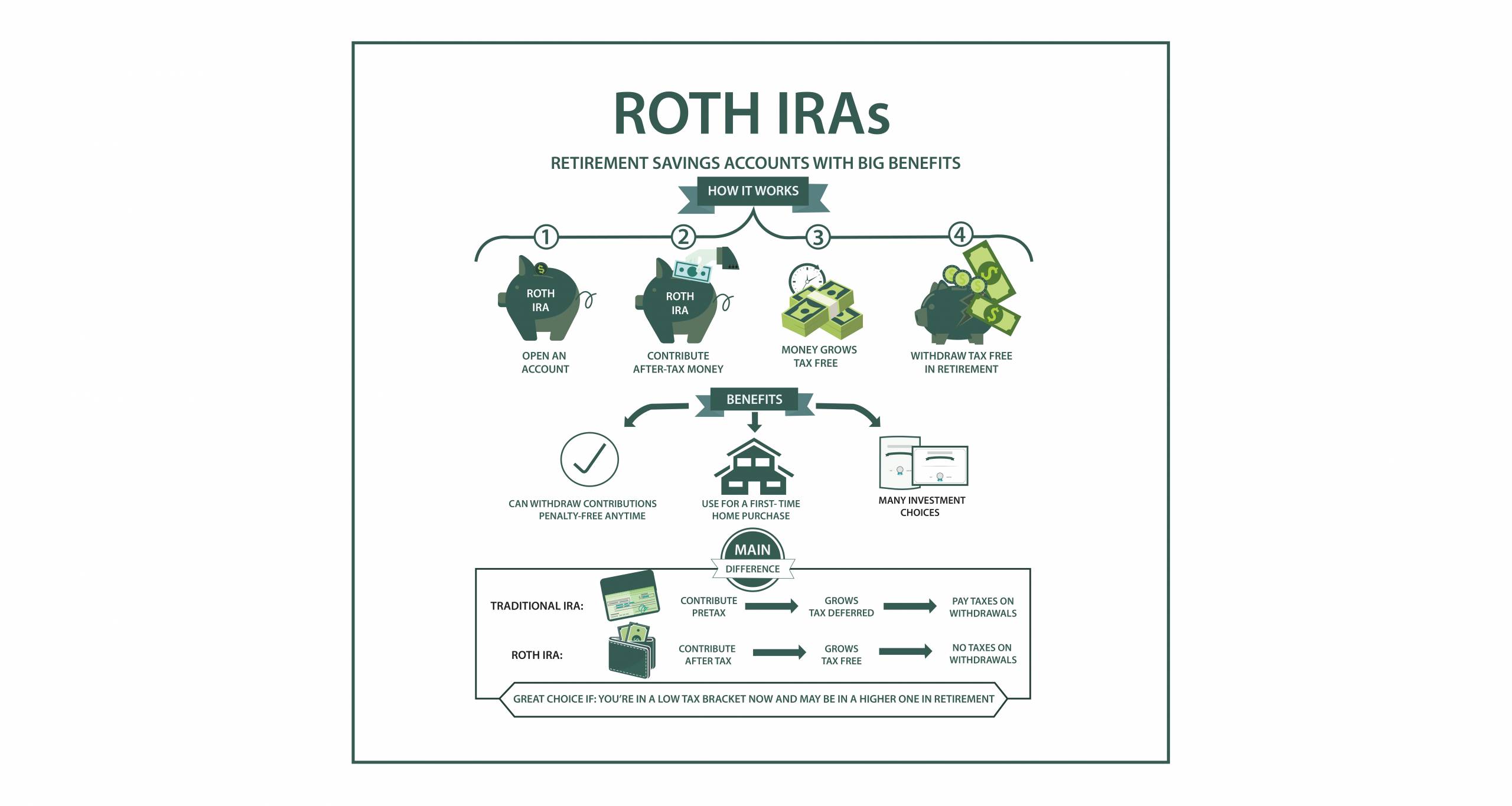
Roth IRA: After-Tax Contributions, Tax-Free Withdrawals
The Roth IRA operates on a “tax now, tax never again” principle, appealing to those who anticipate being in a higher tax bracket in retirement.
-
After-Tax Contributions: Contributions to a Roth IRA are made with money that has already been taxed. You do not get an upfront tax deduction for Roth contributions.
-
Tax-Free Growth and Withdrawals: This is the Roth IRA’s most compelling feature. Your investments grow tax-free, and qualified withdrawals in retirement are completely tax-free. For withdrawals to be qualified, the account must be open for at least five years, and you must be at least 59½ years old, or meet other criteria such as disability or first-time home purchase (up to $10,000).
-
No RMDs for Original Owner: Unlike Traditional IRAs, the original owner of a Roth IRA is not subject to RMDs. This provides greater flexibility for wealth distribution and estate planning.
-
Income Limitations: Eligibility to contribute directly to a Roth IRA is subject to income limitations. If your MAGI exceeds certain thresholds, you may not be able to contribute directly, though strategies like the “Backdoor Roth” exist.
-
Early Withdrawal Penalties: Similar to Traditional IRAs, non-qualified withdrawals before age 59½ (and before the 5-year rule is met) can be subject to income tax and a 10% penalty on the earnings portion of the withdrawal. Your original contributions can generally be withdrawn tax- and penalty-free at any time.
Deciding Between Traditional and Roth: Key Considerations
Choosing between a Traditional and Roth IRA largely depends on your current income, your expected income in retirement, and your tax outlook:
-
Current vs. Future Tax Bracket: If you believe you are in a higher tax bracket now than you will be in retirement, a Traditional IRA’s upfront deduction might be more appealing. If you anticipate being in a higher tax bracket in retirement, a Roth IRA’s tax-free withdrawals could be more beneficial.
-
Need for Upfront Deduction: If you need to reduce your current taxable income, a Traditional IRA (if deductible) offers that immediate benefit.
-
Flexibility and RMDs: The absence of RMDs for Roth IRAs provides greater control over your money in retirement and can be an advantage for estate planning.
-
Income Eligibility: Your income might dictate whether you can contribute to a Roth IRA directly.
Beyond Traditional and Roth: Other IRA Varieties
While Traditional and Roth IRAs are the most common, other specialized IRA accounts exist to serve specific needs, particularly for small business owners and the self-employed.
SEP IRA: For Small Business Owners and Self-Employed
A Simplified Employee Pension (SEP) IRA is designed for self-employed individuals and small business owners to contribute to their own and their employees’ retirement.
-
Higher Contribution Limits: SEP IRAs allow for significantly higher contribution limits than Traditional or Roth IRAs, often aligning with limits for employer 401(k) plans.
-
Employer Contributions Only: Contributions are made by the employer (or the self-employed individual acting as their own employer) on behalf of themselves and eligible employees. Employees cannot contribute to a SEP IRA directly.
-
Similar to Traditional IRA Tax Treatment: Contributions are tax-deductible for the employer, and investments grow tax-deferred. Withdrawals in retirement are taxed as ordinary income.
-
Simplicity: SEP IRAs are relatively simple to set up and administer compared to other employer-sponsored plans.
SIMPLE IRA: A Small Business Retirement Plan
The Savings Incentive Match Plan for Employees (SIMPLE) IRA is another option for small businesses with 100 or fewer employees. It allows both employers and employees to contribute.
-
Both Employer and Employee Contributions: Employees can make salary deferral contributions (like a 401(k)), and employers are required to make either a matching contribution or a non-elective contribution.
-
Lower Contribution Limits than SEP: While higher than Traditional/Roth IRAs, SIMPLE IRA contribution limits are generally lower than SEP IRAs.
-
Similar to Traditional IRA Tax Treatment: Contributions are tax-deductible, growth is tax-deferred, and withdrawals in retirement are taxed as ordinary income.
-
Mandatory Employer Contributions: The employer contribution requirement makes SIMPLE IRAs distinct from SEP IRAs.
Rollover IRA: Consolidating Your Retirement Funds
A Rollover IRA is a specific type of Traditional IRA designed to receive funds transferred from an employer-sponsored retirement plan, such as a 401(k), 403(b), or 457(b), when you leave a job.
-
Purpose: To consolidate retirement assets, maintain tax-deferred status, and avoid early withdrawal penalties and taxes when transitioning between jobs or retiring.
-
Benefits: Offers greater control over investment choices, potentially lower fees, and simplifies management by bringing all retirement funds under one roof.
-
Direct vs. Indirect Rollovers: A direct rollover moves funds directly from your old plan to your new IRA custodian. An indirect rollover involves you receiving a check (minus 20% federal tax withholding) and then depositing the full amount into a new IRA within 60 days. Direct rollovers are generally recommended to avoid potential tax implications and penalties.
Setting Up and Managing Your IRA
Once you’ve decided which type of IRA is right for you, the next steps involve opening the account, making contributions, and managing your investments.
Choosing an IRA Custodian
An IRA custodian is a financial institution that holds your IRA assets and administers the account according to IRS rules. Common custodians include:
-
Banks: Offer CDs and savings accounts, but often limited investment options.
-
Brokerage Firms: Provide a wide array of investment choices (stocks, bonds, mutual funds, ETFs) and often offer robust research tools.
-
Mutual Fund Companies: Specializing in their own family of mutual funds.
-
Robo-Advisors: Automated investment platforms that build and manage diversified portfolios based on your risk tolerance.
When choosing a custodian, consider factors like fees (maintenance, trading, advisory), the breadth of investment options, customer service quality, and the availability of helpful tools and resources.
Making Contributions and Allocating Investments
After opening your IRA, you’ll need to contribute funds and then invest them. Many custodians offer options to set up automatic contributions, which is an excellent way to consistently save and leverage dollar-cost averaging.
Once funds are in your IRA, you must choose your investments. Your investment strategy should align with your age, risk tolerance, and retirement timeline. Younger investors might opt for a more aggressive, growth-oriented portfolio, while those closer to retirement might prefer a more conservative, income-focused approach. Regular rebalancing of your portfolio (adjusting asset allocation back to your target percentages) is crucial to maintain your desired risk level over time.
Understanding Distributions and Penalties
Navigating distributions from your IRA is just as important as contributing to it. Understanding the rules helps you avoid unnecessary taxes and penalties.
-
Qualified Withdrawals: For a Traditional IRA, qualified withdrawals after age 59½ are taxed as ordinary income. For a Roth IRA, qualified withdrawals (after 59½ and the 5-year rule) are completely tax-free.
-
Non-Qualified Withdrawals: Withdrawals before age 59½ are generally subject to your ordinary income tax rate and a 10% early withdrawal penalty.
-
Exemptions to the 10% Penalty: Several exceptions exist, including distributions for:
-
Unreimbursed medical expenses (exceeding 7.5% of AGI).
-
Health insurance premiums while unemployed.
-
Qualified higher education expenses.
-
First-time home purchase (up to $10,000 lifetime).
-
Disability.
-
Substantially equal periodic payments (SEPP).
-
-
Managing RMDs: For Traditional IRAs, carefully track and take your RMDs once you reach the required age to avoid a hefty 25% penalty on the amount not withdrawn.
Strategic Considerations for Maximizing Your IRA
IRAs offer more than just basic savings. With strategic planning, they can become even more powerful tools in your financial arsenal.
Backdoor Roth IRA
For high-income earners who exceed the MAGI limits for direct Roth IRA contributions, the “Backdoor Roth” strategy can be a valuable option. This involves contributing non-deductible funds to a Traditional IRA and then immediately converting those funds to a Roth IRA. If you have no other pre-tax IRA money, the conversion is generally tax-free. This allows high earners to still enjoy the benefits of tax-free growth and withdrawals that a Roth IRA offers. It’s crucial to understand the pro-rata rule if you have existing pre-tax IRA balances.
Leveraging the Saver’s Credit
Also known as the Retirement Savings Contributions Credit, the Saver’s Credit is a non-refundable tax credit available to low and moderate-income individuals who contribute to retirement accounts, including IRAs. This credit can significantly boost your retirement savings by directly reducing your tax liability, effectively giving you “free money” for saving. Eligibility and the credit amount depend on your Adjusted Gross Income (AGI) and filing status.
Integrating IRAs into Your Broader Financial Plan
IRAs should not be viewed in isolation but as part of a comprehensive financial plan.
-
Complementing 401(k)s: If you have access to an employer’s 401(k), maxing out any employer match there is often the first step. After that, contributing to an IRA allows for additional tax-advantaged savings and often greater investment flexibility.
-
Estate Planning: Roth IRAs, in particular, can be excellent estate planning tools due to their tax-free nature and lack of RMDs for the original owner. Beneficiaries inherit a tax-free income stream.
-
Regular Review and Adjustments: Your financial situation, risk tolerance, and tax laws can change. Regularly review your IRA contributions, investment allocations, and overall retirement strategy with a financial advisor to ensure it remains aligned with your goals.

Conclusion
IRA accounts are powerful, flexible tools for building long-term wealth and securing your financial future in retirement. Whether you opt for the upfront tax deduction of a Traditional IRA, the future tax-free income of a Roth IRA, or one of the specialized accounts for small business owners, the core principle remains the same: consistent, tax-advantaged investing over time yields significant rewards.
Starting early, contributing consistently, and making informed investment choices within your IRA are key to maximizing its potential. While this guide provides a comprehensive overview, personal financial situations vary greatly. Consulting with a qualified financial advisor can provide tailored guidance, helping you navigate the complexities of IRA rules and integrate these accounts seamlessly into your overall retirement strategy. Take control of your financial destiny today by understanding and utilizing the power of IRAs.
aViewFromTheCave is a participant in the Amazon Services LLC Associates Program, an affiliate advertising program designed to provide a means for sites to earn advertising fees by advertising and linking to Amazon.com. Amazon, the Amazon logo, AmazonSupply, and the AmazonSupply logo are trademarks of Amazon.com, Inc. or its affiliates. As an Amazon Associate we earn affiliate commissions from qualifying purchases.