
The Dow Jones Industrial Average (DJIA), often referred to simply as “the Dow,” is arguably the most recognized financial index in the world. Established in 1896 by Charles Dow and Edward Jones, it serves as a barometer for the health of the United States economy and the broader stock market. Unlike the S&P 500, which tracks 500 of the largest U.S. companies based on market capitalization, the Dow is a price-weighted index consisting of just 30 “blue-chip” companies. These organizations are leaders in their respective industries, representing the bedrock of American commerce.
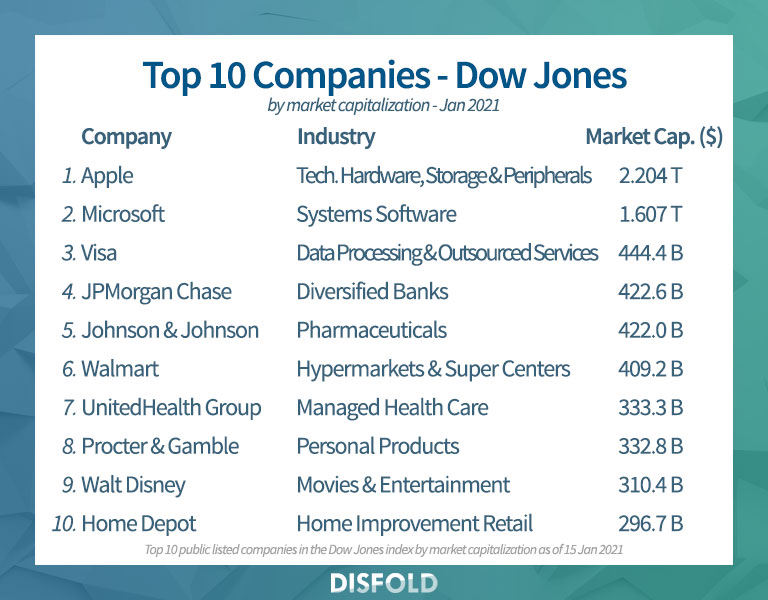
Understanding which 30 companies currently comprise the Dow is essential for any investor looking to gauge market sentiment and economic stability. Because the index is price-weighted, the stocks with the highest share prices exert the most influence on the index’s daily fluctuations. This article provides a comprehensive look at the current constituents, the methodology behind their selection, and what their inclusion means for the modern investor.
The 30 Constituents of the Dow: A Sector-by-Sector Breakdown
The Dow is designed to provide a cross-section of the U.S. economy, excluding the transportation and utilities sectors (which have their own dedicated Dow Jones averages). As of 2024, the index includes a mix of technology giants, healthcare leaders, financial powerhouses, and consumer mainstays.
Technology and Communications
In the 21st century, the Dow has shifted its focus from heavy industry to technology, reflecting the digital transformation of the global economy.
-
Microsoft (MSFT): A cornerstone of the index, Microsoft represents the shift toward cloud computing and artificial intelligence.
-
Apple (AAPL): Added in 2015, Apple’s massive consumer reach and hardware ecosystem make it a primary driver of market sentiment.
-
Salesforce (CRM): Representing the “Software as a Service” (SaaS) model, Salesforce illustrates the importance of enterprise cloud solutions.
-
Intel (INTC): Though it has faced challenges recently, Intel remains the representative for the semiconductor industry within the Dow.
-
Cisco Systems (CSCO): A leader in networking hardware, Cisco represents the physical infrastructure of the internet.
-
IBM (IBM): One of the oldest tech members, IBM focuses on hybrid cloud and AI services for global enterprises.
-
Verizon (VZ): The primary telecommunications representative, reflecting the essential nature of connectivity.
-
Disney (DIS): A unique hybrid of media, entertainment, and technology, Disney showcases the power of intellectual property.
Financial Services
The financial sector is heavily represented in the Dow, as banking and payments are the lifeblood of economic activity.
-
Goldman Sachs (GS): Because of its high share price, Goldman Sachs is one of the most influential members of the price-weighted index.
-
JPMorgan Chase (JPM): As the largest bank in the U.S., JPMorgan represents the stability and growth of the banking sector.
-
Visa (V): Visa highlights the global shift toward digital payments and a cashless society.
-
American Express (AXP): This company represents the intersection of finance, travel, and premium consumer spending.
-
Travelers Companies (TRV): The sole property and casualty insurance representative in the index.
Healthcare
With an aging population and rising medical costs, healthcare companies have become vital components of the Dow’s performance.
-
UnitedHealth Group (UNH): Often the most influential stock in the Dow due to its high share price, this healthcare giant manages both insurance and provider services.
-
Johnson & Johnson (JNJ): A diversified healthcare leader known for pharmaceuticals and medical devices.
-
Merck & Co. (MRK): A pharmaceutical powerhouse focusing on innovative treatments and vaccines.
-
Amgen (AMGN): Representing the biotechnology sector, Amgen was added to reflect the modern medical landscape.
Consumer Goods and Retail
The strength of the American consumer is tracked through some of the world’s most recognizable brands.
-
Amazon (AMZN): Added in February 2024, Amazon replaced Walgreens Boots Alliance to better reflect the dominance of e-commerce in the retail landscape.
-
Walmart (WMT): The world’s largest retailer remains a bellwether for consumer spending and inflation.
-
Procter & Gamble (PG): The manufacturer of household staples like Tide and Gillette represents the “defensive” side of the index.
-
Coca-Cola (KO): A global symbol of American consumerism and a staple for dividend-seeking investors.
-
Home Depot (HD): This company tracks the health of the housing market and consumer investment in real estate.
-
Nike (NKE): The leader in athletic apparel and a major player in global brand marketing.
-
McDonald’s (MCD): A primary indicator of the fast-food industry and discretionary spending.
Industrials, Energy, and Materials
While the “Industrial” in the Dow’s name is less dominant than it was in 1896, these sectors still form the backbone of physical production.
-
Boeing (BA): A massive player in global aerospace and defense, though its volatility often impacts the index significantly.
-
Caterpillar (CAT): The leader in construction and mining equipment, often used as a proxy for global infrastructure growth.
-
Honeywell (HON): A diversified industrial conglomerate focusing on aerospace, building technologies, and performance materials.
-
3M (MMM): Known for innovation across thousands of products, 3M represents the diversified manufacturing sector.
-
Chevron (CVX): The sole energy representative in the Dow, reflecting the oil and gas industry.
-
Dow Inc. (DOW): A major materials science company (not to be confused with the index itself) representing the chemical industry.
How the Dow is Calculated: The Price-Weighting Methodology
To truly understand why these 30 companies matter, one must understand the unique way the Dow is calculated. Most modern indices, such as the S&P 500 or the Nasdaq 100, are market-cap weighted. In those indices, the total value of the company (share price multiplied by the number of shares) determines its influence.
The Dow Jones Industrial Average is different; it is price-weighted. This means that a company with a share price of $400 has four times the impact on the index as a company with a share price of $100, even if the $100-per-share company has a larger total market capitalization.
The Dow Divisor
Because companies frequently undergo stock splits or issue dividends, simply adding the 30 share prices together and dividing by 30 would result in a distorted number. To maintain continuity, the “Dow Divisor” is used. This is a mathematical constant that is adjusted whenever a corporate action (like a split) occurs. When you see the Dow “up by 200 points,” it means the sum of the 30 stock prices increased by an amount that, when divided by the current divisor, equals 200.
The Power of High-Price Stocks
This methodology creates a unique dynamic. For instance, UnitedHealth Group and Goldman Sachs often have share prices significantly higher than Apple or Coca-Cola. Consequently, a 1% move in UnitedHealth moves the Dow significantly more than a 1% move in Apple, despite Apple being a much larger company by market value. This is a common point of criticism among financial analysts, but it remains a hallmark of the Dow’s history and tradition.
Why the Dow Composition Changes
The Dow is not a static list. The Averages Committee, composed of representatives from S&P Dow Jones Indices and The Wall Street Journal, monitors the index and makes changes as needed. There are no rigid rules for inclusion, but the committee generally looks for companies with an excellent reputation, sustained growth, and interest to a large number of investors.
Recent Shifts in the Index
The most notable recent change occurred in February 2024, when Amazon was added to the index, replacing Walgreens Boots Alliance. This move was prompted by Walmart’s decision to execute a 3-for-1 stock split. Because the Dow is price-weighted, Walmart’s split would have reduced the retail sector’s overall weight in the index. Adding Amazon—a high-priced stock and a retail juggernaut—corrected this imbalance and modernized the index’s exposure to the digital economy.
Previous changes include the 2020 “mega-shuffle” where Salesforce, Amgen, and Honeywell replaced ExxonMobil, Pfizer, and Raytheon Technologies. The removal of ExxonMobil was particularly symbolic, as it was the longest-serving member of the Dow at the time, signaling the waning influence of traditional oil and gas in favor of software and biotechnology.
Investing in the Dow: Strategies for Personal Finance
For the individual investor, the Dow represents a “blue-chip” strategy. Investing in these 30 companies is generally seen as a way to achieve steady growth with lower volatility than high-growth tech indices.
Exchange-Traded Funds (ETFs)
The most common way to invest in the Dow is through an ETF that tracks the index, such as the SPDR Dow Jones Industrial Average ETF Trust (DIA), often called “Diamonds.” By purchasing shares of DIA, an investor gains exposure to all 30 companies in their appropriate weightings with a single transaction. This is a popular choice for those looking for a “set it and forget it” component for their retirement portfolios.
The “Dogs of the Dow” Strategy
A popular value-investing strategy involves the Dow constituents. The “Dogs of the Dow” strategy suggests that at the beginning of each year, an investor should buy the 10 stocks in the DJIA with the highest dividend yields. The theory is that these companies are temporarily undervalued, and as their stock prices recover, the investor benefits from both the high dividend income and capital appreciation.
Blue-Chip Stability
While the Dow may not offer the explosive growth of the Nasdaq during a tech bull market, it offers a level of protection during downturns. Because the 30 companies are established, profitable, and often pay dividends, they tend to be more resilient during economic contractions. For investors focused on capital preservation and income, the Dow remains a premier benchmark.

Conclusion: The Modern Relevance of the Dow
Critics often argue that an index of only 30 companies cannot possibly represent the complexity of the modern $50 trillion U.S. stock market. However, the Dow persists because it represents the “titans” of industry—companies that employ millions of people and provide the products and services that define daily life.
When people ask, “How did the market do today?” they are usually looking for the Dow’s performance. Its 30 constituents are more than just stocks; they are symbols of economic power. By monitoring these 30 companies, investors can gain a high-level understanding of corporate profitability, consumer health, and the overall trajectory of the American economy. Whether you are a seasoned trader or a novice saver, understanding the makeup of the Dow Jones Industrial Average is a fundamental step in mastering the world of finance.
aViewFromTheCave is a participant in the Amazon Services LLC Associates Program, an affiliate advertising program designed to provide a means for sites to earn advertising fees by advertising and linking to Amazon.com. Amazon, the Amazon logo, AmazonSupply, and the AmazonSupply logo are trademarks of Amazon.com, Inc. or its affiliates. As an Amazon Associate we earn affiliate commissions from qualifying purchases.