
Navigating the complexities of modern banking requires more than just keeping an eye on your balance; it requires a deep understanding of how your financial institution handles the moments when your spending outpaces your available funds. For millions of customers, Chase Bank is the primary hub for these transactions. However, the question of “how much” Chase will allow you to overdraft is not answered by a single, static number. Instead, it is governed by a sophisticated blend of account types, specific policy features like Chase Overdraft Assist, and the individual’s banking history.
Understanding the nuances of Chase’s overdraft policy is essential for maintaining financial health. Overdrafting is essentially a short-term, high-interest loan from the bank, and while Chase has modernized its approach to make it more consumer-friendly in recent years, the costs can still accumulate quickly if you are not careful.
Understanding Chase’s Overdraft Policies and the $50 Buffer
In the past, banking institutions were often criticized for “predatory” overdraft fees, where a $2 coffee could result in a $35 penalty. In response to consumer advocacy and changing market pressures, Chase overhauled its system to include more leniency. The most significant of these changes is the $50 Overdraft Buffer.
The Overdraft Assist Program
Chase Overdraft Assist℠ is the primary mechanism that determines your immediate “allowance.” Under this policy, Chase does not charge an Insufficient Funds Fee if you are overdrawn by $50 or less at the end of the business day. This provides a crucial safety net for minor mathematical errors or small, unexpected automated payments.
If you exceed that $50 threshold, you still have a window of opportunity. Chase allows you until the end of the next business day to deposit or transfer enough funds to bring your account balance back to a status where it is overdrawn by $50 or less. If you meet this deadline, the $34 Insufficient Funds Fee is waived. This “grace period” is a cornerstone of modern personal finance management, allowing consumers to self-correct without immediate financial punishment.
Standard Overdraft Practice vs. Debit Card Coverage
It is important to distinguish between how Chase handles different types of transactions. For standard overdraft practice, which applies to checks and recurring ACH payments (like your utility bill or mortgage), Chase may authorize and pay these items at their discretion, even if you don’t have enough money.
However, for “everyday” debit card transactions—such as buying groceries or gas—Chase will typically decline the transaction at the point of sale unless you have specifically opted into “Debit Card Coverage.” If you have not opted in, your card will simply be declined, and no fee will be charged. If you have opted in, Chase may allow the transaction to go through, potentially triggering the $34 fee if the amount puts you more than $50 in the red.
The Financial Mechanics: Fees, Limits, and Costs
While Chase provides a buffer, there are hard limits on how often and how much they will charge you. Understanding these limits is vital for anyone who finds themselves frequently hovering near a zero balance.
The $34 Insufficient Funds Fee
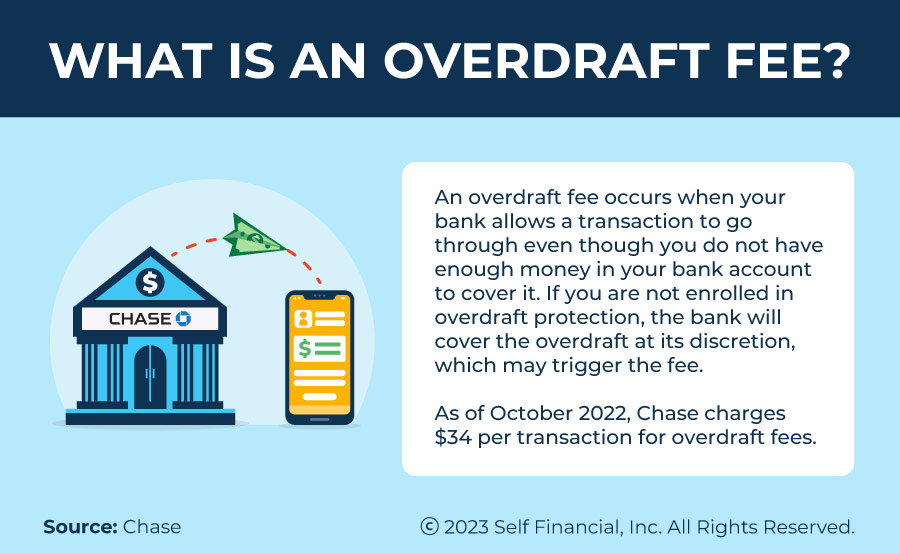
The standard fee for an overdraft at Chase is $34. This fee applies to each item that the bank pays on your behalf when your account is overdrawn by more than $50. It is a steep price to pay for the convenience of having a transaction covered, which is why financial advisors generally recommend avoiding the use of overdrafts as a form of credit.
Daily Fee Maximums
Chase limits the number of Insufficient Funds Fees they will charge you in a single business day. Currently, that limit is three fees per day. This means the maximum amount you can be charged in fees in a single day is $102. While this prevents a “snowball effect” from dozens of small transactions, $102 remains a significant hit to most personal budgets.
It is also worth noting that Chase does not charge fees for items that are $5 or less, regardless of your total overdrawn balance. This “de minimis” rule ensures that very small transactions don’t result in disproportionately high penalties.
Chase Secure Banking: The No-Fee Alternative
For those who want to eliminate the risk of overdraft fees entirely, Chase offers the “Chase Secure Banking” account. This is a low-cost checking account designed specifically to prevent overdrafts. It does not offer a traditional overdraft facility; if the money isn’t there, the transaction is declined, and there are no insufficient funds fees. This is an excellent tool for students or individuals working to rebuild their financial standing.

Factors That Determine Your Personal Overdraft Limit
Many customers want to know if there is a specific dollar amount—such as $500 or $1,000—that Chase will allow them to go into the negative. The answer is that Chase does not publicize a “hard limit” for its customers. Instead, the amount they are willing to cover is determined dynamically by an internal risk algorithm.
Account Age and Stability
A customer who has held a Chase account for ten years with consistent direct deposits is likely to have a higher “invisible” overdraft limit than someone who opened an account last month. The bank looks for patterns of stability. If you have a history of quickly rectifying overdrawn balances, the bank’s automated systems are more likely to authorize larger transactions even when funds are low.
Deposit Patterns
The frequency and size of your deposits play a major role. If Chase can see that a $2,000 payroll deposit is scheduled to arrive every Friday, they are much more likely to cover a $200 utility bill on a Thursday. They view the upcoming deposit as collateral. Conversely, if your deposits are irregular or if you have a history of returned checks, your “discretionary” overdraft limit will be significantly lower, or perhaps non-existent.
The “Discretionary” Nature of Coverage
It is vital to remember that Chase is under no obligation to cover any overdraft. Every time a transaction exceeds your balance, the bank makes a real-time decision. Just because they covered a $100 overdraft last month does not guarantee they will cover a $50 one today. Relying on overdrafts is a high-risk strategy because of this lack of a guaranteed limit.
Strategies to Avoid Overdrafts and Protect Your Wealth
In the realm of personal finance, the goal is always to keep your money in your own pocket rather than handing it over to a financial institution in the form of fees. There are several tools Chase provides to help you stay in the black.
Overdraft Protection Linking
One of the most effective ways to manage overdrafts is to link your Chase checking account to a Chase savings account. This is known as Overdraft Protection. If you spend more than what is in your checking account, Chase will automatically pull the necessary funds from your linked savings account to cover the difference. This prevents the “Insufficient Funds Fee” and ensures your transactions are processed smoothly. While there used to be a fee for this transfer, Chase has eliminated the Overdraft Protection Transfer Fee for most accounts, making it a free and essential safety net.
Real-Time Alerts and Mobile Management
The Chase Mobile app is a powerful tool for monitoring your balance in real-time. You can set up “Low Balance Alerts” that send a push notification or text message when your account drops below a specific dollar amount (e.g., $100). This serves as an early warning system, allowing you to stop spending or move money between accounts before an overdraft occurs.
Utilizing the 24-Hour Grace Period
If you do overdraw your account, the clock starts ticking immediately. Because Chase operates on a business day cycle, you must be aware of “cut-off times.” If you overdraw on a Friday, you generally have until the end of the business day on Monday to fix the balance. Using mobile check deposit or Zelle for an instant transfer from a friend or family member can be a lifesaver in these scenarios, allowing you to hit the $50-or-less target before the fee is finalized.
The Long-Term Impact of Overdrafting on Financial Health
Frequent overdrafting is often a symptom of a larger budgeting issue, but it also has direct consequences on your ability to access banking services in the future.
ChexSystems and Banking Reputation
Banks do not just report to credit bureaus; they also use a service called ChexSystems. If you frequently overdraft your account and fail to bring it back to a positive balance, Chase may close your account and report you to ChexSystems. This can make it incredibly difficult to open a bank account at any other major institution for several years. It essentially “blacklists” you from the traditional banking system, forcing you to rely on high-fee check-cashing services or “second-chance” bank accounts.

Moving Toward a “Buffer” Mindset
The ultimate solution to the overdraft question is to move away from the “allowance” mindset and toward a “buffer” mindset. Instead of asking how much the bank will let you borrow for a fee, financial success is found by building a personal cash buffer within the account.
Treating your $0 balance as if it were $500 is a psychological shift that protects you from the unpredictability of automated payments and the high costs of banking fees. By understanding Chase’s specific rules—the $50 buffer, the $34 fee, and the power of linked accounts—you can navigate your finances with the confidence that you are in control of your money, rather than the other way around.
aViewFromTheCave is a participant in the Amazon Services LLC Associates Program, an affiliate advertising program designed to provide a means for sites to earn advertising fees by advertising and linking to Amazon.com. Amazon, the Amazon logo, AmazonSupply, and the AmazonSupply logo are trademarks of Amazon.com, Inc. or its affiliates. As an Amazon Associate we earn affiliate commissions from qualifying purchases.