
Understanding how interest accrues on a daily basis is one of the most empowering financial skills a borrower can possess. Whether you are managing a mortgage, a student loan, a car note, or a revolving credit card balance, interest is the primary cost of doing business with a lender. While most people focus on the monthly payment amount, the true cost of debt is hidden in the daily accrual—the “per diem” interest that adds up every 24 hours.
By learning to calculate daily interest, you gain the ability to verify your lender’s math, project future balances, and, most importantly, develop strategies to pay off your debt faster. This guide provides a comprehensive breakdown of the mechanics, formulas, and strategic applications of daily interest calculations.

Understanding the Fundamentals of Daily Interest
Before diving into the mathematics, it is essential to understand why interest is calculated daily rather than just once a month. Most modern loans use a “daily balance method.” This means that for every day you carry a balance, the lender charges you a small fraction of your annual interest rate.
The Difference Between Simple and Compound Interest
The first step in any calculation is identifying whether your loan uses simple or compound interest.
-
Simple Interest: Most installment loans, such as auto loans and some student loans, use simple interest. In this model, interest is calculated only on the principal balance. If you pay your interest monthly, the principal remains the same, and the interest does not “snowball.”
-
Compound Interest: Credit cards and many business lines of credit often utilize compound interest, frequently compounding on a daily basis. This means the interest charged today is added to your principal balance tomorrow, and the next day’s interest is calculated on that new, higher amount. This creates an exponential growth of debt if not managed carefully.
Why Daily Interest Matters for Borrowers
Daily interest is the reason why the timing of your payments matters just as much as the amount. On a simple interest loan, making a payment five days early means you are charged five fewer days of interest on that portion of the principal. Over the life of a 30-year mortgage or a 5-year car loan, these “interest-free days” can aggregate into thousands of dollars in savings. Conversely, paying five days late—even if within a “grace period”—can result in a higher portion of your payment going toward interest rather than the principal.
The Step-by-Step Formula for Daily Interest Calculation
Calculating daily interest is a straightforward process once you have three key pieces of information: your current principal balance, your Annual Percentage Rate (APR), and the number of days in the year the lender uses for their calculations.
Identifying Your Key Variables
-
Current Principal Balance: This is not your original loan amount, but what you currently owe today. You can find this on your latest statement or online portal.
-
Annual Percentage Rate (APR): This is the yearly cost of the loan expressed as a percentage. Note that the APR includes interest and sometimes other fees, but for daily calculations, we typically use the stated interest rate.
-
The Day Count Convention: Most lenders use a 365-day year. However, some commercial loans and older banking systems use a “360-day year” (often called the Banker’s Rule), which slightly increases the daily interest charge.
The Standard Formula for Simple Daily Interest
To find your daily interest charge, follow this three-step formula:
Step 1: Determine the Daily Interest Rate
Divide your annual interest rate by the number of days in the year.
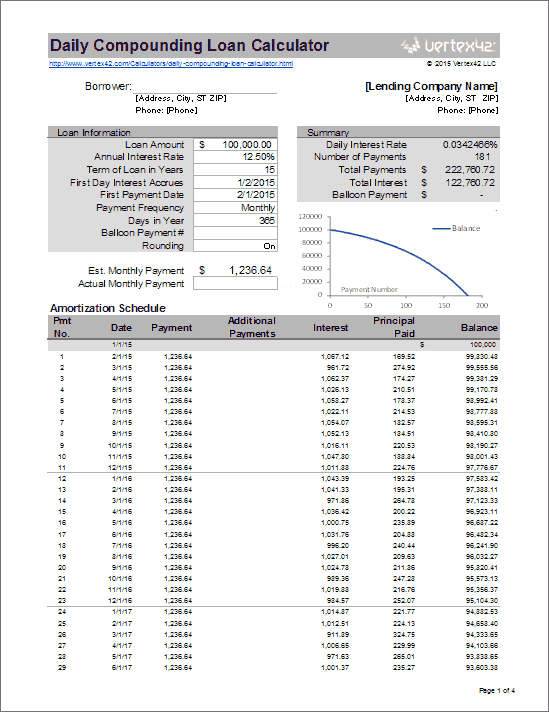
Formula: APR / 365 = Daily Interest Rate
Example: 0.06 (6%) / 365 = 0.00016438
Step 2: Calculate the Daily Interest Amount
Multiply your current principal balance by the daily interest rate.
Formula: Principal Balance × Daily Interest Rate = Daily Interest Amount
Example: $10,000 × 0.00016438 = $1.64 per day
Step 3: Calculate for a Specific Period
To find out how much interest will accrue between payments, multiply the daily amount by the number of days in the billing cycle.
Formula: Daily Interest Amount × Number of Days = Total Interest for Period
Example: $1.64 × 30 days = $49.20
Factoring in 360 vs. 365-Day Years
It is a subtle but important distinction. A 360-day year assumes twelve 30-day months. If your loan document specifies a 360-day year, your daily interest rate will be slightly higher (e.g., 6% / 360 = 0.00016667). While the difference seems negligible—fractions of a penny—on a $500,000 mortgage, it can result in significant discrepancies over decades. Always check your promissory note to see which convention your lender employs.
Calculating Interest for Different Loan Types
The general formula provides a baseline, but different financial products have unique nuances in how they apply daily interest.
Mortgages and “Per Diem” Interest
In the mortgage industry, daily interest is often referred to as “per diem” interest. This is most visible during the closing process. If you close on a house on the 15th of the month, the lender will charge you per diem interest from the 15th until the end of the month. This ensures that your first full monthly payment, which typically starts a month later, aligns with a clean calendar cycle. Understanding this calculation helps you choose a closing date that minimizes the cash you need to bring to the table.
Credit Card Daily Periodic Rates (DPR)
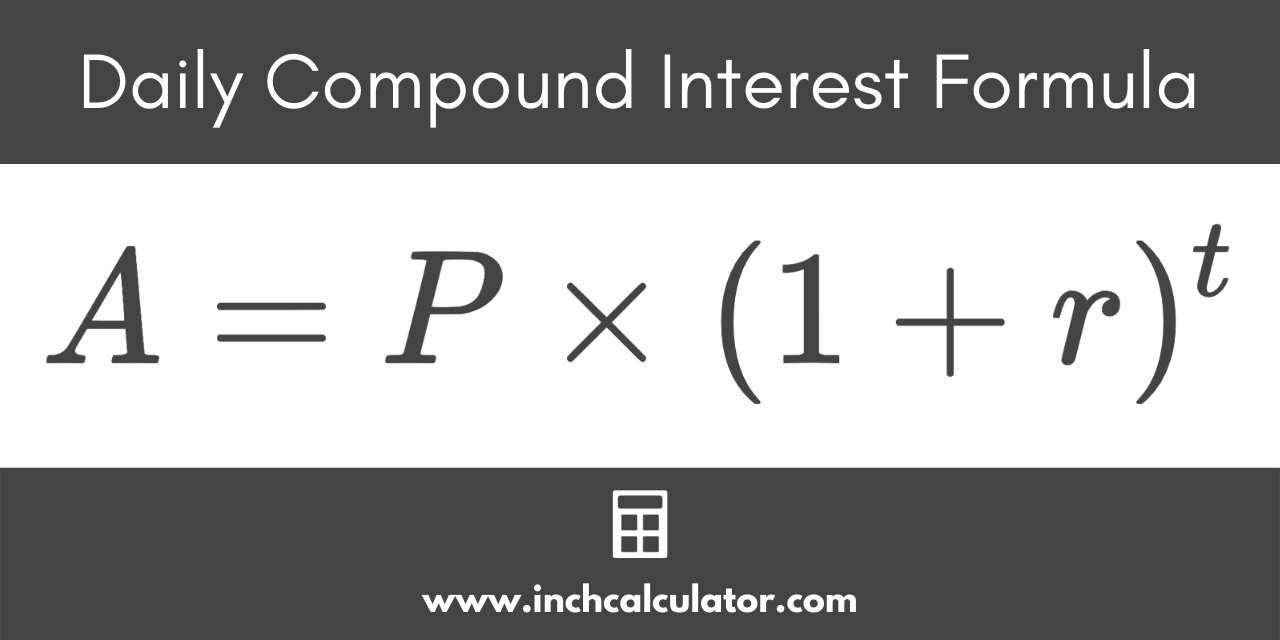
Credit cards are unique because they use the Average Daily Balance (ADB) method. Instead of calculating interest on the balance at the end of the month, the card issuer tracks your balance every single day of the billing cycle. They add up each day’s balance, divide by the number of days in the cycle to find the average, and then apply the Daily Periodic Rate (DPR).
If you make a large purchase at the beginning of the month and pay it off at the end, your average daily balance will be high, resulting in high interest. However, if you make multiple small payments throughout the month, you lower your average daily balance, thereby reducing the interest charged, even if the total amount paid remains the same.
Student Loans and Capitalization
Many student loans accrue interest daily while the student is still in school or during deferment. If this interest is not paid as it accrues, it may be “capitalized.” Capitalization is the process where unpaid interest is added to the principal balance. Once capitalized, the daily interest is then calculated on the new, larger balance. By calculating the daily interest on your student loans, you can determine exactly how much you need to pay each month during school to prevent your balance from growing before you even graduate.
Advanced Strategies to Save Money on Interest
Once you master the calculation of daily interest, you can move from passive borrower to active strategist. You can use these numbers to manipulate the cost of your debt in your favor.
The Power of Mid-Cycle Payments
Because most interest is calculated based on the balance present on a specific day, making payments earlier in your billing cycle reduces the principal earlier, which in turn reduces the interest accrued for the remainder of that cycle.
For example, if you have a $5,000 credit card balance and you have $1,000 ready to pay, paying it on day 2 of your billing cycle instead of day 28 will significantly lower your Average Daily Balance. Over time, this “early payment” strategy can shave months or even years off a long-term debt repayment plan.
Utilizing Principal-Only Payments
When you make a standard payment, the lender first applies the money to the interest that has accrued since your last payment. Anything left over goes toward the principal. By calculating your daily interest, you can see exactly how much of your check is being “eaten” by the bank.
If your budget allows, you can request a “principal-only” payment. By making an extra payment that is designated strictly for the principal, you immediately lower the base number used for all future daily interest calculations. This creates a permanent reduction in the cost of your loan every single day moving forward.
Refinancing and Consolidation Timing
When considering refinancing a loan to a lower rate, the daily interest calculation helps you determine the “break-even” point. By comparing the daily interest cost of your current loan with the projected daily interest of a new loan (minus closing costs), you can decide if the move is financially sound. If the new loan only saves you $0.15 a day but costs $2,000 in fees, you can accurately calculate that it will take years to recover that cost.
Common Pitfalls and Calculation Errors to Avoid
Even with a solid grasp of the formulas, several variables can complicate your math. Being aware of these pitfalls ensures your projections remain accurate.
Misunderstanding Grace Periods
Many borrowers confuse a “grace period” for a period where interest does not accrue. In the world of credit cards, a grace period usually means you won’t be charged interest if you pay the full statement balance by the due date. However, if you carry even a small balance forward, the grace period often vanishes, and interest begins accruing daily on every new purchase from the date of the transaction.
Overlooking Variable Interest Rates
If you have an Adjustable-Rate Mortgage (ARM) or a variable-rate credit card, your APR can change based on market indices like the Prime Rate. When the rate changes, your daily interest calculation must be updated immediately. A 1% increase in APR might seem small, but on a large balance, it can significantly change your daily per diem, requiring an adjustment to your repayment strategy.
The Impact of Leap Years
It is a minor detail, but for high-accuracy financial planning, remember that leap years contain 366 days. Some lenders will adjust the denominator in their daily interest formula to 366 during these years, slightly lowering the daily charge, while others stick to a fixed 365 or 360-day convention regardless of the calendar year. Checking your loan’s specific language regarding “day count conventions” will reveal how your lender handles this.
By mastering the calculation of daily interest, you strip away the complexity of lending and see your debt for what it truly is: a daily cost. With this professional insight, you are no longer just making payments; you are strategically managing capital to build a more secure financial future.
aViewFromTheCave is a participant in the Amazon Services LLC Associates Program, an affiliate advertising program designed to provide a means for sites to earn advertising fees by advertising and linking to Amazon.com. Amazon, the Amazon logo, AmazonSupply, and the AmazonSupply logo are trademarks of Amazon.com, Inc. or its affiliates. As an Amazon Associate we earn affiliate commissions from qualifying purchases.