
Deciding when to claim Social Security benefits is one of the most critical financial decisions a person will make in their lifetime. For many retirees, Social Security represents a significant portion of their guaranteed retirement income, acting as an inflation-protected annuity that lasts as long as they live. However, the system is complex, and the difference between claiming at age 62 and age 70 can result in a permanent difference of 76% or more in the monthly benefit amount.
Determining the “best” time requires a deep dive into personal finance, actuarial math, and strategic planning. There is no one-size-fits-all answer; rather, the decision hinges on health, marital status, tax considerations, and overall retirement goals.
The Mechanics of Social Security Timing
To understand the best time to claim, one must first understand the concept of Full Retirement Age (FRA). For anyone born in 1960 or later, the FRA is 67. This is the age at which you are entitled to 100% of your primary insurance amount (PIA).
The Cost of Early Filing
The Social Security Administration allows individuals to begin taking benefits as early as age 62. However, doing so comes at a steep price. If your FRA is 67 and you claim at 62, your monthly benefit is permanently reduced by 30%. This reduction is prorated based on how many months before FRA you begin receiving checks.
From a personal finance perspective, claiming early is often seen as “locking in” a lower floor for your retirement income. While you receive checks for five additional years compared to waiting until age 67, those checks are significantly smaller. This is a gamble on longevity; if you live a long life, the cumulative total of those smaller checks will eventually fall behind the cumulative total of the larger checks you would have received by waiting.
The Reward for Delayed Filing
Conversely, the system rewards those who wait. For every year you delay claiming beyond your FRA—up until age 70—your benefit increases by 8% annually. This is known as Delayed Retirement Credits. If your FRA is 67 and you wait until age 70, your monthly benefit will be 124% of your PIA.
There are very few investment vehicles in the private market that offer a guaranteed, inflation-adjusted 8% annual return. For this reason, many financial advisors view delaying Social Security as one of the most effective ways to hedge against “longevity risk”—the risk of outliving your money.
Evaluating Longevity and the Break-Even Point
At the heart of the Social Security timing debate is the “break-even analysis.” This is a calculation designed to find the age at which the total cumulative benefits of waiting to claim exceed the cumulative benefits of claiming early.
Calculating the Break-Even Age
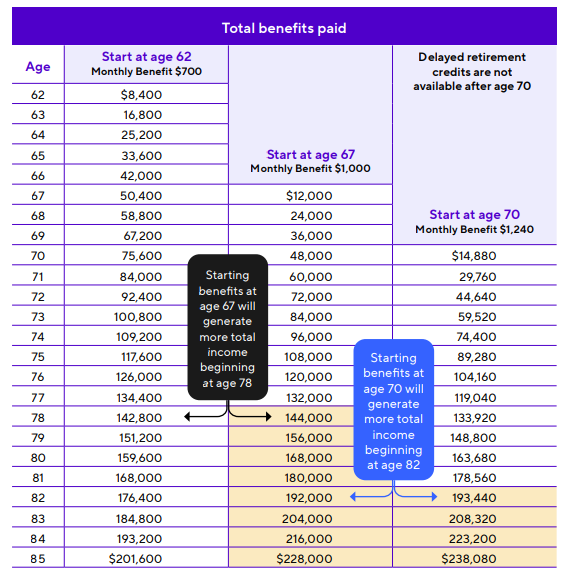
For most people, the break-even age between claiming at 62 versus claiming at 67 is roughly age 77. The break-even age for waiting until 70 versus claiming at 67 is usually around age 82.
If you believe you will live past these ages, the math strictly favors waiting. If your family history suggests longevity, or if you are in excellent health, delaying is almost always the superior financial strategy. On the other hand, if you have chronic health issues or a shorter life expectancy, claiming early may allow you to maximize the total dollars you receive from the system before you pass away.
Longevity Risk as a Financial Factor
It is important to view Social Security not just as a pot of money to be extracted, but as insurance. The real danger in retirement planning is not dying too soon, but living too long. In a scenario where a retiree lives to 95 or 100, the difference between an early-claim benefit and a late-claim benefit can amount to hundreds of thousands of dollars in total lifetime income. By waiting until 70, you are essentially buying the highest possible “insurance policy” against running out of funds in your final decades.
Marital Status and Spousal Strategies

The decision of when to claim becomes significantly more complex for married couples. Social Security is not just an individual benefit; it is a household asset.
The Higher-Earner Strategy
A common recommendation among financial planners is for the higher-earning spouse to delay benefits until age 70. This serves two purposes. First, it maximizes the benefit while both spouses are alive. Second, and perhaps more importantly, it maximizes the survivor benefit.
When one spouse dies, the surviving spouse is entitled to the higher of the two Social Security checks the couple was receiving. If the higher earner waited until 70 to claim, they have locked in that 124% benefit for the surviving spouse, regardless of when the lower-earning spouse claimed their own benefit. This is a vital component of protecting a surviving spouse’s standard of living, especially since expenses do not always drop by 50% when a partner passes away.
Spousal Benefits and Coordination
The lower-earning spouse may choose to claim their own benefit earlier to provide some cash flow for the household, while the higher-earner lets their benefit grow. This “split” strategy allows the couple to bridge the gap until the larger check kicks in. However, it is essential to remember that you cannot claim a spousal benefit until the primary worker has also filed for their own benefits. Navigating these rules requires careful coordination to ensure no money is left on the table.
The Impact of Continued Employment and Taxes
For those who plan to work during their 60s, the “best time” to claim is often dictated by the Social Security Earnings Test and the tax code.
The Earnings Test
If you claim Social Security before your FRA and continue to work, your benefits may be temporarily withheld if you earn above a certain threshold. For 2024, if you are under FRA, the Social Security Administration deducts $1 from your benefit payments for every $2 you earn above $22,320.
While these withheld benefits are not “lost”—your benefit is recalculated and increased once you reach FRA to account for the months they were withheld—it effectively negates the reason for claiming early. If you are still working and making a significant income, there is rarely a compelling financial reason to claim Social Security before your FRA.
The “Tax Torpedo”
Social Security benefits are not always tax-free. Depending on your “provisional income” (which includes your Adjusted Gross Income, tax-exempt interest, and 50% of your Social Security benefits), up to 85% of your benefits could be subject to federal income tax.
If you have large traditional IRA distributions or a pension, claiming Social Security early could push you into a higher tax bracket, leading to what is colloquially known as the “tax torpedo.” In this situation, every extra dollar of income causes more of your Social Security to become taxable, creating a high effective marginal tax rate. Delaying Social Security can sometimes allow you to perform Roth conversions or spend down taxable assets at a lower rate before the larger, taxable Social Security checks begin.
Crafting a Comprehensive Retirement Income Strategy
Ultimately, Social Security should not be viewed in a vacuum. It is one piece of a larger puzzle that includes 401(k)s, IRAs, taxable brokerage accounts, and potentially real estate or part-time work.
Using Other Assets to Delay
A sophisticated strategy involves using other retirement assets to “buy” a higher Social Security benefit. For example, a retiree might spend down a portion of their 401(k) between the ages of 62 and 70 to cover living expenses, allowing their Social Security benefit to grow by 8% per year.
Because Social Security is inflation-indexed and tax-advantaged (at most 85% is taxed), it is often a more valuable asset than a 401(k) of equivalent value. Using “riskier” assets like stocks or “tax-heavy” assets like IRAs to preserve and grow the “guaranteed” asset of Social Security is a hallmark of defensive financial planning.

The “Right” Time is Personal
While the math often points toward waiting until age 70, life isn’t lived on a spreadsheet. If you need the money to pay for basic necessities, the best time to take Social Security is as soon as you need it. If you have a terminal illness, claiming at 62 is the logical choice. If you have a unique opportunity to retire early and pursue a lifelong dream that requires immediate cash flow, the 30% reduction might be a price worth paying for the freedom it provides.
In conclusion, the best time to take Social Security is the point at which the benefit aligns with your health, your tax situation, and your long-term legacy goals. For the majority of people, waiting at least until Full Retirement Age—and ideally until age 70—provides the most robust financial foundation for a long and stable retirement. By understanding the trade-offs between immediate cash and long-term security, you can make a decision that maximizes your financial well-being for decades to come.
aViewFromTheCave is a participant in the Amazon Services LLC Associates Program, an affiliate advertising program designed to provide a means for sites to earn advertising fees by advertising and linking to Amazon.com. Amazon, the Amazon logo, AmazonSupply, and the AmazonSupply logo are trademarks of Amazon.com, Inc. or its affiliates. As an Amazon Associate we earn affiliate commissions from qualifying purchases.