
The concept of a “living wage” has transitioned from a niche academic discussion to a central pillar of American economic discourse. As inflation fluctuates and the cost of basic necessities—housing, healthcare, and education—continues to outpace wage growth in many sectors, the distinction between a minimum wage and a living wage has never been more critical. To understand the financial landscape of modern America, one must look beyond the federal mandates and examine what it actually costs for an individual or a family to achieve financial stability without relying on public assistance or falling into a cycle of high-interest debt.

A living wage is defined as the minimum income necessary for a worker to meet their basic needs and maintain a decent standard of living within a specific community. Unlike the minimum wage, which is a static legal floor set by federal or state governments, a living wage is a dynamic figure that adjusts based on the actual cost of living in a given geographic area. In the United States, where the economic reality of a resident in New York City is vastly different from that of a resident in rural Mississippi, the living wage provides a more accurate barometer of economic health and personal financial security.
The Mechanics of a Living Wage: More Than Just Survival
To calculate a living wage, economists and researchers look at a “market basket” of essential goods and services. This is not a budget for a middle-class lifestyle filled with luxuries; rather, it is a calculation of what is required to stay out of poverty while maintaining physical and mental well-being. The most prominent model used today is the MIT Living Wage Calculator, which breaks down costs into several key categories.
Key Components of the Calculation
The primary driver of a living wage is housing. According to standard financial wisdom, an individual should spend no more than 30% of their gross income on shelter. However, in many American metropolitan areas, even those earning well above the federal minimum wage find themselves “rent-burdened,” spending 50% or more of their income on housing. A living wage must account for the local Fair Market Rent (FMR) to ensure that a worker is not sacrificed to the volatility of the real estate market.
Food is the second major component. This calculation is usually based on the USDA’s “Low-Cost Food Plan,” which assumes that all meals are prepared at home and focuses on nutritional adequacy rather than convenience or dining out. Healthcare follows closely behind, factoring in the cost of employer-sponsored insurance premiums as well as out-of-pocket expenses. For families, the most significant “hidden” cost is childcare. In many states, the cost of quality childcare for two children can exceed the cost of a monthly mortgage payment, making it one of the largest barriers to labor force participation for parents.
Geographic Disparities and the “Local” Factor
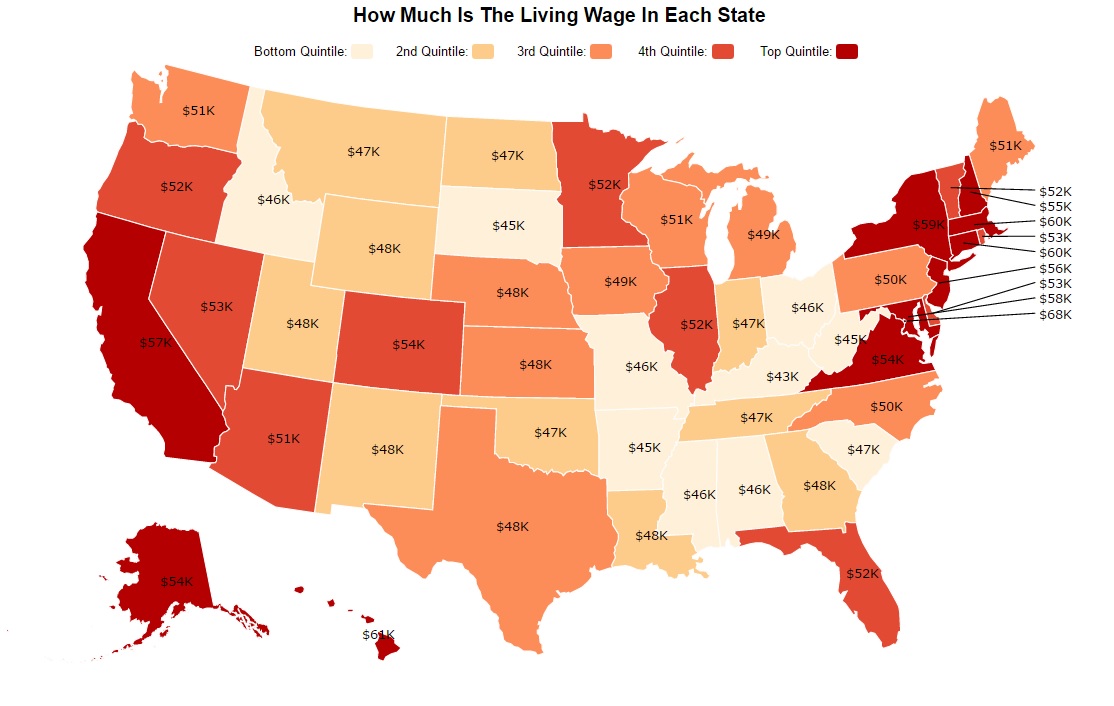
One of the most complex aspects of the living wage in America is its extreme variance by location. As of 2024, a single adult with no children might need a living wage of approximately $25.00 per hour in a high-cost state like Massachusetts or California to cover basic expenses. In contrast, that same individual might reach the living wage threshold at $16.00 or $17.00 per hour in states like South Dakota or Arkansas.
These disparities create a unique challenge for national corporations and remote-first businesses. A salary that provides a comfortable lifestyle in a Midwestern suburb may lead to functional poverty in a coastal tech hub. Consequently, the “living wage” is not a single number, but a moving target that reflects the local cost of property taxes, utility rates, and state-specific insurance mandates.
The Stagnation Gap: Living Wage vs. Minimum Wage
The federal minimum wage in the United States has remained at $7.25 per hour since 2009. While many states and cities have independently raised their local minimums—some reaching as high as $16.00 or $17.00—there remains a significant “stagnation gap” between what the law requires and what the economy demands.
The Purchasing Power Problem
When the federal minimum wage was first established in 1938 as part of the Fair Labor Standards Act, its intended purpose was to ensure that work would provide a “minimum standard of living necessary for health, efficiency, and general well-being.” Over the decades, however, the link between productivity and wages has severed. If the minimum wage had kept pace with worker productivity growth since the late 1960s, it would be over $20 per hour today.
The erosion of purchasing power means that individuals earning the minimum wage—and even many earning several dollars above it—are experiencing a net loss in financial stability each year. This leads to the “working poor” phenomenon, where individuals hold multiple jobs yet remain unable to build an emergency fund, contribute to a retirement account, or invest in assets that appreciate over time.
The “Cliff Effect” in Personal Finance
A critical hurdle in the transition from a minimum wage to a living wage is the “benefits cliff.” This occurs when a worker receives a modest pay increase that disqualifies them from public assistance programs, such as SNAP (food stamps) or Medicaid, before their new income is high enough to cover the cost of those services privately.
For many American workers, a raise of $2.00 per hour can actually result in a net financial loss because the cost of replacing lost subsidies exceeds the increase in take-home pay. A true living wage must be high enough to bypass this cliff entirely, allowing workers to move into self-sufficiency without a temporary period of increased financial fragility.
The Business Case for a Living Wage
While the discussion around living wages is often framed as a social or moral issue, there is a powerful business and financial argument for companies to adopt living wage standards. High-turnover industries, such as retail and fast food, often suffer from the hidden costs of low wages.
Employee Retention and Productivity
From a corporate finance perspective, turnover is expensive. The cost of recruiting, hiring, and training a new employee can range from 1.5 to 2 times that employee’s annual salary. Companies that pay a living wage—often referred to as “high-road employers”—frequently see a dramatic reduction in turnover rates. When workers are paid enough to cover their basic needs, they experience less financial stress, which translates into higher productivity, fewer absences, and better customer service.
Retail giants like Costco and, more recently, certain divisions of Amazon and Target, have experimented with higher internal minimums. The result is often a more loyal workforce and a “virtuous cycle” where employees have more disposable income to spend back into the economy, driving demand for the very products and services they produce.
Brand Loyalty and Consumer Ethics
In the modern marketplace, brand strategy is increasingly tied to corporate social responsibility. Consumers, particularly Millennials and Gen Z, are more likely to support brands that demonstrate ethical treatment of their workforce. Paying a living wage has become a competitive advantage in the “war for talent” and a marketing asset. Brands that are certified as Living Wage Employers often use this status to differentiate themselves from competitors who may be perceived as exploiting “gig economy” loopholes or maintaining poverty-level wages.
Financial Strategies in a High-Cost Economy
For individuals currently earning below the living wage for their area, the path to financial stability requires a combination of aggressive budgeting, skill acquisition, and the strategic use of financial tools.
Leveraging Financial Technology
The rise of fintech has provided new ways for workers to manage tight budgets. Earned Wage Access (EWA) tools allow employees to access their pay as they earn it, rather than waiting for a bi-weekly cycle, which can help avoid high-interest payday loans. Additionally, automated savings apps can help individuals build an initial “buffer” by rounding up transactions, though these are secondary to the primary need for a higher base income.
The Role of Side Hustles and Upskilling
In the absence of a living wage from a primary employer, many Americans have turned to the “side hustle” economy. While this provides a necessary income boost, it often lacks the benefits and stability of traditional employment. A more sustainable long-term strategy often involves “upskilling”—seeking certifications or associate degrees in high-demand fields like healthcare, IT, or skilled trades, where the market wage is naturally closer to or above the living wage threshold.

The Macroeconomic Outlook for American Workers
As we look toward the future, the debate over the living wage will likely intensify. The rise of automation and artificial intelligence is expected to displace many entry-level roles, potentially putting downward pressure on wages in certain sectors while increasing the demand for highly skilled labor.
The discussion is also shifting toward broader systemic changes. Some economists argue that a living wage cannot be achieved through paychecks alone; it must be supported by “social wages,” such as subsidized childcare, universal healthcare, and affordable housing initiatives. By reducing the “market basket” costs that a living wage must cover, the burden on individual employers is lessened, and the floor for financial security is raised for everyone.
Ultimately, a living wage in America is more than a calculation of dollars and cents. It is a reflection of the nation’s economic priorities. As personal finance becomes increasingly complex, understanding the gap between survival and stability is the first step toward building an economy where work provides a genuine path to prosperity. For the individual, the business owner, and the policymaker, the living wage remains the definitive metric of a functioning and equitable financial system.
aViewFromTheCave is a participant in the Amazon Services LLC Associates Program, an affiliate advertising program designed to provide a means for sites to earn advertising fees by advertising and linking to Amazon.com. Amazon, the Amazon logo, AmazonSupply, and the AmazonSupply logo are trademarks of Amazon.com, Inc. or its affiliates. As an Amazon Associate we earn affiliate commissions from qualifying purchases.