
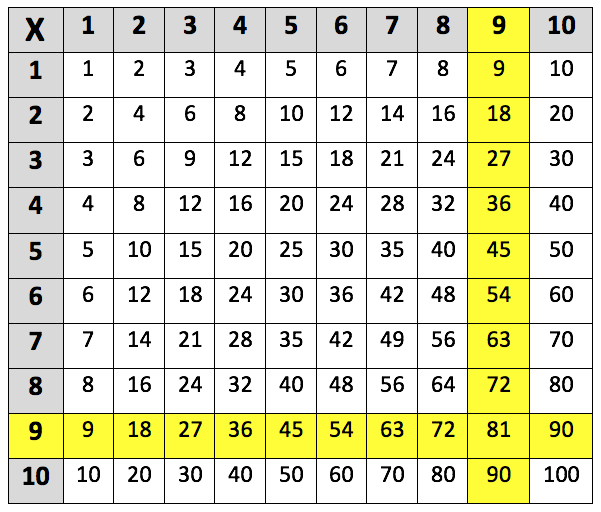
On the surface, “what is 9 times 3?” is a simple arithmetic problem, yielding the immediate answer: 27. It’s a foundational query we learn in childhood, a building block of mathematical understanding. Yet, within the intricate world of personal finance and wealth creation, this seemingly elementary question transforms into a profound metaphor. It encapsulates the essence of how simple, consistent actions and fundamental principles, when correctly applied and multiplied over time, lead to substantial and often surprising financial outcomes.
In finance, 9 times 3 isn’t just about obtaining 27; it’s about understanding the power of multiplication, the exponential nature of growth, and the critical role of basic arithmetic in achieving financial success. From the smallest savings habit to the most sophisticated investment strategy, the core mechanisms often boil down to this fundamental concept: consistent application of a positive “times factor” to your financial resources. This article delves into the “Money” niche, exploring how this simple mathematical query holds the key to unlocking significant financial potential, guiding us from basic understanding to strategic wealth accumulation.
The Foundational Arithmetic of Wealth Accumulation
The journey to financial well-being isn’t built on complex algorithms alone, but rather on the consistent application of fundamental arithmetic. Just as 9 multiplied by 3 yields a clear result, consistent financial actions multiplied over time create discernible and often dramatic outcomes. Understanding this foundational arithmetic is the bedrock upon which all successful financial strategies are built.
More Than Just a Sum: The Power of Compound Growth
The most powerful illustration of “9 times 3” in finance is the concept of compound interest, often hailed as the “eighth wonder of the world.” Imagine 9 as your initial investment or consistent saving amount, and 3 (or more realistically, a factor like 1.05 for 5% annual growth) as the multiplier representing your return. The magic isn’t just in the first multiplication; it’s in the subsequent iterations where the return itself begins to earn returns.
If you consistently invest $100 (our ‘9’ for simplicity) each month and earn a modest 7% annual return (our ‘times factor’ over the year), that initial $100 begins to grow. The next month, your new $100 adds to the slightly larger pot, and then both the principal and the accumulated interest earn returns. Over decades, this seemingly small, consistent multiplication creates a snowball effect. An initial $10,000 invested at age 25 with a 7% return, without any further contributions, could become over $150,000 by age 65. If you add to that principal consistently, the growth multiplies exponentially, turning modest inputs into significant wealth. This demonstrates that “9 times 3” isn’t a one-off calculation; it’s a continuous process where the output of one cycle becomes the input for the next, fueling exponential growth.
Income Streams and Their Multiplicative Potential
Another critical application of the “9 times 3” principle lies in generating and diversifying income. Many people focus solely on their primary job (their initial “9”), but truly successful financial individuals understand the power of multiplying their income sources. A side hustle, a rental property, dividends from investments, or online ventures each represent a potential “times factor” that adds to and multiplies your overall financial input.
Consider an individual earning a solid salary (“9”). If they start a successful side gig that brings in an additional 30% of their primary income, they’ve effectively multiplied their earnings by a factor of 1.3. This isn’t just additive; it often opens doors to new opportunities, skills, and networks that can, in turn, lead to further multiplicative income streams. The diversification protects against single points of failure and accelerates wealth accumulation far beyond what a single income source could achieve. Each new income stream becomes a “times factor,” working alongside the others to amplify your overall financial strength.
The Cost of Inaction: How Missing the “Multiply By” Can Hurt
Just as positive multiplication can build wealth, the absence of it—or worse, a negative multiplier—can erode it. The “cost of inaction” is a stark reminder that simply maintaining the status quo, especially in an inflationary environment, means losing purchasing power. If your money isn’t working for you, either through interest, investments, or income generation, it’s effectively being divided by inflation.
Forgetting the “times factor” of consistent saving or investing means missing out on potential compound growth. Furthermore, ignoring high-interest debt allows a negative multiplier to work against you, rapidly increasing your liabilities. The difference between saving consistently for retirement starting at age 25 versus age 35, for instance, can be hundreds of thousands of dollars due to the lost decade of compounding. Understanding “9 times 3” also means recognizing when not to multiply negatively and ensuring your financial resources are always working to increase, not decrease, their value.
Deconstructing Financial Decisions: Beyond the Surface Numbers
Many financial decisions appear complex, shrouded in jargon and intricate models. However, when stripped to their core, most boil down to a series of fundamental calculations and an understanding of how inputs are multiplied or divided to reach an outcome. Deconstructing these decisions with the “9 times 3” mindset allows for clearer, more effective financial planning.
Budgeting as a Strategic Multiplier for Savings
Budgeting is often perceived as a restrictive exercise of subtraction – cutting expenses to make ends meet. Yet, a truly strategic budget acts as a powerful multiplier for your savings and investment potential. By consciously allocating funds, you’re not just reducing spending; you’re redirecting resources to multiply your future wealth.
For example, choosing to reduce a discretionary expense like daily coffee (say, $5 or our ‘9’) and investing that amount instead means you’re multiplying that small sum by your investment returns over time. Over a year, $5 a day is $1,825. At a 7% annual return, this modest sum, consistently applied, can become a significant component of your wealth. Each dollar saved from mindful budgeting isn’t merely an avoided expense; it’s a dollar strategically deployed to generate more dollars, acting as a crucial “times factor” in your financial equation. It transforms passive spending into active wealth creation.
Understanding Return on Investment (ROI): Your Personal “Times Factor”
Return on Investment (ROI) is arguably the most direct application of “9 times 3” in finance. It’s the metric that tells you how effectively your capital is being multiplied. If you invest $1,000 (your ‘9’) and it generates $300 in profit, your investment has yielded a “times factor” of 1.3 (or 30% ROI). Understanding and calculating ROI allows individuals to objectively compare investment opportunities and make informed decisions about where to deploy their capital for the best multiplicative effect.
This applies not only to traditional investments but also to personal development. Investing in a course that enhances your skills might cost $500 (‘9’), but if it leads to a job promotion or a new income stream that adds an extra $5,000 annually, the ROI is a stunning 10 times, or 1,000%. Your knowledge and skills become assets with a powerful “times factor,” multiplying your earning potential many times over. The ability to assess potential returns is key to making wise financial choices that lead to consistent growth.
Debt: The Negative Multiplier
While we focus on positive multiplication, it’s crucial to acknowledge its inverse: debt, especially high-interest debt, acts as a negative multiplier, diminishing your financial resources. A credit card balance of $9,000 with an annual interest rate of 20% means that balance isn’t just static; it’s constantly being multiplied by 1.20 each year if left unpaid. This negative “times factor” rapidly escalates the amount owed, trapping individuals in a cycle where a significant portion of their income is consumed by interest payments rather than being used for wealth creation.
Understanding the mechanics of compound interest is equally vital when dealing with debt. Just as compound interest can grow wealth exponentially, compound interest on debt can exponentially increase liabilities. Managing and strategically eliminating high-interest debt is therefore a critical step in reversing this negative multiplication and freeing up capital that can then be deployed as a positive “times factor” in your financial planning.

Cultivating the “9 Times 3” Mindset in Personal Finance
Mastering personal finance isn’t just about knowing the numbers; it’s about adopting a mindset that recognizes the power of foundational principles and consistent application. The “9 times 3” mindset emphasizes proactive engagement, continuous learning, and disciplined action over complicated, fleeting trends.
Financial Literacy as Your Core Calculation Skill
The first step to cultivating this mindset is embracing financial literacy as a core life skill. Understanding concepts like compound interest, ROI, inflation, and the time value of money isn’t just for financial professionals; these are the basic “multiplication tables” of personal finance. Just as knowing that “9 times 3 equals 27” is essential for advanced math, understanding these foundational principles empowers you to make informed decisions that impact your financial future.
Without this core calculation skill, individuals are vulnerable to misinformation, poor advice, and costly mistakes. It’s about being able to look at any financial product or decision and mentally (or literally) calculate its potential “times factor” – will it multiply your wealth, or diminish it? This fundamental understanding provides a framework for evaluating opportunities and risks, ensuring you’re always operating with clear objectives and an accurate assessment of potential outcomes.
The Discipline of Consistent Financial Habits
Knowing “9 times 3” is one thing; consistently applying it is another. The real power of financial multiplication comes from the discipline of consistent habits. Regular savings contributions, automated investments, diligent debt repayment, and periodic financial reviews are the “times factors” that you apply repeatedly over time.
It’s the commitment to setting aside a small percentage of every paycheck, irrespective of market conditions, that allows compound interest to work its magic. It’s the habit of reviewing your budget and adjusting spending that frees up more capital for investment. These consistent, often small, actions are far more impactful than sporadic, large efforts. They represent the steady multiplication that defines long-term financial success, turning basic arithmetic into robust wealth.
Overcoming Analysis Paralysis with Foundational Understanding
In today’s information-saturated world, many people suffer from “analysis paralysis” when it comes to finance. The sheer volume of investment options, financial products, and conflicting advice can be overwhelming. The “9 times 3” mindset helps cut through this complexity by reminding us to return to the fundamentals.
Rather than getting lost in the intricacies of options trading or exotic investments, focus on mastering the basics: consistent saving, strategic budgeting, diversified low-cost investing, and understanding your personal ROI. If the foundational “multiplication” isn’t clear, then the advanced strategies will likely be ineffective. By grounding decisions in these simple, powerful principles, individuals can make confident choices without being paralyzed by excessive information, trusting in the consistent multiplication of sound financial habits.
Leveraging Tools and Strategies for Exponential Financial Growth
Once the “9 times 3” mindset is firmly established, individuals can leverage modern tools and strategic approaches to amplify their financial growth exponentially. Technology, in particular, offers unprecedented opportunities to automate and optimize the application of these fundamental multiplicative principles.
Automation: Putting Your Multipliers on Autopilot
One of the most effective ways to ensure consistent application of the “9 times 3” principle is through automation. Setting up automatic transfers from your checking account to savings or investment accounts means your money is always being put to work, consistently multiplying. Automated investing platforms, known as robo-advisors, take this a step further by automatically rebalancing your portfolio and reinvesting dividends, ensuring that your wealth is continually compounding without manual intervention.
This hands-off approach overcomes procrastination and ensures discipline. It transforms the often-challenging task of consistent saving and investing into a seamless background operation, allowing the power of multiplication to unfold uninterrupted. Your initial input (our ‘9’) is automatically multiplied over and over, creating significant returns with minimal effort after the initial setup.
Strategic Investing: Beyond Simple Interest
While compound interest is a powerful foundational multiplier, strategic investing takes this concept further by considering asset allocation, diversification, and understanding market multipliers. Diversifying your investments across different asset classes (stocks, bonds, real estate, etc.) spreads risk and potentially enhances returns over the long term, acting as a different kind of “times factor.” Each asset class has its own potential for growth, and by combining them strategically, you optimize the overall multiplicative potential of your portfolio.
Understanding the unique “times factor” of various investment vehicles—e.g., the potential for growth stocks to multiply capital faster than dividend stocks, or the stability of bonds as a hedge—allows for a more nuanced application of the “9 times 3” principle. It moves beyond just simple interest to a sophisticated blend of growth strategies that maximize long-term wealth accumulation.
Business Finance: The Ultimate Application of “9 Times 3”
For entrepreneurs and business owners, the “9 times 3” principle is the very engine of their enterprise. Business finance is fundamentally about multiplying inputs (capital, labor, resources) to generate greater outputs (revenue, profit). Understanding concepts like profit margins, economies of scale, and operational efficiency are all direct applications of multiplicative thinking.
A business that can increase its sales by 9 units and achieve a 3-fold profit margin improvement is experiencing a powerful multiplicative effect. Scaling a business means multiplying its reach, its production, and ultimately its financial returns. From analyzing unit economics to forecasting growth, every aspect of successful business operations revolves around optimizing these “times factors” to achieve exponential growth and maximize shareholder value. It’s the highest form of applying basic arithmetic to create substantial wealth.

Conclusion
“What is 9 times 3?” may be a simple question, but its answer of 27 carries a profound lesson for anyone navigating the complexities of personal finance and wealth creation. It is a metaphor for the foundational arithmetic that underpins all financial success: the consistent application of positive multipliers to your resources.
From the relentless power of compound interest transforming small savings into significant wealth, to the strategic multiplication of income streams, and the disciplined budgeting that turns spending cuts into investment opportunities, the principle holds true. Conversely, it warns against the negative multiplication of debt and the costly inaction that erodes purchasing power. By cultivating a “9 times 3” mindset—embracing financial literacy, developing consistent habits, and leveraging modern tools—individuals can deconstruct financial complexities, make informed decisions, and proactively build a future where their financial resources multiply, not merely add up. Ultimately, financial success isn’t about magic; it’s about understanding and diligently applying these fundamental equations, ensuring that your “9 times 3” consistently yields a powerful and prosperous 27, and beyond.
aViewFromTheCave is a participant in the Amazon Services LLC Associates Program, an affiliate advertising program designed to provide a means for sites to earn advertising fees by advertising and linking to Amazon.com. Amazon, the Amazon logo, AmazonSupply, and the AmazonSupply logo are trademarks of Amazon.com, Inc. or its affiliates. As an Amazon Associate we earn affiliate commissions from qualifying purchases.