
At first glance, “what is 7/12 as a decimal” might seem like a simple arithmetic question, a relic from a school textbook. However, for anyone navigating the intricate world of personal finance, investing, or business operations, the ability to convert and interpret fractions as decimals is far more than a mathematical exercise; it is a fundamental skill for achieving financial precision. In an era where every percentage point can impact savings, investment returns, or business profitability, understanding the nuances of these conversions becomes indispensable.
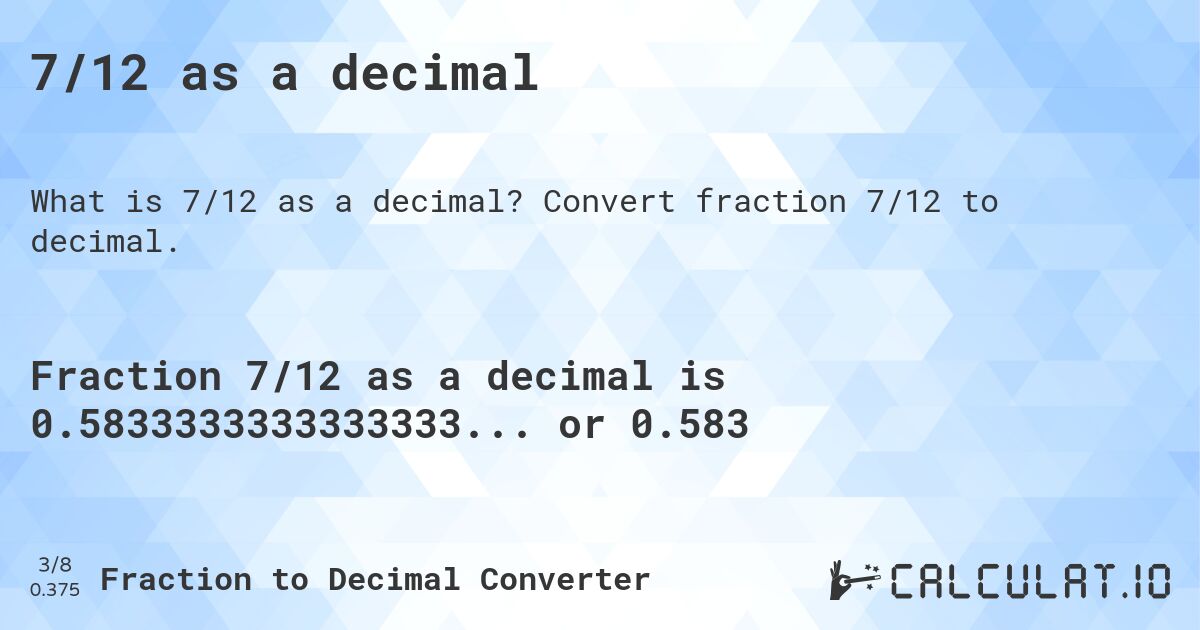
A fraction like 7/12 represents a portion of a whole. To express this portion in a more universally understandable and calculable format, we convert it to a decimal. The process is straightforward: divide the numerator (7) by the denominator (12).
$7 div 12 = 0.58333…$
This result, 0.5833…, is a repeating decimal, typically rounded to a practical number of decimal places for financial contexts, such as 0.5833 or 58.33%. This seemingly simple conversion opens the door to a deeper understanding of financial concepts, enabling accurate calculations, informed decision-making, and robust financial planning across all aspects of the money landscape.

The Foundational Role of Decimals in Personal Finance
Personal finance is inherently numerical, and decimals serve as the bedrock for understanding and managing one’s monetary landscape. From budgeting to debt repayment and income analysis, the ability to work with and interpret decimals ensures clarity and control.
Budgeting and Expense Tracking
Budgeting is the cornerstone of effective personal finance, and it relies heavily on proportional understanding, often expressed through decimals and percentages. When you allocate a portion of your income to various categories – housing, food, transportation, savings – you are essentially dealing with fractions of your total income. Converting these fractions into decimals allows for easy comparison and calculation.
For example, if your rent constitutes 7/12 of your monthly take-home pay, understanding that this translates to approximately 58.33% immediately provides a clear picture of how much of your income is consumed by a single expense. This decimal figure is crucial for:
-
Setting Realistic Limits: Is 58.33% of your income for housing sustainable? A quick decimal conversion offers a stark reality check that might be less apparent when viewing it as an abstract fraction.
-
Identifying Overspending: By tracking expenses, you can determine what fraction or percentage of your budget you’ve spent in a category. If your food budget allows for 1/4 (0.25) of your income, and you find yourself spending 7/12 (0.5833), the decimal comparison clearly highlights an area for adjustment.
-
Comparing Costs: When evaluating different goods or services, prices might be presented in various ways (e.g., “half off,” “two-thirds more expensive”). Converting these to consistent decimal or percentage formats simplifies comparison and helps you make the most cost-effective choices.
Savings and Debt Management
Decimals are absolutely critical when it comes to savings and debt. Interest rates, whether on savings accounts, loans, or credit cards, are almost universally expressed as percentages, which are direct derivatives of decimals.
-
Understanding Interest: An annual percentage rate (APR) of 7% is understood as 0.07 in decimal form for calculation purposes. If you’re calculating interest for a portion of a year, say 7/12 of a year, you’d apply the decimal equivalent of the rate over that fraction of time. This level of precision is vital for accurately projecting future balances or debt accrual.
-
Calculating Loan Payments: Loan calculators use decimals to compute interest portions of monthly payments, ensuring that your repayment schedule accurately reflects the total cost of borrowing. Without decimal understanding, navigating interest accrual on mortgages, car loans, or student debt would be nearly impossible.
-
Saving Goals: When aiming to save a specific fraction of your income, converting that fraction to a decimal helps quantify the exact monetary amount. If you commit to saving 7/12 of a bonus, knowing that’s 58.33% allows you to immediately calculate the precise sum, facilitating disciplined savings toward your financial goals.
Income Streams and Taxation
From evaluating side hustles to understanding your tax obligations, decimals provide the clarity needed for effective income management.
-
Diverse Income Streams: Individuals with multiple income sources – a primary job, freelance work, rental income – often need to calculate fractional portions from each. If a client pays you 7/12 of their project fee upfront, understanding that this is 58.33% helps you manage cash flow and expectations.
-
Taxation: Tax brackets, effective tax rates, and deductions are all percentage-based. Understanding how fractions of your income fall into different tax categories, or how a deduction reduces your taxable income by a certain decimal percentage, is fundamental to accurate tax planning and compliance. Precise decimal calculations ensure you neither overpay nor underpay your taxes.
Decimals in Investing and Wealth Building
The world of investing thrives on precision. Every basis point, every fractional return, contributes to the overall success or failure of an investment strategy. Decimals are the lingua franca of investment analysis, enabling investors to make informed decisions and accurately track performance.
Understanding Returns and Yields
When it comes to measuring investment performance, decimals and percentages are paramount.
-
Stock Returns: If a stock’s price increased by a certain fraction, converting that to a decimal or percentage (e.g., a gain of “7/12” of its original value would be a 58.33% return) allows for easy comparison with other investments or benchmark indices. Investors rarely speak of fractional returns but rather percentage gains or losses, which are simply decimals multiplied by 100.
-
Bond Yields: Bond yields, representing the return an investor receives on a bond, are always quoted as percentages (e.g., a 3.5% yield). This translates to 0.035 in decimal form for calculating interest payments.
-
Dividend Yields: Similarly, dividend yields express a company’s annual dividend as a percentage of its stock price, providing a clear decimal-based metric for income-focused investors.
-
Compound Interest: The magic of compound interest relies on precise decimal calculations. Small fractional differences in interest rates, when compounded over many years, can lead to vastly different outcomes. Calculating future values of investments requires applying interest rates as decimals (e.g., an annual growth rate of 7/12 or 58.33% would be a remarkable return, calculated as 1 + 0.5833… raised to the power of the number of periods).
Fractional Ownership and Allocation
Modern investment platforms have democratized access to assets by allowing fractional ownership. While 7/12 of a share is not a typical trade size, the concept underpins this flexibility, and decimals are the way these portions are quantified.
-
Fractional Shares: Investors can now buy fractions of expensive stocks, meaning they might own, for example, 0.75 of a share, or 0.125 of a share. This allows for smaller investments and greater diversification.
-
Portfolio Allocation: A well-diversified portfolio assigns specific weightings (expressed as percentages or decimals) to different asset classes. An investor might decide to allocate 7/12 of their portfolio to equities and the remaining 5/12 to bonds. Translating these to 58.33% in equities and 41.67% in bonds ensures the allocation strategy is clear, measurable, and easily adjusted. This precision prevents unintended over-concentration or under-diversification.

Risk Assessment and Diversification
Quantifying risk is central to prudent investing. Decimals are used to express probabilities, standard deviations, and other statistical measures that help assess potential downsides and optimize diversification.
-
Probability: The likelihood of certain market events or investment outcomes is often expressed as a decimal (e.g., a 0.05 probability of a market downturn).
-
Volatility: Measures of volatility, such as standard deviation, are calculated using price movements and often result in decimal figures, indicating the degree of price fluctuation.
-
Correlation: The correlation between different assets, which helps in diversification strategies, is represented by a decimal between -1 and +1. Understanding these decimal values allows investors to build portfolios that balance risk and return effectively.
Business Finance: Beyond Simple Numbers
In the corporate world, the stakes are even higher, and the need for decimal precision escalates. Business finance relies on decimals for everything from day-to-day operations to long-term strategic planning, financial reporting, and investor relations.
Profit Margins and Revenue Shares
The health and profitability of a business are consistently measured using decimal-based ratios.
-
Profit Margins: Gross profit margin, operating profit margin, and net profit margin are all calculated as percentages (decimals) of revenue. If a company achieves a 7/12 (58.33%) gross profit margin, it means that for every dollar of revenue, 58.33 cents remain after the cost of goods sold. These metrics are crucial for evaluating operational efficiency and overall financial performance.
-
Revenue Shares: In joint ventures or partnerships, revenues are often split based on predefined fractions or percentages. If one partner is entitled to 7/12 of the revenue, accurate decimal conversion ensures transparent and fair distribution.
-
Pricing Strategy: Setting prices often involves calculating desired profit margins as decimals to ensure products and services are profitable while remaining competitive.
Financial Ratios and Performance Metrics
Financial ratios are the pulse of a business, providing insights into its liquidity, solvency, efficiency, and profitability. All these ratios are derived from financial statements and expressed as decimals.
-
Liquidity Ratios: Current ratio (current assets / current liabilities) and quick ratio (acid-test ratio) are key indicators of a company’s ability to meet short-term obligations. A current ratio of 1.5 (meaning $1.50 in current assets for every $1 in current liabilities) is a decimal representation that speaks volumes about financial health.
-
Solvency Ratios: Debt-to-equity ratio, debt-to-asset ratio help assess a company’s long-term financial stability.
-
Efficiency Ratios: Inventory turnover, accounts receivable turnover, and asset turnover ratios, all presented as decimals, reveal how effectively a company is utilizing its assets.
-
Earnings Per Share (EPS): A fundamental metric for investors, EPS divides net income by the number of outstanding shares, resulting in a decimal figure that indicates profitability on a per-share basis.
Budgeting and Forecasting for Growth
Accurate budgeting and forecasting are vital for strategic decision-making and sustainable growth. Decimals play a critical role in these processes.
-
Growth Rates: Companies project future revenue and expense growth using decimal percentages. A projected annual growth rate of 7/12, or 58.33%, for a new product line would be a significant figure, used to inform investment decisions, hiring plans, and production schedules.
-
Market Share: Measuring and projecting market share involves calculating the company’s sales as a decimal percentage of the total market sales.
-
Resource Allocation: Businesses allocate budgets to different departments or projects based on strategic priorities, often expressed as a fraction or percentage of the total budget. Converting these to decimals ensures precise allocation and accountability.
Leveraging Financial Tools for Decimal Accuracy
While understanding the manual conversion of 7/12 to a decimal is important, modern financial management heavily relies on technological tools that automate and enhance decimal accuracy.
Spreadsheets and Software
Spreadsheets like Microsoft Excel and Google Sheets are indispensable financial tools. They automatically handle complex decimal calculations, apply percentages, and format data, minimizing human error.
-
Automated Calculations: Users input raw data, and formulas process it, performing conversions, summing, averaging, and applying percentages with precise decimal results. This is critical for everything from constructing complex financial models to simple budget tracking.
-
Data Visualization: Spreadsheets can convert decimal results into charts and graphs, making financial data more digestible and patterns more apparent (e.g., a pie chart showing expenses as percentages of total income).
-
Scenario Analysis: Financial software allows users to run “what-if” scenarios, adjusting decimal inputs (like interest rates or growth percentages) to see their impact on outcomes.
Online Calculators and Apps
A myriad of online financial calculators and apps simplify decimal-based computations for individuals and businesses alike.
-
Mortgage and Loan Calculators: These tools instantly calculate monthly payments, total interest paid, and amortization schedules, all based on decimal interest rates and loan terms.
-
Investment Return Calculators: Users can input initial investments, regular contributions, and annual percentage returns (decimals) to project future wealth.
-
Budgeting Apps: Many apps visualize spending and income as percentages, converting raw numbers into easily understandable decimal-based proportions.
Data Interpretation and Decision Making
Ultimately, the goal of converting fractions to decimals and using financial tools is to facilitate better data interpretation and decision-making.
-
Reading Financial Reports: Understanding company financial statements, analyst reports, and economic indicators requires a solid grasp of decimals. Profit margins, growth rates, inflation rates, and bond yields are all presented in this format.
-
Strategic Planning: Whether it’s a personal decision about retirement savings or a business decision about capital expenditure, accurate decimal-based projections and analyses inform effective long-term strategies.
-
Comparative Analysis: Decimals provide a standardized way to compare different financial products, investment opportunities, or business performance metrics. A 7/12 return is abstract; a 58.33% return is concrete and directly comparable to other percentage returns.
Conclusion
The seemingly simple question, “what is 7/12 as a decimal,” opens a gateway to understanding the profound importance of numerical precision in the financial world. From managing personal budgets and debts to making informed investment choices and steering a business towards profitability, the ability to convert fractions into decimals and interpret these figures is not merely an academic skill but a critical financial competency. It underpins transparency, enables accurate calculations, facilitates meaningful comparisons, and ultimately empowers individuals and organizations to make smarter, more strategic financial decisions. Embracing this fundamental mathematical concept is a crucial step towards achieving greater financial literacy, control, and long-term success in all monetary endeavors.
aViewFromTheCave is a participant in the Amazon Services LLC Associates Program, an affiliate advertising program designed to provide a means for sites to earn advertising fees by advertising and linking to Amazon.com. Amazon, the Amazon logo, AmazonSupply, and the AmazonSupply logo are trademarks of Amazon.com, Inc. or its affiliates. As an Amazon Associate we earn affiliate commissions from qualifying purchases.