
Understanding basic mathematical conversions, such as transforming a fraction like 5/12 into its decimal equivalent, might seem like a trivial exercise from a high school math class. However, for anyone navigating the intricate world of personal finance, investing, or business operations, these foundational skills are anything but trivial. They are the bedrock upon which sound financial decisions are built, enabling individuals and professionals alike to accurately interpret financial data, perform crucial calculations, and effectively leverage financial tools. In the realm of money, where precision is paramount, knowing how to convert 5/12 to its decimal form, and understanding its implications, is a gateway to greater financial literacy and empowerment.
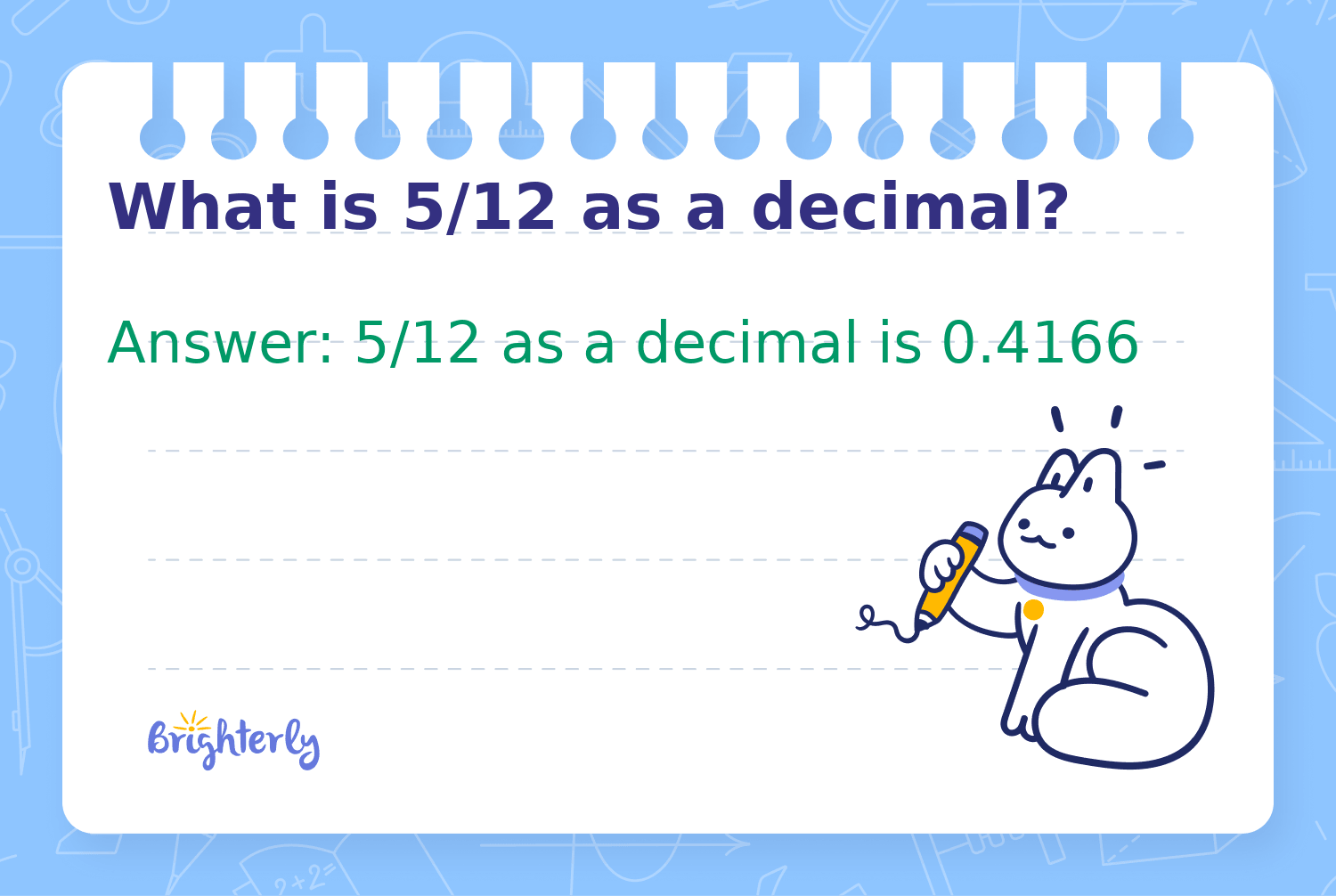
At its core, 5/12 represents five parts of a whole divided into twelve equal parts. As a decimal, this fraction provides a more universal and often more practical format for calculation and comparison, especially in financial contexts where percentages, interest rates, and precise allocations are the norm. The simplicity of the conversion belies its profound impact on how we perceive and manage our financial resources, moving from abstract concepts to tangible numbers that directly influence our wallets and portfolios.
The Fundamental Conversion: From Fraction to Decimal
The journey from a fraction to a decimal is a straightforward arithmetic operation, yet its significance in finance cannot be overstated. Fractions, while excellent for representing proportions, can be cumbersome when performing calculations, especially with varying denominators. Decimals, on the other hand, offer a standardized base-10 system that integrates seamlessly with modern financial tools and reporting.
The Mechanics of Division
To convert 5/12 into its decimal form, one simply divides the numerator (5) by the denominator (12).
5 ÷ 12 = 0.41666…
This results in a repeating decimal, typically rounded for practical applications. For most financial purposes, rounding to two, four, or sometimes more decimal places is sufficient, depending on the required level of precision. For instance, 0.4167 is a common rounding to four decimal places. This decimal figure immediately tells us that 5/12 represents approximately 41.67% of a whole.
Understanding Rational Numbers in Finance
In finance, understanding rational numbers—numbers that can be expressed as a fraction p/q where p and q are integers and q is not zero—is crucial. Fractions like 5/12 are rational numbers that frequently appear in financial scenarios. Whether it’s a portion of a year, a share of a profit, or a segment of an asset allocation, these fractional representations need to be translated into decimals to facilitate calculations. For example, if you are looking at an annual interest rate, and you need to calculate the interest for 5 months out of 12, expressing that period as 5/12 or 0.4167 of a year is essential for accurate pro-rata interest calculation. Without this fundamental understanding, financial models become less robust, and the ability to compare different financial instruments or opportunities diminishes. The decimal form provides a universal language for quantitative financial analysis, making it indispensable for investors, accountants, and everyday consumers alike.
Why 5/12 Matters in Personal Finance & Budgeting
In personal finance and budgeting, fractions like 5/12 frequently emerge in various forms, often without us consciously recognizing them. Converting these fractions into decimals simplifies complex scenarios, making it easier to manage money, plan for the future, and understand the true cost or benefit of financial decisions.
Pro-Rata Calculations and Annualizing Expenses
One of the most common applications of fractions to decimals like 5/12 in personal finance is in pro-rata calculations. These calculations are essential when dealing with expenses or income that are not perfectly aligned with a full year. For instance, if you move into an apartment halfway through a month, your rent for that initial period will be pro-rated. Similarly, if you start a job partway through the year, your benefits or initial salary may be pro-rated. Consider an annual expense of $1,200 for a subscription that you only use for 5 months. To find the pro-rated cost, you’d calculate 5/12 of $1,200. Converting 5/12 to 0.4167 allows for a quick calculation: 0.4167 * $1,200 = $500. This is significantly more intuitive than working with fractions, especially when dealing with multiple such calculations. Understanding how to annualize expenses or income that span only a portion of a year is equally vital. If an expense costs you $500 over 5 months, you can estimate its annual cost by recognizing that $500 is 5/12 of the total annual cost. Dividing $500 by 0.4167 gives you an approximate annual cost of $1,199.95, or roughly $1,200. This capability is critical for accurate budgeting and financial forecasting.
Budgeting for Irregular Income and Expenses
Many individuals face irregular income streams or have recurring expenses that don’t fit neatly into monthly cycles. Freelancers, seasonal workers, or those with dividend income often need to normalize their financial figures over a year. If a significant portion of your income arrives in 5 specific months of the year, understanding what 5/12 of your projected annual income is (0.4167) helps you budget for those peak periods and distribute funds for the leaner months. Conversely, some large expenses, like annual insurance premiums or property taxes, might be paid at specific intervals. If you want to set aside money monthly to cover an expense that hits every 5 months, you need to understand that each payment represents 5/12 of your total annual allocation for that item. Translating these irregular patterns into decimal fractions helps create a more stable and realistic monthly budget, preventing financial surprises and ensuring funds are available when needed.
Understanding Interest Rates and Dividends
Interest rates and dividends are often quoted on an annual basis. However, in reality, interest might compound monthly, quarterly, or semi-annually, and dividends might be paid out quarterly. To calculate the actual interest earned or paid over a specific period shorter than a year, say 5 months, you’ll inherently be working with fractions of the annual rate. If a loan has an annual interest rate, and you repay it after 5 months, the interest charged will be proportional to 5/12 of the annual rate. Converting 5/12 to 0.4167 allows you to accurately determine the fractional portion of the annual interest applicable to your specific repayment period. Similarly, if a stock pays an annual dividend, but you only owned it for 5 months, calculating your expected dividend involves applying the 5/12 factor. This precision is vital for investors evaluating returns, borrowers understanding loan costs, and anyone trying to calculate effective yields or prorated distributions from financial products.
5/12 in the World of Investing and Business Finance
Beyond personal budgeting, the conversion of fractions to decimals, exemplified by 5/12, takes on even greater strategic importance in the complex landscapes of investing and business finance. Here, precision in numbers directly correlates to profitability, valuation, and competitive advantage.

Stock Market Interpretations: Beyond Whole Numbers
While stock prices are now almost universally quoted in decimals, historically, they were often quoted in fractions (e.g., 1/8, 1/4, 1/16). Even today, understanding fractional parts of a share can be relevant in certain advanced financial instruments or specialized markets. More broadly, when analyzing company performance or investment returns, investors frequently encounter scenarios where fractions represent crucial data points. For instance, if a company reports earnings for a fiscal period that is 5 months long, an investor needs to understand that this period represents 5/12, or approximately 0.4167, of a full year. To annualize these earnings for comparison with other companies or historical data, the investor would apply this decimal factor. Similarly, in scenarios involving stock splits or dividend re-investments where fractional shares might be issued, understanding how these fractions translate to decimals ensures accurate portfolio valuation and return calculations. Without the ability to perform such conversions rapidly, investors risk misinterpreting financial reports, making suboptimal investment decisions, or failing to capture the full picture of a company’s financial health.
Business Forecasting and Revenue Allocation
For businesses, accurate forecasting and precise revenue allocation are pillars of sustainable growth. Fractions like 5/12 are implicitly present in many business models. Consider a business that recognizes revenue evenly throughout the year, but a specific project or service contract spans only 5 months. To accurately forecast quarterly or annual revenue from this project, financial analysts must determine what portion 5 months represents of the entire fiscal year. Using 0.4167 (from 5/12) allows for clear projection of how much of the annual revenue target this specific project will contribute. Furthermore, in partnership agreements or joint ventures, profits or costs might be allocated based on time spent or resources contributed, which could easily be represented by a fraction like 5/12. Converting this to a decimal ensures that each partner receives their exact share, avoiding disputes and maintaining transparency in financial dealings. This mathematical precision is critical for maintaining accurate financial statements, informing strategic planning, and ensuring compliance with accounting standards.
Analyzing Financial Ratios and Performance Metrics
Financial ratios are a cornerstone of business analysis, providing insights into a company’s liquidity, solvency, efficiency, and profitability. These ratios often involve comparing figures from different time periods or specific segments of a business. For example, if a company wants to analyze its sales growth over a non-standard 5-month period and compare it to an annualized industry average, it needs to adjust its 5-month sales figures. Multiplying the 5-month sales by the inverse of 5/12 (i.e., 12/5 or 2.4) would annualize the sales figure, allowing for a direct comparison. Similarly, when calculating metrics like “days payable outstanding” or “inventory turnover” over an irregular period, the number of days or months in that period must be accurately converted into a decimal fraction of a year. If a company’s reporting period is 5 months, and it wants to calculate an annualized inventory turnover, it must understand that 5 months is 0.4167 of a year. Dividing the 5-month turnover by 0.4167 would give an approximate annualized figure. Accurate conversion of fractions to decimals is therefore indispensable for generating meaningful financial ratios, conducting performance reviews, and benchmarking against competitors or industry standards.
Leveraging Financial Tools: Where Decimals Reign Supreme
In today’s fast-paced financial world, technological tools have become indispensable. From sophisticated trading platforms to simple budgeting apps, these tools are designed to process and display financial data primarily in decimal form. Understanding the underlying fraction-to-decimal conversion, such as 5/12, is not just about manual calculation; it’s about intelligent interaction with these powerful digital aids.
Spreadsheets and Financial Calculators
Spreadsheets like Microsoft Excel or Google Sheets are the workhorses of personal and business finance. They excel at performing complex calculations, but they operate predominantly with decimals. If you input “5/12” into a spreadsheet cell, it will instantly convert it to 0.416666666666667 (or 0.4167 if formatted to four decimal places). This automatic conversion is a testament to the decimal’s utility in computation. When building a budget, an investment model, or a cash flow projection, you might frequently need to apply fractional portions of an annual figure (e.g., 5 months out of 12). Directly using the decimal 0.4167 simplifies formula creation and reduces the potential for errors that might arise from manual fractional arithmetic. Similarly, financial calculators, whether physical devices or online tools, are engineered to take decimal inputs for interest rates, time periods, and payment frequencies. A loan repayment calculated over 5 months out of a 12-month year will require the time period to be input as a decimal fraction of a year (0.4167) for accurate amortization schedules or interest accrual. Without this foundational understanding, users might struggle to correctly input data or interpret the results generated by these essential financial tools.
Investment Platforms and Reporting
Online investment platforms, brokerage accounts, and robo-advisors invariably present financial information in decimal format. Stock prices, bond yields, expense ratios, dividend yields, and portfolio returns are all displayed with decimal precision. When dealing with fractional shares, for instance, a platform might show you own “0.4167” of a share, rather than “5/12.” This standardization streamlines the user experience and facilitates quick comparisons. Investment reports, whether daily, monthly, or annual, heavily rely on decimals to convey performance metrics. A growth of “0.4167%” might not seem significant, but knowing its fractional origin (5/12%) can provide a deeper understanding of its context. Furthermore, when analyzing financial statements of publicly traded companies, investors will find all figures, from earnings per share to price-to-earnings ratios, presented in decimal form. The ability to mentally or manually convert back and forth between fractions and decimals helps investors to fully grasp the nuances of these reports and make informed decisions based on precise numerical data.
The Pitfalls of Misinterpretation
The convenience of financial tools can sometimes lead to a dependency that bypasses fundamental understanding. If a user merely inputs figures without comprehending their underlying fractional or decimal nature, there’s a significant risk of misinterpretation. For example, if a financial report states a “0.4167” portion of a specific asset, someone unfamiliar with fractions might not immediately recognize this as “5/12” or roughly 41.67%. This lack of understanding can lead to incorrect assumptions about asset allocation, risk exposure, or return expectations. Rounding is another common pitfall; while tools often round for display, the underlying calculations may use greater precision. Understanding that 5/12 is a repeating decimal (0.4166…) and that rounding it to 0.4167 might introduce tiny discrepancies over many calculations is crucial, especially in high-stakes financial modeling where even small errors can compound. An informed user of financial tools knows not just how to use them, but also why the numbers appear as they do, fostering a critical mindset that prevents costly mistakes stemming from numerical misinterpretations.
Mastering Basic Math for Financial Empowerment
The seemingly simple act of converting 5/12 to its decimal form is far more than a mathematical exercise; it’s a foundational skill for financial empowerment. In an increasingly data-driven world, where financial decisions are often made based on complex numerical information, a solid grasp of basic arithmetic, including fractions and decimals, is non-negotiable.
Building Foundational Financial Literacy
Financial literacy is not solely about understanding sophisticated investment strategies or tax codes; it begins with the basics. The ability to interpret a fraction as a decimal, and vice-versa, is a fundamental component of this literacy. It enables individuals to dissect interest rates, understand budgeting allocations, analyze investment returns, and evaluate loan terms with greater clarity. Without this basic numerical fluency, individuals are more susceptible to misinterpreting financial product details, overpaying on interest, or making uninformed investment choices. Mastering conversions like 5/12 to 0.4167 provides a sense of confidence and control over one’s financial data, demystifying calculations that might otherwise seem daunting. It builds a crucial bridge between abstract financial concepts and their tangible, numerical impact on personal and business wealth.

From Theory to Informed Decision-Making
Ultimately, the goal of understanding “what is 5/12 in decimal form” in a financial context is to facilitate informed decision-making. Whether you’re a student budgeting for the first time, a seasoned investor evaluating a company’s quarterly report, or a business owner projecting cash flow, the precise translation of fractional proportions into decimal values is indispensable. It transforms theoretical knowledge into practical insight, allowing for accurate comparisons, precise calculations, and robust financial planning. This simple conversion is a gateway to understanding percentages, ratios, and effective rates, which are the language of finance. By mastering this seemingly elementary mathematical concept, individuals and businesses can navigate their financial journeys with greater confidence, make more intelligent choices, and ultimately, achieve stronger financial outcomes. The power lies not just in knowing the answer (0.4167), but in appreciating why that answer matters across every facet of the financial world.
aViewFromTheCave is a participant in the Amazon Services LLC Associates Program, an affiliate advertising program designed to provide a means for sites to earn advertising fees by advertising and linking to Amazon.com. Amazon, the Amazon logo, AmazonSupply, and the AmazonSupply logo are trademarks of Amazon.com, Inc. or its affiliates. As an Amazon Associate we earn affiliate commissions from qualifying purchases.