
In the intricate world of finance, numbers are the universal language. From budgeting personal income to dissecting corporate balance sheets, a firm grasp of fundamental mathematical concepts is indispensable. Among these foundational elements, fractions stand out as crucial building blocks, often simplifying complex proportions and relationships that underpin financial health and growth. This article delves into “2/3” as a fraction, not merely as a mathematical concept, but as a lens through which we can better understand, manage, and optimize our financial lives, both personally and professionally. Understanding what 2/3 represents and how it translates into real-world financial scenarios is a cornerstone of robust financial literacy and informed decision-making.
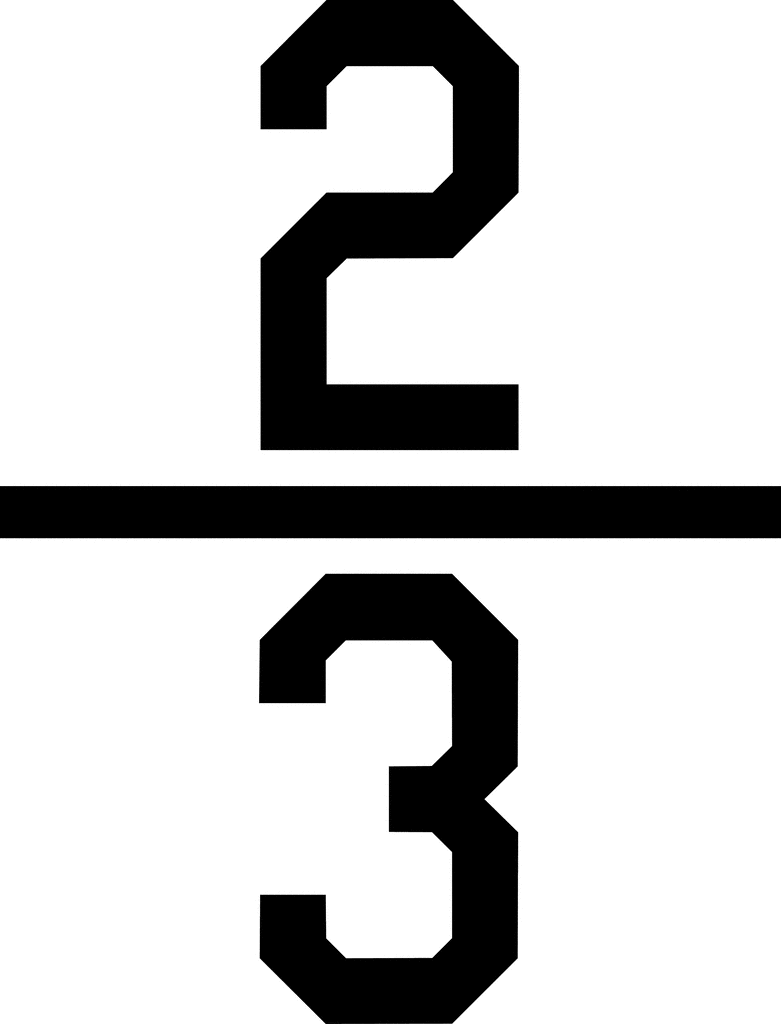
The Core Concept: Deconstructing “2/3” as a Fraction
Before exploring its financial applications, it’s essential to unequivocally define what 2/3 signifies as a fraction. This foundational understanding ensures that all subsequent financial interpretations are built on solid ground.
Numerator, Denominator, and the Whole
A fraction, by definition, represents a part of a whole. It consists of two key components: the numerator and the denominator.
-
The numerator (the top number) indicates how many parts of the whole are being considered. In “2/3”, the numerator is “2”.
-
The denominator (the bottom number) represents the total number of equal parts that make up the whole. In “2/3”, the denominator is “3”.
Thus, “2/3” means “two out of three equal parts.” If you have a whole entity divided into three identical sections, 2/3 refers to two of those sections.
Visualizing 2/3
To make this concept tangible, consider simple analogies. Imagine a pizza cut into three equal slices; 2/3 of the pizza would be two of those slices. If a team has three members and two of them are present, then 2/3 of the team is present. This intuitive understanding is crucial because financial quantities are often represented as parts of a larger whole – a portion of income, a share of ownership, a segment of a budget.
Converting to Decimal and Percentage
While 2/3 is a clear representation, financial calculations often require conversion into decimals or percentages, especially for easier comparison and computation.
-
To convert 2/3 to a decimal, you simply divide the numerator by the denominator: 2 ÷ 3 = 0.6666… (often rounded to 0.67 for practical purposes).
-
To convert this decimal to a percentage, you multiply by 100: 0.6666… × 100 = 66.67%.
Therefore, 2/3 is equivalent to approximately 0.67 or 66.67%. This conversion is critically important in finance, as interest rates, growth rates, and budget allocations are frequently expressed as percentages, and fractional understanding allows for seamless translation between these forms.
2/3 in Personal Finance: Budgeting, Savings, and Debt Management
For individuals, understanding fractions like 2/3 is not an academic exercise but a practical skill that directly impacts their financial well-being. It empowers more intelligent decisions concerning income, expenses, and long-term goals.
Budgeting and Income Allocation
Many popular budgeting frameworks rely heavily on fractional or percentage allocations. For instance, the 50/30/20 rule suggests allocating 50% of your after-tax income to needs, 30% to wants, and 20% to savings and debt repayment. While not directly using 2/3, this illustrates the principle of dividing income into parts. More directly, one might decide that 2/3 of their monthly income must cover essential living expenses like rent, utilities, and groceries, leaving 1/3 for discretionary spending and savings. This simple fractional split provides a clear, actionable guideline for managing cash flow effectively and preventing overspending in critical categories.
Saving Goals and Progress
Tracking progress towards savings goals often involves fractions. If you aim to save $30,000 for a down payment on a house, and you’ve already accumulated $20,000, you have saved 2/3 of your goal. Recognizing this fraction provides a tangible sense of achievement and helps maintain motivation. Similarly, if an investment fund aims for a specific return, and it has achieved 2/3 of that return by mid-year, it offers a snapshot of performance relative to targets, aiding in re-evaluation or adjustment.
Debt Reduction Strategies
Managing debt is another area where fractions prove invaluable. If you owe $3,000 on a credit card and have paid down $2,000, you have reduced 2/3 of your principal. This understanding allows individuals to monitor their progress, estimate remaining payments, and celebrate milestones in their journey towards becoming debt-free. It also helps in understanding the mechanics of interest—what fraction of your monthly payment is going towards reducing the principal versus simply covering interest charges.
Investing and Business: Leveraging Fractional Understanding for Growth
In the realms of investing and business, fractions move beyond personal budgeting to represent ownership, evaluate performance, and distribute profits, underpinning strategic financial decisions.
Shares and Ownership Stakes
Perhaps one of the most direct applications of fractions in business is in ownership. If a company is divided into three equal shares and an investor owns two of them, they effectively own 2/3 of the company. This translates directly to proportional control, voting rights, and claims on assets. In smaller partnerships or family businesses, fractional ownership (e.g., 1/2, 1/3, 2/3) dictates the power dynamics and distribution of responsibilities and rewards among partners. Understanding these fractions is fundamental to negotiating deals, structuring partnerships, and assessing control.
Profit Sharing and Distribution
Following from ownership, profit distribution often follows fractional or percentage rules. If a business generates a profit of $300,000, and a partner is entitled to 2/3 of the profits, their share would be $200,000 ($300,000 * 2/3). This clear, fractional calculation ensures transparency and fairness in profit allocation, crucial for maintaining healthy business relationships and incentivizing performance. Similarly, dividends paid by public companies are a fraction of their earnings per share, reflecting their financial health and distribution policy.

Investment Portfolio Allocation
While commonly expressed in percentages, portfolio allocation intrinsically relies on fractional thinking. If an investment advisor recommends allocating 2/3 of your portfolio to equities and 1/3 to bonds, they are essentially prescribing a fractional division of your total investment capital. Understanding this allows investors to visualize their risk exposure and potential growth opportunities. For instance, a growth-oriented investor might have 2/3 of their portfolio in high-growth stocks, understanding that this fraction represents their primary exposure to market volatility and potential returns.
Financial Ratios and Metrics
Many critical financial ratios are, at their core, fractions used to evaluate a company’s performance, solvency, or efficiency. Ratios like Debt-to-Equity, Current Ratio, or Price-to-Earnings are calculated by dividing one financial metric by another. For example, if a company’s debt-to-equity ratio is 2/3 (meaning debt is 2/3 of equity), it provides insights into its leverage. Comparing these fractional ratios against industry benchmarks or historical data helps investors and analysts make informed decisions about a company’s financial health and investment potential.
Practical Applications: Discounts, Taxes, and Financial Planning
The presence of fractions extends to everyday financial transactions and long-term planning, making an understanding of 2/3 a valuable tool for savvy consumers and planners alike.
Understanding Discounts and Sales
“Get 2/3 off your purchase!” This is a common marketing tactic, and knowing what 2/3 means allows consumers to quickly calculate the actual savings. If an item costs $90, “2/3 off” means a discount of $60 ($90 * 2/3), resulting in a final price of $30. Misinterpreting this fraction can lead to overspending or missed savings opportunities. Conversely, understanding it helps identify genuine bargains and plan purchases effectively.
Tax Brackets and Deductions
While tax rates are usually expressed as percentages, the underlying concept of taxing a fraction of income or allowing deductions for a fraction of expenses is pervasive. For example, specific tax codes might allow you to deduct 2/3 of your home office expenses if you meet certain criteria. Calculating this correctly ensures accurate tax filings and optimizes your tax burden, directly impacting your disposable income.
Real Estate and Property Shares
In real estate, co-ownership scenarios often involve fractional interests. Two individuals might purchase a property, with one owning 2/3 and the other 1/3, particularly in investment properties or multi-generational homes. This fractional ownership dictates responsibilities for expenses, rights to rental income, and proceeds from a sale. Clear understanding prevents disputes and ensures equitable sharing.
Insurance Payouts and Coverage
Insurance policies can also involve fractional concepts. A policy might cover 2/3 of the replacement cost of certain items, or a deductible might represent a fraction of the claim value. Knowing these fractions is crucial for assessing the true value of your coverage and understanding your financial liability in the event of a claim.
Beyond the Basics: The Psychological and Strategic Edge of Fractional Thinking
Understanding 2/3 and other fractions offers more than just computational ability; it provides a strategic and psychological advantage in navigating the financial landscape.
Simplifying Complex Financial Data
Fractions often offer a more intuitive and digestible way to understand proportions than dense decimals or large numbers, especially in quick mental calculations. Stating that “2 out of every 3 dollars goes towards debt” is arguably more impactful and easier to grasp for some than “66.67% of funds are allocated to debt.” This simplification can aid in quicker assessment and better communication of financial realities.
Informed Decision-Making
A solid grasp of fractions empowers individuals and businesses to make more informed and confident financial decisions. Whether it’s comparing investment returns, evaluating a loan offer, or negotiating a business deal, the ability to quickly understand and apply fractional concepts provides a distinct edge. It moves individuals from passively accepting figures to actively questioning and calculating their implications.
Avoiding Misinterpretations
Financial misinterpretations can be costly. Confusing 2/3 with 1/2 or another fraction can lead to incorrect budget allocations, flawed investment assumptions, or erroneous tax filings. A precise understanding of what 2/3 represents helps in avoiding these common pitfalls, safeguarding financial resources and ensuring accuracy in all monetary dealings.

Conclusion
The seemingly simple fraction “2/3” is far more than just a mathematical concept; it is a fundamental tool woven into the fabric of financial literacy and sound decision-making. From managing personal budgets and savings to structuring business ownership, evaluating investments, and navigating consumer discounts, understanding what two parts out of three represent is an invaluable skill. By mastering this basic fraction and its conversions, individuals and businesses alike can demystify complex financial information, make more strategic choices, and ultimately pave a clearer path toward financial stability and prosperity. Developing a strong foundation in such mathematical basics is not just about crunching numbers; it’s about building the intellectual framework necessary for lifelong financial success.
aViewFromTheCave is a participant in the Amazon Services LLC Associates Program, an affiliate advertising program designed to provide a means for sites to earn advertising fees by advertising and linking to Amazon.com. Amazon, the Amazon logo, AmazonSupply, and the AmazonSupply logo are trademarks of Amazon.com, Inc. or its affiliates. As an Amazon Associate we earn affiliate commissions from qualifying purchases.