
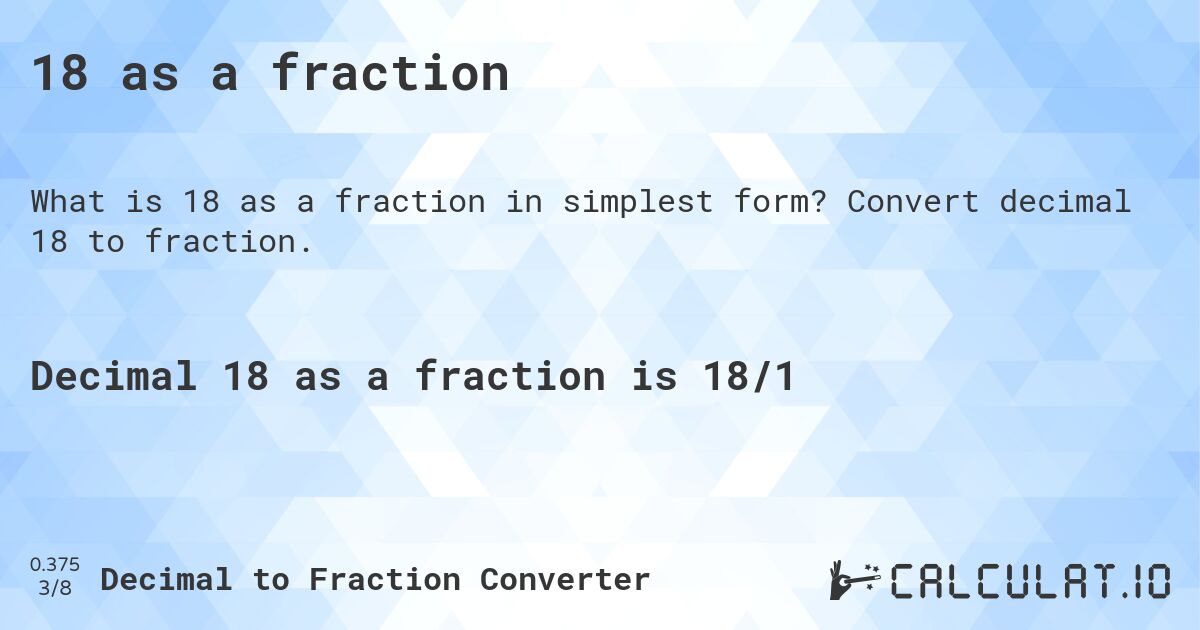
The question “what is 18 in a fraction?” might initially evoke a simple mathematical query. However, in the dynamic landscape of modern finance, this seemingly straightforward phrase can serve as a profound lens through which to examine key investment concepts. It’s not about elementary school arithmetic; it’s about dissecting the essence of fractional ownership, understanding the impact of specific numerical values (like an 18% return or an $18 investment), and realizing how these elements converge to democratize wealth creation.
Today, financial accessibility is paramount, breaking down traditional barriers that once reserved lucrative investments for the affluent. “Fraction” now represents a tangible slice of a larger asset, available to virtually anyone. Simultaneously, “18” can symbolize a critical percentage target, a practical monetary entry point, or a significant time horizon in an investment journey. This article will delve into how these interpretations intertwine, illuminating the strategies and opportunities inherent in this exciting financial paradigm.
The Rise of Fractional Ownership: Demystifying the “Fraction”
The concept of fractional ownership has reshaped the investment world, transforming how individuals access and build their portfolios. No longer restricted to buying whole units of high-value assets, investors can now own a piece, a fraction, of what was once out of reach. This paradigm shift is not just a trend; it’s a foundational change democratizing finance for a new generation of investors.
What is Fractional Investing?
Fractional investing refers to the practice of purchasing a portion or a “fraction” of a financial asset rather than the entire unit. This principle, while not entirely new—think of mutual funds or REITs—has been revolutionized by technology, making direct ownership of fractional assets incredibly accessible. Instead of needing thousands of dollars to buy a full share of a high-priced stock like Amazon or Tesla, an investor can now buy just $50 worth. The same applies to real estate, where platforms allow investors to own a small percentage of a property, or even high-value collectibles like art, rare wines, or classic cars. This model lowers the entry barrier significantly, allowing more individuals to participate in markets that were previously exclusive due to prohibitive costs.
Why Fractional Investing Matters to You
The significance of fractional investing extends beyond mere affordability. Firstly, it offers unprecedented diversification capabilities. With smaller amounts of capital, investors can spread their money across a wider array of assets, sectors, and geographies, significantly reducing portfolio risk. A few hundred dollars can now buy fractions of ten different stocks, rather than just one. Secondly, it fosters financial inclusivity, empowering individuals with modest starting capital to build robust, diversified portfolios that were once the exclusive domain of institutional or high-net-worth investors. Thirdly, it enhances liquidity for certain asset classes; while a whole property might take months to sell, a fractional share could potentially be traded more readily on specialized platforms. Lastly, it cultivates a new generation of informed investors, as the ease of access encourages more people to engage with and understand the mechanics of different markets.
Pinpointing “18”: Unpacking the Number in Financial Contexts
Beyond its mathematical definition, the number “18” can carry significant weight in financial discussions. It serves as a versatile marker, representing anything from ambitious return targets to an accessible investment amount or a crucial age for financial independence. Understanding these different interpretations helps contextualize how numbers shape our financial goals and strategies.
18 as a Percentage: Targets and Returns
In the realm of personal finance and investing, “18” frequently appears as a percentage, often signifying a goal, a return, or an allocation. An 18% annual return on investment (ROI), for example, is often considered an ambitious yet achievable target, particularly in growth-oriented portfolios or specific market conditions. While historical averages might be lower for broad market indices, strategic investments in emerging markets, high-growth stocks, or alternative assets might yield such returns. Similarly, an 18% savings rate can represent a robust commitment to financial security, ensuring significant progress towards retirement or other long-term goals. For portfolio allocation, an investor might consider allocating 18% of their capital to a specific sector, asset class (like real estate or commodities), or a high-risk, high-reward investment as part of a diversified strategy. Understanding what an 18% figure signifies—be it aggressive growth, prudent saving, or strategic allocation—is crucial for setting realistic expectations and tailoring investment strategies.
18 as a Monetary Value: Small Investments, Big Impact
The number “18” can also represent a modest monetary value, such as $18, highlighting the incredible power of micro-investing. In an era where fractional shares are commonplace, investing just $18 might seem insignificant, but its true impact lies in consistency and compounding. Regular investments of small amounts, perhaps $18 every week or month, can accumulate substantially over time. Many micro-investing apps are built on this premise, allowing users to round up purchases or make small, recurring contributions. For many, $18 is a highly accessible figure—less than a daily coffee habit or a single meal out. This accessibility makes it an ideal starting point for new investors, allowing them to gain practical experience and begin building wealth without needing large lump sums. The discipline of consistently investing $18, no matter how small it seems, instills good financial habits and leverages the magic of compound interest.
18 as a Time Horizon or Age Marker
“18” can also mark critical junctures in an individual’s financial journey. Investing for 18 years represents a significant long-term horizon, allowing ample time for market fluctuations to smooth out and for investments to grow substantially through compounding. This kind of time frame is typical for major life goals such as funding a child’s education, saving for a distant retirement, or purchasing a first home. Furthermore, the age of 18 often signifies a transition into adulthood, making it an opportune time to begin investing. Starting at 18 allows individuals to harness the full power of compound interest over their entire working lives. An investment made at 18 has decades more to grow than one made at 28 or 38, potentially leading to dramatically different outcomes by retirement. Encouraging financial literacy and the habit of investing from this early age can fundamentally alter an individual’s long-term financial trajectory.
Synergies: How “18” Intersects with Fractional Investment Strategies

The true power of “18 in a fraction” emerges when we explore how specific financial goals and values, represented by “18,” can be effectively pursued through the mechanism of fractional investing. This synergy unlocks new pathways for achieving ambitious returns, diversifying portfolios with minimal capital, and planning for significant long-term wealth accumulation.
Achieving an 18% Target with Fractional Assets
Targeting an 18% annual return requires a well-thought-out strategy, and fractional investing provides the flexibility to pursue such ambitious goals. By allowing investors to allocate small amounts across various asset classes, fractional platforms enable a highly diversified approach. For instance, an investor aiming for 18% might distribute their capital fractionally across a blend of high-growth technology stocks, a real estate crowdfunding platform, and perhaps a small allocation to a less traditional asset like a fractional art investment. This diversification mitigates the risk associated with any single asset class, while the exposure to multiple growth avenues increases the probability of hitting a higher overall portfolio return. With fractional shares, rebalancing a portfolio to maintain this target—selling a portion of an overperforming asset to buy more of an underperforming one—becomes far more manageable, even for smaller portfolios.
Leveraging $18 for Fractional Portfolio Diversification
The modest sum of $18, when channeled through fractional investing, can become a powerful tool for portfolio diversification. Instead of being limited to a single, inexpensive stock, $18 can now be split across several different companies or even distinct asset types. For example, an investor could use $6 to buy a fraction of a tech giant, $6 for a piece of a renewable energy fund, and $6 for a fraction of a stable dividend stock. Over time, these consistent $18 contributions, diversified across various fractions, build a robust and resilient portfolio. This strategy is particularly appealing for beginners or those with limited disposable income, demonstrating that significant wealth creation doesn’t always require large initial capital. The key is consistent, disciplined investment into a varied mix of fractional assets, allowing each $18 to contribute to a broader financial mosaic.
The 18-Year Horizon: Fractional Investing for Long-Term Wealth
An 18-year investment horizon is a sweet spot for harnessing the full potential of compounding, and fractional investing is ideally suited to this long-term strategy. For goals like retirement, a child’s college fund, or simply long-term wealth accumulation, consistent fractional contributions over 18 years can lead to substantial results. Imagine an individual investing $100 per month consistently for 18 years into a diversified portfolio of fractional shares. Even at a modest 7% annual return, that consistent investment, combined with compounding, would grow to over $40,000. If that monthly contribution started at $18, it would still represent a significant sum. Fractional investing removes the psychological barrier of needing large sums to start, making it easier to commit to the long haul. This sustained approach, leveraging the small, accessible units of fractional assets, proves that patiently investing over nearly two decades can transform even modest inputs into considerable wealth.
Navigating the Fractional Landscape: Opportunities and Considerations
While fractional investing offers unparalleled opportunities for financial empowerment, navigating this evolving landscape requires diligence and informed decision-making. Investors must understand both the exciting potential and the inherent considerations, from platform selection to managing risks and continually expanding their financial literacy.
Choosing the Right Fractional Platforms
The proliferation of fractional investing platforms means investors have more choices than ever before. Selecting the right platform is critical and involves evaluating several key factors. Firstly, consider the asset availability; some platforms specialize in stocks and ETFs, others in real estate, and still others in alternative assets like art or collectibles. Secondly, examine the fee structure, including trading commissions, management fees, and withdrawal charges. Thirdly, regulatory compliance and security are paramount to protect your investments. Look for platforms regulated by relevant financial authorities. Finally, a user-friendly interface and educational resources can significantly enhance your investing journey, especially for beginners. Thorough research and comparing multiple options based on your specific investment goals and risk tolerance will ensure you choose a platform that aligns with your financial strategy.
Risks and Rewards of Fractional Investing
Like all investments, fractional investing comes with its own set of risks and rewards. The primary reward is accessibility and diversification, enabling investors to participate in high-value markets with smaller capital and spread risk across numerous assets. This democratizes wealth-building and allows for greater portfolio resilience. However, risks do exist. For less liquid assets like fractional real estate or art, selling your fraction might be challenging or take time, potentially impacting your ability to access funds quickly. Valuation can also be complex for certain illiquid assets, and the market for fractional shares of these assets might be nascent, leading to price volatility. Furthermore, while fractional ownership of publicly traded stocks is highly regulated, the regulatory environment for newer fractional asset classes (e.g., specific collectibles) can vary, posing regulatory uncertainty. Investors must conduct due diligence on the specific asset and platform, understanding the nuances of each investment to maximize rewards while mitigating potential downsides.
Financial Literacy: The Key to Mastering the Fraction
Ultimately, the success of leveraging “18 in a fraction” lies in robust financial literacy. Simply having access to fractional shares and the ability to invest small amounts is not enough; investors must understand what they are investing in, why, and how it fits into their broader financial plan. This involves continuously educating oneself about market dynamics, asset classes, economic indicators, and personal finance principles. Understanding concepts like asset allocation, risk management, diversification, and the power of compounding is crucial. Financial literacy empowers investors to make informed decisions, avoid common pitfalls, and adapt their strategies as market conditions or personal circumstances change. It transforms the act of investing from a speculative gamble into a strategic endeavor, ensuring that the opportunities presented by fractional ownership are fully harnessed for sustainable wealth creation.

Conclusion
The seemingly simple phrase “what is 18 in a fraction” transforms into a powerful exploration of modern finance. It encapsulates the profound shift towards democratized investing through fractional ownership and underscores the strategic importance of specific financial metrics and goals. Whether “18” represents an ambitious percentage return, an accessible investment amount, or a critical time horizon, its integration with fractional investment strategies opens new avenues for wealth creation.
By understanding the mechanics of fractional investing, leveraging even small sums consistently, and committing to long-term financial discipline, individuals can harness these tools to build diversified portfolios and achieve their financial aspirations. The key to navigating this exciting landscape lies in continuous learning and informed decision-making. In an era where financial barriers are falling, understanding the true potential of “18 in a fraction” isn’t just about math; it’s about mastering the art of modern financial empowerment.
aViewFromTheCave is a participant in the Amazon Services LLC Associates Program, an affiliate advertising program designed to provide a means for sites to earn advertising fees by advertising and linking to Amazon.com. Amazon, the Amazon logo, AmazonSupply, and the AmazonSupply logo are trademarks of Amazon.com, Inc. or its affiliates. As an Amazon Associate we earn affiliate commissions from qualifying purchases.