
In the intricate world of personal and business finance, seemingly simple mathematical concepts often underpin monumental decisions. The question “what is 1/3 of?” might appear elementary, a throwback to grade school arithmetic. Yet, its practical application within the realm of money is profoundly significant, serving as a cornerstone for everything from basic budgeting to sophisticated investment strategies and entrepreneurial endeavors. Understanding how to calculate and, more importantly, apply the concept of one-third can unlock a new level of financial clarity, discipline, and strategic foresight. This article delves into the critical role that this fundamental fraction plays across various facets of financial management, illuminating its power to transform how we save, spend, invest, and grow our wealth.

The Ubiquitous Role of Fractions in Financial Literacy
At its core, financial literacy is the ability to understand and effectively use various financial skills, including personal financial management, budgeting, and investing. Central to this understanding are fundamental mathematical concepts, with fractions standing out as particularly pervasive. From calculating interest rates to understanding market share, determining portfolio allocations, or dividing profits, fractions provide the language through which we interpret and manipulate financial data. The specific fraction “1/3” often emerges as a common, digestible, and powerful benchmark in numerous financial contexts.
Deciphering the “1/3” Principle
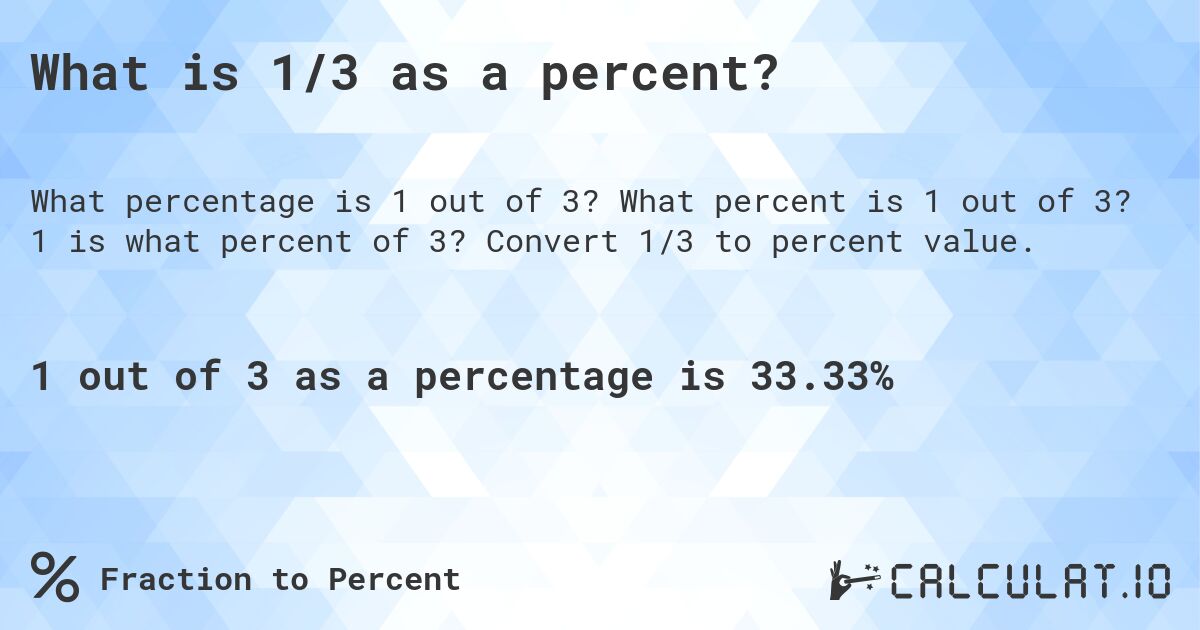
To understand “1/3 of” something is to grasp the concept of division and proportion. It means taking a whole and dividing it into three equal parts, then considering one of those parts. Mathematically, it’s equivalent to dividing a number by three. For instance, 1/3 of $300 is $100. While straightforward, the elegance of 1/3 lies in its simplicity and its capacity to represent a substantial yet manageable portion of a total. Unlike more complex fractions, 1/3 offers a clear, actionable segment that is easily calculable mentally, making it an invaluable tool for on-the-fly financial decisions.
Why Simple Fractions Hold Profound Financial Implications
The power of simple fractions, especially 1/3, in finance stems from several factors. Firstly, they offer an intuitive way to visualize allocation. When we talk about dedicating 1/3 of our income to a particular goal, it creates a concrete mental image of how our earnings are being distributed. Secondly, they facilitate comparison. Is dedicating 1/3 of income to housing manageable? How does that compare to others? Thirdly, they serve as easy-to-remember rules of thumb. Many financial guidelines are expressed in simple fractional or percentage terms because they are actionable and easy to communicate. Ignoring these basic building blocks is akin to trying to construct a house without understanding the strength of its materials; the structure might stand, but its stability and efficiency will be compromised.
From Basic Math to Complex Financial Decisions
While calculating 1/3 of a number might seem like basic math, its application extends into highly sophisticated financial models and personal strategies. In budgeting, it helps structure spending; in investing, it guides diversification; in business, it dictates profit distribution. The transition from simple arithmetic to strategic financial planning through the lens of fractions highlights their foundational importance. Mastering this seemingly simple concept empowers individuals and businesses to make more informed, deliberate, and ultimately, more successful financial choices.
Budgeting for Success: The One-Third Approach to Income Allocation
Perhaps nowhere is the “1/3” principle more prevalent and powerful than in personal budgeting. Effective budgeting is the cornerstone of financial health, enabling individuals to control their money rather than letting their money control them. The concept of allocating proportions of income to different categories is a fundamental budgeting strategy, and the one-third framework offers a versatile and often highly effective approach.
The 50/30/20 Rule and its One-Third Cousin
A widely popular budgeting framework is the 50/30/20 rule, which suggests allocating 50% of after-tax income to “needs” (housing, utilities, groceries), 30% to “wants” (dining out, entertainment, hobbies), and 20% to “savings and debt repayment.” While this rule uses percentages, the 30% allocation to wants is remarkably close to one-third of income (33.33%). This proximity underscores the natural tendency towards dividing income into roughly three primary categories. For those who prefer simpler, rounder figures, a one-third allocation can be a powerful mental shortcut and a starting point for more granular budgeting. For instance, one might aim to allocate 1/3 to fixed expenses, 1/3 to variable expenses and discretionary spending, and 1/3 directly to savings and debt reduction.
Allocating Income for Needs, Wants, and Savings (The 1/3 Variant)
Let’s consider a practical application of a 1/3 variant. Imagine aiming to dedicate:
-
1/3 of your income to essential needs: This would cover rent/mortgage, utilities, basic groceries, and essential transportation. If your income is $3,000 after tax, $1,000 would be designated for these non-negotiable expenses. This portion requires strict management to ensure the remaining two-thirds are impactful.
-
1/3 of your income to savings and investments: This is a highly aggressive and commendable target. Dedicating $1,000 of a $3,000 income directly to an emergency fund, retirement accounts, or other investment vehicles can dramatically accelerate wealth accumulation. This powerful commitment moves savings from an afterthought to a primary financial objective.
-
1/3 of your income to discretionary spending and minor debt repayment: The remaining $1,000 would cover wants, entertainment, non-essential purchases, and any consumer debt payments not covered by the “needs” category (e.g., credit card minimums if needs are met). This structured allocation provides freedom within a defined boundary, preventing overspending while ensuring financial goals are still met.
This structured allocation provides immense clarity and discipline, making it easier to track and adjust spending habits to align with long-term goals.
Tackling Debt: Dedicating a Third to Accelerate Freedom
Beyond general allocation, the 1/3 principle can be a game-changer in debt management. For individuals grappling with high-interest consumer debt, dedicating a significant portion, such as one-third of their disposable income (or even one-third of their entire income if the situation is dire), specifically to debt repayment can drastically reduce the time and interest paid. If after covering needs, you have $2,000 left, dedicating $666.67 to aggressively pay down credit cards or personal loans can significantly shorten your path to debt freedom, liberating capital for savings and investments sooner. This targeted application transforms debt repayment from a slow trickle into a powerful, goal-oriented strategy.
Investing and Wealth Growth: Strategic Fractional Allocation
The impact of the “1/3” concept extends profoundly into the world of investing, where strategic allocation and understanding proportional growth are paramount. Investors regularly employ fractional thinking to manage risk, optimize returns, and plan for long-term wealth accumulation.
Portfolio Diversification: Spreading Risk with One-Thirds

One of the golden rules of investing is diversification – not putting all your eggs in one basket. The 1/3 rule offers a simple yet effective framework for this. An investor might decide to allocate:
-
1/3 of their portfolio to equities (stocks): Targeting growth potential.
-
1/3 to fixed income (bonds): For stability and income.
-
1/3 to alternative investments (real estate, commodities, etc.): To further diversify and potentially reduce correlation with traditional markets.
While actual diversification strategies are often more complex and personalized, a broad 1/3 allocation serves as an excellent starting point, ensuring that no single asset class dominates the portfolio and that risk is spread across different market behaviors. This simple allocation helps mitigate the impact of downturns in any one sector, promoting more stable, long-term growth.
Understanding Returns and Contributions as Fractions
Every investment return is essentially a fraction of the initial capital or a fraction of the total portfolio value. When an investment grows by 10%, it means it has increased by 1/10 of its value. Similarly, regular contributions to investment accounts are fractions of an individual’s income. An investor might commit to contributing 1/3 of their discretionary income, or even 1/3 of a bonus, directly into their investment portfolio. This consistent fractional contribution, especially when compounded over time, is a key driver of wealth accumulation. Understanding that even small, consistent fractional contributions can lead to substantial gains through the power of compounding reinforces the importance of this basic concept.
The Power of Compounding and the Rule of 72 (linking 1/3 to growth duration)
While not directly about “1/3 of,” the concept of compounding interest and its close relative, the Rule of 72, indirectly highlight the impact of fractions on wealth growth over time. The Rule of 72 states that to find the number of years it takes for an investment to double, you divide 72 by its annual rate of return. If your money doubles, you’ve essentially seen a 1/2 increase in value (or 100% growth). When considering how long it takes to grow by a certain fraction, such as growing by 1/3 (i.e., increasing by 33.33%), investors need to understand the relationship between time, rate of return, and the fraction of growth achieved. A consistent 1/3 contribution rate to an investment account, combined with compounding, can lead to exponential growth that far outstrips the sum of the individual contributions.
Entrepreneurship, Side Hustles, and Business Finance: The Fractional Advantage
The “1/3” principle is not confined to personal finance; it is a critical tool in the business world, influencing decisions from profit distribution to cost management and strategic growth. For entrepreneurs, side hustlers, and established businesses alike, understanding and applying fractional concepts can lead to more equitable partnerships, efficient operations, and sustainable expansion.
Profit Sharing and Equity Distribution
In partnerships or early-stage startups, the fair distribution of profits or equity is paramount. A common approach to structuring such arrangements involves simple fractions. While many businesses have complex cap tables, a simplified approach for smaller ventures might involve:
-
Equal Partnership: Each of three partners might take 1/3 of the profits or own 1/3 of the company’s equity. This clear division prevents ambiguity and fosters a sense of shared ownership and responsibility.
-
Performance-Based Fractions: In some models, 1/3 of profits might be allocated based on sales performance, 1/3 based on operational efficiency, and 1/3 as a base share. This incentivizes specific behaviors crucial for business success.
Understanding “what is 1/3 of the profit” becomes a tangible measure of one’s stake and reward in the venture.
Cost Analysis and Revenue Attribution
Businesses constantly analyze costs as a fraction of revenue or total expenses. For example, a business might aim for marketing expenses to be no more than 1/3 of its gross profit, or for employee salaries to constitute no more than 1/3 of its operating expenses. This fractional benchmark provides a clear target for cost control. Similarly, attributing revenue – understanding which products, services, or customer segments contribute what fraction of total sales – is vital for strategic planning. If a particular product line accounts for 1/3 of total revenue, it highlights its significance and might warrant additional investment or attention. This granular understanding allows businesses to optimize resource allocation and enhance profitability.
Scaling and Reinvestment: What is 1/3 of Your Growth?
For growing businesses, the decision of how much to reinvest versus how much to distribute to owners or shareholders is crucial. A common strategic approach is to reinvest a significant fraction of profits back into the business to fuel further growth. An entrepreneur might decide to reinvest 1/3 of their net profit back into marketing, product development, or expanding operational capacity. This consistent fractional reinvestment strategy is a powerful engine for scaling. Understanding “what is 1/3 of our growth?” (e.g., 1/3 of new customers, 1/3 of market share increase) helps in evaluating the impact of different strategies and resources, ensuring that efforts are proportionately contributing to the company’s expansion goals.
Practical Applications and Common Pitfalls to Avoid
The journey through fractional finance is rich with practical applications, but also fraught with potential missteps. Leveraging the “1/3” principle effectively requires not just understanding the math, but also applying it wisely and avoiding common errors.
Calculating Discounts, Taxes, and Proportions
Everyday financial transactions frequently involve fractions. A “1/3 off” sale means you’re saving one-third of the original price, making the item 2/3 of its original cost. Understanding this helps consumers quickly calculate actual savings. Taxes, while often expressed as percentages, are fundamentally fractions of income or purchases. An effective tax rate of 33.33% means that 1/3 of your income goes towards taxes. When dividing assets in an estate, splitting investment returns among partners, or even allocating tips in a service industry, the ability to quickly and accurately calculate “1/3 of” is invaluable for ensuring fairness and transparency.
The Danger of “Rough Estimates” and Over-Simplification
While the simplicity of 1/3 makes it an excellent rule of thumb, there’s a danger in over-simplification or using rough estimates when precision is required. For instance, if you budget 1/3 for savings, ensure that 1/3 is actually being transferred and invested, rather than just an approximate mental note. Small discrepancies, especially in areas like compound interest or debt repayment, can accumulate significantly over time. Rounding 33.33% to 30% might seem negligible in a single month, but over years of budgeting or investing, that 3.33% difference can amount to thousands of dollars in missed savings or slower debt reduction. The “1/3” concept should guide, but not replace, accurate calculations when dealing with real money.
Leveraging Tools and Technology
Finally, while the concept is mathematical, modern financial management benefits immensely from technology. Budgeting apps, investment platforms, and accounting software can automate the tracking and allocation of funds according to fractional rules. Setting up automatic transfers to savings accounts for 1/3 of your paycheck, or configuring investment platforms to allocate 1/3 of new contributions to a specific fund, eliminates human error and reinforces discipline. These tools empower individuals and businesses to implement their “1/3” strategies consistently and effectively, turning a simple mathematical idea into a powerful engine for financial prosperity.
In conclusion, the seemingly basic question “what is 1/3 of?” unravels a vast landscape of financial understanding and strategic application. From personal budgeting and debt management to investment diversification and business growth, the ability to grasp and deploy this simple fraction is a hallmark of strong financial literacy. By consciously integrating the “1/3” principle into our money management habits, we move beyond mere accounting to cultivate a more deliberate, disciplined, and ultimately, a more prosperous financial future.
aViewFromTheCave is a participant in the Amazon Services LLC Associates Program, an affiliate advertising program designed to provide a means for sites to earn advertising fees by advertising and linking to Amazon.com. Amazon, the Amazon logo, AmazonSupply, and the AmazonSupply logo are trademarks of Amazon.com, Inc. or its affiliates. As an Amazon Associate we earn affiliate commissions from qualifying purchases.