
For millions of Americans facing financial hardship due to age, disability, or blindness, Supplemental Security Income (SSI) serves as a vital safety net. Administered by the Social Security Administration (SSA), SSI provides monthly cash benefits to meet basic needs for food and shelter. However, unlike Social Security Disability Insurance (SSDI) or retirement benefits, SSI is a needs-based program, meaning the amount you receive is highly dependent on your individual financial circumstances. Navigating the complexities of SSI can be daunting, but understanding the core principles and how your situation impacts your benefit amount is the first step toward securing this crucial support.
This article aims to demystify Supplemental Security Income, exploring who is eligible, the factors that determine your benefit amount, and what you can expect during the application process. We will delve into the nuances of income and resource limits, explain the federal benefit rate, and shed light on additional state supplements that can further boost your financial stability. By the end, you should have a clear understanding of how your personal situation translates into a potential SSI benefit.
Demystifying Supplemental Security Income (SSI)
Before diving into specific benefit amounts, it’s essential to grasp the fundamental nature of SSI: what it is, who it’s designed for, and how it differs from other Social Security programs. This foundational understanding is crucial for anyone considering applying or helping someone else apply.
What is SSI and Who Is It For?
Supplemental Security Income (SSI) is a federal income supplement program funded by general tax revenues (not Social Security taxes). It is designed to provide financial assistance to low-income individuals who are:
-
Aged: 65 or older.
-
Blind: Meeting the SSA’s definition of blindness.
-
Disabled: Unable to engage in any substantial gainful activity (SGA) due to a medically determinable physical or mental impairment that is expected to last for a continuous period of not less than 12 months or result in death.
Critically, SSI is a needs-based program. This means that to qualify, an individual must have limited income and resources. It is not based on prior work history or contributions to the Social Security system, distinguishing it significantly from other benefit programs. The core purpose of SSI is to ensure that recipients can meet their basic needs for food and shelter, providing a floor of income support for the most vulnerable populations.
SSI vs. SSDI: Key Distinctions
A common point of confusion arises when comparing SSI with Social Security Disability Insurance (SSDI). While both programs are administered by the SSA and provide benefits to people with disabilities, their eligibility criteria and funding mechanisms are fundamentally different:
-
SSI (Supplemental Security Income):
-
Needs-Based: Eligibility depends on limited income and resources.
-
No Work History Required: You don’t need to have worked a certain number of years or paid Social Security taxes.
-
Funded by General Taxes: Not from Social Security trust funds.
-
Provides a Basic Safety Net: Aims to provide a minimum income for basic needs.
-
Automatic Medicaid Eligibility: In most states, SSI recipients automatically qualify for Medicaid.
-
-
SSDI (Social Security Disability Insurance):
-
Work-Credit Based: Eligibility depends on having worked long enough and recently enough, paying Social Security taxes.
-
Not Needs-Based: Your other income and resources (beyond a certain level of earnings from work) generally do not affect eligibility or benefit amount.
-
Funded by Payroll Taxes: From the Social Security trust funds.
-
Replaces Lost Earnings: Designed to replace a portion of lost income due to disability.
-
Medicare Eligibility: After a waiting period, SSDI recipients become eligible for Medicare.
-
It is possible to receive both SSI and SSDI benefits simultaneously, a scenario often referred to as “concurrent benefits,” if your SSDI benefit amount is low enough to also meet SSI’s income limits. Understanding these distinctions is vital to applying for the correct program and having realistic expectations about eligibility.
The Importance of SSI for Vulnerable Populations
SSI plays an indispensable role in the financial well-being of millions, particularly among the elderly poor, blind individuals, and people with severe disabilities who have little to no work history or other means of support. For these groups, SSI often represents their primary, if not sole, source of income. Beyond the direct financial assistance, SSI eligibility often serves as a gateway to other critical support services, such as Medicaid, which ensures access to essential healthcare, and sometimes food assistance programs. Without SSI, many recipients would face extreme poverty, homelessness, and an inability to access necessary medical care, underscoring its profound social and economic importance.
Factors Influencing Your SSI Benefit Amount
The question “how much SSI benefits will I receive?” doesn’t have a single, straightforward answer because the amount is highly individualized. Several key factors weigh into the calculation, primarily focusing on your financial situation and living arrangements.
The Federal Benefit Rate (FBR) Explained
At the heart of the SSI calculation is the Federal Benefit Rate (FBR). This is the maximum monthly SSI payment an eligible individual or couple can receive from the federal government, assuming they have no other countable income. The FBR is adjusted annually for cost-of-living increases, usually announced in October for the following year. For instance, in 2024, the FBR is $943 for an eligible individual and $1,415 for an eligible couple.
The FBR serves as a baseline. Your actual benefit amount will be the FBR minus any countable income you have. It’s crucial to understand that very few people actually receive the full FBR because most applicants have some form of income that reduces their benefit.
How Income Affects Your Benefits (Earned vs. Unearned Income)
The SSA differentiates between various types of income, and each is treated differently when calculating your SSI benefit:
-
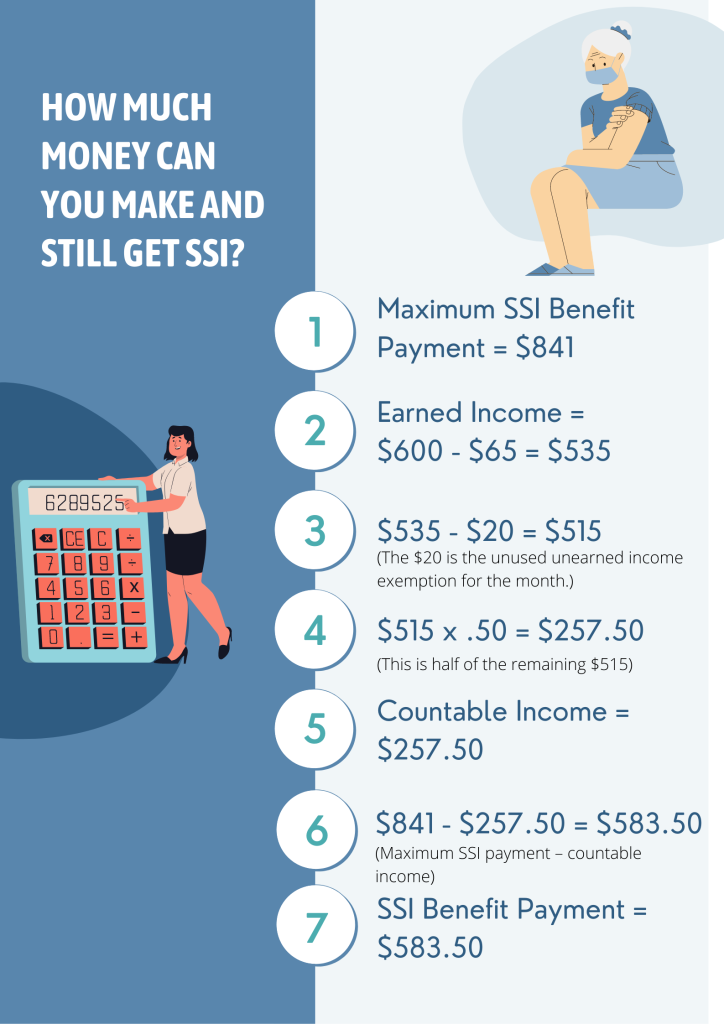
Earned Income: This includes wages, net earnings from self-employment, and certain royalties and honoraria. The SSA is generous with earned income; they generally exclude the first $65 of earned income each month, plus half of the remainder. This means that for every $2 you earn over the initial $65, your SSI benefit is reduced by only $1. This incentive is designed to encourage work, allowing recipients to earn a certain amount without losing all their benefits.
-
Unearned Income: This includes money received from sources other than work, such as Social Security benefits (SSDI, retirement, survivor’s), pensions, veterans’ benefits, unemployment benefits, interest, dividends, and cash gifts. The SSA generally excludes the first $20 of unearned income each month, and then every dollar of unearned income above that reduces your SSI benefit by one dollar. This has a much more significant impact on your benefit amount than earned income.
-
In-Kind Income: This refers to receiving food or shelter for free or at a reduced rate. For example, if someone else pays your rent or provides you with free groceries, the SSA will assign a value to that support, and that value will be counted as income, reducing your SSI benefit. This is a common area where individuals unknowingly impact their benefits.
Understanding these distinctions is vital. A small amount of unearned income can quickly reduce your benefit, while the same amount of earned income would have a much lesser effect.
Resource Limits: What Counts and What Doesn’t
Beyond income, the SSA also considers your “resources” – assets you own and can convert to cash to pay for food and shelter. To be eligible for SSI, your countable resources must not exceed a certain limit:
-
$2,000 for an individual.
-
$3,000 for a couple.
What counts as a resource?
-
Cash
-
Money in bank accounts (checking, savings)
-
Stocks, bonds, mutual funds
-
Land (other than your primary residence)
-
Vehicles (beyond one primary vehicle)
-
Life insurance policies with a cash surrender value
What doesn’t count as a resource?
-
Your home (the house and land you live on)
-
One vehicle (regardless of value, if it’s used for transportation for you or a member of your household)
-
Household goods and personal effects
-
Burial plots and up to $1,500 in burial funds per person
-
Certain trusts (e.g., ABLE accounts for disability-related expenses)
-
Up to $100,000 in an ABLE account (for people with disabilities that began before age 26)
The resource limit is strict. Exceeding it even by a small amount can render you ineligible, though there are rules for “spending down” excess resources to meet the limit.
Living Arrangements and Their Impact
Your living situation can also affect your SSI benefit amount, particularly if you live with others and receive help with food or shelter. The SSA has rules to account for situations where a recipient is not fully responsible for their living expenses.
-
Living Alone/Responsible for Rent & Food: If you live alone or are solely responsible for your share of rent and food, you are generally eligible for the full FBR (minus countable income).
-
Living in Someone Else’s Household and Receiving In-Kind Support and Maintenance (ISM): If you live in another person’s household and receive food and shelter from them, your SSI benefit may be reduced by up to one-third of the FBR. This is often referred to as the “one-third reduction rule” or “Presumed Maximum Value” (PMV) rule.
-
Living in a Medicaid-Funded Institution: If you are in a hospital, nursing home, or other medical institution where Medicaid pays for more than half the cost of your care, your SSI benefit is typically reduced to a small personal needs allowance (e.g., $30 per month).
These rules are complex, and the SSA will ask detailed questions about your living situation during the application process.
Calculating Your Estimated SSI Payment
With the FBR, income rules, and resource limits in mind, we can look at a simplified way the SSA calculates your benefit. While the SSA uses precise formulas, understanding the general steps can give you a good estimate.
The Income Exclusion Rules

The first step in calculating your benefit is to determine your “countable income.” The SSA applies various exclusions to your gross income before subtracting it from the FBR.
-
General Income Exclusion: The first $20 of most income (unearned or a combination of earned/unearned) is excluded.
-
Earned Income Exclusion: After the general exclusion, if you have earned income, the next $65 of earned income is excluded.
-
One-Half of Remaining Earned Income Exclusion: Of the remaining earned income, half is excluded.
Example:
Suppose an individual receives $200 in SSDI benefits (unearned income) and earns $400 from a part-time job (earned income). The FBR is $943.
-
Unearned Income: $200
- Minus $20 General Income Exclusion: $180 countable unearned income.
-
Earned Income: $400
-
No general exclusion remaining (already used for unearned).
-
Minus $65 Earned Income Exclusion: $335
-
Half of remaining earned income excluded: $335 / 2 = $167.50 excluded.
-
Countable earned income: $335 – $167.50 = $167.50
-
-
Total Countable Income: $180 (unearned) + $167.50 (earned) = $347.50
-
Estimated SSI Benefit: $943 (FBR) – $347.50 (countable income) = $595.50
This is a simplified example, and actual calculations can be more complex, especially with multiple income sources or specific deductions.
State Supplemental Payments (SSP)
Many states provide their own supplemental payments on top of the federal SSI benefit. These State Supplemental Payments (SSPs) vary significantly by state, and some states do not offer them at all. The amount of an SSP can depend on your living arrangements, whether you are aged, blind, or disabled, and other factors. Some states administer their own SSP programs, while others allow the SSA to administer them on their behalf. If you live in a state that offers an SSP, your total monthly benefit could be significantly higher than the federal FBR alone. It’s crucial to check with your state’s social services agency or the SSA about available SSPs in your area.
What if You Have a Spouse or Essential Person?
Your marital status significantly impacts your SSI benefits. If you are married and your spouse also receives SSI, the couple’s FBR applies, and their income and resources are combined. If your spouse does not receive SSI but has income and resources, a portion of their income and resources may be “deemed” available to you, which can reduce or eliminate your SSI eligibility.
An “essential person” is someone who lives with you and provides you with necessary care. If you had an essential person living with you in December 1973, and they met certain criteria, their presence might slightly increase your SSI benefit. However, this is a rare situation today, as the essential person provision applies only to those meeting very specific historical criteria.
The Application Process and Maintaining Eligibility
Applying for SSI is a multi-step process that requires thorough documentation and ongoing compliance to maintain eligibility. Understanding these requirements from the outset can save significant time and prevent potential disruptions to benefits.
Steps to Apply for SSI Benefits
The application process typically involves these key steps:
-
Contact the SSA: You can start an application online, by phone, or in person at your local Social Security office. For disability applications, an online application for disability benefits (Form SSA-16) can be initiated, but the SSI application itself often requires a phone interview or in-person visit.
-
Gather Information: The SSA will request extensive details about your income, resources, living arrangements, medical conditions (if applying based on disability or blindness), and work history.
-
Complete the Application Interview: This is a crucial step where an SSA representative will go through your information, clarify details, and explain the program rules.
-
Disability Determination (if applicable): If applying due to disability or blindness, your application will be sent to a state agency (Disability Determination Services, DDS) to evaluate your medical condition. They may request medical records and, if necessary, schedule a consultative examination.
-
Financial Review: Concurrently or after the medical determination, the SSA will review your financial information to ensure you meet the income and resource limits.
-
Decision: You will receive a written notice of the SSA’s decision. If denied, you have the right to appeal.
The process can be lengthy, often taking several months, especially for disability claims. Patience and meticulous record-keeping are essential.
Required Documentation and Information
To ensure a smooth application process, be prepared to provide:
-
Proof of Identity: Birth certificate, driver’s license, U.S. passport.
-
Proof of U.S. Citizenship or Eligible Non-citizen Status: Birth certificate, U.S. passport, Green Card.
-
Social Security Card.
-
Income Records: Pay stubs, tax returns, bank statements, benefit award letters for other benefits.
-
Resource Records: Bank statements, property deeds, vehicle titles, stock certificates.
-
Living Arrangement Information: Rent receipts, mortgage statements, landlord contact information.
-
Medical Records (for disability/blindness): Names and contact information of doctors, hospitals, clinics, dates of treatment, list of medications.
-
Work History (for disability/blindness): Names and addresses of employers, dates worked, types of jobs.
Having these documents organized and readily available will significantly expedite your application.
Understanding Continuing Disability Reviews (CDRs)
For those receiving SSI based on disability or blindness, the SSA periodically conducts Continuing Disability Reviews (CDRs) to determine if your medical condition has improved to the point where you are no longer considered disabled. The frequency of these reviews depends on the nature and severity of your disability. If your condition is expected to improve, reviews may be scheduled more frequently (e.g., every 6-18 months). If improvement is possible but not expected, reviews might occur every 3 years. For permanent conditions, reviews are less frequent (e.g., every 5-7 years). It’s crucial to cooperate with these reviews and provide requested medical information to avoid interruption of benefits.
Reporting Changes to the SSA
Maintaining SSI eligibility is an ongoing responsibility. Recipients are legally required to report changes in their circumstances to the SSA promptly. Failure to report changes can result in overpayments, which the SSA will later attempt to recover, or underpayments. You must report changes such as:
-
Changes in income (earned or unearned) or resources.
-
Changes in living arrangements (moving, changes in who pays for food/shelter).
-
Marital status changes.
-
Absence from the U.S. for 30 consecutive days or more.
-
Becoming incarcerated.
-
Changes in student status (for children receiving SSI).
-
Changes in work activity.
The SSA typically provides several methods for reporting changes, including online, by phone, or in person. It is always best to report changes as soon as they occur to ensure your benefits are calculated correctly.
Beyond the Cash: Other Benefits of SSI
While the primary purpose of SSI is to provide financial assistance, eligibility often unlocks access to a suite of other crucial programs and benefits that significantly enhance the well-being of recipients. These additional benefits can be just as valuable, if not more so, than the direct cash payment itself.
Automatic Medicaid Eligibility
One of the most significant non-cash benefits of receiving SSI is automatic eligibility for Medicaid in most states. Medicaid provides comprehensive health coverage, including doctor visits, hospital stays, prescription drugs, and long-term care services, often with minimal or no out-of-pocket costs for recipients. For individuals with disabilities, chronic conditions, or the elderly, access to affordable healthcare is paramount. SSI’s link to Medicaid ensures that recipients, who often have limited financial means, do not have to choose between paying for basic necessities and critical medical care. This lifeline can prevent medical debt and promote better health outcomes, reducing the overall financial burden on individuals and families.
Food Assistance and Other State Programs
SSI recipients often qualify for other state-specific assistance programs, with food assistance being a prime example. In many states, receiving SSI can automatically make you eligible for the Supplemental Nutrition Assistance Program (SNAP), formerly known as food stamps. SNAP benefits help low-income individuals and families purchase nutritious food, further alleviating the financial strain on tight budgets. Beyond SNAP, states may offer various other programs tailored to their residents, such as housing assistance, utility assistance, transportation programs, or home energy assistance. These programs are designed to complement SSI and address other fundamental needs that fall outside the direct scope of cash benefits. Investigating what additional state and local programs are available for SSI recipients is highly recommended for anyone receiving benefits.

Planning for the Future While Receiving SSI
While SSI is a safety net for those with limited income and resources, it’s also important to consider future financial planning, even within its constraints. Tools like ABLE (Achieving a Better Life Experience) accounts can be invaluable for individuals with disabilities. ABLE accounts allow eligible individuals to save money, up to certain limits (e.g., $18,000 annually from all sources for 2024, and up to $100,000 total), without affecting their SSI or Medicaid eligibility. Funds in an ABLE account can be used for qualified disability expenses, such as education, housing, transportation, employment training, health care, and assistive technology. This allows recipients to save for specific goals or emergencies without jeopardizing their essential benefits, promoting greater financial independence and security. Careful planning and utilizing such tools can significantly enhance the quality of life for SSI recipients, allowing them to build a more stable future.
In conclusion, understanding “how much SSI benefits will I receive” requires a comprehensive look at your personal financial landscape. While the federal benefit rate sets a baseline, your countable income, available resources, and living situation are all critical determinants of your final payment. The application process demands meticulous attention to detail and ongoing compliance with reporting requirements. However, for those who qualify, SSI offers not just financial support but also a crucial pathway to healthcare and other essential services, providing a vital foundation for stability and well-being.
aViewFromTheCave is a participant in the Amazon Services LLC Associates Program, an affiliate advertising program designed to provide a means for sites to earn advertising fees by advertising and linking to Amazon.com. Amazon, the Amazon logo, AmazonSupply, and the AmazonSupply logo are trademarks of Amazon.com, Inc. or its affiliates. As an Amazon Associate we earn affiliate commissions from qualifying purchases.