
The digital asset landscape is often characterized by extreme volatility, speculative fervor, and transformative technology. Among the thousands of cryptocurrencies in existence, few have sparked as much debate, loyalty, and legal scrutiny as XRP. Developed by Ripple Labs, XRP was designed with a specific financial purpose: to serve as a bridge currency for international payments, offering a faster and cheaper alternative to the decades-old SWIFT system. For investors, the burning question remains: how high can XRP go?
To answer this, we must move beyond mere hype and analyze the asset through the lens of institutional finance, market dynamics, and regulatory shifts. XRP is not just a digital token; it is a financial tool intended to lubricate the gears of global commerce. Its price trajectory is inextricably linked to its utility, adoption by central banks, and the resolution of long-standing legal hurdles.
The Fundamental Drivers of XRP’s Value
Unlike Bitcoin, which is often viewed as “digital gold” or a store of value, XRP’s value proposition is rooted in its utility as a liquidity tool. To understand how high the price can climb, one must first understand the problems it solves in the traditional financial sector.
Utility in Global Liquidity and On-Demand Liquidity (ODL)
At the heart of Ripple’s business model is On-Demand Liquidity (ODL), now often referred to as “Ripple Payments.” In traditional cross-border transactions, banks must maintain pre-funded accounts (Nostro/Vostro) in foreign currencies to ensure liquidity. This traps trillions of dollars in capital that could be used elsewhere.
XRP solves this by acting as a bridge. A bank can convert its local currency into XRP, send it across the RippleNet network in seconds, and have it converted into the destination currency at the other end. If XRP manages to capture even a small percentage of the global cross-border payment market—which handles hundreds of trillions of dollars annually—the demand for the token would increase exponentially. High demand coupled with a finite supply is a fundamental catalyst for price appreciation.
Institutional Adoption and Strategic Partnerships
The price of any financial asset is heavily influenced by the “smart money”—institutions, banks, and payment providers. Ripple has already secured partnerships with hundreds of financial institutions worldwide, including Standard Chartered, American Express, and various central banks exploring Central Bank Digital Currencies (CBDCs).
As more institutions integrate Ripple’s technology, the “velocity” and “utility” of XRP increase. In a scenario where XRP becomes the underlying infrastructure for international settlements, its market capitalization would need to expand significantly to facilitate large-scale transfers. This institutional backing provides a “floor” for the asset’s value that many purely speculative memecoins lack.
Navigating the Regulatory Landscape
For the past several years, the most significant weight on XRP’s price has not been market demand, but rather the legal battle between Ripple and the U.S. Securities and Exchange Commission (SEC). This regulatory uncertainty has historically suppressed XRP’s price, preventing it from reaching the all-time highs seen by its peers during previous bull markets.
The Impact of the SEC v. Ripple Case
The SEC’s 2020 lawsuit alleged that XRP was an unregistered security. This led to XRP being delisted from major U.S. exchanges like Coinbase and Kraken, cutting off a massive segment of the world’s largest economy. However, the 2023 court ruling—which stated that XRP sold to retail investors on exchanges did not constitute a security—was a landmark victory for the community.
The full resolution of this case is the single most important short-term catalyst for XRP’s price. Legal clarity allows institutional investors in the United States to hold and use the asset without fear of regulatory reprisal. Once the “shackles” of litigation are fully removed, XRP is expected to undergo a period of price discovery as it reintegrates into the U.S. financial ecosystem.
Global Regulatory Clarity and CBDC Integration
While the U.S. has struggled with clarity, other regions like the UK, Japan, Switzerland, and the UAE have already classified XRP as a non-security or a digital commodity. Ripple is currently working with several nations to develop CBDCs using the XRP Ledger (XRPL).
If XRP becomes the “bridge” that connects different national CBDCs, its role in the global financial architecture would be solidified. This would transition XRP from a speculative retail asset to a critical piece of global financial infrastructure, justifying a significantly higher valuation than its current market price.
Tokenomics and Market Dynamics
To project how high XRP can go, we must perform a “reality check” using market capitalization and tokenomics. XRP has a total supply of 100 billion tokens, with a significant portion held in escrow by Ripple Labs.
Supply, Escrow, and Burning Mechanisms
The vast supply of XRP is often cited by critics as a reason why the price cannot reach astronomical levels like $10,000. However, the supply is managed. Ripple releases a set amount from escrow each month to fund operations and incentivize the ecosystem, but much of this is often returned to escrow.

Additionally, the XRP Ledger has a built-in “burn” mechanism. Every transaction requires a tiny amount of XRP to be destroyed to prevent spamming the network. While this doesn’t result in a rapid reduction of supply, it makes XRP a deflationary asset over a very long time horizon. For the price to reach double or triple digits, the market cap would need to rival that of major global corporations or even traditional asset classes like gold.
Market Sentiment and the Bitcoin Halving Connection
Cryptocurrencies do not move in isolation. The “altcoin market,” which includes XRP, generally follows the price action of Bitcoin. Historically, Bitcoin’s halving cycles—which occur every four years—trigger massive bull runs across the entire sector.
As Bitcoin reaches new highs, capital typically “rotates” into high-utility altcoins. Because XRP has been suppressed for so long due to legal issues, many analysts believe it is a “coiled spring.” During the next major market cycle, if the regulatory clouds have cleared, XRP could potentially outperform Bitcoin in terms of percentage gains as it plays “catch-up” with the rest of the market.
Price Projections: Short-Term vs. Long-Term
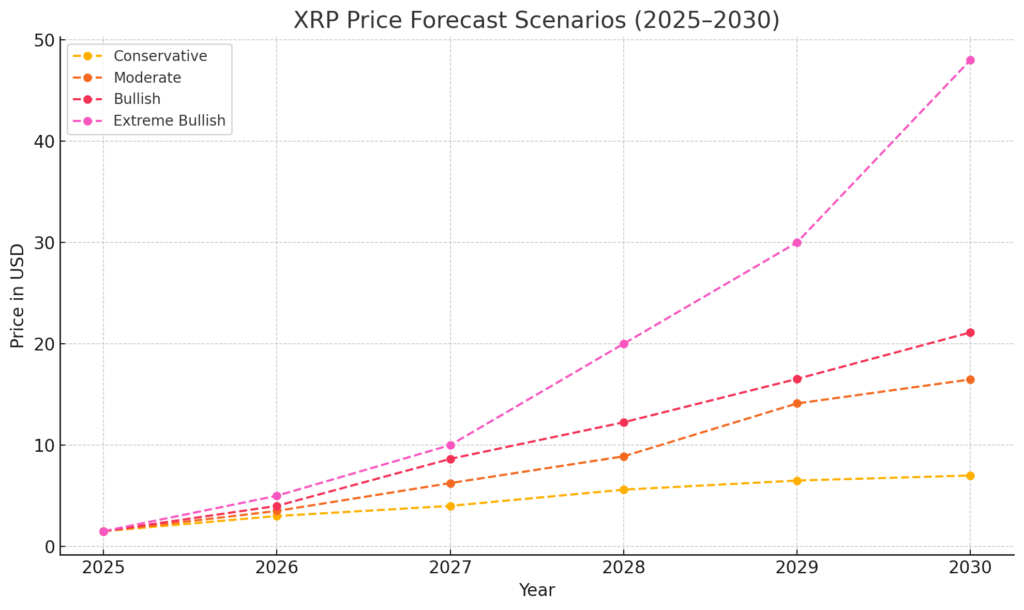
Predicting a specific price is impossible, but we can establish ranges based on different financial scenarios.
Conservative Estimates and Realistic Goals
In the short to medium term, many financial analysts look at previous all-time highs as the first target. XRP hit approximately $3.84 in early 2018. Reclaiming this level would require a significant move, but it is well within the realm of possibility given the current growth of RippleNet.
Conservative estimates for the next bull cycle often place XRP in the $5.00 to $10.00 range. At $10.00, XRP’s market cap would be roughly $550 billion (assuming 55 billion coins in circulation). This would place it in the same league as companies like Visa or JPMorgan, which is logical given that Ripple is competing directly with the traditional banking infrastructure.
The “Moon” Scenario: Could It Reach Three Figures?
More aggressive “moon” predictions suggest XRP could reach $50, $100, or even higher. For these prices to be realized, XRP would need to do more than just grow; it would need to become the primary global settlement asset.
If XRP were to capture a significant portion of the $150 trillion annual cross-border payment volume, the liquidity required would necessitate a high price per token. If the price is too low, there isn’t enough “value” in the tokens to move billions of dollars at a time. Therefore, from a purely functional perspective, a higher price is actually beneficial for the network’s efficiency. While $100 remains speculative, it is mathematically possible if XRP achieves “world reserve” utility status.
Risk Assessment and Strategy
No investment is without risk, and XRP is no exception. Investors must balance the potential for high returns with the realities of a competitive and volatile market.
Volatility and Competitive Challenges
XRP faces competition from other blockchain projects like Stellar (XLM) and even from traditional banks developing their own proprietary blockchain solutions (such as JPM Coin). Furthermore, the broader crypto market is subject to “black swan” events—unforeseen economic crashes or harsh global regulations—that can send prices plummeting regardless of an asset’s fundamentals.
Investors should also be aware of the “opportunity cost.” While XRP has stayed relatively stagnant due to its legal battles, other assets have seen 10x or 100x returns. Holding XRP requires a high level of conviction and a long-term time horizon.
Diversification and Long-Term Holding
For those looking to capitalize on XRP’s potential, a disciplined financial strategy is key. Dollar-cost averaging (DCA)—buying small amounts at regular intervals—can help mitigate the impact of short-term volatility.
Furthermore, XRP should be viewed as one part of a diversified portfolio. While its “upside” is massive, the binary nature of its success (either it becomes a global standard or it doesn’t) makes it a high-risk/high-reward play. Investors who believe in the “Money” aspect of the token—its ability to move value across borders—often view it as a 5-to-10-year investment rather than a “get rich quick” scheme.
Conclusion
The question of “how high will XRP go” is ultimately a question of how much of the global financial system Ripple can modernize. If XRP remains a niche tool for small payment corridors, its price will likely fluctuate in the low single digits. However, if it succeeds in its mission to become the “Internet of Value,” facilitating the seamless movement of money as easily as information moves today, the sky is the limit.
While the path to $10 or $100 is fraught with regulatory and competitive hurdles, the underlying financial logic of XRP—solving a multi-trillion-dollar liquidity problem—remains one of the most compelling cases in the digital asset world. For the patient investor, XRP represents not just a coin, but a stake in the future of global finance.
aViewFromTheCave is a participant in the Amazon Services LLC Associates Program, an affiliate advertising program designed to provide a means for sites to earn advertising fees by advertising and linking to Amazon.com. Amazon, the Amazon logo, AmazonSupply, and the AmazonSupply logo are trademarks of Amazon.com, Inc. or its affiliates. As an Amazon Associate we earn affiliate commissions from qualifying purchases.