
In the complex world of finance, where every decision hinges on calculations of risk and reward, predictability is paramount. Investors pour capital into ventures, businesses sign long-term contracts, and individuals make financial plans, all based on the assumption that the legal and regulatory landscape will remain reasonably stable. This fundamental assumption is largely underpinned by a critical legal principle: the prohibition against ex post facto laws. Far from being an arcane legal term, understanding ex post facto law is vital for anyone navigating the realms of personal finance, investing, business finance, and economic policy. It represents a bulwark against arbitrary governance, ensuring that the rules of the financial game are known in advance and applied fairly.

This article will delve into the concept of ex post facto law, meticulously linking its legal definitions to its tangible impacts within the “Money” domain. We will explore why this prohibition is not merely a legal nicety but a fundamental safeguard that underpins economic confidence, fosters investment, and protects the financial interests of individuals and businesses alike.
Ex Post Facto Law: Defining a Fundamental Financial Safeguard
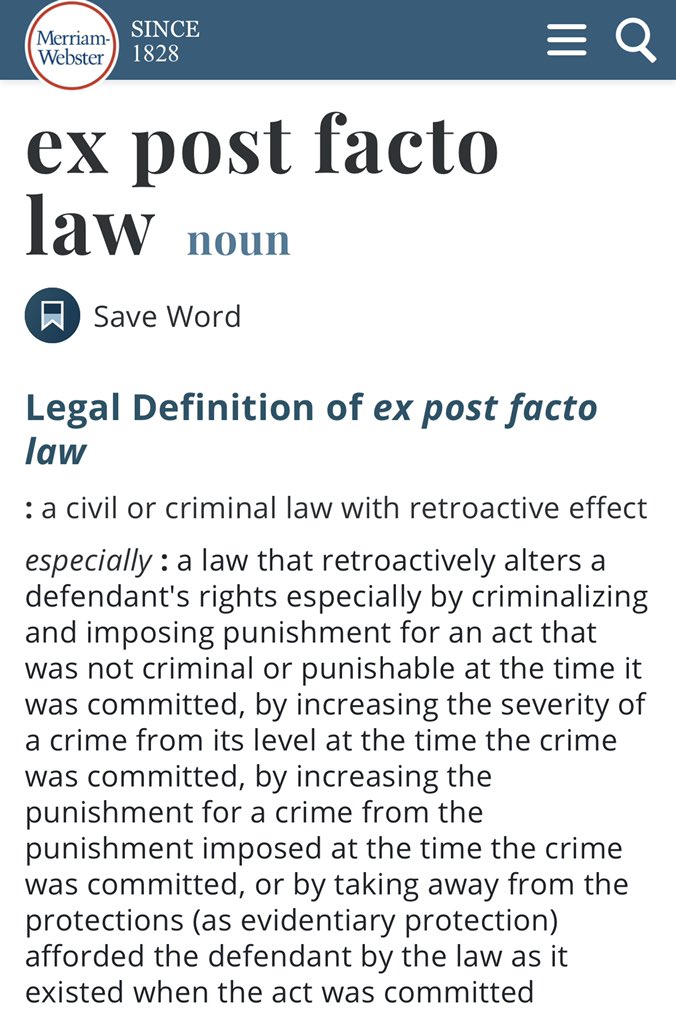
At its core, an ex post facto law (Latin for “from a thing done afterward”) is a law that retroactively changes the legal consequences of actions that were committed before the enactment of the law. This typically means making an action illegal that was legal when committed, increasing the punishment for a crime already committed, or changing the rules of evidence to make conviction easier for past actions. While often discussed in the context of criminal law, its principles—and their constitutional prohibitions in many nations, including the United States—have profound and direct implications for civil law, regulatory frameworks, and thus, for the financial world.
The Core Prohibition: Retroactive Penalties and Rights Impairment
The primary thrust of ex post facto prohibitions is to prevent governments from unfairly penalizing individuals or entities for actions that were lawful or subject to lesser penalties at the time they occurred. Imagine a business makes an investment based on existing tax laws, only for a new law to retroactively declare that investment illegal, or to levy a significantly higher tax rate on profits earned from it years in the past. Such an action would not only be unjust but would also dismantle any semblance of financial planning or risk assessment.
In a financial context, the prohibition guards against laws that:
-
Criminalize past financial activities: Making a previously legal financial transaction, investment strategy, or business practice a criminal offense after it has occurred.
-
Increase financial penalties retroactively: Imposing higher fines, taxes, or forfeitures on past financial misconduct that was subject to lesser penalties at the time.
-
Retroactively invalidate contracts or property rights: While typically focused on criminal matters, the spirit of ex post facto can extend to civil contexts through principles like due process or impairment of contracts, preventing governments from arbitrarily rescinding financial agreements or seizing assets under new, retroactively applied rules.
Types of Ex Post Facto Laws and Their Financial Ramifications
While traditionally categorized as laws that punish past actions, the financial implications extend to any retroactive application of law that detrimentally impacts vested financial rights or expectations. For instance, a law that retroactively changes the terms of a government bond, making it less valuable than when it was purchased, could effectively be seen as an ex post facto measure impairing contractual obligations, severely damaging investor confidence in government securities. Similarly, a regulation that retroactively imposes new, costly compliance requirements on businesses for past operations would drain financial resources and punish firms for operating within the legal framework that existed at the time.
The core takeaway for finance professionals and individuals is that the ex post facto prohibition ensures that the rules of engagement for financial activities are established before the game is played, fostering a stable and trustworthy environment for economic activity.
The Economic Imperative: Why Stability Drives Investment and Business Growth
The consistent enforcement of the ex post facto prohibition is not merely a legal technicality; it is an economic imperative. A stable legal and regulatory environment is the bedrock upon which all sound financial decisions are made. Without it, the risk premium for any investment or business venture would skyrocket, choking off capital formation and economic growth.
Protecting Contracts and Property Rights
Central to any functioning financial system are enforceable contracts and secure property rights. Investors buy stocks, lend money, and purchase real estate with the expectation that the legal validity of these transactions will be upheld. Businesses enter into agreements for supply chains, distribution, and services, relying on the certainty that these contracts will be honored and disputes resolved based on laws existing at the time of agreement.
An ex post facto law that retroactively invalidates a contract, changes its terms, or allows for the arbitrary seizure of property undermines these foundational principles. If a government could, for example, retroactively declare certain types of private contracts illegal or change the terms of property ownership, the entire financial system would grind to a halt. Capital would flee, and long-term investment would become impossible. The prohibition ensures that once a financial right or obligation is established under existing law, it cannot be arbitrarily extinguished or altered by a new law applied backward in time.
Fostering a Predictable Regulatory Environment
Businesses operate within a labyrinth of regulations—environmental, labor, financial, and consumer protection. Compliance with these regulations often requires significant investment in infrastructure, processes, and personnel. When regulations are applied retroactively, businesses are punished for complying with the rules that were in place at the time. This creates an environment of extreme uncertainty, where every past decision could be subject to future, unknown penalties.
The stability provided by the ex post facto principle allows businesses to plan, invest, and innovate with confidence. They can allocate capital efficiently, knowing that the regulatory goalposts for past actions will not be moved arbitrarily. This predictability is crucial for capital budgeting, long-term strategic planning, and assessing market risk—all critical components of business finance and investment decisions.
The Chill of Uncertainty: What Happens Without Such Safeguards
Consider a scenario where ex post facto laws were permissible. Investors would be hesitant to commit capital, knowing that profits could be retroactively taxed at higher rates or even that their investments could be declared illegal. Businesses would shrink their horizons, focusing on short-term gains rather than long-term growth and innovation, fearing that any significant investment could be undermined by a new, retroactive law. This uncertainty would not only deter new investment but could also trigger capital flight, economic stagnation, and a severe loss of trust in governmental institutions. The prohibition against ex post facto laws, therefore, acts as a critical firewall against such economic instability, fostering the trust essential for a vibrant market economy.
Navigating the Grey Areas: Retroactive Laws That Aren’t Ex Post Facto
While the prohibition against ex post facto laws is strict, it is crucial to understand that not all retroactive legislation falls into this prohibited category. The distinction is subtle but vital, especially in the context of tax law and regulatory adjustments that frequently have some level of backward-looking effect. Financial professionals must be adept at discerning permissible retroactive applications from unconstitutional ex post facto impairments.
Prospective vs. Retrospective Application in Tax and Regulation
The key distinction often lies in whether the retroactive law imposes a new penalty for a past act or merely adjusts the future consequences of past actions, or applies to an ongoing financial state. For instance, a tax law that increases the tax rate for the current fiscal year, even if enacted halfway through that year, is generally not considered an ex post facto law. It applies to income earned during the period of the new law’s applicability, not to income from entirely completed past periods under different rules. Individuals and businesses are expected to adjust their financial planning prospectively from the date of the law’s enactment, even if it impacts earnings within the same tax year.
However, a law that retroactively imposes a new tax on income earned and fully reported from a previous completed tax year, under different rules, would likely cross the line. This is because it changes the financial consequences of an action (earning income) that was entirely completed and settled under a different legal framework. The nuance is critical: prospective application, even if affecting an ongoing financial period, is generally permissible, while punitive backward application is not.

Curative and Remedial Legislation: Balancing Fairness and Functionality
Governments sometimes pass “curative” or “remedial” legislation that has a retroactive effect. These laws are typically designed to correct technical errors in prior statutes, validate past governmental actions that might have been flawed, or provide remedies for existing injustices. For example, a law might retroactively validate zoning permits that were issued incorrectly due to an administrative oversight, thereby protecting the property rights and investments of affected homeowners or businesses.
Such laws are generally permissible if they do not impair vested rights, impose new burdens, or create new obligations for past conduct. Instead, they often clarify or perfect existing rights or relieve burdens. In finance, this could involve clarifying ambiguities in securities regulations or ensuring the enforceability of certain financial instruments where technical flaws existed. The intent is not to punish or disadvantage but to ensure the smooth and fair functioning of the legal and financial system.
Understanding these distinctions is essential for financial planners, investors, and business leaders who must continually assess regulatory risk. It underscores the importance of interpreting legal changes not just on their face, but in terms of their true temporal application and underlying purpose.
Real-World Financial Scenarios and the Ex Post Facto Principle
The abstract legal concept of ex post facto law finds concrete resonance in numerous financial scenarios. Its prohibition profoundly influences how capital is deployed, how businesses are structured, and how individuals manage their wealth. Without this safeguard, the very foundations of financial trust and planning would crumble.
Investment Decisions and Legal Frameworks
For investors, both large institutional funds and individual retail investors, the legal framework is a critical component of risk assessment. When considering an investment in a particular country, industry, or asset class, investors meticulously evaluate regulatory stability and the rule of law. The assurance that the government cannot retroactively alter the rules governing property ownership, corporate governance, or capital gains taxes is a powerful incentive for long-term investment.
Conversely, jurisdictions with a history of arbitrary retroactive laws or weak protections against them are typically shunned by prudent investors. The risk of sudden, unpredictable shifts in the legal landscape—which could wipe out returns or even initial capital—is too high. This is why discussions around ex post facto laws often arise in emerging markets or during periods of political instability, where legal predictability is less assured. It directly influences capital flows, impacting everything from foreign direct investment to the pricing of sovereign debt.
Business Planning and Risk Mitigation
Businesses, in particular, rely heavily on a stable legal environment to make long-term strategic decisions. Whether it’s investing in new plant and equipment, developing new products, or expanding into new markets, these ventures often involve significant upfront capital expenditure with expected returns over many years. The absence of ex post facto laws provides the comfort that the fundamental legality of their operations and the taxation of their profits will not be retroactively undermined.
Business finance departments perform extensive due diligence to understand not just current laws but also the strength of legal protections against retroactive changes. This informs their risk mitigation strategies, influencing capital allocation, insurance purchases, and even the choice of corporate domicile. Without this protection, businesses would be forced into a highly defensive, short-term operational mode, severely limiting innovation and economic expansion.
Case Studies (Hypothetical or General): How Legal Challenges Emerge
Consider a hypothetical scenario: A company invests heavily in a new energy technology, adhering strictly to all environmental regulations and subsidies available at the time. Years later, a new government comes into power and passes a law retroactively imposing massive fines on companies using technologies that were previously deemed acceptable, or retroactively rescinding subsidies for past performance. Such a law would instantly cripple the company, punishing it for actions taken entirely legally in the past. This is precisely the kind of scenario the ex post facto prohibition aims to prevent, safeguarding investment and entrepreneurial risk-taking.
Another example: A national government, facing financial crisis, attempts to retroactively impose a “wealth tax” on assets acquired and legally owned in previous years, significantly above the tax rates in effect when those assets were accumulated. Such a measure, if deemed an ex post facto impairment of vested property rights or an unduly punitive retroactive tax, would face severe legal challenges and, if successful, would decimate public confidence in the financial system. These examples underscore how the principle, though often debated in courts, has tangible, direct financial consequences.
For Investors and Businesses: Leveraging Legal Predictability
The understanding and recognition of the ex post facto principle are not merely academic exercises for legal scholars; they are essential tools for anyone engaged in financial decision-making. Investors, entrepreneurs, and financial advisors can leverage this knowledge to make more informed choices, mitigate risks, and contribute to a more stable economic environment.
Due Diligence and Legal Environment Assessment
For investors and businesses, performing thorough due diligence extends beyond financial statements and market analysis. It critically includes an assessment of the legal and regulatory environment. This means evaluating a jurisdiction’s commitment to the rule of law, its constitutional protections against arbitrary governmental action (including ex post facto laws), and its track record of legal stability. A robust legal framework, explicitly prohibiting retroactive penalties and ensuring the sanctity of contracts, signals a lower political and regulatory risk, making it a more attractive destination for capital.
Financial professionals advising clients on international investments or complex business ventures must incorporate this legal stability assessment into their recommendations. Understanding the specific constitutional or statutory provisions that guard against ex post facto laws in different jurisdictions can be a key differentiator in identifying truly secure investment opportunities.
Advocating for Stable Legal Frameworks
Beyond individual decision-making, businesses and financial industry bodies often play a crucial role in advocating for stable and predictable legal frameworks. This includes supporting legislative efforts that reinforce protections against retroactive laws, engaging in public discourse about the importance of legal certainty for economic growth, and, when necessary, challenging governmental actions that appear to violate these principles.
This advocacy is not just about self-interest; it’s about fostering a healthy ecosystem for economic activity. By championing the principles that underpin financial stability, the financial sector contributes to a more predictable and trustworthy environment for everyone, from large corporations to individual savers.
The Long-Term Impact on Economic Prosperity
Ultimately, the prohibition against ex post facto laws is a bedrock principle for long-term economic prosperity. It instills confidence, encourages investment, protects property rights, and allows for rational financial planning. In an increasingly interconnected global economy, countries and regions that consistently uphold this principle tend to attract more capital, foster greater innovation, and achieve more sustainable growth. For individuals, it provides the security to save, invest, and build wealth without the constant threat of having the rules arbitrarily changed after the fact.
By understanding “what is ex post facto law” and its profound implications within the “Money” sphere, financial professionals and individuals alike gain a crucial perspective on the fundamental legal underpinnings that enable a predictable, fair, and prosperous economic landscape.
aViewFromTheCave is a participant in the Amazon Services LLC Associates Program, an affiliate advertising program designed to provide a means for sites to earn advertising fees by advertising and linking to Amazon.com. Amazon, the Amazon logo, AmazonSupply, and the AmazonSupply logo are trademarks of Amazon.com, Inc. or its affiliates. As an Amazon Associate we earn affiliate commissions from qualifying purchases.