
In a world increasingly defined by ones and zeroes, the fundamental concept of “base ten” might seem like an anachronism, a relic of elementary mathematics. Yet, the decimal system, our everyday method of counting, remains profoundly relevant, acting as the critical bridge between human intuition and the binary logic of modern technology. Far from being a mere mathematical curiosity, understanding base ten—and its interplay with other number systems—is essential for anyone seeking a deeper comprehension of how we interact with, develop, and leverage digital tools. This article delves into the core of what base ten represents and illuminates its pervasive, often unseen, influence across the technological landscape, from user interfaces to the very architecture of data itself.

The Foundation of Our Numerical World: Demystifying Base Ten
Before we explore its tech implications, it’s crucial to establish a clear understanding of what base ten truly is. Also known as the decimal system, it is the most common and intuitive way humans represent numbers, ingrained in our daily lives from counting fingers to calculating complex financial equations.
What Exactly is Base Ten?
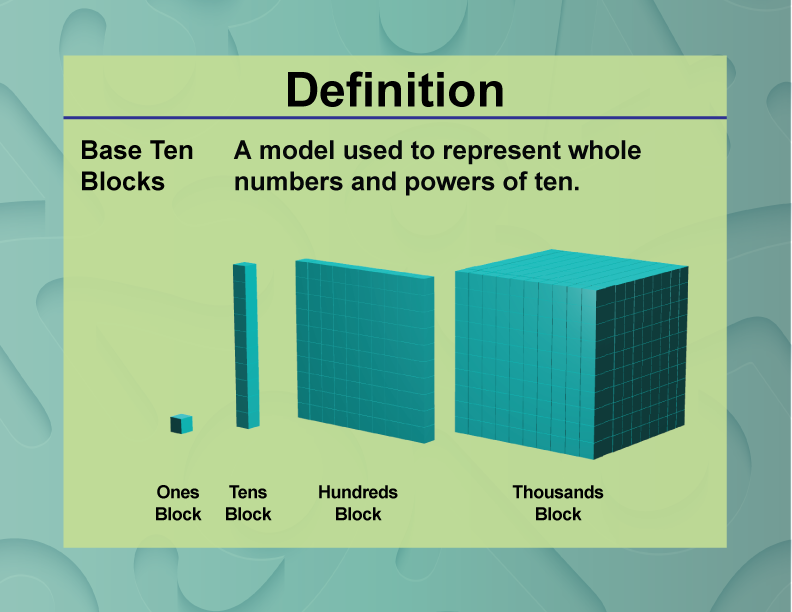
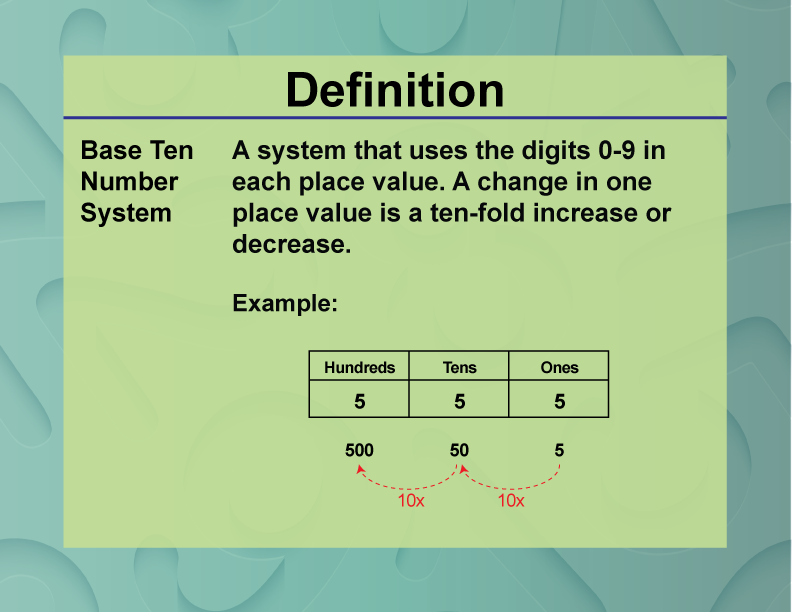
At its heart, base ten is a positional numeral system characterized by the use of ten distinct symbols: 0, 1, 2, 3, 4, 5, 6, 7, 8, and 9. The “base” refers to the number of unique digits (including zero) used to represent any quantity. What makes it powerful is its positional notation, meaning the value of a digit depends not only on the digit itself but also on its position within a number. Each position represents a power of ten.
For example, consider the number 345:
-
The ‘5’ is in the “ones” place (10^0), so its value is 5 * 1 = 5.
-
The ‘4’ is in the “tens” place (10^1), so its value is 4 * 10 = 40.
-
The ‘3’ is in the “hundreds” place (10^2), so its value is 3 * 100 = 300.
Adding these up (300 + 40 + 5) gives us 345. This elegantly simple system allows us to represent infinitely large or small quantities using a finite set of symbols, a principle that underpins all modern number systems, including those used in computing.
Why Base Ten? A Brief Historical and Cognitive Perspective
The prevalence of base ten isn’t an arbitrary choice; it’s deeply rooted in human biology and historical development. The most commonly cited reason is our ten fingers (digits), which naturally lent themselves to counting and tracking quantities. This anthropological factor led to its widespread adoption across diverse cultures throughout history, from ancient Egyptians to the Hindu-Arabic numeral system that dominates today.
From a cognitive standpoint, base ten is incredibly efficient for human processing. Its structure aligns with how our brains intuitively segment and organize information. We learn to count in tens, group in tens, and perform mental arithmetic using this base, making it the bedrock of our quantitative understanding of the world. This intrinsic human familiarity is precisely what makes it so vital when interacting with technology that, at its core, operates differently.
Beyond Simple Counting: The Power of Positional Notation
The true genius of base ten, and indeed any positional system, lies in its ability to express magnitude and fractional values with remarkable clarity and conciseness. Unlike earlier systems that might have required new symbols for larger numbers (like Roman numerals), base ten reuses its ten digits, assigning greater value based on position. This allows for arithmetic operations—addition, subtraction, multiplication, and division—to be performed systematically and efficiently, which was a monumental leap forward in mathematical capability. This efficiency is not just an abstract mathematical concept; it directly translates to how data is stored, manipulated, and presented in computing, even if the underlying representation isn’t always decimal.
Bridging the Human-Machine Divide: Base Ten in Digital Interfaces
The digital realm thrives on electrical signals, which inherently operate in a binary (base two) state: on or off, 0 or 1. Yet, nearly every interaction we have with computers, from typing a document to browsing the web, is presented to us in base ten. This necessitates a sophisticated “translation layer” that allows humans to communicate with machines using our preferred numerical system.
The Binary Reality: How Computers Think
To understand the role of base ten in tech, we must first acknowledge the computer’s native language: binary. In base two, numbers are represented using only two digits: 0 and 1. Each position in a binary number represents a power of two. For example, the binary number 1011 translates to decimal as:
- 1 * 2^3 (8) + 0 * 2^2 (0) + 1 * 2^1 (2) + 1 * 2^0 (1) = 8 + 0 + 2 + 1 = 11.
This binary system is perfectly suited for electronic circuits, which can easily represent these two states (e.g., high voltage/low voltage). Processors, memory, and data transmission all operate on this fundamental binary logic.
The Decimal Abstraction: Why We See Base Ten in Tech
Despite computers’ binary nature, presenting information directly in binary to users would be utterly impractical and cognitively overwhelming. Imagine your phone displaying your battery life as 1100101% or your bank balance as 110101110000.0101! This is where base ten reclaims its critical role. Software engineers, UI/UX designers, and operating systems developers work tirelessly to abstract away the binary complexities, translating all internal operations back into the familiar decimal system for human consumption.
Every number you see on your screen—the time, a file size, a price, a percentage, a line of code in a high-level language—has undergone a conversion from binary to base ten. This conversion happens seamlessly and instantaneously, providing a user experience that leverages our innate understanding of the decimal system. It’s a testament to good design that most users are completely unaware of this continuous translation process.
Translating Worlds: The Role of Conversion in Computing
The conversion between binary and decimal (and sometimes hexadecimal, base 16, which is a convenient shorthand for binary in programming) is a fundamental operation built into nearly every layer of modern computing.
-
Input: When you type “123” into a calculator app, the application takes these decimal digits, converts them into their binary equivalents, performs the calculation in binary, and then converts the binary result back into decimal for display.
-
Output: When a sensor reads a temperature, that raw data might be in a binary format. The device’s firmware or an associated app then translates that binary value into a human-readable decimal temperature.
-
APIs and Data Exchange: Even when different software systems communicate, while they might exchange data in various formats (like JSON or XML), the numerical values embedded within are often expected to be interpreted as decimal by the receiving application, which then converts them to its internal binary representation. This constant interplay ensures that humans and machines can effectively coexist and collaborate in the digital ecosystem.
Base Ten’s Pervasive Influence in Software and Data
Beyond the immediate user interface, base ten’s influence permeates deeper layers of technology, impacting how data is structured, software is written, and numerical precision is managed.
From File Sizes to Financial Transactions: Quantifying Digital Information
Every piece of digital information, no matter how complex, can ultimately be quantified. Base ten provides the universal language for this quantification.
-
Storage and Memory: While computers measure memory in bytes (groups of 8 bits), the way we express storage capacity (kilobytes, megabytes, gigabytes, terabytes) is rooted in powers of ten. Although there’s a slight discrepancy with binary prefixes (kibibytes, mebibytes), the common marketing and user-facing terms are decimal-based. Your 1TB hard drive is understood as 1,000,000,000,000 bytes, not 2^40 bytes.
-
Data Rates: Network speeds (Mbps, Gbps), processing speeds (GHz), and data transfer rates are all expressed using decimal prefixes, providing a readily understandable scale for performance metrics.
-
Financial Applications: Perhaps nowhere is base ten’s importance more critical than in financial technology (FinTech). Banking software, trading platforms, and e-commerce systems absolutely must use base ten for all monetary calculations to ensure accuracy and prevent rounding errors that could lead to significant financial losses. While internal representations might involve binary, the arithmetic operations and final results are rigorously tied to decimal precision.
Programming with Base Ten: High-Level Languages and User Logic
While low-level programming (assembly, machine code) directly manipulates binary values, high-level programming languages (Python, Java, C#, JavaScript, etc.) primarily allow developers to work with decimal numbers. This abstraction significantly simplifies the development process, enabling programmers to focus on application logic rather than intricate binary conversions.
-
Variables and Constants: Programmers declare variables and assign values using decimal notation (e.g.,
let quantity = 100;). -
Arithmetic Operations: All standard arithmetic operations (addition, subtraction, etc.) behave as expected in base ten within these languages, even though the compiler or interpreter will translate these instructions into binary for the CPU.
-
Data Structures: When working with arrays, lists, or databases, the indices and values often follow decimal patterns, making it intuitive to access and manipulate data. This design choice dramatically increases productivity and reduces the cognitive load on developers, allowing them to build complex applications faster and with fewer errors.
The Precision Paradox: Floating-Point Numbers and Decimal Accuracy
One fascinating area where the interplay between binary and decimal becomes critical is in the representation of fractional numbers, known as “floating-point numbers” in computing (e.g., 3.14159). While integers convert perfectly between binary and decimal, many decimal fractions (like 0.1) cannot be represented precisely in binary using a finite number of bits. This can lead to subtle rounding errors or inaccuracies when performing calculations that involve fractions, which is often termed the “floating-point precision problem.”
For example, 0.1 + 0.2 in a standard binary floating-point system might not exactly equal 0.3. While these errors are often negligible for most applications, they become paramount in fields requiring absolute precision, like financial calculations, scientific simulations, or engineering. To mitigate this, many programming languages and databases offer specific “decimal” or “arbitrary-precision arithmetic” data types that internally handle numbers in a way that preserves exact base ten representation, even if it requires more memory or processing power. This explicit choice highlights the enduring necessity of base ten for certain critical applications within tech.
Educational Implications and Future Prospects
The fundamental role of base ten in technology extends into education and shapes our cognitive understanding of the digital world, influencing how we teach and learn about computing.
Teaching Digital Natives: Understanding Number Systems
For digital natives growing up surrounded by screens, understanding base ten is often taken for granted. However, to truly grasp computing principles, it becomes vital to teach the relationship between base ten and other number systems.
-
Curriculum Development: Educational programs in computer science and STEM increasingly emphasize number system conversions (decimal, binary, hexadecimal) not just as abstract math but as foundational concepts for understanding data representation, memory addressing, and network protocols.
-
Conceptual Models: Explaining how a computer translates our base ten input into its binary operations helps students build robust conceptual models of how technology works, demystifying the “magic” behind the screen. This foundational knowledge empowers future innovators to design more intuitive systems and troubleshoot complex issues.
The Cognitive Link: How Base Ten Shapes Our Digital Intuition
Our lifelong immersion in the decimal system profoundly shapes our intuition when interacting with technology. When a progress bar shows “50% complete,” we immediately grasp the meaning. When a file manager displays “2.5 GB,” we have an instant sense of its size. This immediate comprehension is a direct result of our ingrained base ten understanding. Software developers and UI/UX designers leverage this cognitive link to create interfaces that are intuitive, easy to learn, and efficient to use, minimizing the cognitive load on the user. The success of a user interface often hinges on its ability to present complex technical information in a simple, decimal-based format.
Beyond Binary and Decimal: Exploring Other Bases in Specialized Tech
While binary and decimal dominate, other number bases also find specialized niches in technology, often serving as convenient shorthand.
-
Hexadecimal (Base 16): Programmers frequently use hexadecimal to represent binary data concisely. Since 16 is a power of 2 (2^4), four binary digits (bits) can be represented by a single hexadecimal digit (0-9, A-F). This is common in memory addresses, color codes (e.g., #FF0000 for red), and debugging, making long strings of binary much more manageable for humans.
-
Octal (Base 8): Less common now, octal used to be a convenient way to represent binary in systems where bit groupings were multiples of 3.
Understanding base ten, therefore, is not about isolating it from other systems but about understanding its role as the human interface—the default lens through which we perceive and manipulate the numerical aspects of technology. It’s the constant reference point against which other bases are measured and interpreted.
In conclusion, “what is base ten” is far more than a simple arithmetic question; it’s an inquiry into the fundamental language of human interaction with numbers, a language that remains indispensable even in our binary-driven digital age. From the intuitive displays on our smartphones to the meticulous financial calculations within complex algorithms, base ten serves as the unseen translator, the cognitive anchor that makes technology accessible, understandable, and ultimately, useful to billions of people worldwide. Its enduring relevance underscores the deep connection between fundamental mathematical principles and the cutting edge of technological innovation.
aViewFromTheCave is a participant in the Amazon Services LLC Associates Program, an affiliate advertising program designed to provide a means for sites to earn advertising fees by advertising and linking to Amazon.com. Amazon, the Amazon logo, AmazonSupply, and the AmazonSupply logo are trademarks of Amazon.com, Inc. or its affiliates. As an Amazon Associate we earn affiliate commissions from qualifying purchases.