
In the vast lexicon of mathematics, few symbols are as instantly recognizable and fundamental as the radical sign (√). While its primary association for many is the ubiquitous square root, this deceptively simple symbol underpins a far broader set of mathematical operations crucial to countless fields, not least of which is technology. To truly grasp “what is a radical sign” is to understand a core concept that enables everything from calculating distances in virtual reality to optimizing algorithms in machine learning. It’s a bridge between abstract mathematical principles and their concrete applications in the digital world.

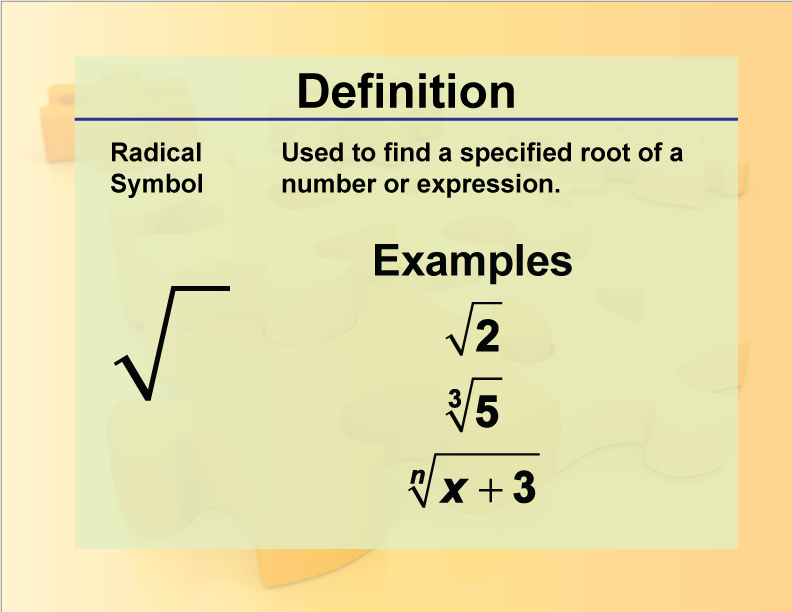
At its essence, the radical sign denotes the operation of finding a “root” of a number. This means determining a value that, when multiplied by itself a specified number of times, yields the original number. When no small number (the index) is explicitly written above the radical sign, it implicitly signifies the square root (finding a number that, when multiplied by itself twice, gives the original number). When an index, say ‘n’, is present (ⁿ√), it indicates the nth root, demanding a number that multiplies itself ‘n’ times to reach the original value. Understanding this symbol is not just about rote memorization; it’s about appreciating a foundational tool whose digital manifestations are integral to the advancements we witness daily in software, data, and hardware.
The Mathematical Foundation in a Digital World
Before diving into its technological implications, it’s essential to solidify our understanding of the radical sign’s mathematical underpinnings. Its journey from ancient Greek geometry to modern computing illustrates its enduring significance.
Origins and Meaning
The concept of roots dates back to ancient civilizations, particularly the Babylonians and Egyptians, who developed methods for calculating square roots for architectural and astronomical purposes. The symbol itself, ‘√’, is believed to have originated from the letter ‘r’, an abbreviation for the Latin word “radix,” meaning “root.” Introduced in its current form by Christoff Rudolff in his 1525 algebra textbook, “Coss,” the radical sign provided a concise way to express these operations.
Mathematically, when we say √x, we are asking: “What number, when multiplied by itself, equals x?” For example, √9 = 3 because 3 * 3 = 9. When considering negative numbers, the principal (positive) root is usually assumed in real number contexts. However, in the realm of complex numbers, the concept expands to include imaginary roots, further broadening its scope. The precision and efficiency with which these calculations are performed are paramount in computational environments, demanding algorithms that can quickly and accurately resolve these fundamental queries.
Types of Roots and Indices
While the square root is the most common, the radical sign extends to higher-order roots, each denoted by an index.
-
Square Root (√x): As discussed, finding a number ‘a’ such that a² = x. (e.g., √25 = 5).
-
Cube Root (³√x): Finding a number ‘a’ such that a³ = x. (e.g., ³√8 = 2 because 2 * 2 * 2 = 8).
-
Nth Root (ⁿ√x): A general form, finding a number ‘a’ such that aⁿ = x.
These different “strengths” of roots are critical in various scientific and engineering calculations. For instance, calculating the side length of a cube given its volume requires a cube root, a task frequently encountered in 3D modeling or material science simulations. The ability of modern computing systems to perform these calculations with high precision and speed is a testament to sophisticated numerical methods and robust hardware.
Beyond Square Roots: Fractional Exponents
An alternative and often computationally advantageous way to express roots is through fractional exponents. The nth root of x can be written as x^(1/n). For example, √x = x^(1/2) and ³√x = x^(1/3). This exponential notation is particularly useful in programming and algebraic manipulation because it allows for the application of standard exponent rules, simplifying complex expressions and often making numerical computations more straightforward. Many programming languages directly implement power functions (e.g., pow(x, 0.5) in C++, x ** 0.5 in Python) which handle these fractional exponents, providing an efficient means to calculate roots without explicit radical sign symbols in the code.
Radical Signs in Computing and Algorithms
The theoretical understanding of radical signs translates directly into practical utility within computer science and software development. From low-level arithmetic operations to high-level algorithmic design, roots play a pivotal role.
Representing Roots in Programming Languages
In coding, the radical sign symbol itself (√) is rarely used directly within standard code syntax. Instead, roots are typically computed using dedicated mathematical functions or by leveraging fractional exponents.
-
sqrt()Function: Most programming languages (C++, Java, Python, JavaScript, etc.) offer a built-insqrt()function (often part of amathlibrary) for calculating square roots. This function is highly optimized for performance and accuracy. -
pow()Function: For higher-order roots, the general power functionpow(base, exponent)is used. To calculate the nth root of a numberx, one would typically callpow(x, 1.0/n). This method is versatile and covers all types of roots. -
Operator Overloading: In some object-oriented languages or scientific computing libraries, custom operators might be defined to represent roots more symbolically, but this is less common in general-purpose programming.
Understanding these representations is crucial for developers to correctly implement mathematical models and algorithms. The choice of method can sometimes impact precision or performance, particularly in computationally intensive applications.
Computational Methods for Extracting Roots
Computers don’t “see” a radical sign like humans do. Instead, they employ numerical algorithms to approximate the value of roots. Exact roots are rare and often require floating-point numbers.
-
Newton’s Method: One of the most common iterative algorithms for finding roots of functions, including square roots. It starts with an initial guess and refines it through successive approximations, converging rapidly to the correct root.
-
Binary Search: This method can be adapted to find roots by repeatedly halving the search interval until the desired precision is achieved. It’s generally slower than Newton’s method but robust.
-
Lookup Tables and Hardware Accelerators: For extremely performance-critical applications, especially in embedded systems or graphics processing units (GPUs), pre-calculated lookup tables or specialized hardware instructions might be used to quickly retrieve or approximate common square root values. Modern CPUs often include dedicated instructions for fast square root computation.
These underlying computational methods are invisible to the end-user but are the reason why your smartphone can instantly calculate complex equations or render realistic 3D graphics.
Performance Considerations in Algorithm Design
The computational cost of extracting roots, particularly higher-order roots, can be significant. In algorithm design, developers must consider the frequency and precision with which root calculations are needed.
-
Approximations vs. Exactness: In many real-time applications (e.g., game physics), an exact root might not be necessary, and faster approximations can be used to improve performance without noticeable degradation in quality.
-
Pre-computation: If the same root needs to be calculated repeatedly for a static value, it can be computed once and stored, avoiding redundant calculations.
-
Optimization Libraries: Utilizing highly optimized mathematical libraries (like Intel MKL, NumPy in Python, or BLAS/LAPACK) ensures that root calculations are performed using the most efficient algorithms available for the specific hardware.
-
Floating-Point Precision: Dealing with floating-point numbers inherently involves precision limitations. Developers must be mindful of potential rounding errors and accumulation of inaccuracies, especially when roots are part of a longer chain of calculations.
Balancing accuracy, speed, and resource usage is a constant challenge in software engineering, and the handling of radical sign operations is a prime example of where these considerations come into play.
Practical Applications Across Technology
The radical sign, through its various computational manifestations, is woven into the fabric of modern technology. Its applications span diverse domains, illustrating its indispensable nature.
Graphics and Game Development
In the visually rich worlds of video games and computer graphics, roots are fundamental to numerous operations:
-
Distance Calculations: Determining the distance between two points (e.g., objects, characters, cameras) in 2D or 3D space often uses the Euclidean distance formula, which involves a square root (√(Δx² + Δy² + Δz²)). This is critical for collision detection, AI pathfinding, and rendering visible objects.
-
Vector Normalization: Normalizing a vector (making its length equal to 1) is a common operation in graphics for directional calculations (lighting, reflections). This involves dividing each component of the vector by its magnitude, which is calculated using a square root.
-
Physics Engines: Simulating realistic physics, from projectile trajectories to object collisions, frequently requires square roots for velocity, acceleration, and force calculations.
Without efficient radical computations, the immersive and dynamic experiences we expect from modern graphics would be impossible.
Data Science and Machine Learning
The burgeoning fields of data science and machine learning heavily rely on statistical and geometric principles where roots are central:
-
Euclidean Distance: Beyond graphics, Euclidean distance is a staple in clustering algorithms (like K-means) to measure the “proximity” of data points, and in recommendation systems.
-
Standard Deviation: A key statistical measure of data dispersion, standard deviation involves calculating the square root of the variance. This helps data scientists understand the spread and variability within datasets.
-
Root Mean Square Error (RMSE): A common metric for evaluating the performance of regression models, RMSE is calculated by taking the square root of the average of squared errors, providing a single measure of predictive accuracy.
-
Principle Component Analysis (PCA): In dimensionality reduction techniques like PCA, eigenvectors and eigenvalues (which can involve complex root calculations) are used to transform data into a lower-dimensional space while retaining crucial information.
The accuracy and speed of these root-based calculations directly impact the efficacy and efficiency of analytical models and predictive algorithms.
Cryptography and Security
While advanced cryptography often involves complex number theory, modular arithmetic, and prime numbers, the underlying mathematical principles can sometimes trace back to foundational concepts like roots. For instance, certain cryptographic algorithms rely on properties of numbers that are “hard” to compute, and while not always direct radical signs, the computational difficulty of discrete logarithms or factoring (which can be conceptualized as finding “roots” in a modular arithmetic sense) is fundamental to their security. Furthermore, performance benchmarks for cryptographic operations often involve assessing how quickly a system can perform basic arithmetic, including roots, which contribute to overall processing time for encryption/decryption.
Engineering and Physics Simulations
Across various engineering disciplines—civil, mechanical, electrical—and in physics research, roots are indispensable for solving equations and modeling real-world phenomena:
-
Structural Analysis: Calculating stresses, strains, and material properties often involves equations with square roots.
-
Electrical Engineering: Impedance calculations in AC circuits, power factor corrections, and resonant frequency determinations frequently use square roots.
-
Fluid Dynamics: Complex simulations of fluid flow, turbulence, and pressure distributions often incorporate square root relationships derived from physical laws.
-
Quantum Mechanics: Many fundamental equations in quantum mechanics involve square roots or fractional powers when dealing with wave functions and probabilities.
The precision and speed of root computations are critical for the accuracy and reliability of these complex simulations, which can impact everything from bridge design to nuclear reactor safety.
Tools and Software for Radical Calculations
Modern technology provides an array of tools, from handheld devices to powerful software, to efficiently handle radical sign operations.
Scientific Calculators and Software Libraries
For everyday use and educational purposes, scientific calculators (both physical and software-based) are equipped with dedicated square root buttons and often nth root functions. For more advanced programming, software libraries are crucial:
-
Python (NumPy, SciPy): These libraries offer highly optimized functions for numerical operations, including a wide range of root calculations, forming the backbone of scientific computing in Python.
-
Java (Math Class): Java’s
java.lang.Mathclass providessqrt()andpow()methods for basic root operations. -
C++ (cmath): The
<cmath>header providessqrt(),cbrt()(cube root), andpow()for C++ developers. -
JavaScript (Math Object): The built-in
Mathobject includesMath.sqrt()andMath.pow().
These libraries abstract away the complex underlying algorithms, allowing developers to focus on higher-level problem-solving.
Symbolic Computation Systems
For analytical or symbolic manipulation of expressions involving radical signs, software like Wolfram Alpha, Mathematica, and SymPy (Python library) are invaluable. These systems can:
-
Simplify radical expressions (e.g., converting √8 to 2√2).
-
Solve equations containing roots.
-
Perform calculus operations on functions with radical terms.
-
Provide exact answers rather than just numerical approximations.
Such tools are critical for researchers, mathematicians, and engineers who need to work with mathematical expressions in their symbolic form.
Integrated Development Environments (IDEs) and Math Functions
Modern IDEs often integrate powerful debugging and auto-completion features that assist developers in using mathematical functions correctly. For instance, when typing Math.sqr, an IDE might suggest Math.sqrt(), along with its documentation. Furthermore, some IDEs for scientific computing (like Jupyter Notebooks for Python) allow for the direct display of mathematical expressions, sometimes even rendering them in a format similar to LaTeX, including proper radical signs, which aids in readability and verification of mathematical code.
The Future of Root Computation and Mathematical Literacy in Tech
As technology continues to advance, the methods and applications of root computation will also evolve. The foundational understanding of radical signs remains critical.
Quantum Computing’s Potential Impact
Quantum computers promise to revolutionize computation by exploiting quantum mechanical phenomena. Shor’s algorithm, for instance, can factor large numbers exponentially faster than classical computers, which has profound implications for cryptography. While not directly about “radical signs” in the classical sense, the ability to find “roots” or factors of numbers incredibly quickly showcases how advanced computing paradigms could fundamentally alter our approach to solving problems that have historically been computationally intractable. The underlying mathematical principles will remain, but the tools for solving them will become vastly more powerful.

The Enduring Importance of Mathematical Fluency
Despite the availability of sophisticated tools and libraries, a deep understanding of mathematical concepts like the radical sign is more important than ever for anyone working in technology.
-
Debugging and Optimization: Understanding the math behind an algorithm helps in identifying errors and optimizing performance.
-
Innovation: New algorithms and technologies often emerge from a fresh perspective on fundamental mathematical principles.
-
Problem Solving: The ability to translate real-world problems into mathematical models that leverage operations like roots is a core skill for engineers and data scientists.
-
Critical Evaluation: A strong mathematical background allows professionals to critically evaluate claims, understand the limitations of models, and interpret results accurately.
In conclusion, the radical sign, a humble mathematical symbol, represents an operation that is foundational to the digital age. From the architectural marvels of antiquity to the complex algorithms driving AI, its influence is pervasive. For anyone navigating the ever-evolving landscape of technology, a clear understanding of “what is a radical sign” is not merely academic; it is an essential component of mathematical literacy, enabling deeper insights, more robust solutions, and continued innovation.
aViewFromTheCave is a participant in the Amazon Services LLC Associates Program, an affiliate advertising program designed to provide a means for sites to earn advertising fees by advertising and linking to Amazon.com. Amazon, the Amazon logo, AmazonSupply, and the AmazonSupply logo are trademarks of Amazon.com, Inc. or its affiliates. As an Amazon Associate we earn affiliate commissions from qualifying purchases.