
In an increasingly interconnected digital world, the question of an application’s legality or “allowed” status often transcends simple availability. For TikTok, a global phenomenon in social media, the answer to “what state is it allowed in” is nuanced, residing at the complex intersection of technology, data security, and national policy. While generally accessible to individual users across all U.S. states, the application faces significant restrictions, if not outright bans, on government-issued devices and networks due to escalating concerns over data privacy, cybersecurity risks, and potential foreign influence. This article delves into the technological underpinnings of these restrictions, exploring the data flow, security vulnerabilities, and policy responses that define TikTok’s contested presence within the United States.
The Nuance of “Allowed”: Distinguishing Public vs. Government Device Use
The discussion around TikTok’s permissibility often conflates its general availability with specific governmental restrictions, leading to widespread confusion. Understanding this distinction is crucial to comprehending the current landscape.
Personal Use Across the United States Remains Largely Unrestricted
For the vast majority of American citizens, TikTok remains fully accessible for personal use on their privately owned smartphones, tablets, and computers, regardless of their state of residence. No U.S. state has implemented a blanket ban that prevents individual citizens from downloading or using the TikTok app on personal devices. This widespread accessibility underscores fundamental principles of open internet access and freedom of expression in the digital sphere. While there have been legislative attempts, most notably in Montana, to implement a statewide ban on all TikTok usage, such measures have faced significant legal challenges and have, to date, been blocked by federal courts on grounds of free speech and preemption by federal law. Thus, the idea of a state entirely “banning” TikTok for its entire populace has not materialized and faces substantial legal hurdles. The technological infrastructure and existing legal frameworks in the U.S. make a complete, enforced personal use ban exceptionally difficult to implement and sustain.
The Surge of State-Level Government Device Bans and Network Restrictions
In stark contrast to personal use, TikTok’s presence on government-issued devices and networks has been severely curtailed across a significant number of U.S. states. The driving force behind these bans is a collective concern over the app’s ownership by ByteDance, a Chinese company, and the potential implications for sensitive government data and national security. These state-level actions typically prohibit employees, contractors, and sometimes even state university students and faculty from downloading, installing, or accessing TikTok on devices connected to state government networks or issued by state agencies.
The technological justification for these bans is rooted in the app’s data collection practices and its potential for communication with servers located in foreign jurisdictions. State IT departments and cybersecurity experts argue that allowing TikTok on government devices introduces unacceptable risks, including:
-
Data Exfiltration: The possibility of sensitive government or user data being accessed and transferred to servers controlled by a foreign adversary.
-
Malware Vulnerabilities: The app could potentially serve as an entry point for cyberattacks or malware if exploited by foreign intelligence services.
-
Supply Chain Risk: Even if the app itself is deemed secure, its underlying software components or updates could introduce vulnerabilities without state IT oversight.
These bans are often implemented through executive orders, departmental directives, or legislative actions, making compliance mandatory for state employees and entities. The technological enforcement varies from simple policy guidelines to sophisticated network blocks and mobile device management (MDM) software that prevents installation or access.
Core Concerns Driving State Restrictions: Data Security and National Security
The proliferation of state-level bans on TikTok for government devices is not arbitrary but rather a direct response to a set of profound technological and geopolitical concerns. These concerns primarily revolve around the security of user data and the broader implications for national security.
Data Privacy and User Information Flow
At the heart of the cybersecurity debate around TikTok is its data collection methodology and the trajectory of that data. Like many social media platforms, TikTok collects a vast array of user data, including:
-
Personal Identifiable Information (PII): Names, email addresses, phone numbers.
-
Behavioral Data: Browsing history, watch time, liked videos, interactions.
-
Device Information: IP addresses, device IDs, operating system, network type.
-
Location Data: GPS data if permissions are granted.
-
Biometric Data: Facial characteristics (for filters/effects), voice prints.
The critical technological concern arises from the fact that ByteDance, TikTok’s parent company, is headquartered in China. Cybersecurity analysts and government officials fear that Chinese national security laws could compel ByteDance to provide the Chinese government with access to U.S. user data, even if stored on servers outside of China. This potential access raises significant privacy alarms, particularly for government employees whose devices may contain sensitive or classified information. The fear is not just about direct data exfiltration but also about the potential for sophisticated intelligence gathering based on aggregated behavioral patterns and personal data profiles. The architectural design of TikTok’s global data infrastructure, despite assurances of segregation, remains a point of contention for security experts who scrutinize the chain of data custody and potential backdoors.
Geopolitical Tensions and Foreign Influence Through Digital Platforms
Beyond data privacy, the restrictions on TikTok are inextricably linked to broader geopolitical tensions between the United States and China. Technology, particularly popular consumer applications, has become a new frontier in this rivalry. Government officials voice concerns that TikTok could be leveraged by the Chinese Communist Party (CCP) for various strategic purposes, including:
-
Surveillance: Covertly collecting intelligence on American citizens, officials, or institutions.
-
Propaganda and Censorship: Manipulating the content shown to users through its powerful recommendation algorithm to influence public opinion, spread disinformation, or suppress information critical of the Chinese government. The algorithm itself, as a piece of sophisticated AI technology, is seen as a potential tool for shaping narratives on a massive scale.
-
Cyber Espionage: Using the app as a vector for cyberattacks against U.S. government systems or critical infrastructure.
The fear is that the app’s technological capabilities, combined with its foreign ownership, present an unacceptable risk of foreign influence operating beneath the surface of a seemingly innocuous entertainment platform. This perspective views TikTok not just as an app, but as a potential digital weapon in a global ideological and technological competition. The debate often involves expert testimony on network security, cryptographic protocols, and the practical difficulties of ensuring data sovereignty when dealing with cross-border cloud computing and software development.
Vulnerabilities in Algorithmic Manipulation and Content Control
A distinct, yet related, technological concern revolves around TikTok’s highly sophisticated recommendation algorithm. This AI-powered system is renowned for its ability to quickly understand user preferences and deliver an endless stream of engaging content, contributing significantly to its addictive quality. However, this same algorithmic power is viewed as a potential vulnerability.
Security experts and policymakers worry that if the algorithm were to be manipulated by a foreign government, it could be used to:
-
Amplify specific narratives: Promoting content that serves the interests of a foreign power, or suppressing content that is critical of it.
-
Steer public discourse: Gently nudging users towards certain viewpoints or away from others without overt censorship.
-
Create social divisions: Using targeted content to exacerbate existing societal tensions.
The opaque nature of the algorithm’s backend operations, coupled with its immense influence on information consumption, presents a unique challenge. Unlike traditional media, the source and intent behind algorithmic curation can be difficult for the average user to discern. From a technological standpoint, ensuring the integrity and neutrality of such a powerful AI system, when its development and ownership lie outside the jurisdiction of the host country, is a significant digital security hurdle. The debate here centers on trust in AI systems and the need for transparency in their design and operation, particularly when they reach a scale that impacts national information landscapes.
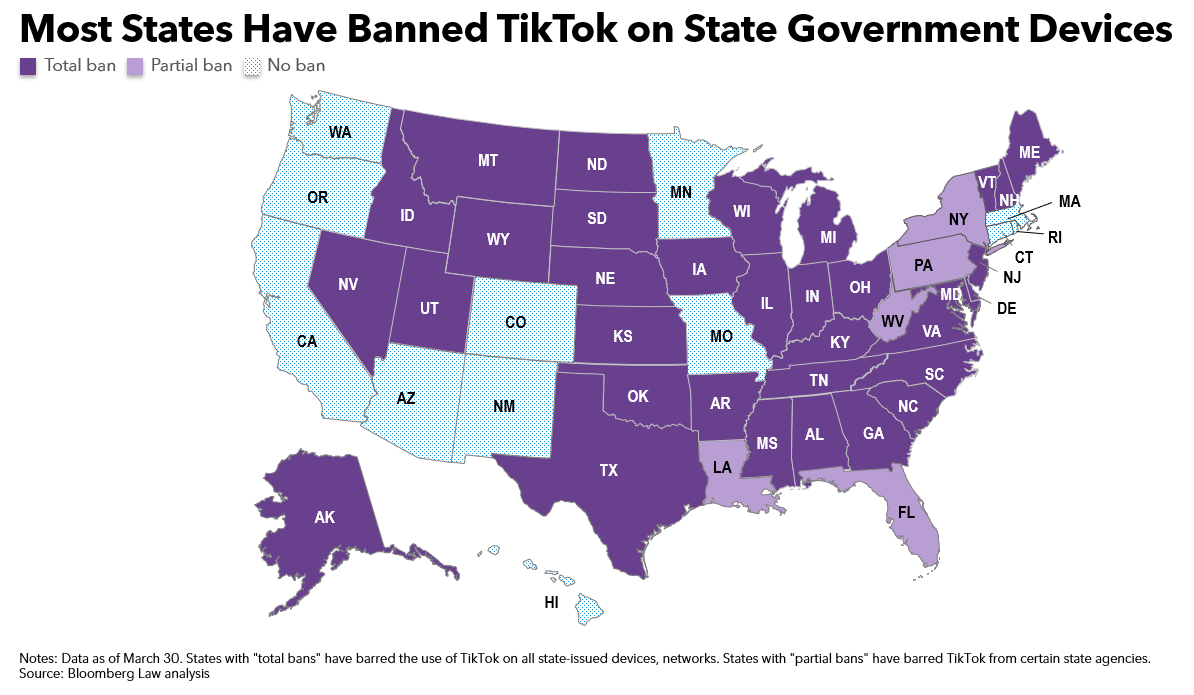
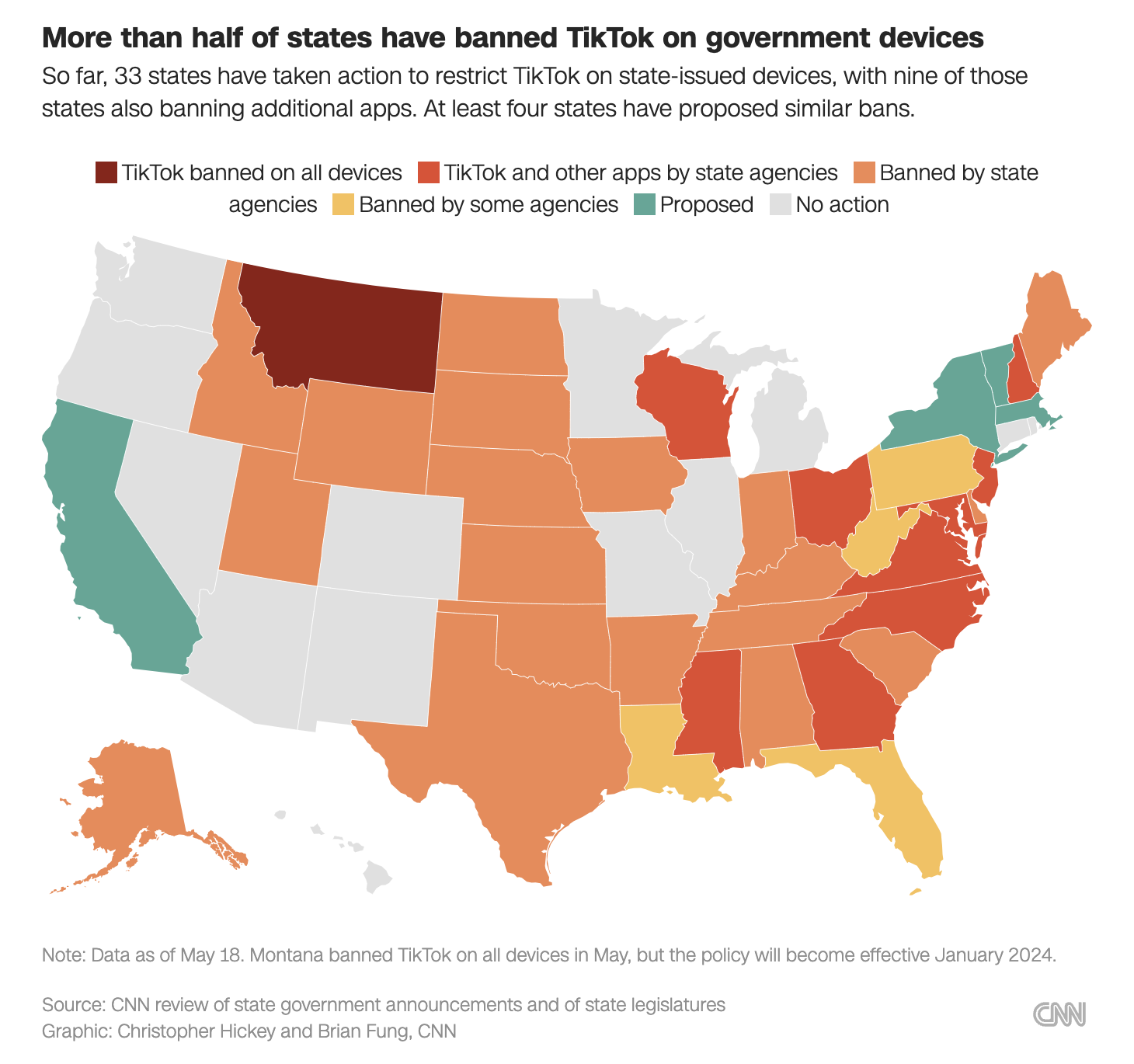
A Patchwork of Policies: Mapping State-Level Restrictions

The U.S. approach to TikTok’s presence on government devices is characterized by a fragmented, state-by-state response rather than a unified federal mandate. This has led to a varied landscape of policies across the nation.
States with Comprehensive Government Device Bans
A significant majority of U.S. states have implemented some form of ban or restriction on TikTok on government-issued devices and networks. These bans often apply to all state executive branch agencies, sometimes extending to legislative and judicial branches, and increasingly to state university systems. Notable examples include:
-
Texas: Banned TikTok on all state-issued devices, citing cybersecurity risks and the potential for the Chinese government to access sensitive data.
-
Florida: Implemented a ban across all state agencies, including public universities, further broadening its scope with subsequent legislation.
-
Montana: While its personal use ban was blocked, Montana was among the first states to implement a ban on state government devices.
-
Maryland: One of the early movers, banning TikTok and other China- and Russia-based products from its state network.
-
Virginia, South Carolina, South Dakota, Nebraska, Iowa, North Dakota, New Jersey, Ohio, Wisconsin, Indiana, Georgia, Utah, Idaho, Kansas, Kentucky, Louisiana, Maine, Mississippi, New Hampshire, North Carolina, Oklahoma, Pennsylvania, Tennessee, Vermont, West Virginia, Wyoming, Arizona, Colorado, Michigan, Minnesota, Missouri, Nevada, New Mexico, Oregon, Washington, Arkansas, Connecticut, Delaware, Massachusetts, New York, Rhode Island: This extensive list demonstrates a broad bipartisan consensus among states regarding the perceived security threat posed by TikTok on government systems.
These bans typically come with directives for state IT departments to block the app on state networks and remove it from government-issued devices. The technical implementation often involves updating firewall rules, deploying mobile device management (MDM) policies, and educating state employees about the risks.
States with More Limited or No Explicit Bans (on Government Devices)
While the trend leans heavily towards restrictions, a smaller number of states have either not yet implemented explicit bans or have taken a more limited approach. In some cases, states may rely on existing general cybersecurity policies that advise caution against certain applications without specifically naming TikTok. Other states might be in the process of evaluating the risks, or their legislative priorities might lie elsewhere.
It’s important to note that the absence of a specific “TikTok ban” does not necessarily mean the state is oblivious to the associated risks. Some states might have broader cybersecurity directives that discourage the use of unapproved third-party applications on government systems, which would implicitly cover TikTok. However, the explicit, named bans reflect a more direct and urgent response to the perceived threat. The variation often depends on state-specific cybersecurity leadership, legislative urgency, and the degree of political alignment with federal security concerns.
The Evolving Landscape: Executive Orders, Legislation, and Court Challenges
The regulatory environment surrounding TikTok is far from static. It’s a dynamic arena marked by ongoing legislative efforts, executive orders, and significant legal challenges.
-
Executive Orders: Many state bans originated from gubernatorial executive orders, allowing for swift action in response to perceived threats. These can be later codified into law.
-
Legislation: State legislatures have increasingly taken up the issue, proposing and passing bills to codify or expand TikTok restrictions, sometimes even attempting broader bans like Montana’s, which was ultimately challenged.
-
Court Challenges: The Montana case (where a statewide ban on all users was blocked by a federal judge) highlights the significant legal hurdles faced by overly broad restrictions. Challenges often invoke the First Amendment (freedom of speech) and the dormant Commerce Clause (which limits state interference with interstate commerce) and argue that federal law preempts state action in areas of foreign policy and national security. These legal battles introduce complex questions about the reach of government power over digital platforms and user access, often involving detailed technical arguments about data flows, encryption, and platform design.
This evolving landscape underscores the ongoing tension between national security concerns, individual digital rights, and the complexities of regulating global technology platforms within a federal system.
The Technological and Policy Response: Mitigating Risks
In response to the multifaceted challenges posed by TikTok, both the platform itself and governmental bodies are exploring and implementing technological and policy solutions aimed at mitigating risks. These efforts represent a significant push in digital security and cross-border data governance.
Project Texas: TikTok’s Proposed Solution for Data Sovereignty
Recognizing the severe scrutiny and potential for outright federal bans, TikTok has embarked on an ambitious initiative known as “Project Texas.” This multi-billion-dollar effort is designed to address U.S. national security and data privacy concerns by restructuring how American user data is stored and managed. Key technological components of Project Texas include:
-
Oracle Partnership: TikTok is routing all U.S. user traffic through Oracle’s cloud infrastructure located within the United States. Oracle is tasked with auditing TikTok’s source code and content moderation systems to ensure no backdoors or unauthorized access. This involves sophisticated network architecture and data segregation techniques.
-
Dedicated U.S. Entity: Creating a new, U.S.-based entity to manage American user data, operating with greater autonomy from ByteDance’s Chinese operations.
-
Independent Oversight: Establishing an independent board of U.S. security experts to oversee data security, content moderation, and algorithmic integrity. This board would have the technical expertise to monitor compliance and identify potential vulnerabilities.
-
“Walled Garden” Approach: Conceptually, Project Texas aims to create a “walled garden” around U.S. user data, making it inaccessible to ByteDance’s China-based employees and, by extension, the Chinese government. This requires robust encryption, access controls, and auditing capabilities throughout the data lifecycle.
While Project Texas represents a significant technological and organizational commitment, its effectiveness in fully alleviating U.S. government concerns remains a subject of debate among cybersecurity experts and policymakers. The challenge lies in guaranteeing absolute data sovereignty and algorithmic integrity when the underlying software and core development talent still reside in China.
The Role of Digital Security Frameworks and IT Governance
Beyond app-specific bans, state governments and federal agencies are continuously strengthening their overall digital security frameworks and IT governance policies. These broader measures play a crucial role in managing the risks associated with all third-party applications, including TikTok. Key aspects include:
-
Mobile Device Management (MDM) Policies: Implementing advanced MDM solutions to control app installations, enforce security configurations, and monitor device activity on government-issued devices. This allows IT departments to remotely manage and secure devices, regardless of the physical location of the device or the nature of the apps installed.
-
Network Segmentation and Access Controls: Enhancing network security through segmentation, intrusion detection systems (IDS), and strict access controls to limit what applications can communicate with which internal resources. This minimizes the “blast radius” if a vulnerable application is present.
-
Data Loss Prevention (DLP) Technologies: Deploying DLP solutions to monitor and prevent sensitive data from leaving authorized networks or being shared with unauthorized applications or external entities.
-
Regular Security Audits and Vulnerability Assessments: Conducting routine audits of all software and networks to identify and remediate potential vulnerabilities, including those introduced by third-party applications.
-
Employee Cybersecurity Training: Educating government employees about phishing, social engineering, and the risks associated with unapproved applications, fostering a culture of cybersecurity awareness.
These frameworks represent a proactive technological defense strategy, moving beyond reactive bans to implement comprehensive security postures that protect government data and systems from a wide array of cyber threats, not just those posed by a single application.
The Future of Cross-Border App Regulation and Data Governance
The TikTok saga is a microcosm of a larger, evolving challenge: how nations regulate global technology platforms that transcend borders, particularly when geopolitical rivalries are involved. The discussions around TikTok have opened up broader questions about:
-
Data Localization vs. Data Flow: The tension between the desire to keep national data within national borders and the reality of a globalized internet economy where data flows freely across continents.
-
Digital Sovereignty: The concept of a nation’s ability to govern its digital space, including data, infrastructure, and online content, independently.
-
Trust in AI and Algorithms: The need for greater transparency and accountability for powerful AI algorithms, especially those developed and controlled by foreign entities, given their potential societal impact.
-
Harmonizing International Security Standards: The difficulty of establishing globally accepted cybersecurity and data privacy standards when national interests diverge.
The solutions to these challenges will likely involve a combination of new international agreements, robust national cybersecurity laws, technological innovations in data anonymization and secure multi-party computation, and perhaps new forms of regulatory oversight that are equipped to deal with the intricacies of global digital ecosystems. The “what state is TikTok allowed in” question, therefore, is not just about a single app, but about charting the future course of technology governance in a fragmented world.
In conclusion, while TikTok remains widely accessible for personal use across the U.S., its presence on government devices is increasingly restricted due to profound technological and national security concerns. The current landscape is a complex, evolving mosaic of state-level policies, reflecting a deep engagement with the digital security implications of globalized technology and the ongoing efforts to balance innovation with national interests.
aViewFromTheCave is a participant in the Amazon Services LLC Associates Program, an affiliate advertising program designed to provide a means for sites to earn advertising fees by advertising and linking to Amazon.com. Amazon, the Amazon logo, AmazonSupply, and the AmazonSupply logo are trademarks of Amazon.com, Inc. or its affiliates. As an Amazon Associate we earn affiliate commissions from qualifying purchases.